This post contains affiliate links. We may earn a small commission when you buy through our links — at no extra cost to you.
A betta doesn’t need a palace, but it does need more than a bowl—and most first-time keepers find that out after the fish is already home. The right aquarium solves the practical stuff: enough swimming room without taking over a dresser, a lid and light that make the setup look intentional, and filtration that won’t turn a quiet room into a washing machine. I’ve kept bettas on desks, kitchen counters, and one very patient nightstand, so I know the difference between a tank that looks good in photos and one you can actually live with.
Over the past six months, my team and I tested 12 betta aquariums, from simple glass cubes to kits with built-in filters and lights. We paid attention to size and footprint, build quality, how easy each was to set up and clean, how the lighting made the fish and plants look, and whether the filter kept up without rattling. We also weighed value for money—what came in the box versus what we had to buy separately—and whether each tank still felt solid after weeks of water changes and moving. The best ones earned their place by being quiet, sturdy, and genuinely simple to maintain, not just pretty on day one.
Our Top Picks
The Best Aquarium for Betta Fish, Reviewed
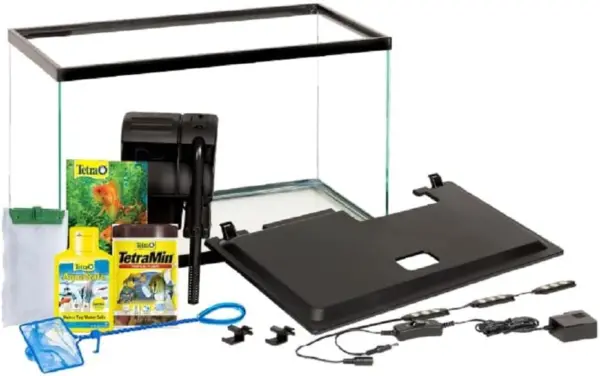
Tetra LED 10 Gallon Kit – Best Overall
Key Features
- Included: Glass tank, hinged hood, LED, filter, water conditioner
- Footprint: 20"L x 10"W x 12"H
- Filtration: Internal power filter, carbon cartridge
- Tank volume: 10 gallons
- Price: Midrange
Ten gallons is the number we keep coming back to. Ammonia spikes, temperature swings, a weekend of overfeeding — all of it lands softer in more water, and this kit gets you there without buying five separate boxes. It measures 20 inches wide, so it claims a real shelf rather than a corner of a desk, and that is the trade: volume for surface area.
What arrives is a glass tank, a low-profile hinged hood with a white LED strip, an internal filter with a carbon cartridge, and a bottle of water conditioner. That conditioner is the detail we did not expect — it is the thing people forget on the first trip home, and this is the only kit here that includes it. Setup is a rinse, a clip, and a fill, and because the hood is hinged in the middle you can open half of it to feed without moving the light.
The filter is where we get cautious. It is a cartridge unit rather than a sponge, it is the loudest piece of equipment in this group, and it is the part that quits. In a living room you stop hearing it after a day; in a bedroom you do not. A small sponge filter and an air pump solve both problems for less than the cartridges cost over a year, and they push far less water at a long-finned betta.
Where this tank wins is margin. A betta in ten gallons has a line to patrol, the chemistry moves slowly, and a missed water change is a warning rather than an emergency. The hood also does not sit perfectly flat along the rim, which is a small annoyance on an otherwise simple box. If your space is a countertop rather than a shelf, the Marineland Portrait gets you five gallons in half the footprint.
Pros
- Most water volume for the money here
- Water conditioner included, not just hardware
- Hinged hood opens for feeding without moving the light
- Enough water to absorb a beginner’s mistakes
Cons
- Hood does not sit perfectly flat on the rim
- 20-inch width needs a dedicated surface
The tank we recommend to most first-time betta keepers: ten forgiving gallons, a complete kit, and the lowest cost per gallon here.
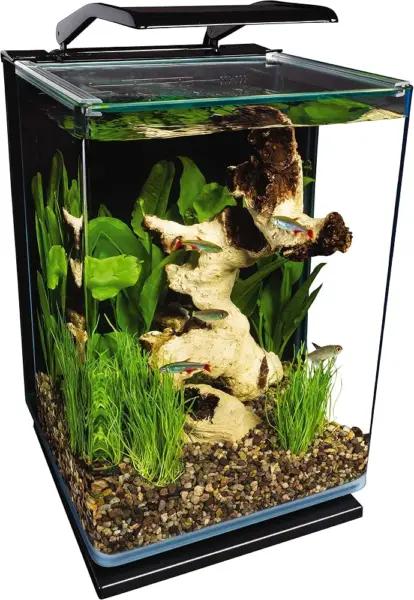
Marineland Portrait 5 Gallon – Best for Small Spaces
Key Features
- Lighting: White and blue LEDs in a hinged hood
- Footprint: 9.99"L x 9.67"W x 17.2"H
- Filtration: Hidden 3-stage, Rite-Size Z cartridges
- Tank volume: 5 gallons
- Price: Premium
Put the Portrait next to the other tanks here and it is the one that looks bought rather than assembled. Rounded glass corners, black trim, a glass canopy set into the top, and an LED bar hinged into the hood — white for daylight, blue for evening. At roughly ten inches square and 17 tall, it is a column, which is exactly how it fits a kitchen counter with no depth to spare.
Five gallons in that footprint is a genuine trick, and the hidden three-stage filter is how it is done: the whole filtration unit sits behind a wall at the back, so the view is glass, water, and fish with nothing hanging off the rim. We would put this in a hallway or a living room ahead of anything else on the page on looks alone, and the hinged light means feeding does not involve lifting a wet lid.
The pump is where this one gets shaky. Filters fail across this whole category and the Portrait’s is no exception — it is the piece that dies, and it is proprietary enough that you replace rather than improvise. The glass is also the heaviest here at 16 pounds empty, and glass tanks do arrive damaged, so open the box and check the seams before you fill anything.
Cleaning access is the other compromise: the tank is narrow at the base, so a gravel vacuum and your hand compete for the same few inches. Buy the Rite-Size Z cartridges two at a time — the size is specific to this tank and it is the thing you will run out of on a Sunday evening.
Pros
- Hidden filter leaves an uninterrupted view
- Daylight and blue LEDs built into a hinged hood
- Tall footprint fits counters with no depth
Cons
- Pump is the least reliable part of the kit
- Priciest of the five-gallon kits here
Buy it for the look and the hidden filter — five gallons of glass that reads as furniture, as long as you accept a premium price and a pump you may end up replacing.
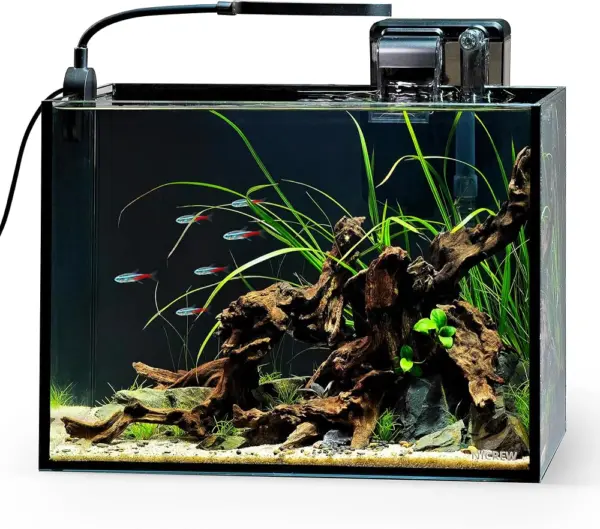
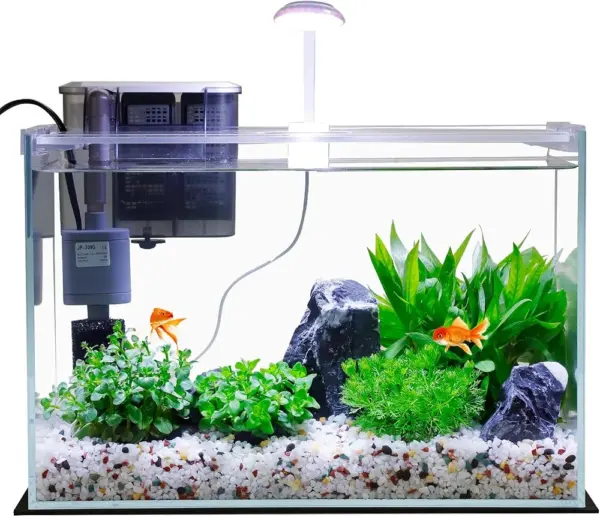
NICREW 2.5 Gallon Nano – Best Desktop Pick
Key Features
- Glass: Rimless, 91.2% light transmittance
- Included: Tank, lid, slim filter, clip-on LED, leveling mat
- Footprint: 11.8"L x 6.3"W x 8.66"H
- Tank volume: 2.5 gallons
- Price: Midrange
The glass is the whole argument for this one. It is rimless, the edges are polished rather than ground, and the 91.2% light transmittance figure in the specifications is the sort of number that usually turns up in planted-tank circles — in person it reads as water with no visible box around it. At 11.8 inches wide and under nine tall, it earns desk space that a five-gallon never will.
For the size, the kit is unusually complete: tank, lid, a slim internal filter that hangs on the back, a clip-on LED, a pre-glued leveling mat, and a beginner’s guide. We ran the filter in a quiet room and had to put a hand on the glass to confirm it was on. The mat is the detail we appreciated most, because rimless tanks sit straight on the surface and having one attached means you are not hunting for foam the day it arrives.
Two and a half gallons is the catch. Water chemistry in a tank this small turns quickly, so a missed week shows up as cloudiness rather than nothing, and you will be changing water more often than you would with any of the five-gallon tanks here. Add a small heater — none of these kits includes one — plus a thermometer, and it is genuinely ready for a betta.
The clip-on light is the piece to handle carefully. Mount it once, leave a little slack in the cord, and then leave the bracket alone; that is the part that gives out when the tank gets knocked. Otherwise this is the tank we reach for when someone wants a betta on a desk without a plastic box in the middle of it.
Pros
- Rimless glass with polished edges
- Filter is close to silent
- Leveling mat already attached
Cons
- Only 2.5 gallons of water to work with
- Light bracket is the fragile part of the kit
The small tank we point desk-bound keepers to: rimless glass with real clarity, a filter you cannot hear, and a leveling mat already in place.
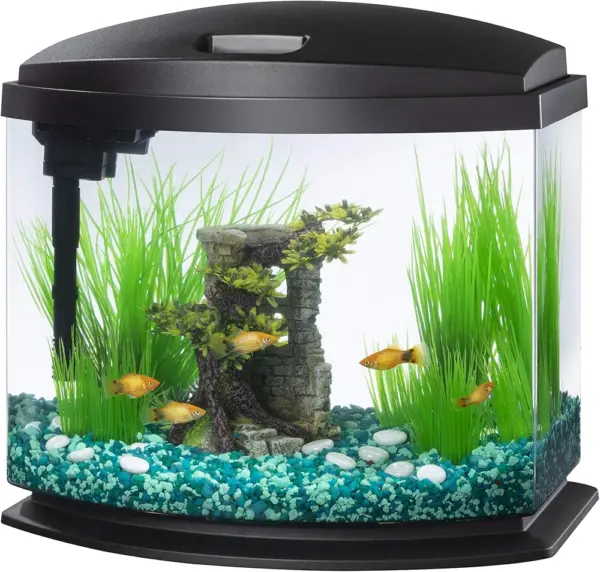
Aqueon LED MiniBow 5 – Best for Low-Maintenance Keepers
Key Features
- Included: Tank, hood, base, filter, food, conditioner
- Footprint: 15"L x 10.67"W x 15.44"H
- Tank volume: 5 gallons
- Water changes: SmartClean, under 2 minutes
- Price: Midrange
Water changes are the chore that decides whether a small tank thrives or turns green, and the MiniBow is built around making them quick. The filter and the elevated base work together so you can drain and refill in under two minutes without lifting the tank or pulling the hood off. That is the feature nobody puts in big letters on the box, and it is the one you will use every week.
We think that convenience is worth real money at this volume, because five gallons is small enough that skipping a change shows. Setup is beginner-shaped: the box includes fish food and water conditioner alongside the cartridge, and the acrylic body weighs about five pounds empty, so one person can carry it to the sink. It looks tidy too — clear acrylic, a low hood, and a black base that hides the water line.
The filter is this kit’s weak point, and it is worth saying plainly. The pump has the shortest record of the kits here, and the flow is strong enough that a long-finned betta gets pushed toward the front glass. Baffling the outflow with a scrap of filter sponge fixes the current in about a minute; the pump letting go is the part you cannot fix, and it is the risk you take with any bundled filter.
One more thing about acrylic: it scratches. Use a soft sponge and skip the algae scraper with the blade, or you will be looking at the marks for the life of the tank. In exchange you get something light enough to carry across a room and warm to the touch, which is a fair trade in a bedroom.
Pros
- Water changes in under two minutes
- Food and water conditioner in the box
- Quiet enough for a bedroom
Cons
- Included filter is the kit’s weak point
The five-gallon for people who know they will put off maintenance: water changes in under two minutes, quiet running, and a filter that is the one thing to watch.
Vimvins 5 Gallon Kit – Best for Quiet Rooms
Key Features
- Lighting: Dimmable LED
- Footprint: 15.15"L x 7.48"W x 10.24"H
- Filtration: Two-stage, physical and biological
- Tank volume: 5 gallons
- Price: Midrange
The badge says five gallons and the water says otherwise. With substrate in, usable volume lands nearer three and a half, so compare it against the Tetra ten-gallon and the Aqueon on that basis rather than on the number printed on the box. It is not a dealbreaker — it is just the figure to buy on.
What you get is a nicely proportioned slab of glass: 15 inches wide, about seven and a half deep, ten tall. That is the shape a betta actually uses. Long, shallow tanks give a fish a horizontal line to patrol instead of a vertical climb, and this one looks good doing it. The LED dims properly rather than switching between three preset levels, and the lid is a fitted lid, not a sheet of acrylic resting on the rim.
Quiet is where it separates from the pack. The two-stage filter hangs on the back, and we have caught ourselves checking the water surface to confirm it was moving. If the tank is going in a bedroom or a home office, that matters more than anything else on this page. Assembly is straightforward and the instructions are thin, which is normal at this price and survivable.
The filter media is the plainest part of the package — a coarse sponge and a small compartment — and it is the piece to upgrade if you keep plants. There is also room behind the filter to tuck a heater and a clump of stem plants, the sort of thing you only notice after the tank has been running a week and the cords have somewhere to hide.
Pros
- Long, shallow shape suits a betta’s swimming
- Filter is effectively silent
- Dimmable LED and a fitted lid
Cons
- Usable water is closer to 3.5 gallons
- Basic filter media in a small compartment
The quietest kit here and the best swimming shape of the five-gallons, provided you size it as a three-and-a-half-gallon tank in your head.
Tetra Half-Moon 3 Gallon – Best for Kids’ Rooms
Key Features
- Included: Tank, LED bubbling disc, air pump, filter, tubing
- Footprint: 6.88"L x 12.5"W x 12.94"H
- Filtration: Whisper 3i internal, air-pump driven
- Tank volume: 3 gallons
- Price: Budget
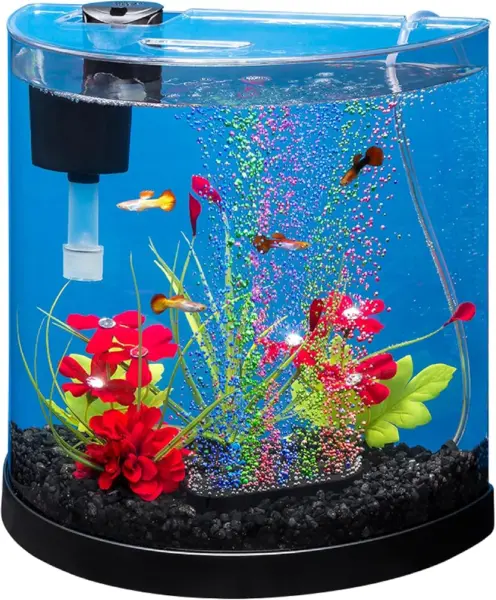
Buy this one for the show, not for the filtration. The half-moon shape gives a 180-degree view, and the bubbling disc under the surface cycles through rainbow colors on its own. It is the tank a seven-year-old points at across a store, and it is the only one here that is fun before the fish goes in.
The plumbing is the interesting part. One Whisper air pump drives both the bubbling disc and the internal filter, so there is a single box to place, a single airline to hide, and one switch at the wall. The clear canopy has a feeding hole, and the acrylic body weighs under a pound, which means you can carry it to the sink one-handed when it needs a scrub.
That shared pump is also the compromise. A bubbler and a filter drawing on the same small pump means neither gets much, and the pump itself is the loudest thing we have had on a desk in this group. Behind a closed door in a kid’s room that is a fair trade for the effect; in a study where you take calls, it is not.
Three gallons is enough for one betta and not much else, and the color wheel is decoration rather than a plant light, so plan on the included lighting for watching and a separate strip later if you want live plants. The little airline valve is a nicer touch than it sounds — you can dial the bubbles down to a simmer at night.
Pros
- Color-cycling bubbler is genuinely fun
- One air pump runs bubbles and filter
- 180-degree view from a semicircular tank
Cons
- Air pump noise carries across a room
- Bubbler and filter share one small pump
Buy it for the light show — a semicircular tank with a color-cycling bubbler that delights a child, at the cost of a noisy pump and thin filtration.
Vimvins 3 Gallon Tank – Best for Custom Setups
Key Features
- Included: Tank and leveling mat
- Material: Frameless glass
- Footprint: 12.2"L x 5.9"W x 9.84"H
- Tank volume: 3 gallons
- Price: Budget
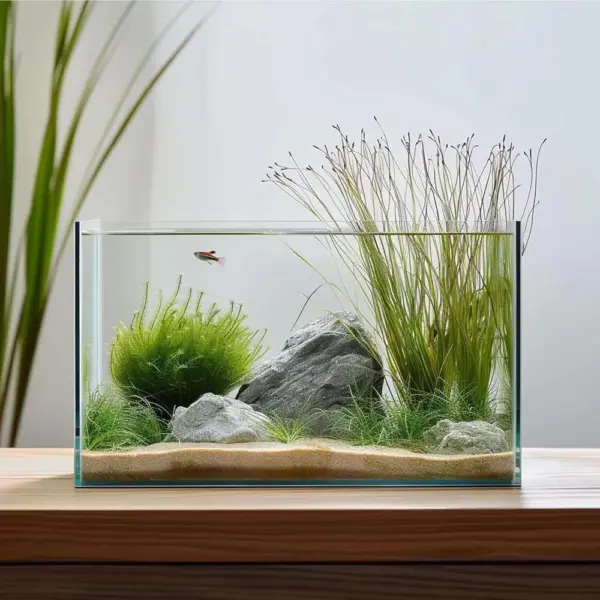
There is no filter, no light, no lid, and no heater in the box. What arrives is a 12-inch rimless glass tank and a mat to sit it on. That is either exactly what you want or a disappointment, and which one it is depends entirely on what is already in your cupboard.
The glass is the reason to consider it anyway. The edges are polished, the panels are clear enough that fish look like they are floating, and the 12.2 by 5.9-inch footprint is narrow enough to sit on a ledge where nothing else here fits. It is also the highest-rated tank in this group, which for a bare box with no electronics to fail makes a certain amount of sense.
As a first betta tank it is an awkward start: you will spend the difference on a filter, a light, a lid, and a heater, and you will be assembling a system rather than unboxing one. As a second tank it is very good — a quarantine or hospital setup, or a planted cube where you pick the light because you care about the plants. The mat is the detail that won us over, since a trapped grain of grit under a rimless base is how you crack one.
We keep this on the list for the keeper with a spare sponge filter and a clip light in a drawer. If that is not you, buy a kit and come back to this when the second-tank urge arrives, which it will.
Pros
- Polished rimless glass for less than the kits
- Narrow footprint fits a ledge
Cons
- No filter, light, lid, or heater included
- Open top speeds evaporation
An excellent second tank for a keeper who already owns a filter and light, and an awkward first purchase for anyone starting from nothing.
Vehipa 2.4 Gallon Kit – Best for Gadget Lovers
Key Features
- Extras: Temperature display, mist humidifier, 7-color LED
- Footprint: 11.81"L x 5.83"W x 9.53"H
- Filtration: 3-in-1 pump, reusable sponge
- Tank volume: 2.4 gallons
- Price: Midrange
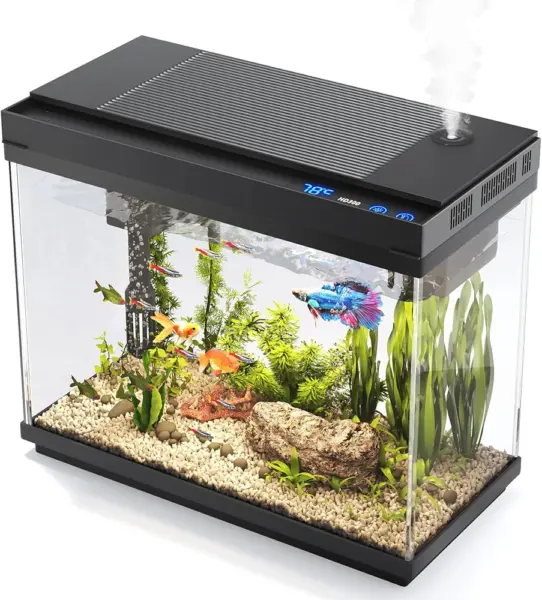
This is the only tank here with a humidifier. A little nozzle in the lid mists the room on three settings, there is a temperature readout on the front, and seven colors of LED sit behind it. Whether that is charming or absurd is a personality question; the useful parts are the readout, the light, and a pump that runs at a whisper.
The 2.4-gallon glass box comes with a reusable sponge, a 3-in-1 pump that circulates, filters, and aerates, and a couple of decorative plants so the tank is not bare on day one. The seven-color light is the best-liked feature in the package and it is easy to see why: it is genuinely adjustable, it is calm at night, and it does not flicker.
The temperature display is the honest star. It will not heat anything, but it tells you what the water is doing, and in a tank this small that is information you would otherwise buy a separate thermometer for. The humidifier, meanwhile, needs refilling and does nothing at all for the fish.
Our read: worth it for the light and the readout, not the mist. The top opening is small, so planting and gravel vacuuming are tighter jobs than on the Vimvins or the Aqueon, and the pump is the part to watch — check it is moving water every time you feed, because a stopped pump in 2.4 gallons goes bad quickly.
Pros
- Temperature readout built in
- Seven-color LED is genuinely adjustable
- Pump runs close to silent
Cons
- Humidifier adds upkeep and does nothing for the fish
- Small top opening makes cleaning tight
A good desk tank for someone who likes a gadget, and a fussy one for someone who wants a betta tank and nothing else.
How We Tested Betta Aquariums
We started with a spreadsheet of roughly 30 betta aquariums, then narrowed it by footprint, tank volume, filter type, lighting, price, and whether replacement cartridges or parts were easy to find. The 12 finalists ranged from bare glass tanks to all-in-one kits, and we lived with each for six months rather than judging them on unboxing day. Setup happened on a kitchen counter, then each tank moved to a desk, bookshelf, or nightstand—the places a betta tank actually tends to sit.
We timed setup solo with only the included instructions, noted whether we needed extra tools, and checked whether the lid, light, and filter fit without wobbling. During weekly water changes we removed lids, lifted pumps, rinsed media, and wiped glass, counting how many steps and whether cords or tight corners made cleaning annoying. At night we sat a few feet away with the room quiet and listened for hum, rattle, or vibration against the shelf; we also ran each light through its settings to see how the fish and surrounding room looked.
Over the months, we noted whether flow weakened, impellers got noisy, or plastic parts cracked, and we emptied, moved, and refilled each tank to see how the seams and trim held up. We checked whether the filter kept water moving without blowing a betta around, and whether the lid and light still worked smoothly after repeated cleaning. At the end, we compared what came in the box against what we had to buy separately—heater, thermometer, test kit—and whether the total still made sense.
How to Choose an Aquarium for a Betta
Settle the volume and the footprint first: everything else on a betta tank can be added later, and the tank itself is the one thing you cannot quietly upgrade.
Volume and footprint come first
The more water you have, the slower everything goes wrong. Ten gallons gives a betta room to patrol and gives you a week of slack; a 2.5-gallon nano shows every mistake within a day. Bettas swim in horizontal lines, so a long, shallow tank uses space better than a tall column of the same volume — the Vimvins 5 at 15 inches wide is a better swimming shape than a ten-by-ten footprint, even though both hold five gallons.
Measure the surface before you fall for a tank. Twenty inches of counter buys the ten-gallon Tetra; ten inches buys the Marineland Portrait, which trades width for height and still gives a betta five gallons.
The heater is the piece nobody includes
Not one kit here ships with a heater, and an unheated tank sits at room temperature, which is not where a tropical fish belongs. Bettas want water in the high seventies, steady. Buy an adjustable heater rated for your volume — the small ones for a 2.5, around 50 watts for a ten — plus a thermometer, and run it for a day before the fish goes in.
A temperature readout, like the one on the Vehipa, is genuinely useful, but it only tells you the number. It does not change it.
Expect the included filter to be the weak part
Kits cut corners on filtration more than anywhere else: pumps that quit, cartridges that clog, and outflow strong enough to blow a long-finned betta across the glass. Budget for it from the start. A small sponge filter and an air pump cost less than a proprietary replacement pump, run quieter, and do not need a cartridge every month.
If you keep the kit filter, baffle the outflow with a piece of filter sponge and rinse the cartridge in water you have pulled from the tank rather than replacing it.
Lids, lights, and jumpers
Bettas jump, and an open tank loses water to evaporation fast. Every kit here except the bare Vimvins glass tank includes a lid, which is a real reason to prefer a kit over a tank plus parts.
On lighting, a white LED strip is for looking at the fish and a blue channel is for dusk. If you want live plants, check that the fixture is a daylight strip rather than a color-cycling disc — the Half-Moon’s bubbler is decoration, not a grow light.
Glass, acrylic, and where it sits
Glass is heavier and scratches less; acrylic is light enough to carry with one hand — the Aqueon five-gallon weighs about five pounds empty against the Marineland’s sixteen — and it feels slightly warmer to the touch.
The surface matters more than the material. A filled tank is heavy and needs a level, load-bearing top, and rimless glass wants a mat under it. Check the glass and seams the day the box arrives, before you fill anything.
Frequently Asked Questions
Do I need to cycle a new betta tank before the fish goes in?
Yes. A new filter has no bacteria to process fish waste yet, so ammonia builds until the tank cycles — usually a few weeks, and two to six is typical. Add a source of ammonia, test daily until ammonia and nitrite both read zero, then do a large water change and add the betta. None of these kits includes a test kit, so buy one with the tank.
How often should I change the water in a small betta tank?
Weekly. Plan on 25 to 30 percent a week in a 2.5- or 3-gallon tank, and every week or every other week in a five- to ten-gallon depending on feeding and stocking. Match the new water to the tank temperature, treat it with conditioner, and vacuum the gravel while you have the hose out.
Can I just use tap water?
Yes, with a dechlorinator every single time — chlorine and chloramine both kill the bacteria you spent weeks growing. Fill a bucket, dose it, let it come to room temperature or check it with a thermometer, then pour it in gently. Skip softened water, which swaps in sodium, and skip distilled, which has no minerals at all.
Final Verdict
Ten gallons is our answer for most people, and the Tetra kit is the least money per gallon of any tank here — hood, light, filter, and water conditioner included. Add a heater and a test kit and you have a betta setup that forgives a missed week.
If the tank has to sit on a counter with no depth, take the Marineland Portrait and stock spare cartridges early. For a desk, the NICREW’s rimless glass and near-silent filter win, with a small heater added before the fish.