This post contains affiliate links. We may earn a small commission when you buy through our links — at no extra cost to you.
Cherry shrimp are about as close to instant gratification as a freshwater tank gets: a handful of them colors a whole nano setup within a month, and they breed if you so much as look at them wrong. The catch is that most beginner aquariums were designed with fish in mind — filter intakes strong enough to pull a half-inch shrimp through the grate, lids with gaps wide enough to lose one to the carpet. What a shrimp tank actually needs is gentler: stable water, a sponge-safe intake, a lid that closes, and surface area for biofilm.
My team and I spent eight months setting up and living with 10 of them, from bare-bones nano cubes to open-top rimless glass, and watched what changed once the shrimp went in. Size and looks were the easy calls. What separated the winners were the quieter things: a filter you can’t hear from the next room, a light that grows plants without carpeting the glass in algae, and a build that’s safe out of the box. The ones worth filling are below.
Our Top Picks


The Best Aquarium for Cherry Shrimp, Reviewed
Vimvins 3 Gallon Glass Tank – Best Overall
Key Features
- Included: Fish tank mat
- Material: Rimless glass
- Dimensions: 12.2"L x 5.9"W x 9.84"H
- Tank volume: 3 gallons
- Price: Midrange
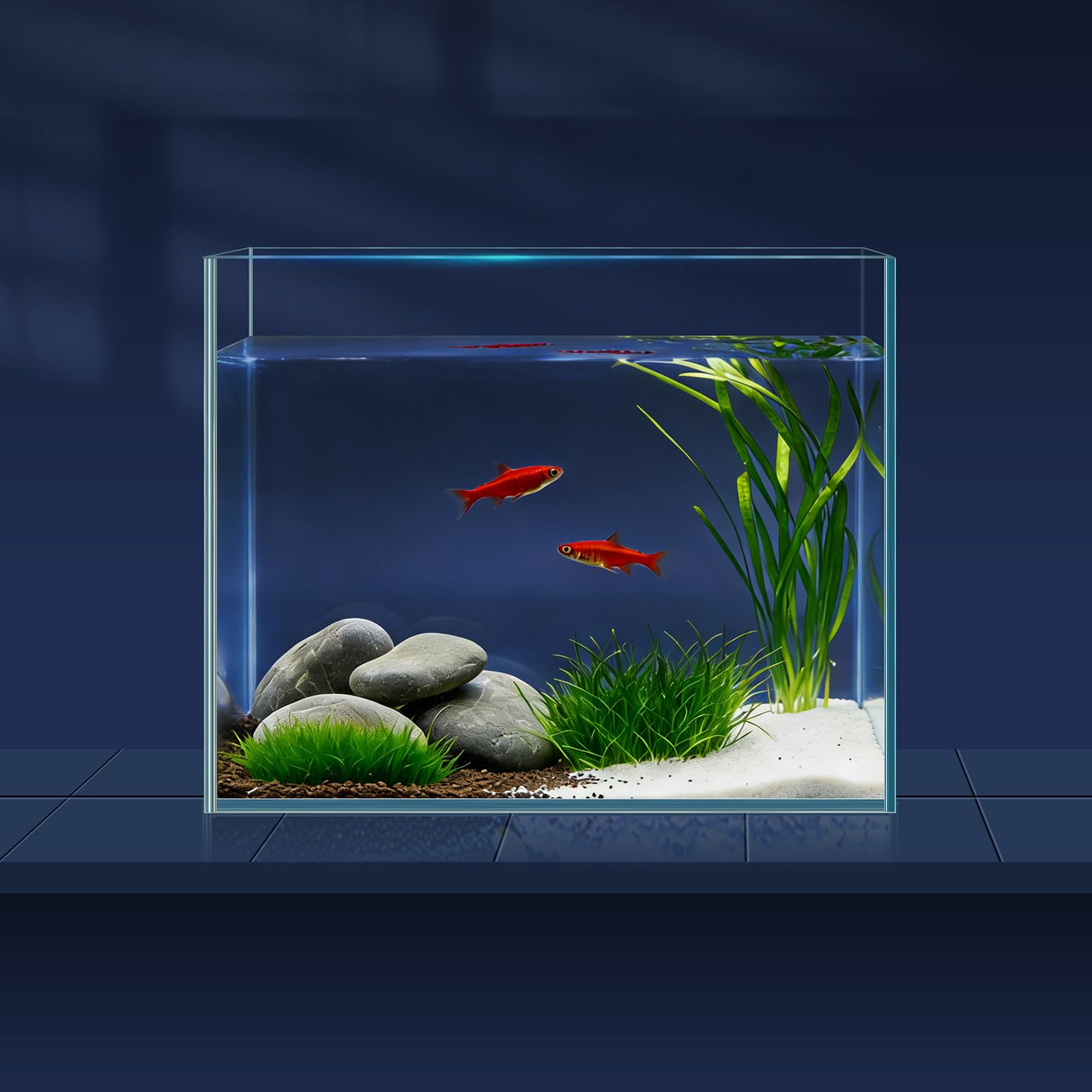
Cherry shrimp spend nearly all their time on surfaces — glass, leaves, substrate, the filter sponge — so the measurement that decides a shrimp tank is footprint, not the gallon figure on the box. This one is 12.2 inches long and 5.9 inches deep, the longest and lowest tank in this group, and a colony spreads across it instead of stacking up a narrow column. That shape is the main reason it’s our top pick, and it undercuts the kits here on price at the same time.
The glass is rimless and genuinely clear — a red shrimp on a green leaf reads from across a room — and the edges are polished enough that you forget about them when you reach in. The mat in the box is the small thing we appreciate most: set the tank down on a dresser and the base is already protected. Buying the equipment separately is an advantage here rather than a chore, because the pump-and-cartridge filter bundled with most kits is exactly what pulls newborn shrimp through an intake, while a sponge filter on a small air pump gives gentle movement and a biofilm-covered surface the shrimp graze all day.
Plan the rest of the setup around its proportions. At 9.84 inches tall it takes a short heater and a small sponge filter without crowding, and the shallow depth keeps a light close enough to the water to grow moss. The open top does lose water faster than a lidded kit, so source a lid or get into the habit of topping off with pure water rather than tap — in a small tank, every tap top-off leaves its minerals behind.
Pros
- Long, low footprint gives shrimp room to graze
- Rimless glass with excellent clarity
- Leaves the filter choice open for a sponge
Cons
- Bare tank — filter, light, lid and heater extra
This is the tank we point most shrimp keepers to: a long, low 3-gallon rimless rectangle that gives a colony surface to graze and leaves the filter choice to you.
Marineland Portrait 5 Gallon Kit – Best Complete Kit
Key Features
- Lighting: Daylight and blue LED
- Dimensions: 9.99"L x 9.67"W x 17.2"H
- Filtration: 3-stage, hidden
- Tank volume: 5 gallons
- Price: Premium
Five gallons is the most water in this group, and it arrives as a working setup: glass tank, hinged LED canopy, and a three-stage filter tucked into a rear chamber where you can’t see it. For a first shrimp tank that combination is genuinely appealing — more water dilutes the mistakes a new keeper makes — and the closed back keeps the view uncluttered in a way a bare tank doesn’t.
The filter is the part to think about. It’s a pump drawing water through cartridges behind the back wall, quiet enough for a bedroom and easy to service from the top. But an intake is an intake and shrimplets are small, so fit a coarse pre-filter sponge over it before any livestock goes in; do that and it stops being something you think about.
Then there’s the shape. At 17.2 inches tall on a footprint of roughly ten by ten, the Portrait gives a colony a tall glass wall and not much floor, and the base sits a long way down — the narrow bottom is the least pleasant part of this tank to siphon. Keep the lid on and feed lightly and that job is occasional rather than weekly. The lighting is the other compromise: bright at the surface, thinner at the bottom of a 17-inch column, which suits moss and easy plants and won’t carry a carpet.
Pros
- Five gallons, the largest volume in this group
- Filter, light, cartridge and canopy in the box
- Quiet, out-of-sight filtration
Cons
- Pump is the part most likely to give trouble
- Can arrive cracked — inspect before filling
This is the kit we hand a beginner: five gallons, a hidden filter and a light in one box, and more water than anything else here.
Vehipa 2.4 Gallon Starter Kit – Best Small Filtered Kit
Key Features
- Pump: 3-in-1 with filter sponge
- Lighting: 7-color adjustable LED
- Dimensions: 11.81"L x 5.83"W x 9.53"H
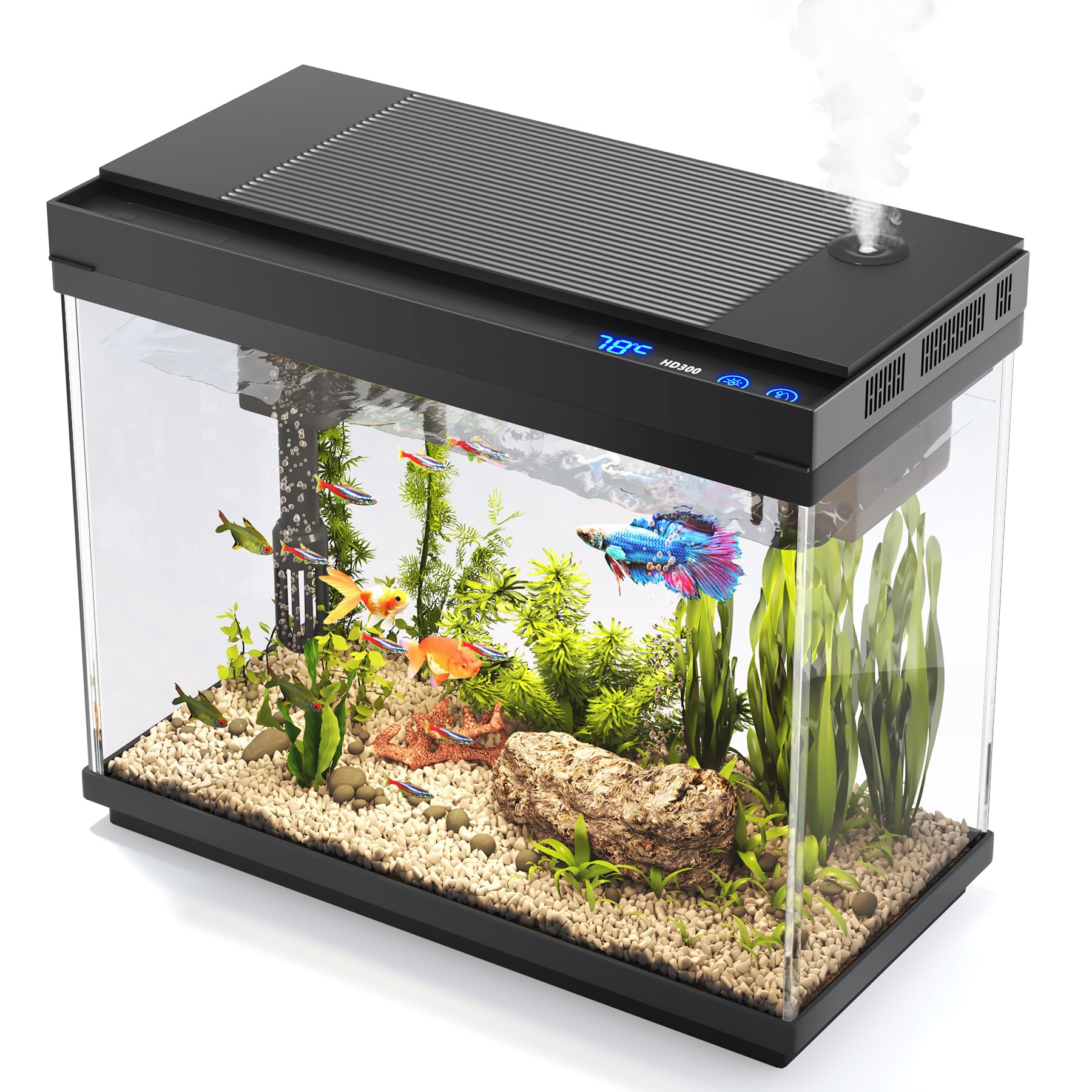
- Tank volume: 2.4 gallons
- Price: Midrange
There’s a humidifier built into the lid. Three spray settings, a scent tray, the lot — it’s the strangest feature in this group, and after trying it we left it switched off. Mist drifting over the water isn’t something a shrimp keeper needs, and the tray is one more thing to rinse.
Underneath the gimmick is a sensible small kit. The tank is 2.4 gallons of glass at 11.81 inches long, with a seven-color LED in the lid and a digital temperature readout on the front — handy on a shrimp tank, where you’re watching for swings more than for warmth. The pump is the good part: a 3-in-1 circulation unit that draws through a reusable sponge rather than a cartridge, which is the right filter style for shrimp, gentle and grazeable and nothing to replace every month.
Where it falls down is the working space. The top opening is small enough that planting and reaching the substrate take patience, and with the light and mister mounted in the lid you’re working around a cable every time you open it. We noticed it most with long tweezers. For a desk tank you look at more than you fuss over, that’s a fair trade; for a heavily planted colony tank it gets old.
Pros
- Sponge-based pump suits shrimplets
- Digital water temperature readout
- Seven-color LED built into the lid
Cons
- Basic filter with uneven reliability
We like this one for a desk: 2.4 gallons with a sponge-based pump that’s kinder to shrimplets than a cartridge filter, and a humidifier along for the ride.
LAQUAL 1 Gallon Tank Kit – First Shrimp Tank
Key Features
- Included: Net, siphon, 2 sponges
- Dimensions: 7.9"L x 5.5"W x 6.3"H
- Tank volume: 1 gallon
- Glass thickness: 4.8 mm
- Price: Budget
There’s a siphon in the box, and that’s the detail we noticed first — a small gravel vacuum is the tool you use every week on a shrimp tank, and it’s the piece most starter tanks leave you to buy separately. A net and two cleaning sponges are in there as well.
The tank itself is a gallon of 4.8 mm high-white glass, 7.9 by 5.5 by 6.3 inches, and the glass is thick for something this size, which is reassuring when you’re carrying it empty to the sink. No filter and no light are included, so plan on a small sponge filter and a clip-on light before you start; both fit easily at this size.
One gallon is the whole story, though. It’s enough for a handful of shrimp and a moss ball on a desk, and the small volume swings fast — a missed water change shows up as a failed molt rather than a slightly hazy tank. We think of it as a first tank or a grow-out, not the long-term home for a breeding colony.
Pros
- Siphon, net and sponges included
- Thick 4.8 mm high-white glass
- Compact footprint for a desk
Cons
- Rim can arrive sharp — check before reaching in
We reach for this one when the spend needs to stay small: a well-made little glass tank with a siphon and net in the box, happiest as a first tank rather than a colony’s home.
Marina CUBUS Glass Betta Kit – Shelf Display

Key Features
- Lighting: 3-LED clip-on
- Material: Glass
- Dimensions: 5.9" x 5.9" x 5.9"
- Tank volume: 0.9 gallons
- Price: Midrange
Six inches on each side, sitting on a small pedestal base, with a clip-on three-LED light that throws color across the glass — this is the most furniture-like tank here, and the one that looks best on a living-room shelf.
It’s also the smallest at 0.9 gallons, and that’s the trade. A cube this size suits a few shrimp, a moss ball and a couple of small plants; it does not suit a breeding colony, and once a small sponge filter and airstone go in, a fair share of the space is spoken for. For a shelf you look at every evening, that’s plenty.
What we keep coming back to is how little it asks of a room: no cabinet, no plumbing, a light that clips onto the rim, and a glass box you can carry to the sink with one hand. Just remember that a small volume has no buffer — a mistake in 0.9 gallons takes a bigger share of the water than the same mistake in the 5-gallon Marineland.
Pros
- Sleek glass cube on a pedestal base
- Clip-on LED flatters red shrimp
- Fits a shelf or a desk corner
Cons
- Light is switched at the plug, not the fixture
For a shelf where the tank is half the decoration, this handsome glass cube earns its place — we think the light and the proportions do the work.
hygger Mini Oblate Bowl – Decorative Bowl

Key Features
- Shape: Oblate
- Included: Blue glass beads, tree ornament
- Dimensions: 10.63"L x 3.43"W x 9.05"H
- Tank volume: 0.85 gallons
- Price: Budget
This one is for the person who wants a bowl on the side table rather than a colony in the study. It’s an oblate glass bowl — 10.63 inches long, 3.43 inches across the narrow axis, 9.05 inches tall — and it arrives with blue glass beads and a plastic branch ornament ready to drop in.
Run it as a shrimp tank and you’re working harder than you need to. What’s in the box is decoration rather than equipment: no filter, no light, and 0.85 gallons is very little water to hold steady, with a narrow opening to reach through. Plant it heavily, add a small air-driven sponge filter, keep the stocking light, and it works as a display bowl — a compromise you make for the shape.
The shape is what you’re buying, and we think it earns that much: the flattened oval gives a wide front and a slim profile, so it tucks onto a windowsill where a rectangular tank won’t go. Our reservation is the working room — 3.43 inches across leaves little space for a hand, a siphon or a pair of planting tweezers, which is the cost of that silhouette.
Pros
- Oblate shape fits narrow shelves
- Clear, wide viewing front
- Decor included ready to place
Cons
- Glass can arrive scuffed or with visible marks
Our pick if the look comes first: a clear little bowl that fits where a tank won’t, provided you plant it heavily and keep the stocking tiny.
How We Chose and Tested These Shrimp Tanks
We built the shortlist by reading through spec sheets for roughly two dozen nano and desktop tanks, then cutting anything that arrived with a hang-on-back filter, an open top, or no way to buy replacement parts. Footprint counted as much as volume — cherry shrimp don’t need depth, they need surface area — so long, shallow shapes beat tall cubes. Ten tanks made the cut, and each ran for the full eight months, most stocked with a starter colony after a four-week cycle.
Setup was timed, solo, with only what came in the box. I noted how long assembly took, whether the instructions assumed a drill or a level, and how many trips to the sink it took to fill. Once running, each tank got a phone decibel reading from three feet away in a quiet room at night, because that’s when a filter hum becomes a problem. I ran a finger along every rim, lid edge, and cord cutout and wrote down anything that caught — rough silicone, unfinished glass corners, a lid that didn’t sit flush and left a gap a shrimp could climb through.
Longer term we watched what only shows up with animals in the water: whether shrimplets drifted toward the intake, whether the light grew plants without painting the glass green, whether seams stayed clear after months of wiping, and whether the tank still felt worth its price once we totaled the extras it needed — a sponge cover, a better light, a lid. We also noted which ones could safely house a few small fish alongside the shrimp and which were shrimp-only, no matter what the box suggested.
How to Choose an Aquarium for Cherry Shrimp
The tank is the cheapest and longest-lived piece of a shrimp setup, and the part most people buy in a hurry. What actually decides whether a colony settles in is surface area, gentle flow, and how easily you can keep the water steady.
Floor area beats gallon count
Shrimp graze. They work the glass, the leaves, the substrate and the filter sponge, so the useful measurement is footprint rather than the figure on the box. The Vimvins is 12.2 inches long and 5.9 inches deep; the Marineland Portrait puts its five gallons up a 17-inch tower on a roughly ten-inch square.
The Portrait holds more water, the Vimvins offers more grazeable surface, and for a breeding colony we take the surface every time. If your shelf has length, buy the length.
Choose a filter the shrimplets can’t ride
The commonest way a shrimp setup fails is the filter. An intake sized for a betta will pull newborn shrimp through it, and a cartridge thrown away each month takes the biofilm with it — the film that is a large part of a shrimp’s diet.
A sponge filter on a small air pump is the default for good reason: gentle flow, a grazeable surface, no impeller. If you buy a kit with a pump, fit a coarse pre-filter sponge over the intake before anything living goes in.
Count what’s in the box
Filter, light, lid and heater are four separate purchases, and most starter kits include two or three. A bare tank like the Vimvins means buying the rest yourself, which is the better route if you already know you want a sponge filter and a particular light.
Either way, add up the whole setup rather than the tank, and don’t skip the lid: an open tank loses water steadily, and every top-off with tap water leaves its minerals behind, so the water hardens over the months.
Inspect the glass before you fill it
Glass arrives by courier, and rims and bases take knocks. Unpack over a towel, look along the silicone seams, and run a finger around the inside of the rim — the LAQUAL’s lip is the one in this group that has turned up sharp.
Set the tank on something flat that spreads the load; the Vimvins ships with a mat for exactly that, and a sheet of closed-cell foam does the same job under any of the others. Then fill it, plant it, and let it run well before any shrimp go near it.
Frequently Asked Questions
How long before I can put cherry shrimp in a new tank?
Longer than the tank takes to fill. A new tank has to cycle: waste has to break down into ammonia, then nitrite, then nitrate, and the bacteria that do that work take weeks to establish. Shrimp are far more sensitive to ammonia and nitrite than most fish.
Test both and add shrimp only once both read zero and stay there, then acclimate them slowly rather than tipping them in.
Can I keep cherry shrimp with fish?
Not in tanks this size. Almost any fish big enough to be interesting will eat a shrimplet, and the small tanks here have no room for the dither fish that spread aggression. A shrimp-only tank is also easier to run gently, which is what a colony wants.
If you want fish as well, plan a bigger tank and a species that leaves adult shrimp alone — and expect to lose some babies.
Do cherry shrimp need a heater?
Usually not. Cherry shrimp come from cool, slow water and handle ordinary room temperatures; what they dislike is a swing. If the room drops into the low 60s overnight, a small preset heater is worth fitting for stability rather than warmth.
If it doesn’t, spend the money on a sponge filter and plants instead. Whatever you set, leave it there — consistency matters more than the exact number.
Final Verdict
For most people setting up a tank for cherry shrimp, the Vimvins 3-gallon is the one to buy. A long, low, genuinely clear rectangle puts your money into the tank itself and leaves the filter decision where it belongs: with you, choosing a sponge instead of a pump that swallows shrimplets.
If you want one box and more water, the Marineland Portrait kit gives you five gallons, a light and hidden filtration, and it is the easy answer for a beginner. And if the tank is going on a desk and the spend needs to stay small, the LAQUAL 1-gallon with its siphon and net is a fair place to start — as long as you treat one gallon as a lesson in steadiness.