This post contains affiliate links. We may earn a small commission when you buy through our links — at no extra cost to you.
The night before a long weekend last spring, I stood over my tank portioning flakes into a weekly pill organizer, wondering whether my fish were better off with a neighbor’s guesswork. An automatic feeder is supposed to retire that ritual — same amount, same time, every day, whether I’m home or three states away. What it actually fixes is consistency, which matters more to a tank than any premium food, and it quietly solves the overfeeding problem most of us create out of guilt.
I’ve kept everything from a heavily planted 40-gallon to a bare-bottom quarantine tank, and I’ve watched cheap feeders jam solid, dump a week of food in one go, or die quietly on day three. So my team and I ran 14 models through four months of ordinary tank life, and the differences almost never showed up on the spec sheet. A feeder is only as good as its hinge, its clamp, and its willingness to keep running on the batteries you forgot about in January. The picks below are the ones that earned their spot above the water line.
Our Top Picks
The Best Automatic Fish Feeders, Reviewed
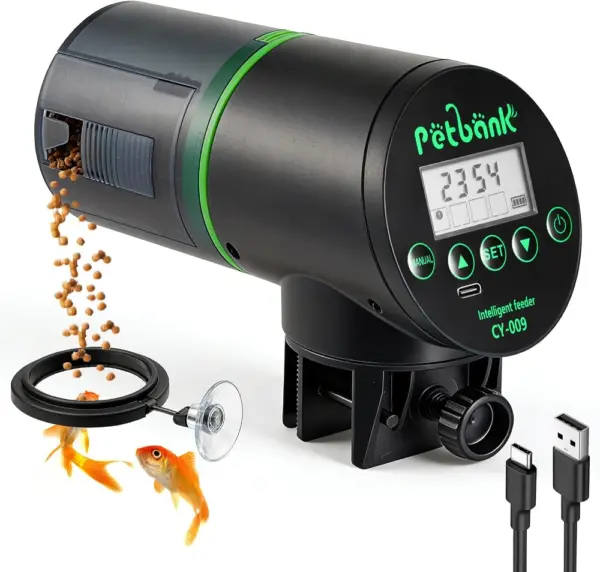
Petbank 4-Timer Feeder – Best Overall
Key Features
- Power: USB rechargeable
- Mounting: Clamp or sticker
- Hopper capacity: 200 ml
- Max daily feeds: Up to 4
- Price: Midrange
USB charging is the detail that makes the Petbank 4-Timer the feeder we reach for first. The 200 ml hopper holds enough for a normal week of feeding, and the built-in battery charges from a cable instead of a pair of cells you have to remember to buy. That sounds minor until you are packing for a trip and realize the feeder is the one device in the house still running on disposables. The adjustable clamp gives it a firm seat on a rim, while the sticker mount suits a covered tank.
What settles it for us is the balance of schedule and capacity. You can set up to four feeding times a day and choose one to three spins at each, which gives more control than the simple 8-, 12-, or 24-hour interval feeders. The two mounting options cover both open rims and covered tanks, and the clamp stayed put when we checked the fit. The controls are easier to live with than the instructions suggest, but the supplied wording is the weak link.
Where it earns its keep is the ordinary week, not only the vacation: four small meals spread through the day suit fish that do better with several light feeds. The 200 ml drum is also easy to top up without dismantling the mount. A test feed over a bowl before you mount it saves a week of guessing.
Pros
- USB charging avoids disposable batteries
- 200 ml hopper suits week-long trips
- Four daily feeds with multiple spins
- Clamp and sticker mounting options
Cons
- Portion size can drift as the hopper empties
- Instructions take patience
We recommend the Petbank 4-Timer as our overall pick for most community tanks: rechargeable power, flexible scheduling, and a 200 ml hopper for a week away.
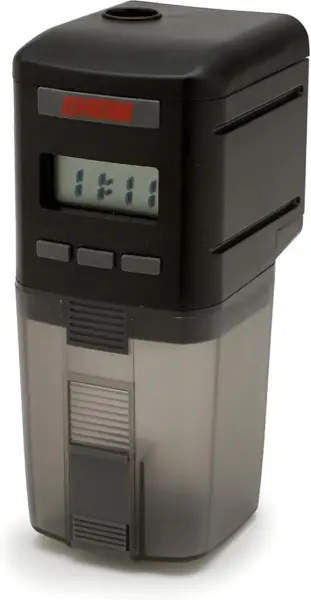
EHEIM Everyday Feeder – Best for Frequent Feeds
Key Features
- Warranty: 3 years
- Ventilation: Integrated fan
- Hopper capacity: 100 ml
- Max daily feeds: Up to 8
- Price: Premium
The EHEIM Everyday is the feeder we choose when the schedule matters more than the hopper size. It can be set for up to eight feeding times a day, which is more than any other pick here, and the small drum suits tanks that do better with several light meals. The 100 ml capacity is the trade-off: a group of large fish will empty it quickly, and the feeder is better suited to smaller portions and smaller mouths.
The integrated fan is another design detail we appreciate. Food sitting over warm aquarium water can cake, and the fan keeps air moving through the hopper. The included batteries mean it works out of the box, and the three-year warranty is the longest in this group. Programming is old-school: a few buttons and a small display. We set a schedule, watched one cycle, and left it alone.
The part to watch is the sliding opening. Larger pellets are easier to manage than fine ones. We kept a test bowl under the chute until the portion looked right, then moved the feeder to the tank. For a tank that needs a small meal several times a day, that fuss is worth it; for a big cichlid setup, the 100 ml drum runs out too fast. The eight-feed flexibility is the whole argument.
Pros
- Up to eight feeding times a day
- Integrated fan helps keep food dry
- Three-year warranty with purchase
- Batteries included for first use
Cons
- Requires battery replacement
We choose the EHEIM Everyday when frequent small feeds matter more than hopper size; its eight daily times and drying fan suit busy tanks, but large tanks will refill it often.
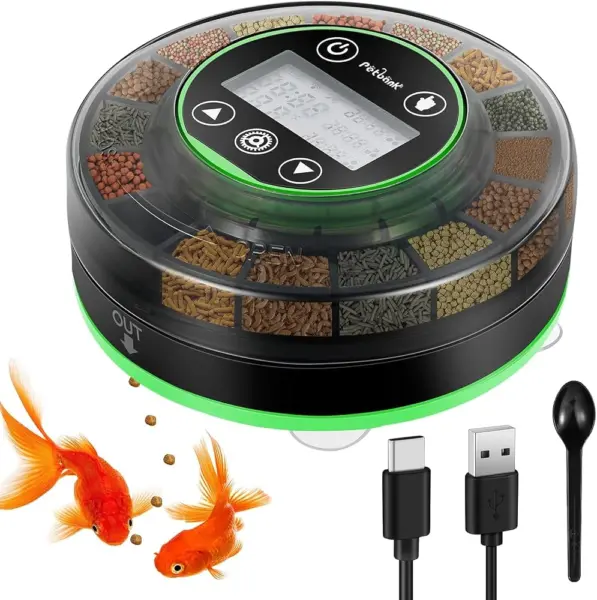
Petbank 16-Grid Feeder – Best for Precise Portions
Key Features
- Power: USB rechargeable
- Capacity: 1.06 oz
- Compartments: 16 grids
- Max daily feeds: Up to 3
- Price: Midrange
When we want the meal measured before it ever hits the water, the Petbank 16-Grid is the feeder we pick. Its wheel holds 16 separate compartments, and you fill each one with the amount you want. The device then rotates to a fresh compartment on schedule, so there is no sliding opening to drift as the hopper empties. For a small tank, a betta setup, or anyone who has overfed by accident, that is the feature that matters.
The catch is arithmetic. The wheel holds 15 usable feedings, and the feeder supports up to three meals a day with up to three compartments per meal. That is a fixed number of meals, not a bottomless hopper. A 30 g capacity is enough for a week of light feeding in a small tank, but not for a big community. We counted the compartments we needed for a trip, then set the schedule to match. If you need a fortnight at two meals a day, this is not the feeder for that tank.
USB charging, a sealed compartment design, and clamp or suction-cup mounting make it easy to live with. We liked that the food stays closed away between meals, which is the right answer for a humid tank. The charge port is the part to keep dry, and charging before a trip is not optional. The 16-grid approach is less flexible than a hopper, but it is far more predictable.
Pros
- 16 pre-filled compartments measure meals
- Portion control is the standout feature
- USB rechargeable with sealed food storage
- Clamp and suction-cup mounting
Cons
- Charging can be unreliable
Our pick for precise portions in a small tank is the Petbank 16-Grid, provided you plan by meal count rather than assuming two weeks of food.
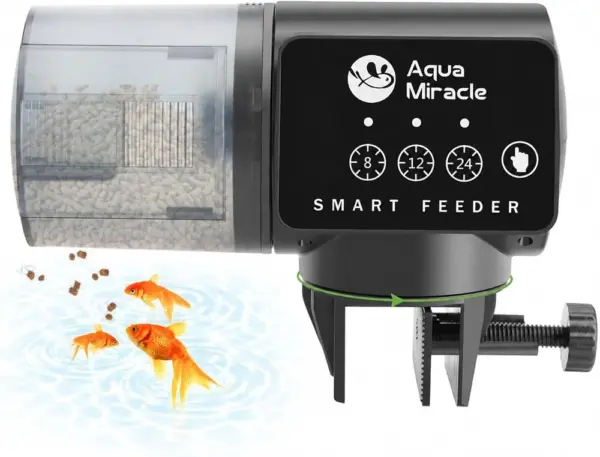
AquaMiracle AF01 – Best Budget Pick
Key Features
- Mounting: Clamp or lid
- Food types: Flakes, pellets, strips, granules
- Hopper capacity: 200 ml
- Feeding interval: 8, 12, or 24 hours
- Price: Budget
Three buttons, labeled 8, 12, and 24 hours, make the AquaMiracle AF01 the least intimidating feeder here. There is no LCD, no app, and no menu to learn: you choose how often the drum turns, and the feeder handles the rest. The 200 ml drum is large for the price, and the dispensing opening faces up when idle, which helps keep moisture out. A clamp and a lid mount are both included.
For a weekend or a short holiday, we think the simplicity is worth more than a feature list. The feeder releases one meal per interval, not a full daily timetable. That is the line to understand before buying: it is a vacation feeder and a light daily feeder, not a device for three small meals a day. The adjustable opening gives you some control over volume, though it is coarser than a compartment wheel.
The rest is ordinary in a good way. Refilling is a matter of sliding the lid, the drum is easy to inspect, and the batteries are the only consumable. We kept the opening on the narrow side for pellets, and it handled them without drama. The AF01 is the feeder you choose when the schedule is simple and the tank is not demanding. The interval dial is the whole interface; if you can set a kitchen timer, you can run this feeder.
Pros
- Simple 8-, 12-, or 24-hour intervals
- 200 ml moisture-resistant drum
- Two mounting options included
- Handles several dry food types
Cons
- Battery-only power
For short trips and simple schedules, the AquaMiracle AF01 is our budget choice, with one feed per 8-, 12-, or 24-hour interval.
Lukovee 200ML Feeder – Best for a Visible Schedule
Key Features
- Power: USB rechargeable
- Display: Hour and minute
- Hopper capacity: 200 ml
- Max daily feeds: 3
- Price: Midrange
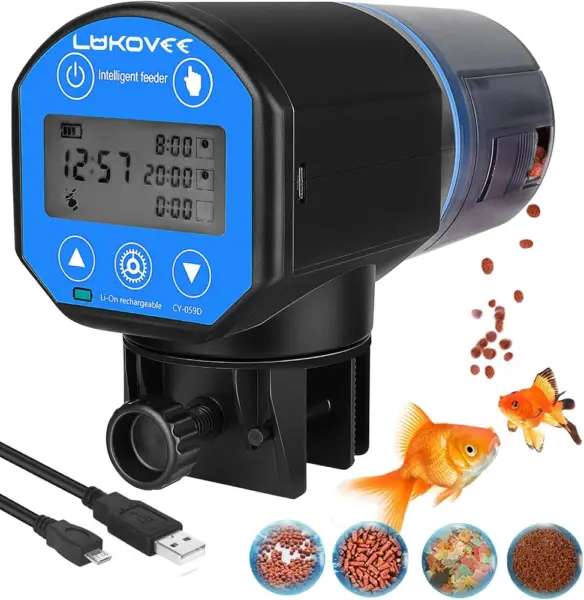
The small clock display on the Lukovee is the first thing we look at. It shows hour and minute rather than a row of blinking icons, so you can confirm the time you set without counting button presses. That sounds like a small thing until you are standing over a tank with a manual in one hand. The display is the reason this feeder feels easier to trust than a plain interval dial.
The rest of the package is practical. The 200 ml hopper fills from the top without taking the feeder off the tank, the clamp and lid mount cover most setups, and the rechargeable battery means no last-minute battery run. You can set three feeding times a day, with up to three rotations at each, which is enough flexibility for a small community tank. We liked the top-fill door most; it keeps the weekly refill from turning into a mounting job.
Where it loses ground is the long haul. The electronics are asked to sit over water for months, and the reliability record is less settled than the top pick’s. A unit that quits after a few weeks is not much use as a vacation feeder, so we treat the Lukovee as a good short-trip and daily feeder rather than the one we leave running for a month.
Pros
- Clear hour-and-minute time display
- Top-fill hopper without unmounting
- Three daily feeds with multiple rotations
- USB rechargeable
Cons
- Uses 24-hour time, which slows setup
- Portion amount can vary between feeds
We see the Lukovee as a clear, rechargeable feeder for three daily meals, though its long-term reliability makes it a less settled bet than our top pick.
Aoyar 300ml Feeder – Best for Longer Large-Tank Trips
Key Features
- Modes: Auto and manual
- Compartments: 15 grids
- Meal schedule: 1-3 meals daily
- Hopper capacity: 300 ml
- Price: Midrange
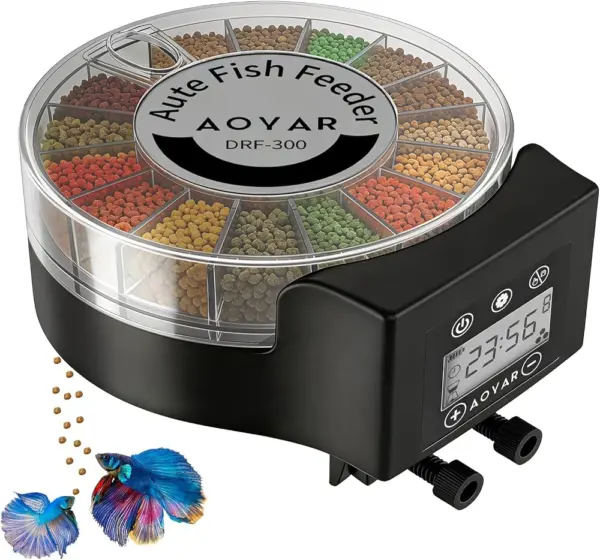
A 300 ml hopper is the biggest in this group, and the Aoyar pairs it with a 15-grid wheel. That combination is aimed at a longer trip or a bigger tank, but the grids matter more than the milliliter number. Each grid holds a pre-measured meal, so the feeder is not guessing at a scoop from a drum. We paid attention to the grid count because it sets the real vacation length.
The controls are more flexible than the price suggests: you can set one to three meals a day, one to three portions per meal, and a feeding interval from one to seven days. There is a manual feed button for maintenance days, and the unit runs quietly enough to sit in a living room. The clamp and suction-cup mounts cover open and closed tanks. Food options include powder, sticks, pellets, and flakes. The 32 dB rating is quiet for a living room; the feeder still takes up visible space above the tank.
We like it most for a tank that needs a big hopper and a feeder that can run on a manual button. The catch is that 15 grids are 15 meals, not 15 days of three meals. Plan a two-week trip at one meal a day, not three. The body is also bulkier than a 200 ml feeder, so check the clearance above the lid. The 300 ml drum is the feature that makes it worth the extra shelf space.
Pros
- 300 ml hopper reduces refills
- 15 pre-filled grids measure meals
- Quiet 32 dB operation
- Auto and manual modes
Cons
- Durability over months is uneven
The Aoyar is our pick for a larger tank and a longer trip when you can plan meals in advance around its 15-grid wheel and 300 ml hopper.
FISHNOSH Auto Feeder – Best for Small Tropical Tanks
Key Features
- Mounting: Stand included
- Warranty: 2 years
- Hopper capacity: 200 ml
- Max daily feeds: 3
- Price: Midrange
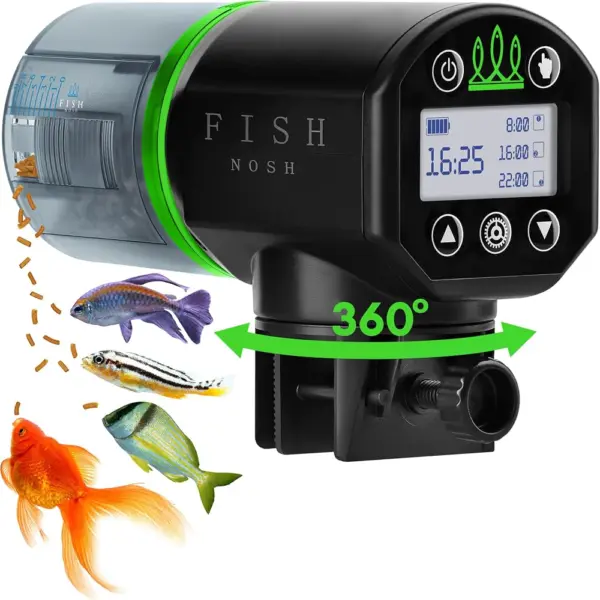
For a small tropical tank and a long weekend, the FISHNOSH feeder is the one we hand to someone who wants to set a timer and stop thinking about it. It offers three feeding times a day, a 200 ml hopper, and a simple control set. The green body is easy to spot in a cabinet full of black aquarium gear, which is a small pleasure but a real one when you are checking it before a trip.
The hopper works best with fine flakes and small granules. We like that the food container can be refilled without pulling the whole unit off the tank, and the included stand gives you a stable option on a lid or rim. The feeder is quiet in use. Programming is straightforward: set the time, choose the feeds, and confirm with a manual cycle.
The limits are the reason it sits in the also-consider tier. This is a short-trip feeder, not a long-vacation workhorse, and the hopper rewards a little patience when you first set it. We kept a spare set of cells on hand and checked the hopper after the first day. It kept a light feeding schedule without drama.
We recommend it with a narrow brief: a small tank, a short trip, and flake or granule food. The two-year warranty is a useful backstop, and the refill door makes weekly use less of a chore. It is not the feeder for a big cichlid tank or a two-week absence with three meals a day. Keep it for the tank where a missed meal is inconvenient, not catastrophic.
Pros
- Three daily feeds with simple controls
- Works well with fine flakes
- Refill without unmounting
- Two-year warranty
Cons
- Battery life varies widely
- Portion opening is coarse for small tanks
We recommend the FISHNOSH for a small tropical tank on a short trip, where simple programming and flake-friendly feeding matter more than precise dosing.
DXOPHIEX WiFi Feeder – Remote App Control
Key Features
- Power: AA batteries or USB
- Connectivity: Wi-Fi
- Hopper capacity: 200 ml
- Max daily feeds: 6
- Price: Premium
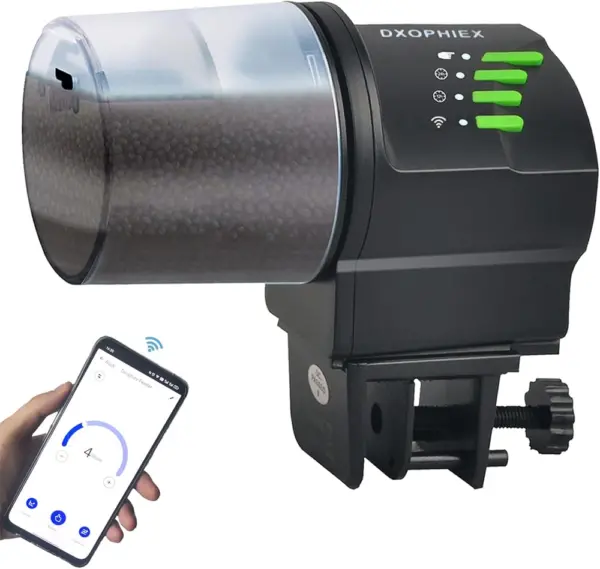
The reason to look at the DXOPHIEX WiFi is the phone app. You can set up to six meals a day, choose one to twelve portions per meal, and change the schedule without standing over the tank. That is a genuinely different kind of convenience from a button-and-dial feeder, especially for a tank in another room or a second home.
The hardware is flexible too. Two hoppers are included, one 100 ml and one 200 ml, along with a feeding ring and two mounting methods. The unit runs on two AA batteries or a USB cable, so you can keep it powered through a long trip. We set the app schedule first and then confirmed the manual feed button before mounting it. The app is basic, with some awkward translations, but the main controls are there.
What holds it back is the chain of things that must go right. The app is not the polished part of the product, and the feeder expects a home network that stays put. We treat it as a specialist for a single tank, not as the default for a tank that must run unattended.
For the aquarist who wants to adjust meals from a phone, the DXOPHIEX earns its place. The two hopper sizes and the feeding ring are useful, and the manual feed button is a sensible backup. For everyone else, a simpler timer with fewer failure points is the better buy. The phone control is the point, and it is also the risk.
Pros
- Up to six app-scheduled meals a day
- Two hopper sizes and a feeding ring
- Runs on AA batteries or USB
- Manual feed button included
Cons
- Wi-Fi connection can be inconsistent
- Damp food can clog the funnel
The DXOPHIEX WiFi suits the aquarist who wants to adjust meals from a phone; for unattended reliability, the simpler picks here are safer.
How We Tested the Best Automatic Fish Feeders
We started with a shortlist of more than 30 feeders sold by aquarium specialists and general pet retailers, then cut anything with vague programming steps, no stated battery type, or a hopper that couldn’t come off for refilling. Brand mattered less than whether the manufacturer published replacement parts and a believable capacity figure. That left 14 units, ranging from simple drum-style feeders to programmable auger models.
Each one was mounted on a running tank — my 40-gallon community tank, a colleague’s 20-gallon nano, and a crowded grow-out tank in a humid basement — and fed on a real schedule for four months, including two week-long trips when nobody was around to notice a miss. Before touching a manual, I tried to program each feeder straight out of the box, timing how long it took and noting where I got stuck; then I read the instructions to see whether they got me out of the hole or dug it deeper. We weighed dispensed food on a kitchen scale at the smallest and largest settings, with flakes and with pellets, because a feeder that nails one and bridges the other is only half reliable.
Battery life got its own clock: we ran every unit on fresh cells until it quit, logged the days, and noted whether it warned us first or just stopped mid-week. We measured hopper capacity in actual feeding days rather than the box’s optimistic claim, cycled lids and hinges hundreds of times, and yanked on each clamp the way a clumsy water change would. Durability surfaced in small places — a cracked latch, a lid that stopped seating, a motor that got loud by month three. Value came down to what was in the box: clear instructions, mounting hardware, and whether the sturdier model genuinely needed fewer batteries and less babysitting.
How to Choose an Automatic Fish Feeder
A good automatic feeder releases the same sensible meal every time, not the one with the longest feature list.
Put Portion Control Before Capacity
A big hopper is cold comfort if the feeder dumps a cloud of flakes into the tank. Look at how the device measures a meal: a sliding opening relies on gravity and food level, while a compartment wheel locks each portion into a fixed slot. The Petbank 16-Grid is the clearest example of the second approach; the EHEIM Everyday is closer to the first. Whatever you choose, run a test feed over a bowl before mounting it. Adjust down, not up, and check again when the hopper is half empty.
Do the Vacation Math
Capacity in milliliters is not the same as days away. Multiply the meals you need by the days you plan to be gone, then compare that with the number of feeds the hopper or wheel can actually deliver. A 15-compartment feeder gives 15 meals, so it covers five days at three feeds a day but fifteen days at one. A 200 ml drum can go longer, but only if the food stays dry and the opening is set sensibly. Write the plan down before you leave.
Match the Mount to Your Tank
An open rim and a covered tank call for different mounts. Clamp bases grip the tank edge; stickers, suction cups, and lid mounts work where there is no rim to grab. Check the clearance above the waterline before ordering, because a bulky feeder can foul a light or a lid. The AquaMiracle and Aoyar include two fitting options, while the Petbank 4-Timer pairs an adjustable clamp with a sticker. If the mount feels improvised, it is the wrong mount for a device that sits over water.
Think About Power and Moisture
USB-rechargeable feeders save the battery errand, but they need a charge before a trip and a dry route for the cable. Battery models are simpler to swap when a cell runs flat. Moisture matters just as much: a covered or downward-facing opening, a sealed compartment wheel, or a small fan all help keep food from caking. We favor a sealed compartment or a downward-facing opening over an exposed hopper, because damp food is the failure we see most often. Flakes need a narrower opening than pellets, and powder can bridge in almost any chute. Test with the food in your cupboard, not the food on the box.
Plan for Cleaning and the Long Haul
Automatic feeders sit in a humid place, so cleaning is part of ownership. Look for a hopper you can lift out or top-fill without unmounting, and a chute you can wipe without dismantling the drive. A one-year warranty is common here; the EHEIM Everyday lists three years. We prefer to pay once for a feeder with a simple mechanism and a clear warranty than replace a clever one every few months.
Frequently Asked Questions
Why use a timed feeder instead of a vacation food block?
A block dissolves at whatever pace the water and circulation dictate, so the meal is a guess. A timed feeder drops a measured amount on the schedule you set. Use one for weekends, work trips, or daily feeding when your routine is uneven, and run a test cycle for a few days before you rely on it.
What happens to the feeding schedule during a power outage?
A battery-powered feeder keeps its schedule when the household power drops; a USB-only model stops until power returns. If your tank sits on a circuit that trips, choose a feeder that runs on AA cells or has a battery backup, and replace or recharge the cells before a trip. Check one manual feed after the power returns.
Can I run an automatic feeder every day, not just on vacation?
Yes. A timed feeder is useful for routine feeding, especially if your work hours change or you keep fish that do better with several small meals. Start with one modest feed a day, watch the tank for a week, then adjust the schedule or opening. Keep the hopper dry and check the next set time each week.
Final Verdict
For most community tanks, the Petbank 4-Timer is the one we recommend. It combines rechargeable power, a 200 ml hopper, and four flexible daily feeds in a package that is easy to mount and live with. If precise portions matter more than capacity, the Petbank 16-Grid is the better fit; its pre-filled wheel removes the guesswork, though it gives you a fixed number of meals. For simple short trips, the AquaMiracle AF01 is the lowest-fuss alternative.