This post contains affiliate links. We may earn a small commission when you buy through our links — at no extra cost to you.
A root tab should feed the plants, not the algae, not the fish, and definitely not the water column. These fertilizer plugs go under the substrate, where rooted plants like swords, crypts, and bulb plants feed through their roots. A tab that crumbles, floats up, or releases too fast can cloud the tank, stress fish, and leave you scraping algae instead of trimming new leaves. What you want is steady root-level feeding you can bury once and trust for weeks.
I keep a low-tech planted tank at home, and over eight months my team and I tested 13 root-tab options in setups ranging from a nano shrimp bowl to a deeper community aquarium. We pressed each into sand, gravel, and planted soil, watched whether it stayed put or floated, and tracked plant color, leaf size, and water clarity weekly. The best were easy to push in without breaking apart, safe around fish and shrimp, and still feeding roots after cheaper tabs had turned to mush.
Our Top Picks
The Best Aquarium Root Tabs, Reviewed
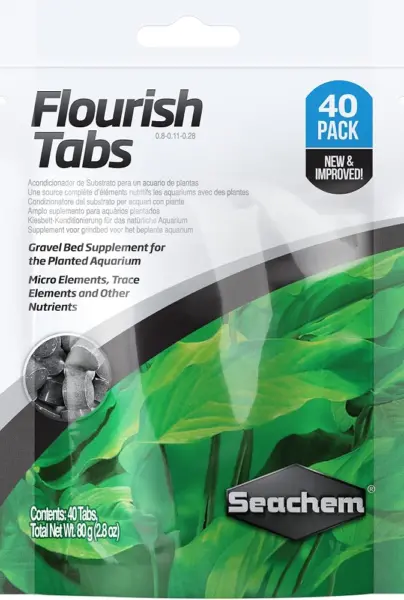
Seachem Flourish Tabs – Best Overall
Key Features
- Form: Tablets
- Count: 40 tablets
- pH effect: Will not alter pH
- Dose interval: Every 3 to 4 months
- Price: Midrange
Three to four months between doses is the number that decided this one for us. You push a set of tabs into the substrate, and the next set is not due until the seasons have changed — no bottle to shake, no weekly measurement to remember. For a tank that quietly slid back into being a fish tank because liquid dosing became a chore, that interval is the entire argument.
What we think earns it the top spot is how little it asks of the rest of the tank. Seachem states the tablets will not alter pH, which matters in a shrimp tank or a setup you have spent months stabilising, and the slow breakdown means the water stays clear instead of going milky the way a fast-dissolving tablet can. There is nothing to mix and nothing to measure; the whole routine is a pair of tweezers.
Swords, crypts and other heavy root feeders are the plants that collect the benefit, and the tabs go under them rather than broadcast across the footprint — a stem plant feeding through its leaves gets nothing from a tablet buried beside it. That precision is also why a 40-count box stretches as far as it does.
Cost is where it stings. Per tablet this sits near the top of this group, and a large, densely planted tank goes through a pack quickly at each dosing. In a modest tank with a handful of swords and crypts the convenience is worth paying for; in a six-foot wall of stems, a cheaper tab that needs re-dosing more often does the same job for less.
Pros
- Four months between doses
- Label states it will not alter pH
- Sinks and dissolves slowly without clouding
- Long record of growth in heavy root feeders
Cons
- Costs more per tablet than most picks
The safest default here: a dose every few months, a tab that stays buried, and the longest record of root feeders responding.
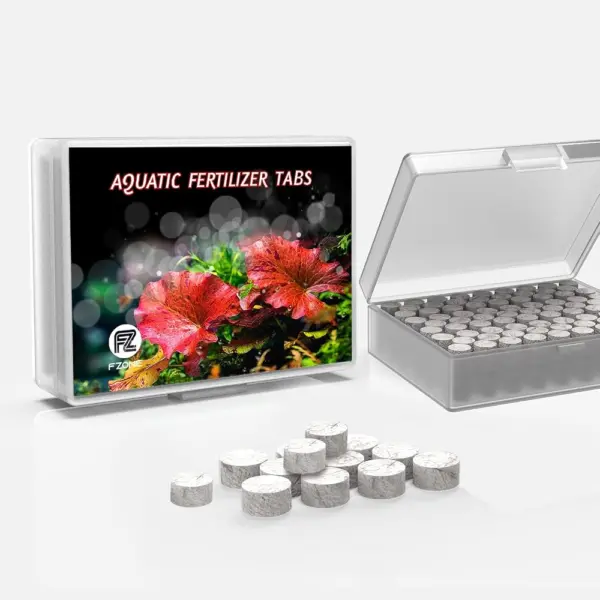
FZONE Root Tabs – Best for Nano Tanks
Key Features
- Count: 50 tablets
- Release: Up to 2 months
- Stated ratio: 20:9:11
- Coverage per tab: 5 to 6 inches
- Price: Budget
Small is the whole idea here. In a tank with an inch of sand over soil, a fat tablet sits half-exposed no matter how carefully you push it down, and FZONE’s are the most compact tabs in this guide — which is why we reach for them whenever the substrate is shallow.
The size pays off at planting time as well: less force with the tweezers, less depth needed, and less chance of burying a tab under the wrong plant. Each one is listed as covering a five- to six-inch area, with release stated at up to two months on a 20:9:11 ratio. That is a shorter window than a four-month tablet, so you are back in the tank sooner — though in a nano cube, that is a couple of minutes of work.
They hold their shape once wet and sink rather than drifting, so you are not left with fertilizer dust clouding the water, and the listing states they are safe for fish and shrimp. That combination makes them easy to recommend for a shrimp colony or a small tank with a betta in it, where moving everything around to plant is the last thing you want to do. Fifty tabs at this spacing covers a lot of small-tank real estate.
Pros
- Fits shallow sand and gravel
- Easy to plant with tweezers
- Sinks and stays under the substrate
- Stated safe for fish and shrimp
Cons
- Smaller tab covers less ground per placement
Compact tabs for shallow sand and nano tanks, where a full-size tablet would sit half-exposed.
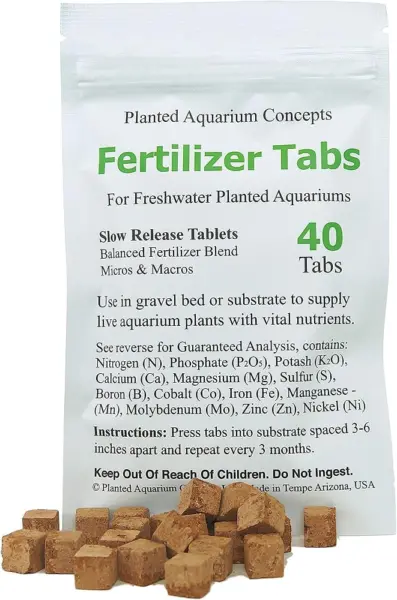
Planted Aquarium Concepts Tabs – Best Full-Spectrum Tablet
Key Features
- Form: Tablets
- Count: 40 tablets
- Nutrients: N, P, K plus eight trace minerals
- Price: Midrange
Eleven nutrients, printed by symbol on the label: that is the pitch. Planted Aquarium Concepts lists N, P, K, Fe, Mg, Mn, Zn, Mo, B, Co and Ni, which is a fuller accounting than most tabs here give you and a different proposition from a tablet you buy as an iron top-up.
They are tablets, so they sink and stay where they land, and they hold their shape long enough to get under gravel with tweezers without crumbling. Once waterlogged they do soften, so push them deep on the first attempt and leave them alone afterwards — digging around a soaked tab is how a clear tank turns cloudy.
We think this is the tablet for a tank running on plain gravel where the plants have been surviving rather than growing. What keeps it off the top of this list is how uneven the results are; some tanks take off and others show nothing, which is true of root feeding generally but shows up sharply here. If your substrate is inert and your swords have stalled, it is a reasonable bet — dose two or three plants first and see how the new leaves come in before treating the whole footprint.
Pros
- Broad mineral list including N and P
- Sinks and stays in the substrate
- Easy to push into gravel with tweezers
Cons
- Growth results vary tank to tank
Buy it for the full mineral list in a tablet that sinks, and dose a couple of plants before the whole tank.
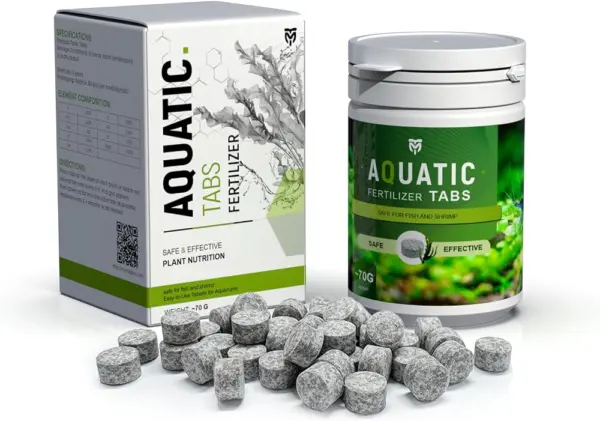
MagTool Root Tabs – Best Budget
Key Features
- Pack: 70 g box
- Release: 2 to 3 months
- Planting grid: One tab every 5 inches
- Tablet weight: 0.04 oz
- Price: Budget
The budget end of this list is where most people should start, and MagTool’s box is the one we point to: 1-gram tablets, a stated two- to three-month release, and a price that makes a first attempt at root feeding low-stakes. Buying the big premium tub before you know whether your plants respond is the wrong order of operations.
The label does something the rest do not: it gives a planting grid, one tab every five inches, which turns how many do I need into arithmetic instead of guesswork. A 70-gram box of 1-gram tabs covers a decent footprint at that spacing, and the release window sits in the middle of the range here — shorter than Seachem’s four months, longer than FZONE’s two.
Handling is where cheap tabs usually give themselves away, and these hold up: they sink, they do not crumble on the way in, and they stay put instead of working their way back out during a gravel vac. What you accept is the size of the box — in a big, heavily planted tank you will be reordering sooner than you expect.
Pros
- Lowest-priced way into root feeding
- Planting grid makes dosing easy
- Sinks without crumbling or floating
Cons
- Small box runs out fast in big tanks
The low-stakes way to find out whether root feeding works in your tank.
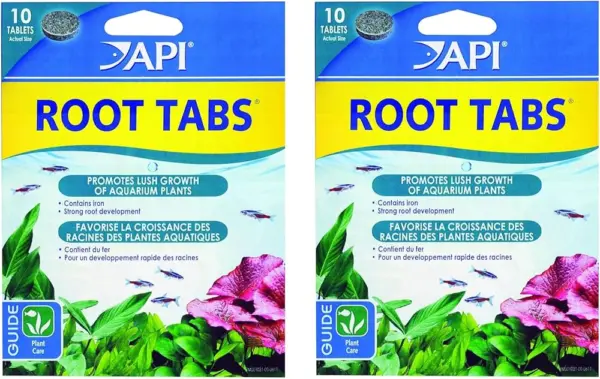
API Root Tabs – Best Starter Pack
Key Features
- Form: Tablets
- Count: 20 tablets
- Key nutrients: Iron, potassium, carbon
Two 10-count boxes instead of one tub looks like odd packaging, and it is the most useful thing about this pack: keep one sealed while the other is open, and you have a starter quantity rather than a supply you are stuck with.
The listing names iron, potassium and carbon and leaves it there, promising strong root development and a faster start for newly planted specimens. That is a narrower brief than the tablets here that spell out a full analysis — it reads as a root tonic rather than a complete substrate program, and it suits a tank where the plants need a nudge rather than an overhaul.
What we appreciate is the low commitment. Twenty tabs is enough to find out whether substrate feeding changes anything in your tank before you spend on a bigger box, and the tablets go in the same way as any other — no capsule to vent, no gel shell to squeeze. The catch is scale: twenty tabs disappear fast past a modest tank, and the pack does not say how much ground a tab covers, so start with a couple under your hungriest plants and give it a few weeks.
Pros
- Small two-box pack suits a first try
- Iron, potassium and carbon for root feeding
- Simple tablet that needs no venting
Cons
- Twenty tabs go quickly in a larger tank
A twenty-tab starter pack for a small tank, with no capsule to vent and nothing to measure.
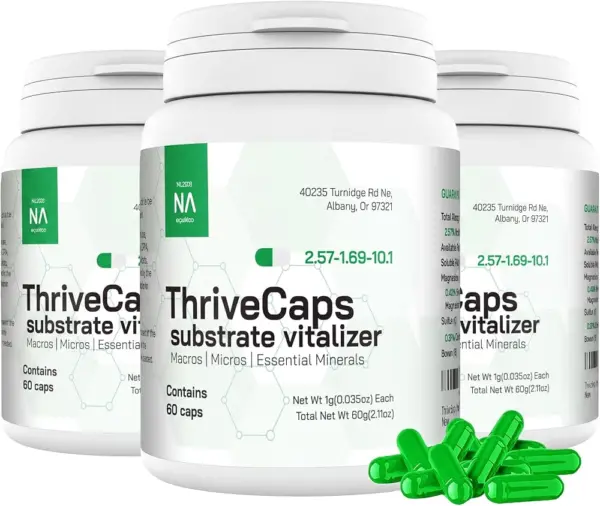
NilocG ThriveCaps – Best for Complete Substrate Feeding
Key Features
- Form: Capsules
- Count: 180 capsules
- Nutrients: Micro and macro, including N and P
- Capsule weight: 0.04 oz
- Price: Midrange
Capsules are the format that divides people, and ThriveCaps show why. What is inside is the most complete nutrient load in this guide — nitrogen and phosphate alongside the traces, blended with iron-rich clay and mineralized top soil. What is outside is a gel capsule with air in it, and air floats.
The fix is one extra step: pierce the capsule, squeeze the air out, then push it under the substrate with tweezers. Skip it and you will be chasing capsules around the surface while the rooted plants get nothing. It is obvious once you have done it and completely invisible on the product page.
Three jars of sixty at a gram apiece is a serious amount of feeding, and the price reflects the formulation rather than the count. Because these carry nitrogen and phosphate, they put more into the substrate than a trace tab does — what a heavy root feeder in inert gravel wants, and more than a lightly planted, heavily stocked tank needs. Start with part of the footprint and watch the water.
Our view is that the fuss is worth it for someone already committed to feeding macros through the substrate rather than the water column. One practical difference from tablets: the shells keep their shape far longer, so expect to find them when you uproot a plant — harmless, but a reminder of how slowly they let go.
Pros
- Nitrogen and phosphate, not just traces
- 180 capsules at a gram each
- Shells hold their shape in the substrate
Cons
- Costs more than most picks here
- Growth results vary tank to tank
The most complete nutrient load here, in capsules you will need to vent before they sink.
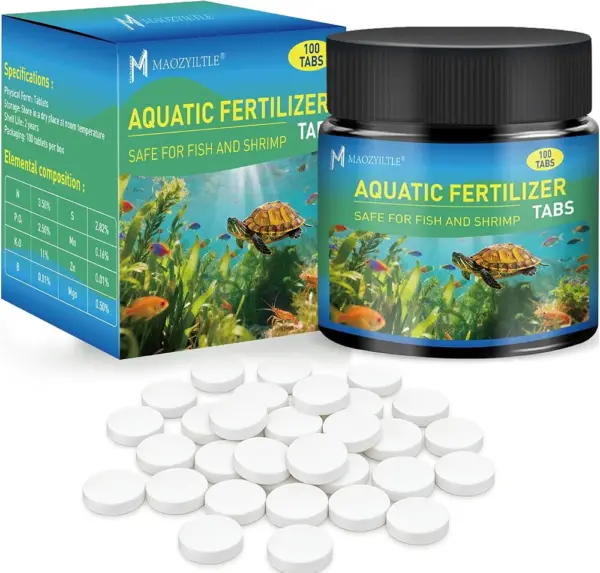
Montorchid Root Tabs – Best for Large Footprints
Key Features
- Count: 100 tablets
- Release: 2 to 3 months
- NPK ratio: 1:0.5:2.8
- Tablet weight: 0.04 oz
- Price: Budget
First-time users are told to start at eighty percent of the full dose, which is a more honest instruction than most labels carry. The analysis behind it is deliberately lean — 1:0.5:2.8, low nitrogen, low phosphorus, high potassium — which suits a tank that already has plenty of nitrate and does not need more pushed into the gravel.
A hundred 1-gram tablets is the kind of quantity that lets you treat a whole footprint without rationing, release is stated at two to three months, and they sink fast. For a large tank on a tight budget, that combination is the reason it is here. Push them deep and leave the substrate alone for a few days afterwards; a tab that ends up uncovered can put a haze in the water.
Pros
- Hundred tablets at a gram each
- Lean NPK for tanks already high in nitrate
- Sinks fast and releases over months
Cons
A hundred lean-formula tablets for a big footprint, at the lowest cost per dose here.
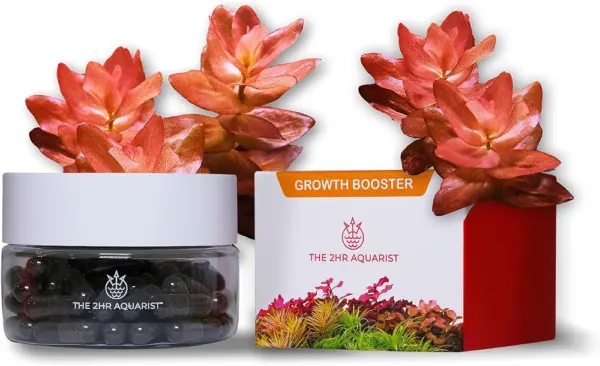
2HR Aquarist APT Jazz – Best for Lean-Dosing Setups
Key Features
- Form: Tablets
- Count: 54 tablets
- Pack weight: 2.01 oz
- Price: Premium
APT Jazz is built around a method rather than a nutrient list: keep nitrate low in the water column and push what the plants need under their roots, so growth stays compact and the water stays lean. The label puts it as nitrate limitation made easy, with thicker, fuller growth as the promise.
Fifty-four tablets at 57 grams is a small box at the top of this group’s price range, and the listing says little beyond that about what is in them. This is not the tab you buy to rescue a struggling sword in a community tank; it is the one you buy when you are already running a lean dosing routine and want a substrate partner that will not fight it.
We are wary of premium root tabs that lean on a philosophy, and this one earns its place only if the philosophy is already yours. Run careful water-column dosing, keep nitrate where you want it, and APT Jazz plays the substrate half of that plan. Want greener crypts with nothing to calculate, and the cheaper tablets here will do it with more room for error.
Pros
- Made for nitrate-limited aquascapes
- Aimed at compact, fuller plant growth
Cons
- Costs the most per tablet here
- Sparse detail on nutrient content
Premium tablets for a tank already run on nitrate limitation; skip them if you just want greener plants.
How We Chose and Tested the Best Aquarium Root Tabs
To build the shortlist, I read through the root-tab options sold for freshwater planted tanks, compared ingredient lists, tablet dimensions, dosing directions, and cost per dose, then narrowed the field to 13 products that covered different formats and price points. Over eight months, we buried them in a low-tech community tank, a nano shrimp bowl, and a deeper sand-and-gravel setup, using planting tweezers and following each label’s spacing and depth instructions.
We timed how long a full dose took to place with tweezers and noted whether tabs snapped, crumbled, or stayed intact. Before burying each one, we dropped a tab into a cup of tank water to see whether it sank or floated, then checked the substrate surface afterward for anything working its way up. Every week we looked at water clarity and test-kit readings, and watched fish and shrimp for changes in appetite, activity, and breathing that might suggest stress.
At two weeks, one month, and two months, we pressed near each dose to judge whether the tab had softened, broken down, or disappeared, and we tracked new leaf count, leaf color, and whether roots clustered around the buried tabs. We compared tablet size against the root zones of small crypts and larger swords, and calculated cost per month per tank so value reflected how often we had to redose. Photos under the same light let us compare tank fullness and plant appearance rather than relying on memory.
How to Choose Aquarium Root Tabs
The things that separate a good root tab from a disappointing one are invisible in the packet: whether it stays buried, how slowly it lets go of its nutrients, and whether it fills the gap your tank actually has.
Tablets, capsules, and the floating problem
Tablets are dense and sink; capsules are gel shells holding a pocket of air, and that air is why so many of them come straight back up. If you buy capsules, pierce one end and squeeze the air out before it goes under the substrate, or you will spend the evening netting them off the surface while your rooted plants get nothing.
For a first purchase, tablets are the simpler route, and they are the better choice if your substrate is deep gravel. Capsules earn their place when the formulation inside is the reason you are buying — a blend that carries nitrogen and phosphate as well as traces, for instance.
What’s actually in the tab
Some tabs are iron and trace-mineral supplements. Others carry nitrogen and phosphate too. Neither is better in the abstract; it depends on the water above the gravel. A lightly stocked tank on inert substrate, with swords and crypts that have stopped growing, usually benefits from the fuller profile. A heavily stocked tank that already reads high nitrate does not need more of it pushed into the substrate.
Read the analysis before you buy. If the label names only iron, potassium and carbon, you are buying a supplement rather than a complete feed, and pairing it with a water-column fertilizer is usually the sensible move.
How far a pack actually goes
Two numbers decide the real cost: how many tabs are in the box, and how often you re-dose. A cheap tablet you replace every two months can cost more across a year than a pricier one that lasts four.
Work out your footprint first. A common instruction is one tab every five inches in a grid, with each covering a five- to six-inch area, then multiply by the number of plants you are actually feeding. A 20-count starter pack is a false economy in a large tank and a sensible one in a nano cube.
Substrate depth and keeping tabs down
A tab has to sit below the surface and stay there. In an inch of sand, a compact tablet is far easier to bury than a fat one; in deep gravel, size barely matters. Aim for a couple of inches out from the crown rather than directly beneath it, and angle the tweezers so the hole closes behind them.
Leave the substrate alone for a few days afterwards. Digging around a waterlogged tab is the most reliable way to turn a clear tank cloudy.
More is not better: clarity, algae and dosing
Overdosing is the usual way root feeding goes wrong. Nutrients the plants cannot use feed algae, haze the water, and in a small or heavily stocked tank can tip the water chemistry. Several labels here suggest starting at a reduced dose, and that is good advice whatever brand is in your hand.
Dose part of the footprint, give it two or three weeks, then extend if the plants respond and the water stays clear. Root feeding rewards patience far more than enthusiasm.
Frequently Asked Questions
Do I still need liquid fertilizer if I use root tabs?
Often yes. Root tabs feed what the roots can reach, which suits swords, crypts and other heavy substrate feeders. Stem plants and floating plants take most of their nutrients through leaves and get little from a tablet buried beside them.
The practical split: run root tabs for the substrate feeders and a water-column fertilizer for everything above the gravel. If your tabs are traces-only and your nitrate reads low, the liquid half matters even more.
Are root tabs safe for shrimp and snails?
Shrimp keepers watch two things: copper in the formulation and sudden nutrient spikes. Check the analysis on the label before you buy, and bury the tab rather than dropping it in and letting it leach into the water column.
Then give the tank a week. If the colony is behaving normally and the water is clear, carry on; if anything looks off, do a partial water change and hold the next dose.
How long before root tabs make a difference?
Judge by new growth, not by the leaves already on the plant. Older leaves that have yellowed or melted will not repair themselves, so watch the crown and the newest leaves over the following weeks.
If nothing new appears after about a month, the limiting factor is probably light or carbon rather than root nutrition, and more tabs will not fix it.
Do root tabs go bad in storage?
They keep well if they stay dry. Store them at room temperature with the bag or box sealed, and keep capsules away from damp air, which softens the shell before it ever reaches the tank.
A tab that has clumped or gone sticky has already started taking on moisture. Bin it rather than pushing it into the substrate.
Final Verdict
Seachem Flourish Tabs are the ones we point most people to. A dose every three to four months, a label that promises not to move your pH, and a tablet that sinks and stays where the tweezers put it make it the least fussy way to feed a planted tank.
Two situations change the answer. If your substrate is shallow sand in a nano tank, FZONE’s compact tablets go where a full-size tab cannot. If you are feeding a large footprint and want the lowest outlay, MagTool’s box with its five-inch planting grid is the sensible place to start.