This post contains affiliate links. We may earn a small commission when you buy through our links — at no extra cost to you.
Automatic fish feeders promise carefree vacations, but many dispense too much food or clog with damp flakes. The result: overfed fish or a feeder that stops working mid-trip. The real challenge isn’t finding one that works — it’s finding one that works for your tank and food type. Fish keepers quickly learn that the cheapest models often require the most tinkering.
Portion control is the biggest differentiator. Compartment-based feeders give exact servings per meal, while adjustable sliders require trial and error to set correctly. Battery life and moisture sealing also separate reliable models from those that fail. This guide covers the feeders that balance these factors effectively.
From a budget-friendly option for large tanks to a smart WiFi model for tech-savvy owners, each pick is chosen for a specific use case. The goal: a feeder you can trust when you’re not home, without the guesswork.
Top Picks
Best for Daily Feeding
Petbank USB Feeder
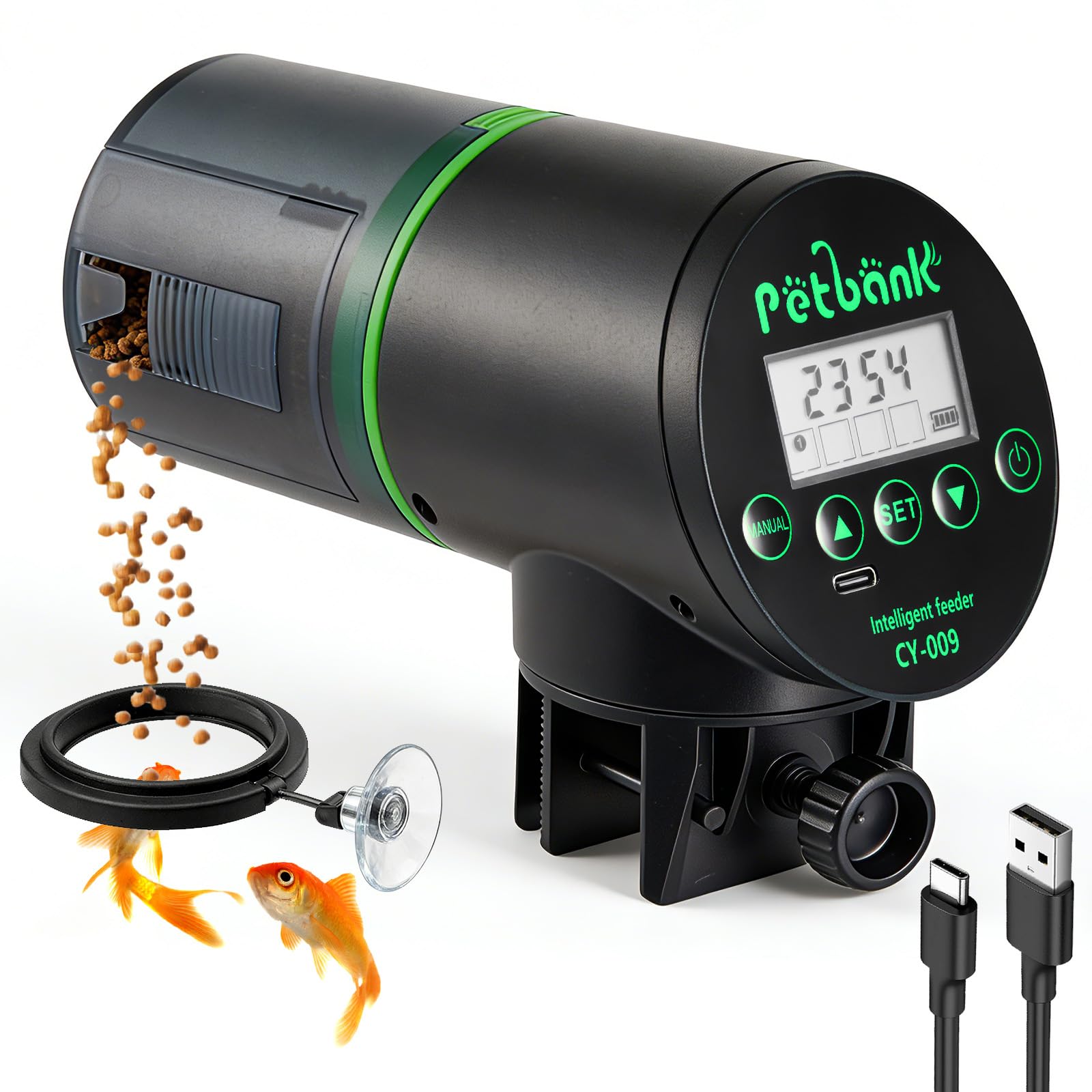
Rating: 4.3 ★ | Price: $$ | Capacity: 200 ml | Power Source: USB rechargeable | Portion Control: Adjustable slider | Setup: Clamp or sticker
The Petbank runs 3–6 months on a single USB charge, a span that covers even extended travel. A full 200 ml hopper paired with adjustable interval modes (8h, 12h, 24h, 48h) means you can set four feedings daily and ignore the feeder for months. The clamp or sticker mount holds securely on most tanks, and the build feels solid — not the creaky plastic common at budget price points.
Out of the box, the manual’s cryptic arrows and sparse text may confuse. The front panel relies on blinking lights for programming feedback, and without a clear legend it’s guesswork. A quick online video search turns that friction into a one-time task. Once configured, the slider-based portion control works consistently for flakes, pellets, and granules in community tanks. For a solo betta or shrimp bowl, the smallest opening may still dispense more than a single occupant needs — a larger community tank handles that surplus without waste.
This feeder suits anyone who wants set-and-forget convenience: fill the hopper, set the timer, and leave it alone for a whole season. People who don’t mind a 10-minute learning curve with the button sequences will be rewarded. It’s ideal for community tanks where the default portion isn’t oversized, and for keepers wanting a second unit for a secondary aquarium. If you feed just one tiny fish and need milligram-level control, a different design — like a compartment tray feeder — will serve you better.
Pros
- Months of battery life per charge, covering long vacations without needing a power outlet.
- Front-panel controls are simple to use once past the initial programming step.
- Sturdy build quality that feels durable compared to flimsy budget alternatives.
- Mid-range price delivers battery longevity and build that outpace the cost.
Cons
- The included manual is sparse, making initial programming a puzzle — online videos clarify the process.
- In single-fish tanks, the narrowest slider setting can still dispense more food than a betta or lone fish needs.
If a rechargeable feeder that runs for months is your priority, the Petbank is the one to get — just plan on watching a quick setup video to bypass the paper instructions.
Best for Medium-Large Tanks
FISHNOSH Auto Feeder

Rating: 4.3 ★ | Price: $$ | Capacity: 200 ml | Power Source: 2x AA batteries | Portion Control: Adjustable sliders | Setup: Clip or stand
The FISHNOSH automatic feeder stands out with a 2-year warranty and a track record that keeps fish fed during vacations. Where the top pick in this set prioritizes battery longevity, this model offers more flexible portion control and works with a wider range of food types. Battery life has been noted to be inconsistent across units, so checking battery levels before extended absences is prudent.
This feeder suits fish keepers with medium to large tanks who want a simple programming interface and a device they can count on while away. It may not be ideal for single betta in small tanks, where portion sizes are too large, or for those needing guaranteed long battery life without monitoring.
Pros
- Consistent performance keeping fish fed during vacations
- Easy to set up and program with intuitive controls
- Adjustable portion control and feeding schedule for mixed food types
Cons
- Battery life can vary between units – worth checking before trips
- Portion control may release too much food for very small tanks
A solid mid-range choice for aquarium owners who prioritize build quality and straightforward setup over battery longevity.
Best for Precision Portions
Petbank Rechargeable

Rating: 4.3 ★ | Price: $$ | Capacity: 16 compartments | Power Source: USB rechargeable | Portion Control: Individual compartments | Moisture Proof: Auto-closing lid | Setup: Clamp or suction cup
The Petbank Rechargeable uses a 16-compartment tray that lets you portion out exact amounts for each feeding – a meaningful advantage over rotating-drum feeders for fish keepers who need consistency. The trade-off vs. the Petbank USB Feeder is shorter battery life (1–2 months vs. 3–6 months) and a higher chance of unit-to-unit variation.
This feeder suits vacation schedules with up to 3 feedings per day, and the auto-closing lid keeps pellets dry. It works best with pellet or granular foods – flake food may not dispense reliably. Some units have shown motor or rotation issues after months of use, so buying from a retailer with a flexible return policy is advisable.
Pros
- 16 separate compartments allow exact food portions per feeding, reducing waste and overfeeding.
- USB rechargeable battery lasts 1–2 months per charge, reducing the need for frequent battery swaps.
- Auto-closing lid keeps food dry, preventing clogs and spoilage.
Cons
- In some units, the battery may not charge fully or loses charge quickly, requiring periodic checks.
- Motor or rotation issues may appear after several months of use in a portion of units.
The right fit for fish keepers who need portion accuracy and moisture protection and can accommodate some variability in long-term build quality.
Best for Large Tanks
FREESEA Easy Setup
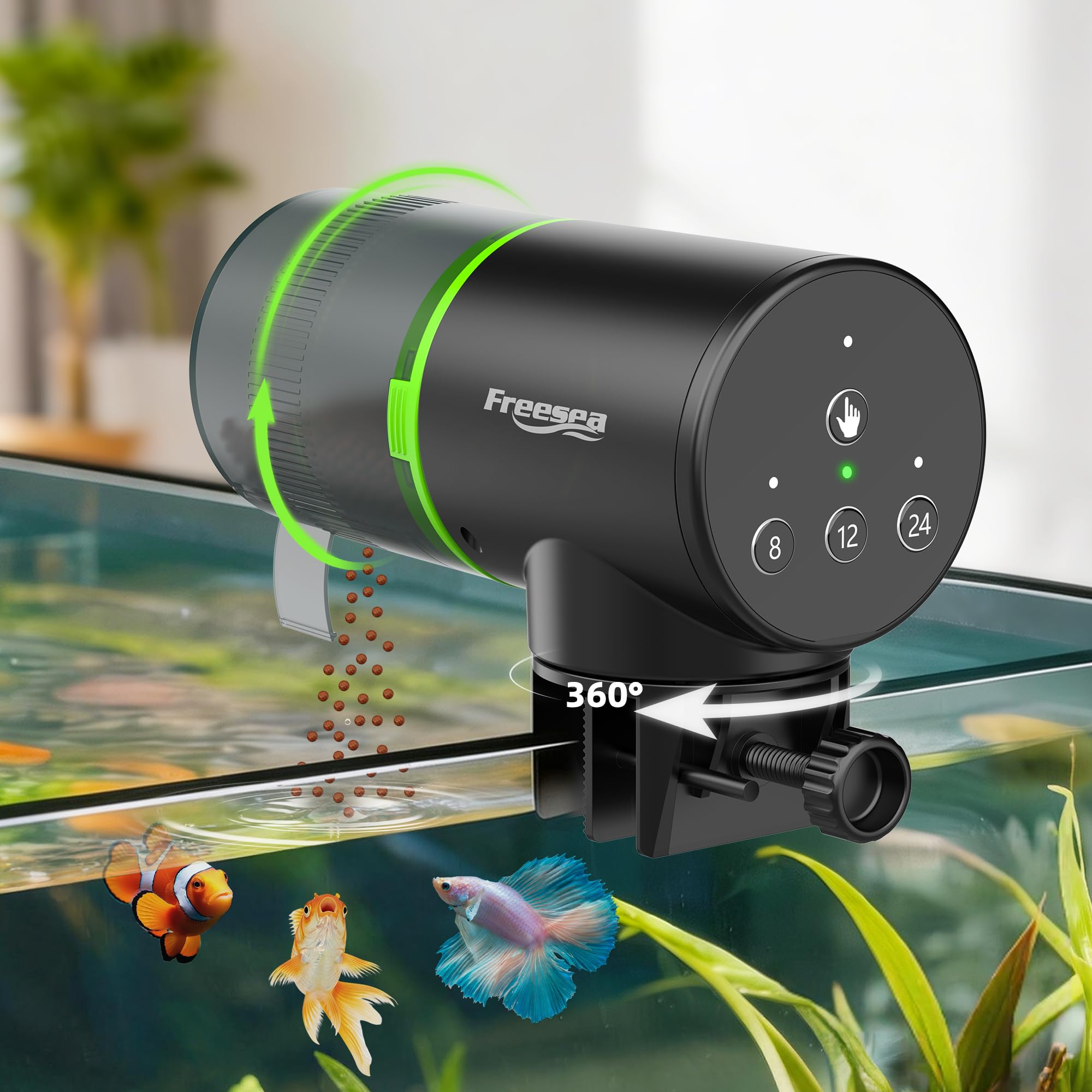
Rating: 4.2 ★ | Price: $ | Capacity: 200 ml | Power Source: 2x AA batteries | Portion Control: Sliding cover | Moisture Proof: Lid blocks humidity | Setup: One-touch timer
Over 5,400 reviews confirm this feeder handles the core task of dispensing food on a fixed schedule while you’re away. Setup involves just one touch to cycle through 8, 12, or 24-hour intervals, and the 200ml hopper holds enough for a week or more. Unlike the standard FISHNOSH feeder that offers more precise portioning and a 2-year warranty, the Freesea sacrifices portion accuracy for a lower entry price. The moisture-blocking lid keeps flakes from clumping in humid environments, though the sliding cover is the primary adjustment and it does not fine-tune easily.
This feeder makes sense for a medium to large tank with a community of fish where a few extra flakes won’t spike ammonia. The large dispensing opening and coarse slider mean it quickly overfeeds small bowls, nano tanks, or single-fish setups — water quality can sour within days. For those situations, the top pick’s compartment-based design gives exact portions and avoids the guesswork. If your priority is basic vacation survival at minimal cost and your tank can absorb the imprecision, this delivers.
Pros
- Keeps fish fed throughout short vacations without any intervention.
- One-touch timer programming takes seconds; no confusing menu navigation.
- Build quality feels solid for a budget-priced feeder, with a tight-sealing lid to block humidity.
Cons
- The sliding portion cover offers limited granularity — even the narrowest setting can drop more food than a small tank requires.
If budget is the primary concern and your tank can handle a few extra flakes, the Freesea gets the job done. Just don’t expect fine-tuned portion control.
Best for Dual Power Backup
DXOPHIEX Dual Power

Rating: 4.3 ★ | Price: $ | Capacity: 100/200 ml containers | Power Source: Battery + USB backup | Setup: Stent or funnel base
The DXOPHIEX feeder runs on batteries and USB simultaneously, ensuring feeding continues even if the power goes out – a practical advantage for vacationers or areas with unstable electricity. Its rotating funnel mechanism handles pellets smoothly, but the design differs from the compartment-style top pick, especially when it comes to moisture-sensitive foods.
This feeder is best for owners of larger tanks or ponds who prioritize power backup above portion precision. Flake food users should expect occasional clogging from condensation, and the dispensed amount can vary between feedings – minor in a big tank but risky in a small one. For those who accept these boundaries, the dual-power feature delivers real peace of mind on trips.
Pros
- Dual battery and USB power keeps feeding going during outages – ideal for vacations or unstable electricity.
- Simple programming with clear controls – set up in minutes without confusion.
- Solid build quality that feels durable enough for long-term use.
Cons
- Clogs with flake food due to moisture – best to use pellets or granules instead.
- Dispensing amount can be inconsistent, leading to over or underfeeding in smaller tanks.
For large tanks or ponds where power backup matters and pellet food is the norm, this dual-power feeder provides peace of mind – just keep flake food out of the funnel.
Best for Pellet Precision
Papettly 15-Compartment

Rating: 4.4 ★ | Price: $$ | Capacity: 15 compartments, ~2g | Power Source: USB rechargeable | Portion Control: Individual compartments | Moisture Proof: Auto-closing ports
The 15-compartment tray gives this feeder an edge in portion accuracy: each chamber holds about 2 grams of pellets, eliminating the guesswork of rotating drums. Auto-closing ports keep humidity out, so food stays dry and flowable even above the water line. That mechanical precision makes it a strong companion for reef or planted tanks where overfeeding can foul water quickly.
The feeder fits pellet-only diets and absences up to a week. At three feedings a day, the 15 meals last five days; with once-daily feeding, you can stretch it to 15 days. Flakes and shrimp foods jam the mechanism and are not supported. For longer trips or mixed-food households, a drum-style feeder like the top pick is a more flexible alternative.
Pros
- Sealed compartments deliver exact, fixed portions — no overfeeding spikes.
- USB-rechargeable battery lasts months per charge, so no cord clutter during use.
- Operation is quiet (under 30 dB), staying unobtrusive in living spaces.
Cons
- Not suitable for flakes or shrimp-sized foods — does best with pellets and granules only.
- 15-meal limit means absences beyond a week require once-daily feeding or a larger feeder.
For pellet-only tanks and predictable short trips, the Papettly’s compartment precision keeps feeding tight — just don’t count on it for flakes or extended vacations.
Best for Long Vacations
Lukovee Rechargeable

Rating: 4.3 ★ | Price: $$ | Capacity: 200 ml | Power Source: USB rechargeable | Portion Control: Rotating cup | Moisture Proof: Sealed design | Setup: Clamp or sticker
The Lukovee Rechargeable delivers months of battery life and a sturdy build, making it a capable companion for long vacations. However, its inconsistent food dispensing can cause jams mid-trip, and the manual lacks detail — learning the programming via online tutorials is expected. This feeder suits owners who prioritize battery endurance over plug-and-play simplicity and are willing to troubleshoot occasionally.
Pros
- Long battery life holds charge for months between refills
- Sturdy construction feels durable for continuous use
Cons
- Initial programming is confusing due to very basic instructions
For those willing to invest time in initial setup, this rechargeable feeder handles long vacations well.
Best for Rimless Tanks
FISHNOSH Thermometer

Rating: 4.5 ★ | Price: $$ | Capacity: 200 ml | Power Source: 2x AA batteries | Portion Control: Two feeding windows | Setup: Clip for rimless
The FISHNOSH feeder brings a built-in thermometer and dual feeding windows that accommodate pellets or flakes without swapping parts. Portion sizes are consistent across feedings, and the interface is simple to program. The thermometer can read ±9°F off, so it’s useful for general awareness, not precision. The clamp fits rimless glass only – tanks with thick rims will need another mounting method.
Pros
- Consistent feeding portions for daily care
- Simple programming and setup
Cons
A practical option for rimless tank owners who want a feeder with a temperature reference and dual food windows.
Best for Budget Large Tanks
JuzPetz 200ml
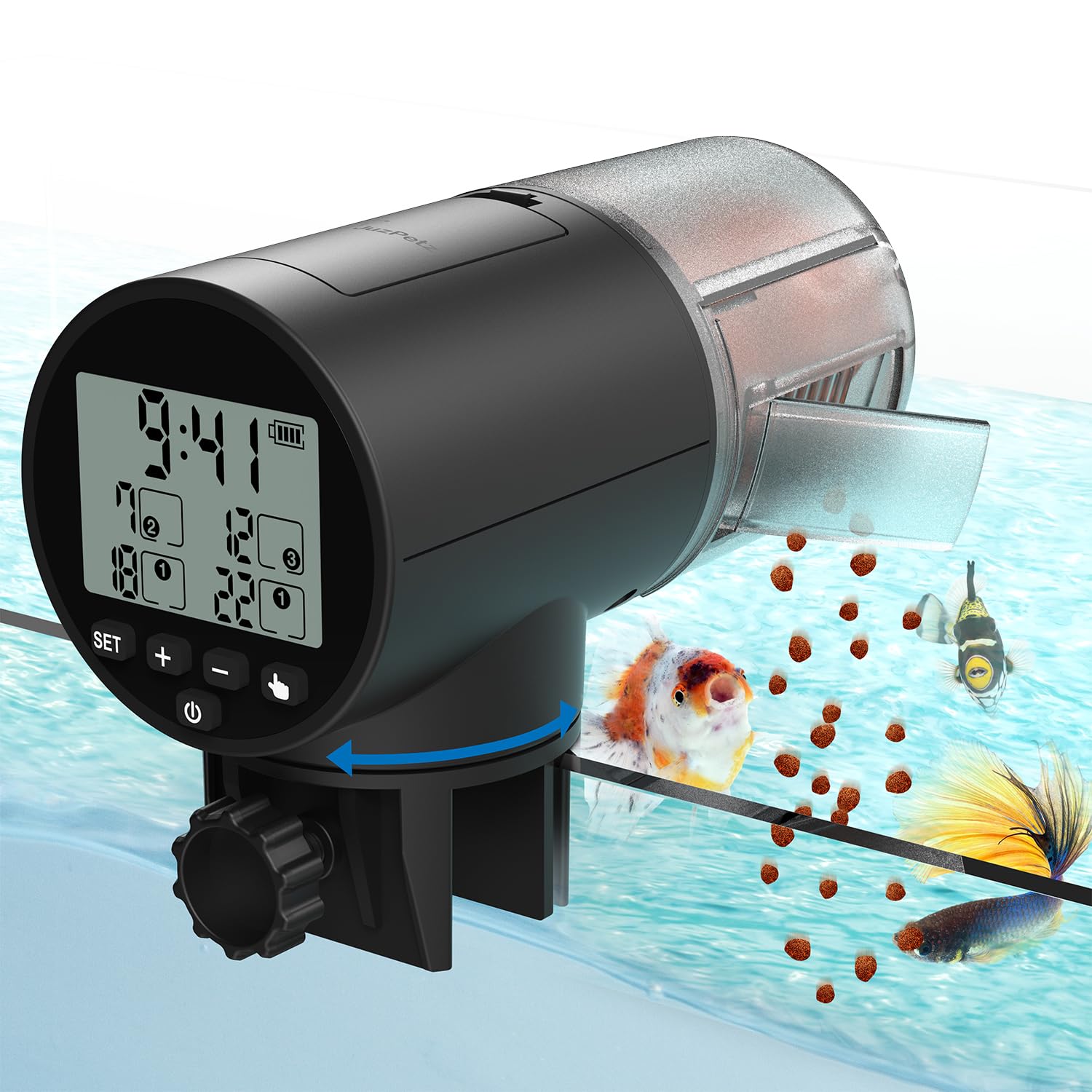
Rating: 4.0 ★ | Price: $ | Capacity: 200 ml | Power Source: 2x AAA batteries | Moisture Proof: Moisture-proof lid | Setup: Clamp or sticker
The JuzPetz feeder is a cost-effective option that comes with batteries and supports up to 14 days of feeding. Setup is quick, and the 200ml hopper holds enough for large tanks. It works best when portion accuracy isn’t a top concern—less consistent than compartment-style feeders, it suits short trips over precise daily management.
Pros
- Setup takes minutes with the included clamp or adhesive mount and batteries.
- Entry-level price makes it a low‑risk choice for occasional vacation feeding.
Cons
- Bulky design may overhang the edges of smaller tanks (under 10 gallons).
- Portion sizes can vary, delivering either too much or too little food per rotation.
An acceptable choice for large tanks on short trips when you’re not overly focused on exact feeding amounts.
Best for Smart Control
Ycozy WiFi Feeder
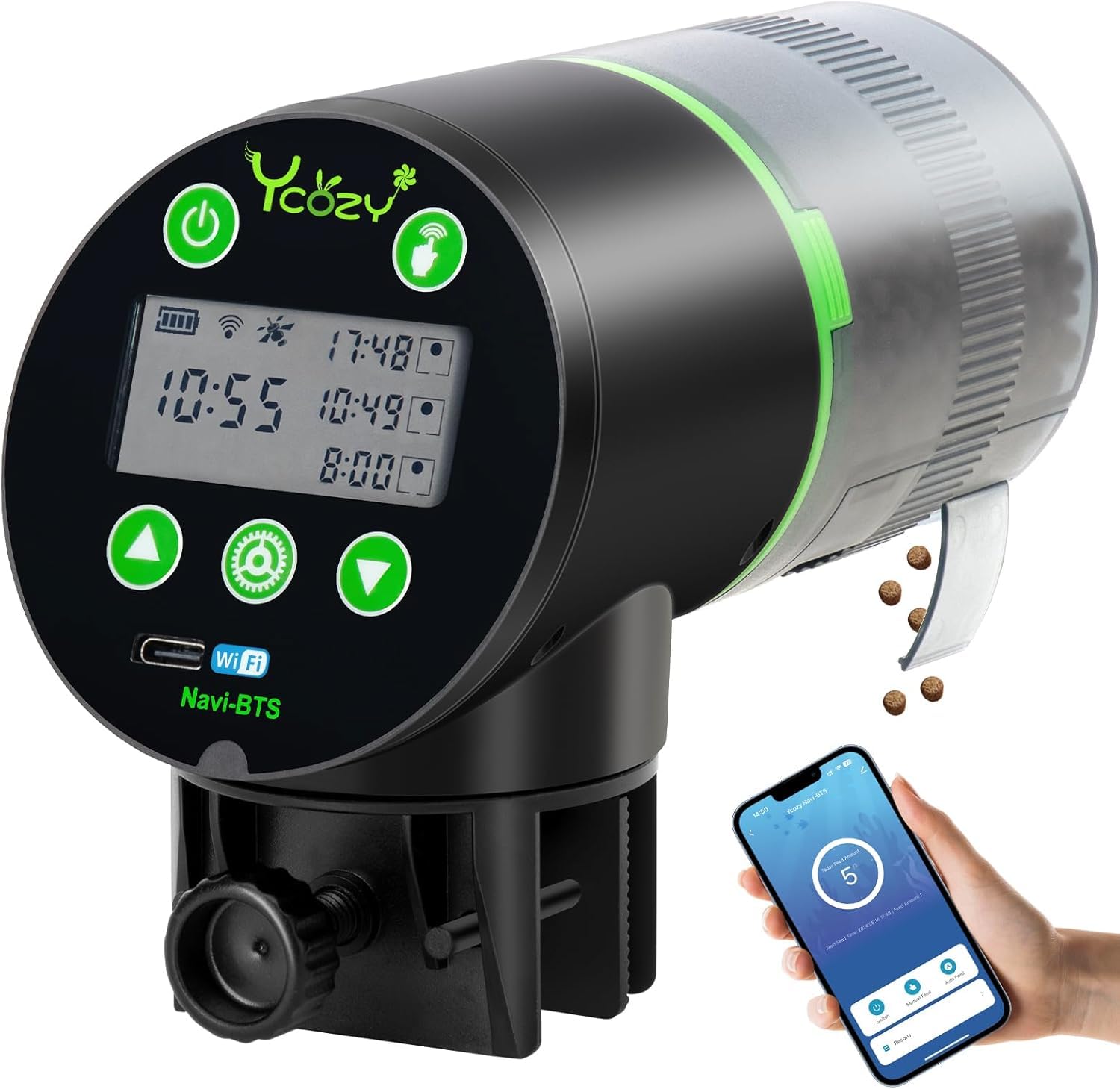
Rating: 4.5 ★ | Price: $$$ | Capacity: 210 ml | Power Source: Plug-in USB-C | Portion Control: 15-level adjustable | Setup: Clamp, 360° rotation
The Ycozy WiFi Feeder brings smart home convenience to fish feeding: schedule and monitor meals remotely via the Tuya Smart app, with 15 portion levels for precise dispensing. Its plug-in design means no battery swaps, but it must stay connected to power and a 2.4GHz WiFi network. That limits placement to tanks near an outlet with compatible routers — and any power outage stops feeding. This makes it a niche fit for tech-savvy owners who prioritize app control over portability or battery backup.
Pros
- Remote feeding and schedule management from your phone via WiFi app
- 15-level portion adjustment gives fine control over food dispensing
Cons
- Must stay plugged into an outlet; power outage interrupts feeding
- WiFi connectivity only works with 2.4GHz networks — may need router configuration
A smart option for tech-savvy owners who have stable WiFi and a nearby outlet, and value app control over battery-powered portability or vacation independence.
Best for Ponds High Capacity
hygger Pond Feeder

Rating: 4.2 ★ | Price: $$$ | Capacity: 5.5 liters | Power Source: Corded electric | Portion Control: 0-9 portions adjustable | Moisture Proof: Weather-resistant
The hygger Pond Feeder delivers on capacity with a robust 5.5-liter hopper and sturdy construction – ideal for koi ponds that require weeks of food without refills. Filling and mounting is straightforward, and the feeder supports up to six feedings per day with adjustable portions. Some units may experience motor or display issues after several months of use, so a flexible return policy is worth considering.
Pros
- Sturdy metal and ABS construction holds up to 5.5 liters of pellets – enough for weeks of pond feeding.
- Large capacity reduces refill frequency – ideal for extended absences or multiple fish.
Cons
- Programming the feeding schedule and portions is not intuitive – the manual is sparse and the menu requires trial and error.
- Controller is not weather-resistant; exposure to rain can cause failure – best installed in a covered location.
This feeder is a strong match for pond owners who can protect the controller from the elements and are comfortable with a patient setup process – its capacity and build quality justify the effort.
Best for Large Capacity
fishkeeper LCD 320ml
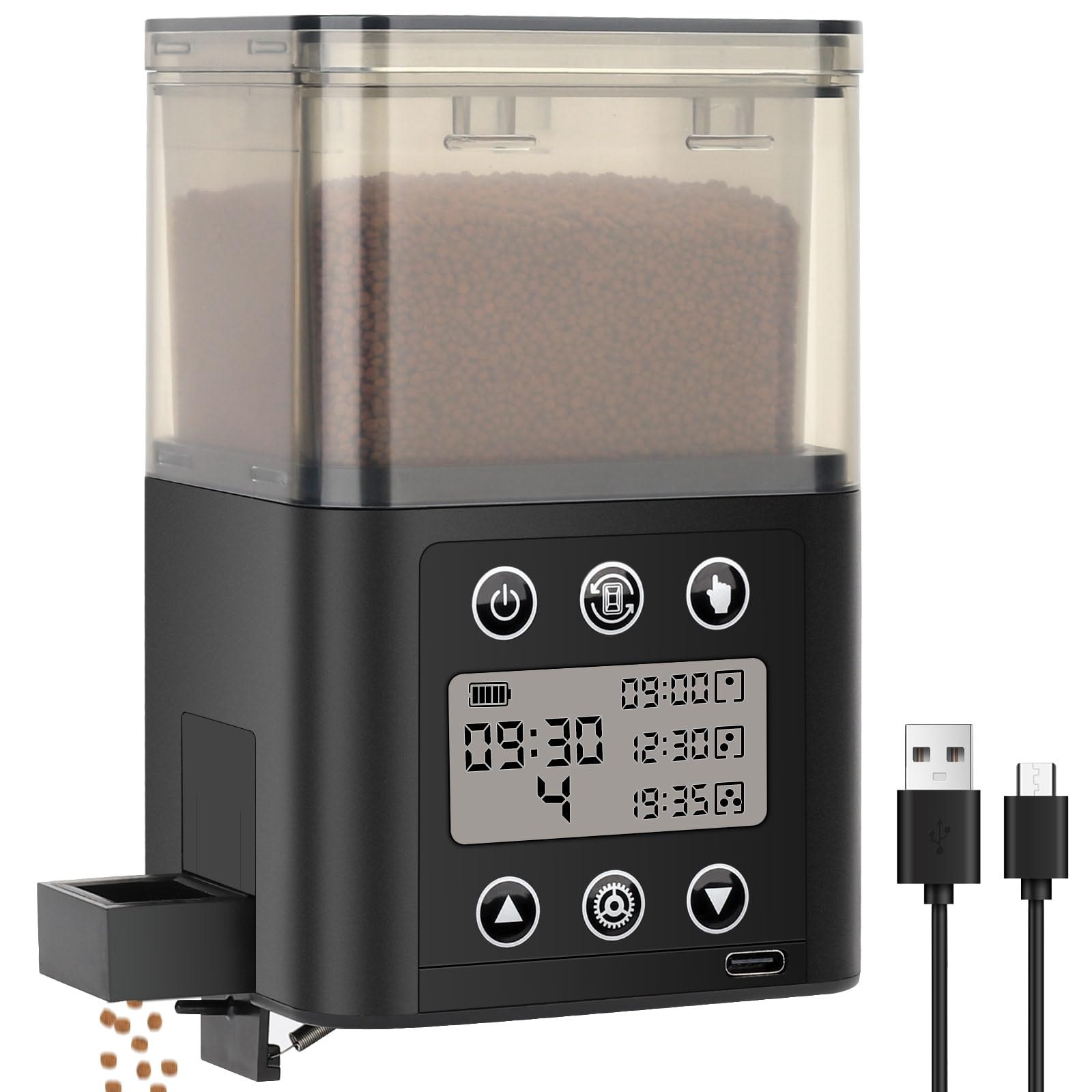
Rating: 4.1 ★ | Price: $$ | Capacity: 320 ml | Power Source: USB rechargeable | Portion Control: 3 discharger sizes | Moisture Proof: Auto-retract drawer
This feeder packs 320ml capacity and a 700mAh battery that can last months on a charge, making it a strong option for extended absences. The food drop mechanism delivers pellets more consistently than rotating-cup designs, and the compact build fits neatly on smaller tank rims. However, the included instructions are not easy to follow, so expect some trial-and-error during initial setup. Best for aquarists comfortable testing a newer model who prioritize large capacity and portion precision over plug-and-play simplicity.
Pros
- 320ml capacity supports weeks of feeding without refill
- Precise food drop reduces overfeeding compared to rotating cup designs
Cons
- Instruction manual is unclear, making initial programming a guessing game
Worth considering if you need a large-capacity, battery-powered feeder and don’t mind spending extra time on setup — but it’s not a grab-and-go choice.
How to Choose
The difference between a feeder that works and one that spoils a vacation comes down to how it controls portions and keeps food dry.
Capacity: How Much Food?
Capacity determines how long the feeder can run without refilling. A 200ml hopper typically lasts one to two weeks for a medium tank, while 320ml models can stretch to a month. But larger capacity often means a bulkier unit that may not fit smaller tanks or hoods.
Power Source: Battery Life Matters
Battery-powered feeders require fresh batteries before trips; a dead feeder mid-vacation means hungry fish. USB rechargeable models can last months per charge, but need to be recharged before they die completely – losing programming if drained. Plug-in models offer constant power but stop working during outages.
Portion Control: Precision vs. Simplicity
Compartment-based feeders give exact servings per meal, ideal for small tanks and precision feeding. Adjustable sliders offer flexibility for different food types but require careful calibration – the smallest setting may still dump too much for a single betta. Rotating drum designs are the least precise and often overfeed.
Moisture Proofing: Preventing Clogs
Humidity from the tank enters the feeder and clumps flake food, causing jams. A moisture-proof design typically includes an auto-closing lid or sealed drawer that opens only during feeding. Without it, you risk a clogged feeder that stops dispensing halfway through your vacation.
Setup: Programming and Mounting
Programming should be intuitive – clear LCD displays and simple button presses avoid frustration. Mounting options matter: clamp-on designs work for rimless tanks, while suction cups or adhesive stickers suit hooded tanks. A feeder that falls off can dump food unexpectedly.
FAQ
Why does my automatic fish feeder dispense too much food even on the smallest setting?
The smallest setting on many sliders still releases a substantial volume because the opening size is fixed. For small tanks, you may need a compartment-based feeder that lets you control the exact number of granules. If you must use a slider, test it over several days to calibrate the portion before relying on it for a vacation.
How do I keep fish flakes from getting damp and clogging my automatic feeder?
Moisture from the tank seeps into the hopper and clumps flake food. Choose a feeder with an auto-closing lid or sealed drawer that only opens during feeding. If your feeder lacks this, store flakes with a silica gel pack inside the hopper and avoid filling it more than a week’s worth.
Can I use an automatic fish feeder with a tank that has a glass lid?
It depends on the feeder’s mounting system. Clamp-on designs typically require a rim to grip, so they don’t work on rimless glass lids. Suction cup or adhesive sticker mounts can attach to glass or plastic lids, but ensure the surface is clean and dry. Check the feeder’s mounting options before buying.
How long do rechargeable batteries in fish feeders actually last?
Rechargeable feeders typically last one to six months per charge, depending on frequency of feedings and battery quality. The Petbank USB feeder, for example, often lasts three to six months. However, when the battery dies completely, some models lose their programming, so recharge before it fully drains.