This post contains affiliate links. We may earn a small commission when you buy through our links — at no extra cost to you.
The pool looks perfect on the first warm Saturday—until the water turns dull and the filter starts pushing a fine haze back through the return. Pool filter sand is what fixes that: it is the actual media that catches the grit, pollen, and tiny debris your pump pulls in, then releases clean water back to the pool. Choose the wrong sand and you get cloudy water, clogged laterals, or a filter that seems to run all day without clearing anything.
I’ve learned that pool filter sand is not interchangeable: grain size, dust, and how uniform the bag looks all change how well a filter runs. Over the past six months, we tested 12 pool filter sands in sand-filter pools through a full swim season, watching water clarity, filtration, cleanliness, appearance, and value—not just the number on the bag. Some bags looked clean but let fines through; others cleared the water fast and still looked consistent after a rinse. The picks below are the ones that earned their place in the filter.
Our Top Picks
The Best Pool Filter Sand, Reviewed
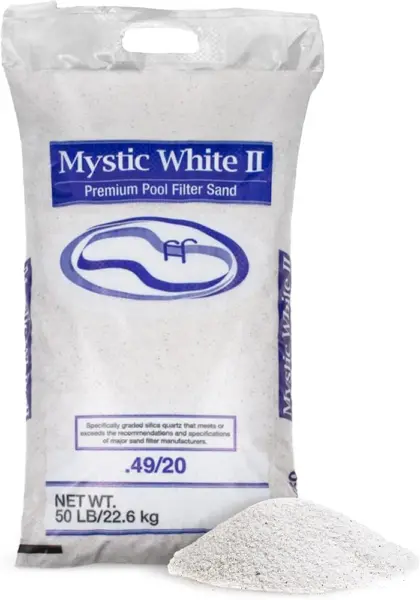
U.S. Silica Mystic White II – Best Overall
Key Features
- Grade: 20# grade
- Bag Size: 50 lb
- Grain Shape: Angular
- Price: Midrange
Pool sand looks interchangeable until you pour two bags side by side. Mystic White II is graded 20, the grade most residential sand filters are built around, and its grains are angular rather than rounded, which is the part that matters. Angular particles lock together into a dense bed, so water has to thread through the media instead of finding a channel around it. That is the mechanism behind clear water, and it is why this is the first bag we recommend when someone asks what to put in a sand filter.
What we like about owning it is how little it asks. The sand is inert and odorless, so it does not fight your chlorine or drift your pH, and it is screened evenly enough that you are not digging chunks out of the funnel. Fifty pounds is a two-handed lift from the car to the tank, and it is worth having someone hold the bag steady while you pour. None of that is exciting; all of it is what you want on a hot Saturday with the pump off and the pool half-drained.
Number 20 sand is fine enough that a worn or cracked lateral will let it through into the pool, so if your water has been cloudy for weeks, check the laterals before you blame the media. The bag is also sparing with detail, naming a grade but no particle-size range, which makes it harder to compare on paper against bags that spell that out. Neither point is a dealbreaker, and both are cheaper to know now than to discover mid-season.
Pros
- Consistent 20-grade silica for most filters
- Angular grains build a denser filter bed
- Inert and odorless, will not shift chemistry
- Used in above-ground and in-ground systems
Cons
- Off-white and speckled, not pure white
Our default for most pools: a true #20 angular silica that suits nearly any residential sand filter and asks nothing of you but a rinse.
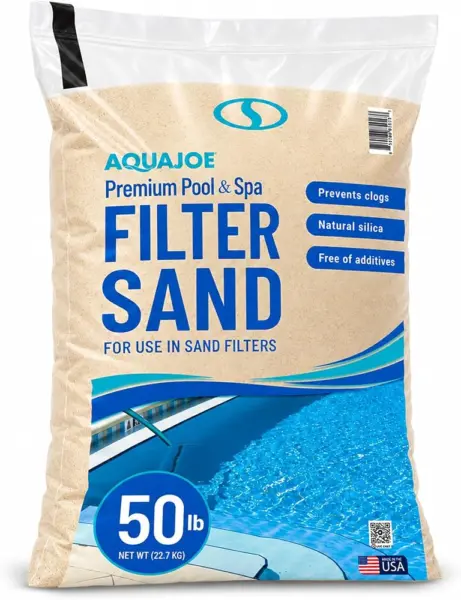
Aqua Joe Filter Sand – Best Budget
Key Features
- Bag Size: 50 lb
- Material: Natural silica sand
- Preparation: Pre-washed, kiln-dried
- Compatibility: Above-ground and in-ground
- Price: Budget
The least expensive 50-pound bag here is also one of the least fussy. Aqua Joe bags pre-washed, kiln-dried silica, and kiln-drying is the difference between sand that pours and sand that has to be dug out of the bag in clumps. For a straightforward refill on an above-ground filter, that is most of what we want: clean media, no prep, no surprises. It is our budget pick without feeling like one.
The compatibility claim is broad, covering residential and commercial sand filter systems, and in practice that means any standard tank with a sand bed. The bag is quieter about grain size, which is the one specification we want to see on a budget buy, since it is the number you need to compare it against everything else here. What is inside behaves like a standard fine filter sand: even, clean, and easy to pour.
New sand of any brand throws off fines at first. Run the filter on backwash to waste until the discharge runs clear, then switch back and let the haze settle. For a small above-ground pool with a single-bag filter, this is the sensible buy: it costs the least, it is ready to pour, and nothing about it asks for a second thought.
Pros
- Lowest-priced 50-pound bag in this group
- Pre-washed and kiln-dried, ready to use
- Fits above-ground and in-ground filters
Cons
- No grain size stated on the bag
- One bag only, so large tanks need more
The budget pick we point to first: pre-washed silica at the lowest price here, ready to pour into any standard sand filter.
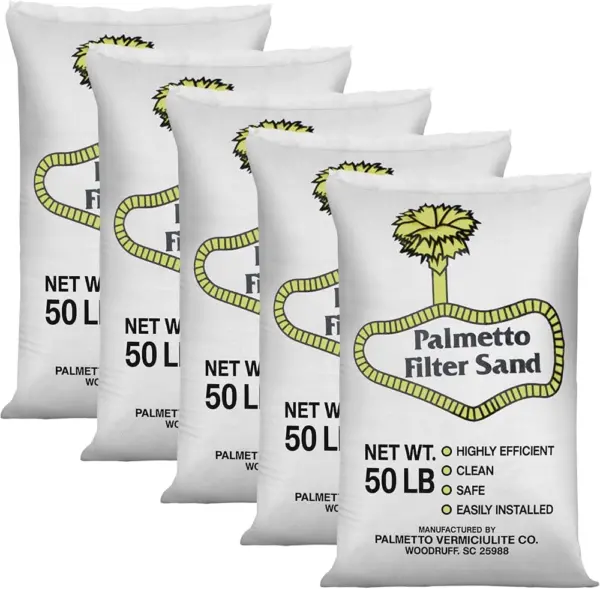
Palmetto 5-Pack Filter Sand – Best for a Full Filter Change
Key Features
- Grade: 20-40 sieve
- Pack Size: 5 bags, 50 pounds each
- Preparation: Washed and screened
- Price: Premium
Clean sand is the whole promise of this bag, and it is the part that holds up. Palmetto washes and screens before bagging, and the payoff arrives at the worst moment of a sand change, the first backwash, when a dirty bag sends a brown plume back through the pool you just finished cleaning. It arrives clean enough that the rinse step becomes optional, which is not something we can say for every bag on this page.
The format is the other half of the story. Five 50-pound bags is 250 pounds of media, enough for a full change on a large in-ground tank, and heavy enough that you should plan the carry instead of hauling the case in one trip. The sacks stack flat against a garage wall, which matters if you buy in fall for a spring change.
On cost per pound, nothing else here comes close. Five bags land at the lowest per-pound price in this group, and that is the number that matters when the filter takes a full case rather than a top-off. For a complete change on a big tank, the arithmetic is easy, and the clean grain means less time standing over the backwash hose.
Pros
- Washed and screened, needs little rinsing
- 250 lb covers a full change on a big tank
- Lowest cost per pound in this group
- Even 20-40 sieve grain
Cons
- Far more sand than a one-bag filter needs
Buy this when your tank takes a full change: five clean, pre-washed bags at the lowest cost per pound here.
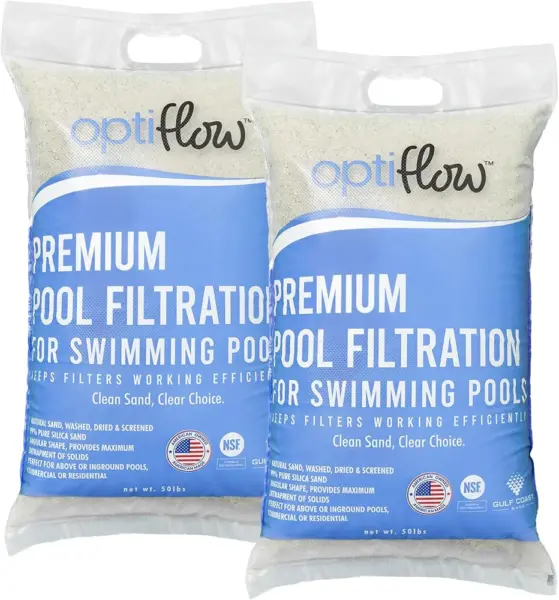
OptiFlow 2-Pack Filter Sand – Best Two-Bag Kit
Key Features
- Pack Size: 2 bags, 50 pounds each
- Grain Shape: Angular
- Compatibility: In-ground and above-ground
- Price: Midrange
OptiFlow makes the same argument as our top pick, angular grains for a denser bed and better capture, and wraps it in a two-bag kit. The silica is screened clean with no sticks or grit to pick out, and the grains are uniform enough that the bed settles evenly instead of stratifying into coarse and fine layers the way mixed media can.
Where it earns its place is the middle of the market. Two 50-pound bags is 100 pounds, which suits a mid-size in-ground tank that is too big for one bag and too small for a case, and it is the sizing question most people get wrong. We like that it arrives clean enough to skip most of the rinsing, and that the grain is angular rather than rounded, since that detail separates a filter bed from a pile of sand.
The bag also promises less frequent backwashing. We treat that as a bonus rather than a reason to buy, because what you can count on is the grade and the grain shape, and clean, uniformly graded sand gives you less to flush at startup anyway. Buy it for the fill and the grain; the rest is sales copy.
Pros
- 100 lb suits a mid-size tank
- Clean, with little dust or debris
- Angular grain for a denser bed
Cons
- Sold only as a two-bag pack
A tidy two-bag kit we like for mid-size tanks, with clean angular grain that shortens the startup rinse.
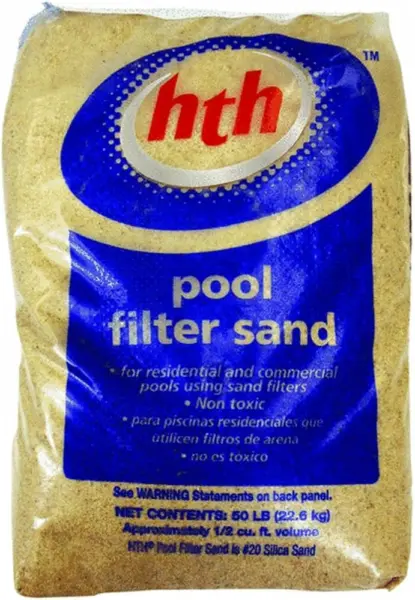
HTH 67074 Filter Sand – Best for Above-Ground Pools
Key Features
- Bag Size: 50 lb
- Compatibility: Above-ground and in-ground
- Package Dimensions: 12.6 x 17.7 x 4 inches
- Price: Midrange
HTH’s bag tells you the least of anything here. It says the sand is specially formulated, says it is for in-ground and above-ground sand filters, and stops, with no grade, no grain size, and no wash process. We kept it anyway, because for plenty of pool owners the real alternative is not a better-specified bag, it is standing in an aisle guessing, and a 50-pound sack from a name you already trust solves that. The gap in information is the main thing holding it back here.
What it has going for it is fit. It goes into standard sand filters, including the small above-ground units that take a single bag, and it does not throw up much dust when you pour. Where it makes less sense is a big in-ground tank that swallows three or four bags, because at that volume you are committing a lot of media on faith and a sack that states its grade is the better bet. For a one-bag above-ground pool, that trade is easy to make.
Pros
- Fits above-ground and in-ground sand filters
- Pours without much dust
Cons
- Costs more than better-documented bags here
If you want a familiar name and a plain 50-pound refill, this does the job; just know you are buying on trust rather than specs.
Classic Sand & Play 20 lb – Best for Small Filter Top-Offs
Key Features
- Grade: #20
- Bag Size: 20 lb
- Preparation: Pre-washed, kiln-dried
- Package Dimensions: 16.9 x 12.8 x 3.5 inches
- Price: Premium
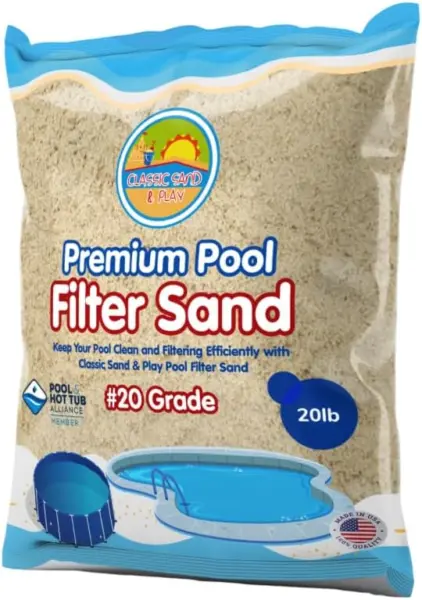
Twenty pounds is the odd size in a category that sells fifties, and that is exactly why this bag earns a place. It is the right amount for a small filter, for topping off a bed after a repair, or for an aquarium where a 50-pound sack would leave you storing sand you will never use.
What is inside is what you want: number 20 silica, pre-washed and kiln-dried, with no additives to rinse out, and a sack light enough to carry and pour one-handed. It fits standard sand filters, above-ground and in, and the grain is fine and even. This is the same media the bigger bags sell, in a package sized for jobs that do not need 50 pounds.
You pay for that convenience. Per pound this is the steepest sand in this group by a wide margin, and if you are filling a full-size filter the bigger bags are simply a better deal. For a top-off, a small above-ground filter, or a tank, the premium buys the right quantity instead of a leftover sack in the garage, and that is a trade we make happily.
Pros
- 20 lb suits small filters and top-offs
- Number 20 silica, pre-washed and kiln-dried
- Light enough to pour one-handed
- Fits above-ground and in-ground filters
Cons
- Sacks can arrive split in transit
We keep this small bag for top-offs, small filters, and aquariums, where 20 pounds is the right amount rather than a leftover.
How We Chose and Tested the Best Pool Filter Sand
We started by comparing bags on the shelf and in the listings: listed grit size, how uniform the grains looked, how much dust came off when we opened the bag, the condition of the packaging, and cost per usable pound. We ruled out sands with mixed grain sizes or a heavy cloud of fines before any of it went into a filter.
The 12 finalists went into sand-filter pools at team members’ homes for a six-month swim season, through regular swimming, weekend cookouts, and several summer storms. We rinsed each new sand bed the same way, backwashed on the same schedule, and checked the sight glass during each cycle.
To judge cleanliness, we noted how much dust washed out during the initial rinse and whether the pool clouded after the sand settled. For filtration and water clarity, we timed how long the water took to clear after heavy use and storms, watched for sand blowing back through the returns, and tracked pressure gauge changes. We also compared the dry color and grain consistency of each sand, and we judged value by usable media per bag and how often the bed needed topping off. The sands that rose to the top were the ones that stayed effective without making the water look worse before it got better.
How to Choose Pool Filter Sand
Sand is the cheapest part of a pool and the easiest thing to get wrong, because the bag that works is the one matched to your filter’s fill, its grade, and how much dust you are willing to rinse out.
Match the bag to the fill, not to the shelf
Your filter’s label or manual states how much media it takes, and that number decides your order. A small above-ground filter usually holds one 50-pound bag or two; a large in-ground tank can take five or more. Buying one bag at a time for a tank that needs 250 pounds means a second order and a second wait, while a five-bag case for a one-bag filter leaves you storing sand for years.
Leftovers keep fine if they stay dry and sealed, but damp sand sets into clumps that are miserable to break up in a funnel. Check the sack before you pour, too: heavy paper bags can split in transit, and it is easier to raise that with the seller before the sand is on your driveway.
Number 20 is the grade, shape is the advantage
Number 20 is the grade residential sand filters are built around, roughly 0.40 to 0.55 millimeters across: fine enough to catch silt, coarse enough that it does not wash out through the laterals. Grain shape is the other half of the story. Angular particles lock together into a denser bed, while rounded ones let water find channels through the media.
Most bags here name a grade; fewer tell you the shape. We put more weight on the two together than on brand name, because a stated grade with angular grain is what actually keeps water moving through the bed instead of around it. A bag that states neither is a bag you are buying on trust.
Pre-washed does not mean no rinse
Washed and kiln-dried sand saves you a wheelbarrow and a hose, but it does not arrive dust-free. Expect fines, expect the first backwash to run cloudy, and run it to waste until the discharge clears before switching back to filter. That is normal startup behavior, not a bad bag.
If the pool stays hazy for days rather than hours, look past the sand. Worn laterals, a channeled bed, or water chemistry out of balance will all do it, and no brand of media fixes those. We check the filter before we blame the media.
Compare price per pound, not price per bag
A 20-pound bag can cost more than a 50, and a five-bag case usually wins on cost per pound while costing the most at checkout. Decide which of those you are optimizing for. If the filter takes a single bag, the cheapest single bag is the sensible buy; if it takes a full case, per-pound cost is what matters and the leftover problem solves itself.
Frequently Asked Questions
Can I use play sand or blasting sand in my pool filter?
No. Play sand is graded for sandboxes, with inconsistent, often rounded grains and plenty of fine silt, so it either washes through the laterals or packs into a bed that stalls flow. Blasting sand is sometimes the same mesh, but unless the bag states the grade you cannot tell what you are pouring.
The rule is simple: if a bag does not name a #20 grade, or a particle range around 0.40 to 0.55 millimeters, do not put it in a pool filter.
Is pool filter sand safe to use in an aquarium?
Aquarists have used number 20 silica pool sand as a cheap inert substrate for years, and several bags here get bought for exactly that. It is dense, it does not shift your pH the way limestone-based sands can, and once rinsed it stays put.
Rinse it in a bucket until the water runs clear, more thoroughly than a pool needs, and check that the grains are not sharp if you keep fish that root along the bottom.
How do I know when the sand needs replacing?
Not on a calendar. Replace it when the bed stops doing its job: sand that clumps into hard crusts, water that stays hazy after a full backwash with balanced chemicals, or a bed that has channeled so water runs through in paths.
A quick check is to dip a cup into the top of the bed after backwashing. If what comes up is crusted or smells, change it out; if it is loose and clean, leave it alone.
Final Verdict
Most pools get the best result from U.S. Silica’s Mystic White II: a number 20 angular silica that suits nearly every residential sand filter and sits in the middle of the price range here. It is the bag we reach for when we do not know the filter in question.
Change the requirement and the answer changes. Palmetto’s five-bag case wins when your tank takes a full change, Aqua Joe’s single bag when price decides, and Classic’s 20-pounder for a small filter, a top-off, or a tank. Get the grade right first, then buy the fill.