This post contains affiliate links. We may earn a small commission when you buy through our links — at no extra cost to you.
There’s a special kind of panic that comes with pouring a fresh bag of sand into a tank and watching the water turn to milk. The right sand shouldn’t do that. It should settle fast, hold a planted tank together, and give bottom dwellers something to sift through without clouding the glass every time they move. Over the past six months, my team and I have rinsed, poured, and vacuumed 14 freshwater aquarium sands, and the difference between a clean, natural-looking substrate and a dusty mess comes down to a few basics.
Appearance matters: a warm tan or deep black can change the whole look of a tank, but color also affects how much fish waste and uneaten food show up. Value isn’t just the sticker price. A bag that still fogs the water after five rinses isn’t a bargain. I want sand that arrives clean, stays put, and suits your fish and plants, and the picks below earned a permanent spot in my tanks.
Our Top Picks
The Best Sand for a Freshwater Aquarium, Reviewed
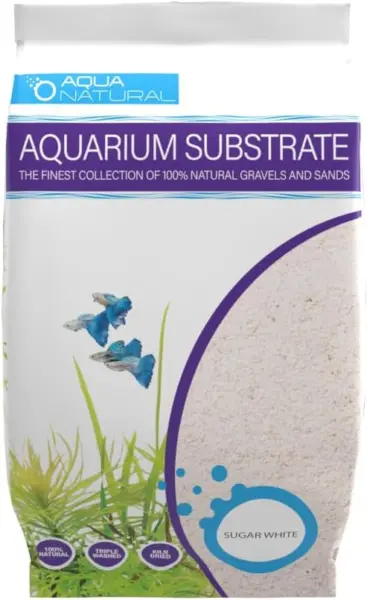
Aqua Natural Sugar White Sand – Best Overall
Key Features
- Colour: Off white
- Bag weight: 10 lb
- Grain size: 0.5-1 mm
- Preparation: Triple washed, kiln dried
- Price: Midrange
0.5 to 1 mm is the grain size we check first in a freshwater tank, and it is why this bag sits at the top of our list. The range is fine enough to read as sand under a shoal of tetras and heavy enough to stay where you put it when a filter outlet pushes water across the bottom. What we cared about most is the claim that there are no fines in the bag, because fines are the dust that turns a new setup milky for days.
Kiln-dried and triple-washed, it still wants a rinse, as every sand does, but the tank clears in hours rather than days, and that first evening is when most people decide whether they like their substrate.
We kept coming back to how little it asks of you. Plants hold once they root, a siphon lifts the mulm without lifting half the bed, and the warm off-white makes fish colour read better than black sand does. Value settles the argument: of the 10 lb and larger bags here, this is the cheapest per pound.
One caveat worth knowing before you order. Under water it reads cream to light tan, not the bright white the name promises. We like it, because pure white under strong light looks bleached, but if you are matching a white background or topping up an existing bag of true white sand, this will come up darker.
Pros
- 0.5-1 mm grain stays put under filter flow
- Triple-washed and kiln-dried; tank clears in hours
- Warm off-white that lifts fish colour
- Cheapest per pound of the 10 lb and larger bags here
Cons
- A 10 lb bag is a thin layer in a 10 gallon
Our default pick for a community tank: a medium-fine sand that settles quickly, needs little rinsing, and brightens the whole tank without looking artificial.
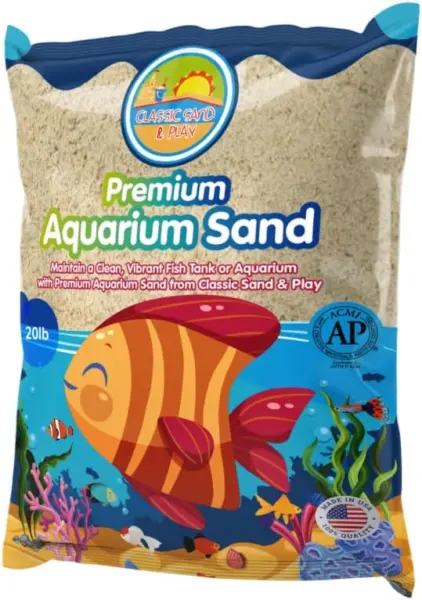
Classic Sand & Play 20 lb – Best for Large Tanks
Key Features
- Grain: Fine sand
- Bag weight: 20 lb
- Preparation: Washed and kiln dried
- Colour options: 7
- Price: Premium
Twenty pounds in one sack is the entire pitch. Bedding a 40 or 55 gallon properly takes a pile of sand, and buying it five pounds at a time means four rinses and a shelf of half-empty bags. This is the bag to reach for when the tank is big and you want to do the job once.
We rate it on the grain rather than on the pre-wash claim. It is genuinely fine, closer to a riverbed than to gravel with pretensions, and stems stay where you push them, which is more than the coarser options here manage. The pre-washing is a real head start too: this is the lightest rinse load in the group.
Fine sand is still fine sand, though. Tip it in dry and you get a haze that takes an evening to clear, so rinse it in a bucket until the runoff runs clear and put it in wet. If you are bedding a 10 or 20 gallon, a smaller bag does the same job.
Pros
- 20 lb single sack suits 40-55 gallon builds
- Fine, natural grain that holds plants
- Pre-washed and kiln-dried, the lightest rinse load here
- Seven colour options
Cons
- Most expensive per pound in this group
Buy this when you are filling a 40 to 55 gallon and do not want four small bags: one sack, pre-washed, with a fine natural grain that holds plants.
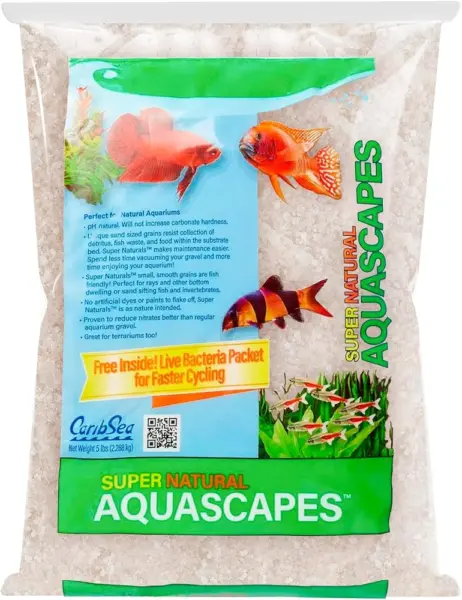
Carib Sea Crystal River Sand – Best for Soft-Water Tanks
Key Features
- pH: Neutral
- Grain: Smooth, rounded
- Additives: None: no paints, dyes or coatings
- Bag weight: 5 lb
- Price: Budget
If your tank runs soft and you keep fish that sift, the sand’s chemistry and grain shape matter more than how bright it is. This one is pH neutral and made without paints, dyes or coatings, so it will not push hardness upward the way a carbonate sand can, and the grains are smooth and rounded rather than angular. That combination is why it is our pick for soft-water setups.
It is also the most natural-looking sand here: warm white, slightly varied, no glitter. Under water it reads like a river bottom rather than a bag of aquarium product. The listing credits it with helping reduce nitrates, which we treat as a bonus claim rather than a reason to buy, because a substrate’s job is to sit there, stay inert and not move the water chemistry around.
Where it earns its keep is a small setup where the fish are the point: a group of corydoras, a few tetras, a bed they can grub through without meeting anything sharp. It is the sand we trust most around bottom dwellers on this page, and that is not a small thing.
Pros
- pH neutral, with no paints, dyes or coatings
- Smooth rounded grains suit sifting fish
- Natural riverbed look under water
Cons
- 5 lb bags go fast past 10 gallons
- Fine grains lift easily when vacuuming
The pH-neutral choice for a soft-water community tank: smooth rounded grains, no dyes or coatings, and a natural riverbed look instead of glitter.
FANTIAN Fine Aquarium Sand – Best Fine Sand for Nano Tanks
Key Features
- Bag weight: 5 lb
- Grain size: 0.4-0.8 mm
- Preparation: Multiple rinses required
- Colours available: 5
- Price: Midrange
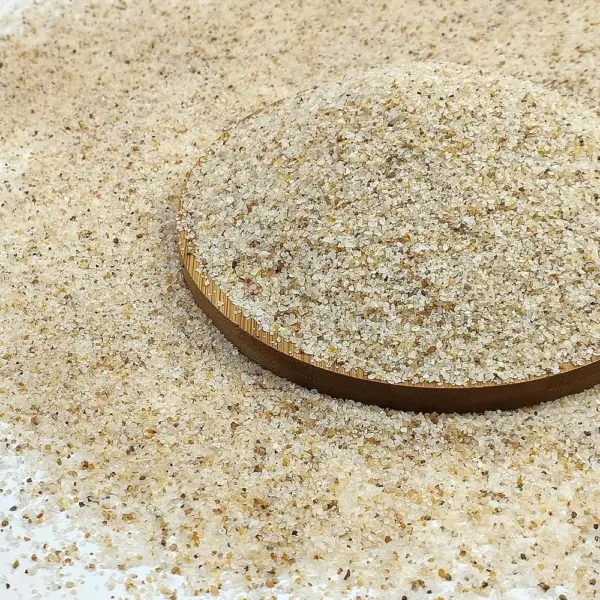
The bag admits the catch itself: the fine sand holds some dust and needs washing a couple of times, and that is honest. At 0.4-0.8 mm this is the finest grain in our group, and fines are exactly what make a bucket go milky. Budget an evening with a hose and a bucket, then rinse, stir, pour off and repeat until the runoff clears.
Do the work and you get a bed that is genuinely nice in a small tank. Half a bag beds a 2 gallon, a full one gives a five a proper layer, and the grain is soft and even in a way the coarser sands here are not: no pebbles, no patchiness. Food and waste sit on top where a siphon can reach them, and shrimp and bottom feeders work over it without meeting an edge.
The compromise is upkeep. A bed this fine lifts if you put a siphon straight into it, so keep the tube above the surface and pinch the hose to slow the pull. Do that and maintenance is no harder than it is with gravel.
Pros
- Finest grain here, for a soft even bed
- Suits shrimp, fry and bottom feeders
- Waste sits on top for easy siphoning
Cons
- Small bags; a 20 gallon takes four
The fine-grain pick for a nano or shrimp tank, provided you accept the bucket work: this sand needs a real rinse before it goes anywhere near water.
YISZM Beige Aquarium Sand – Best for Small Tanks
Key Features
- Grain: Smooth, rounded
- Bag weight: 5 lb
- Sizes available: 2, 5, 10 and 20 lb
- Colours available: Black, white, beige
- Price: Midrange
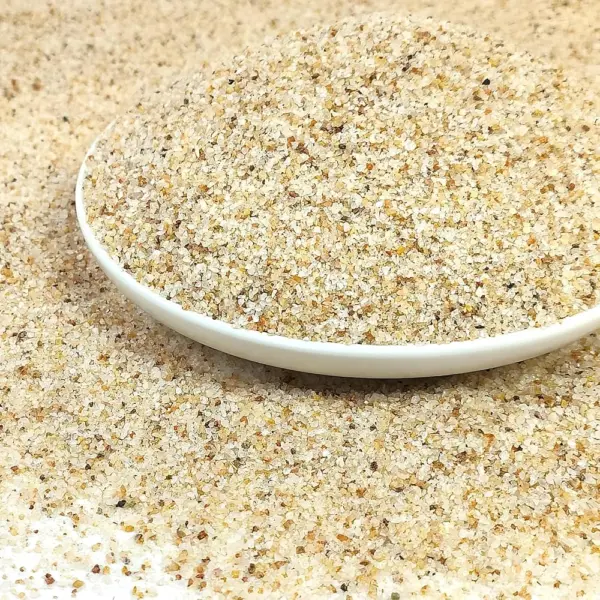
Beige is the honest description. Not white, not grey, but a warm neutral that looks like a beach under aquarium light and, we think, hides a light dusting of mulm better than the brighter bags here. Black and white are offered too, along with 2, 5, 10 and 20 lb bags, so the sand can be matched to the tank instead of the other way round.
The grains are smooth and rounded, which is the property that matters if you keep anything that rootles through the substrate, and the sand is sold as resisting clouding and settling quickly. With a rinse first it does settle rather than hang, which is what you want when there are already fish in the tank.
In the role it is best at, a two or five gallon desktop tank where a couple of pounds is all you need, the colour and the grain are what you notice, and the small bag stops being a limitation.
Pros
- Warm beige that hides mulm well
- Smooth rounded grains, easy on bottom feeders
- Four bag sizes from 2 to 20 lb
Cons
- Most expensive per pound in this group
- Dusty out of the bag; rinse thoroughly
A warm beige sand for a small desktop tank, where the smooth grain and forgiving colour outweigh a small bag at a high price per pound.
GloFish Black Aquarium Sand – Best for Themed Tanks
Key Features
- Use: Substrate or accent
- Glow: Under blue LED lighting
- Colour: Black with fluorescent accents
- Bag weight: 5 lb
- Price: Budget
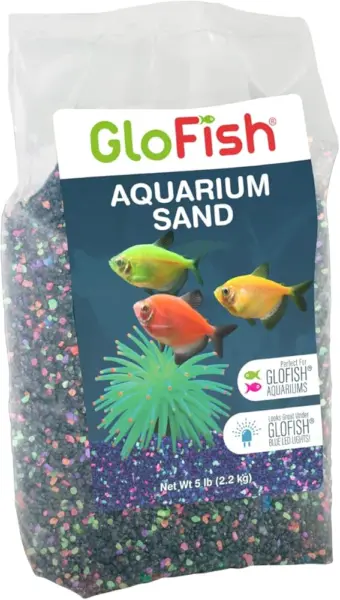
This is not the bag for a planted community tank, and it is not pretending to be. It is black sand with fluorescent specks, sold to sit under GloFish ornaments and blue LEDs, where the accents light up and the dark bed makes the fish look like they are floating in ink. Under ordinary white light you mostly see dark grey grit with the odd coloured piece, because the glow is a lighting effect rather than a property of the sand.
Five pounds goes a surprisingly short way, so treat it as the bed for a 5 or 10 gallon, or as an accent band in something bigger rather than the whole substrate. In a small tank that works fine; in a 40 it is a stripe at the front of the glass.
For a child’s first tank or a blacklight shelf setup, we think the effect earns the fuss, and this is the cheapest route into a themed bed here. It is an accent, though, not the foundation of a community, and the neutral sands above do that job better.
Pros
- Fluorescent specks pop under blue LEDs
- Black makes bright fish stand out
- Cheapest per pound in this group
- Works as a full bed in a small tank
Cons
- Long rinse before the water runs clear
- Colour mix varies from bag to bag
A themed-tank accent rather than a community substrate: black sand with specks that light up under blue LEDs, best in a small GloFish setup.
How We Tested Freshwater Aquarium Sands
We started by pulling together sands sold for freshwater tanks, then narrowed the list by grain size, color options, bag weight, price per pound, and whether the sand was marketed as pre-rinsed or inert. That left 14 bags, which we ran through the same routine for six months. Each one was rinsed in a five-gallon bucket, poured into a bare tank with a sponge filter, and watched at one hour, 24 hours, and one week to see how long the water stayed cloudy and whether a film formed on the surface.
For cleanliness and dustiness, we noted how much rinse water it took before the bucket ran clear, whether dust puffed up when we poured, and how much sand clung to the sides of the bucket. We ran a handful through our fingers to check grain uniformity and look for sharp pieces. Once a tank was running, we vacuumed weekly with a gravel siphon and recorded whether debris sat on top of the sand or disappeared into it, and whether the siphon pulled up grains along with the waste. We also planted stem plants and watched whether they stayed rooted, and let corydoras sift through the sand to see if it clouded the water or seemed rough on their barbels.
Appearance got checked under both a white LED and ordinary room light, since a sand that looks warm in the bag can read gray or too bright in the tank. Value came down to cost per pound and how much area a bag covered in a standard 20-gallon footprint. We also paid attention to the purchase itself: whether bags arrived intact, whether the sand was bagged damp or dusty, and whether the packaging made it easy to store leftovers. The sands that scored best were the ones that rinsed clean quickly, held their color, and stayed put when the fish moved.
How to Choose Sand for a Freshwater Aquarium
Grain size, rinse burden and colour decide whether you like a sand long after the tank has cleared, so settle those three before you compare brands.
Start with grain size, not colour
Between roughly 0.5 and 1 mm you get the useful middle: a bed that reads as sand under a shoal of tetras, stays where you put it under moderate flow, and still lets a siphon lift debris without lifting the whole bed. Finer than that, around 0.4-0.8 mm, looks softer and suits nano tanks and shrimp, but it clouds more readily when disturbed and needs a gentler hand at cleaning time.
Coarser material drifts toward gravel: easier to vacuum, less convincing as sand, and some listings describe 1-2 mm grit as sand when the retailer files it under gravel. Decide the grain size you want first, then compare bags.
Rinsing is part of the purchase
Pre-washed means the worst of the dust is gone, not that you can tip the bag straight in. Put a few pounds in a bucket, run a hose into it, stir with your hand and pour off the milky water, then repeat until the runoff stays clear. A kiln-dried sand takes two or three rounds; a dusty fine sand can take many more.
The cost of skipping it lands on your filter. Fines go straight through the intake and into the media, and that is how a cheap bag becomes an afternoon of rinsing sponges.
Buy about a pound per gallon
A one-inch bed in a standard rectangular tank works out at roughly a pound of sand per gallon: 10 lb for a 10 gallon, 20 lb for a 20, 40 to 50 lb for a 55. Go deeper if you plant heavily or keep fish that dig. Measure the footprint before you order rather than guessing from the photo.
This is where small bags quietly lose. Four 5 lb bags can cost more than a single larger sack and give you four times the rinsing, which is the whole argument for buying the big bag when the tank is big.
Match colour and chemistry to your fish
Light sand throws light back up into the tank and makes dark fish and dark furniture look sharper. Black is dramatic but shows every crumb of waste and every smear on the glass. Beige is the most forgiving of the three and reads most like a river bottom.
Chemistry matters as much as looks. A general community tank wants an inert sand, and a bag sold as pH neutral is the safe default; carbonate-based sands dissolve slowly and push hardness up, which suits some cichlid setups and is wrong for tetras and other soft-water fish.
Frequently Asked Questions
Will aquarium sand raise the pH or hardness of my water?
Not if it is inert. Silica-based sands sit in the tank without dissolving, and a bag sold as pH neutral is the safe default for a community tank. To check sand you already own, drop a spoonful into a glass of white vinegar: fizzing means it is carbonate-based, and that will push hardness up over time.
Can I add sand on top of an existing gravel bed?
Yes, and it is easier than starting over. Rinse the sand first, then lower it in with a cup or a length of pipe so it lands where you want instead of drifting across the tank, and expect a hazy day plus a filter rinse afterwards. Keep the new layer to an inch or so, because two substrates stacked thickly trap waste where nothing can reach it.
Can I use play sand or pool filter sand instead?
You can, and it costs less, but you are buying an ungraded product. Play sand varies from bag to bag and can carry grit coarser than the photos suggest, and pool filter sand is graded for filters rather than for fish. If you go that route, rinse harder than feels reasonable and run the vinegar test on a handful first.
Final Verdict
Sand is one of the few things in this hobby you buy once and then look at every day, so the default matters. The Aqua Natural Sugar White Sand is what we point most freshwater keepers to: it settles fast, rinses easily and reads warm rather than chalky under light.
Filling a 40 gallon or bigger, the 20 lb Classic Sand & Play saves you four separate rinses. Keeping soft-water fish or bottom dwellers, the pH-neutral Carib Sea is the gentler choice. And if the tank is a nano, buy the fine FANTIAN and set aside an evening for the bucket.