This post contains affiliate links. We may earn a small commission when you buy through our links — at no extra cost to you.
A canister filter’s worst day is the one where you walk in and find a puddle creeping out from under the stand. That fear keeps plenty of 75-gallon owners on hang-on-back filters long after the tank has outgrown them, trading clear water for weekly cartridge swaps and a hum you hear from the couch. A canister fixes all of it: more media, water that clears and stays clear, fewer afternoons with your arms in the tank. On a tank this size, it’s the difference between a hobby and a chore.
Here’s what nobody tells you first: the gallon rating on the box is optimistic. Load the trays with media, push water two feet uphill to the return, and real flow lands well under the claim, so shopping a size up is smart. We’ve spent eight months running 10 canister filters on 75-gallon setups, listening from the couch at night and watching how fast the water clears after a heavy feeding. The ones that earned a spot are below.
Our Top Picks
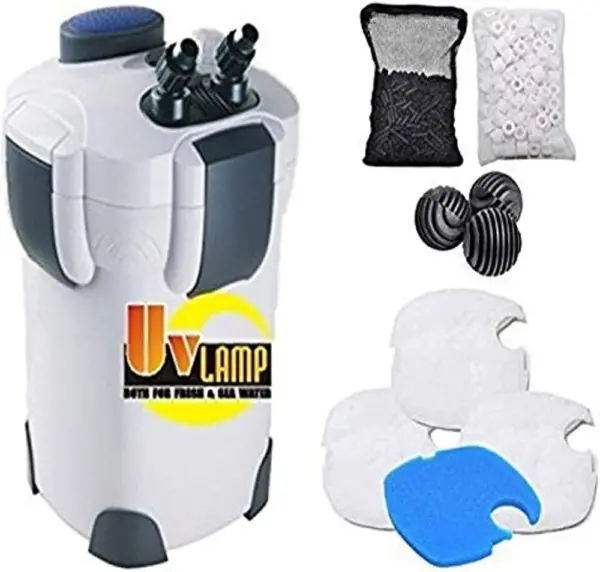
The Best Canister Filter for a 75 Gallon Aquarium, Reviewed
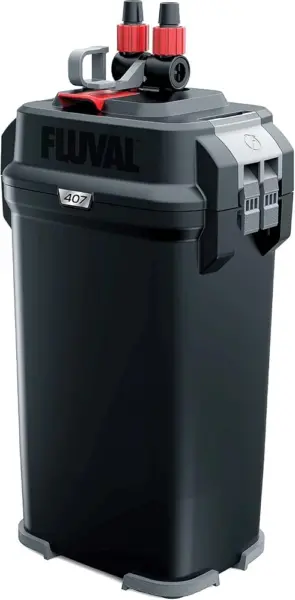
Fluval 407 – Best Overall
Key Features
- Flow rate: 1,450 L/h (about 383 GPH)
- Dimensions: 14.5 x 7.5 x 14.5 in
- Media included: Five media types included
- Rated tank size: Up to 100 gallons
- Price: Premium
Rated to 100 gallons, the 407 gives a 75 something most filters in this group don’t: slack. Fish grow, you add a school, and a filter already running flat out has nowhere to go. At 1,450 liters an hour (about 383 gallons) it turns the tank over roughly five times an hour, which is the range we want here — enough to move waste toward the intake without turning the tank into a washing machine.
The EZ-Lift stack is the detail we appreciated most. The whole media column comes out on a center handle, so a rinse takes a couple of minutes instead of a wrestling match, and the AquaStop valve shuts the line before you disconnect anything. Setup is unfussy too: ribbed hose, rim connectors, intake strainer, and a lid clamp that seats on the first try.
The habits that keep a canister out of trouble apply here more than usual. Stand it in a plastic tray, check the O-ring every time the lid comes off, and reseat the baskets squarely so the lid clamps flat instead of fighting you. The other thing to plan around is hose length — the run in the box is cut close to what a 75 usually needs, so measure from cabinet floor to tank rim before you commit to a spot.
Pros
- Rated for tanks up to 100 gallons
- Quiet enough to forget it’s running
- Media stack lifts out on a center handle
Cons
- Bottom seal and housing are the weak points
- Pricier than higher-flow picks here
For most 75-gallon tanks this is the one: 100 gallons of rated headroom, a pump you won’t hear from the couch, and media baskets that lift out with one finger.
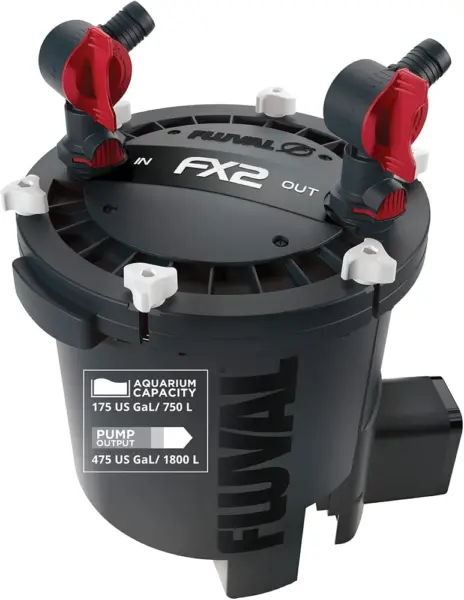
Fluval FX2 – Best for Heavy Bioload
Key Features
- Warranty: 3 years limited
- Flow rate: 1,800 L/h (about 475 GPH)
- Body height: 16.4 in
- Rated tank size: Up to 175 gallons
- Price: Premium
Most canisters open with a priming ritual. The FX2 opens with a shrug: add water, plug it in, and the pump evacuates the air on its own. If you have ever spent twenty minutes working a primer with a bucket balanced on your knee, that is the feature you are paying for, and it is why the first start on this one stopped being a chore.
The rest of the package is built for a tank with a heavy bioload. It is rated to 175 gallons and moves 1,800 liters an hour, more than a stocked 75 needs on paper — which is exactly the margin that matters when the tank holds adult cichlids, a goldfish pair, or a red-eared slider. At 16.4 inches tall it still slides under most stands, and the three-year limited warranty is the longest in this group by a wide margin. That combination is what earns it the upgrade recommendation.
One thing to plan for: output falls as the baskets load with waste, and a filter this size can hide a lot of clogging behind its flow. Keep it on a rinse schedule rather than waiting for the water to go cloudy. And the rating is margin, not immunity — 175 gallons of capacity on a 75 does not change how often the tank needs a water change.
Pros
- Self-primes without a primer pump
- 175-gallon rating suits heavy bioload
- Three-year limited warranty
- 16.4 inches tall, fits under most stands
Cons
- The most expensive filter here
If your 75 carries big cichlids, goldfish, or a turtle, the FX2’s self-priming start, 175-gallon rating, and three-year warranty justify the step up.
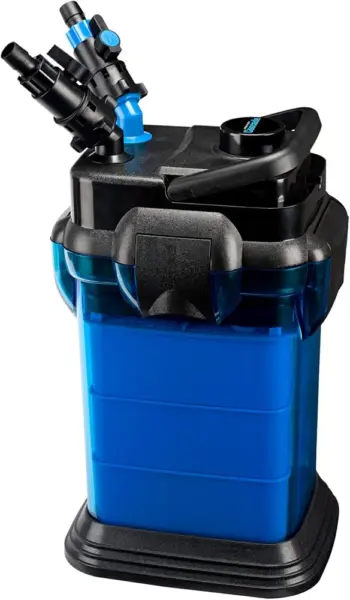
Penn-Plax Cascade 1000 – Best Value
Key Features
- Baskets: Three stackable
- Flow rate: 265 GPH
- Dimensions: 11.4 x 9.8 x 16.9 in
- Rated tank size: Up to 100 gallons
- Price: Midrange
A pair of 360-degree taps, one per hose, is what makes this the filter we reach for when a tank sits in a corner. Twist either valve shut and the canister comes out from under the stand without a kink in the line or a cupful of water on the carpet. That is a small thing on paper and a large one on a Saturday afternoon.
The rest is straightforward: 265 gallons an hour, a 100-gallon rating, and three stackable baskets that take loose media, so the running cost is floss and carbon rather than brand-name cartridges. The push-button primer takes patience — fill the canister most of the way first and it catches on the second or third press instead of the tenth. Water cleared quickly and stayed clear, which for a filter at this end of the price range is the whole argument.
What tempers our enthusiasm is the fit of the plastic. The baskets have to seat squarely or the lid will not pull down clean, and that is a two-handed job in a tight cabinet. Get the stack right and this is the value pick of the group; rush it and you will be reopening the lid.
Pros
- 360-degree taps simplify hose work
- Three baskets take loose media
- Fast, lasting water clarity
Cons
- Tubing and fittings feel brittle
- Flow drops once media packs tight
Three stackable baskets, two rotating hose taps, and a 100-gallon rating make this the value pick — as long as you’re gentle with the plastic.
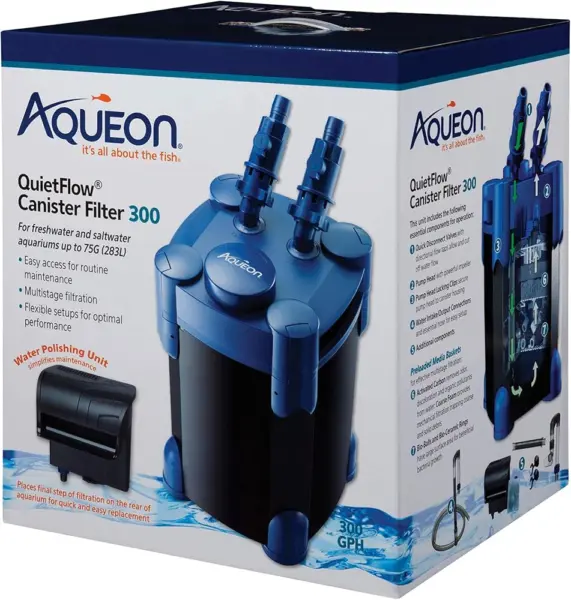
Aqueon QuietFlow 55-100 – Best for Quiet Setups
Key Features
- Warranty: 1 year
- Dimensions: 8.25 x 8.25 x 17.5 in
- Rated tank size: 55 to 100 gallons
- Returns included: Spray bar, director, polisher
- Price: Midrange
With the return sitting below the water line, this is the quietest canister we have had running in a room where people talk. Put an ear to the cabinet and there is pump noise; stand across the room and there is none. For a 75 in a living room, that is the test that matters, and it is why this one is here.
The box includes three returns: a spray bar, a water director, and a polishing unit that hangs on the back like a small second filter. We got the most out of the spray bar across the surface and the director angled at the dead corner behind the wood, and the polisher earns its keep when the water goes hazy after a rescape. Very few canisters let you change the water’s behavior that much without buying anything extra.
Priming is the step that fights back. The tubes take fiddling to seat, and a dry canister can leave you working the primer longer than you expected; fill it by hand before the first start and it behaves. The one-year warranty is the shortest here and worth knowing before you commit a 75-gallon system to it — but on a tank in a living room, the silence is what you notice every night.
Pros
- Quietest operation in this group
- Three return options in the box
- Polishing unit adds a clarity stage
Cons
- One-year warranty, the shortest here
- Tallest body here at 17.5 inches
The quietest canister we ran, and the only one here that adds a hang-on polishing stage — worth it if the tank sits where you watch television.
SunSun HW303B – Best with Uv Sterilizer
Key Features
- Flow rate: 370 GPH (1,400 L/h)
- UV sterilizer: 9 watts
- Media included: Carbon, ceramic rings, bio balls, pads
- Rated tank size: Up to 100 gallons
- Price: Budget
The pitch is simple: a 9-watt UV clarifier lives inside the canister. On a tank that catches morning sun, or one that greens up every July, that is a real difference from a cartridge that only traps what passes through it — every gallon goes past the lamp. We expected a checkbox feature and found one that does something.
The kit is more complete than the money suggests: three baskets, a coarse pad, a pound each of carbon and ceramic rings, and 370 gallons an hour against a 100-gallon rating. It runs quietly enough that we put a hand on the canister to confirm it was on, and setup took an evening, most of it spent deciding media order. For a stocked 75 that does not need headroom, this covers the job.
Set it in a tray and lift the lid straight rather than tilting it — a tilted canister is how a seal gets rolled, and a rolled seal is how a Saturday ends with a wet floor. Given what it does for the money, we can live with this one’s shortcomings, but we handle it more carefully than the Fluval.
Pros
- Nine-watt UV clarifier built in
- 370 GPH with a 100-gallon rating
- Media kit included, nothing extra to buy
- Quiet in a living room
Cons
- Thin hose fittings and valve latch
- UV lamp excluded from the warranty
A working 9-watt UV clarifier, 370 gallons an hour, and a full media kit for the least money here — accept thin fittings and keep an eye on the seals.
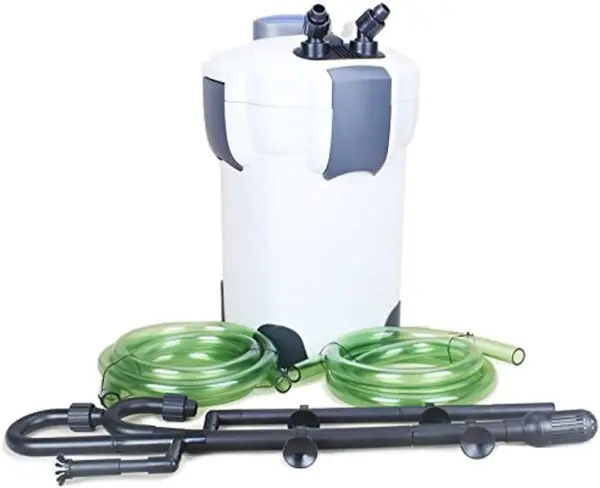
SunSun HW-304B – Best for Cichlids and Turtles
Key Features
- Flow rate: 525 GPH (2,000 L/h)
- Dimensions: 11 x 11 x 17 in
- UV sterilizer: 9 watts
- Rated tank size: Up to 150 gallons
- Price: Budget
A 150-gallon rating on a 75-gallon tank sounds like overkill, and for a community tank it is. Turnover matters where waste does: adult cichlids, goldfish, a turtle, anything that eats like a machine and fouls the water to match.
What the money buys is 525 gallons an hour, five stages of media, a 9-watt UV lamp, and enough basket volume to run coarse sponge, ceramic rings, and floss without crowding any of them. Loose media again, so the running cost is pads and carbon rather than cartridges, and at 11 inches square the body fits cabinets that will not take anything wider.
We minded the paperwork more than the hardware: media order and hose routing are on you, and the diagram will not help, so fill the canister by hand to prime and skip the instructions entirely. For a 75 that runs dirty, the flow and the UV are hard to argue with, and the pump noise stays well under the tank’s own bubble and splash.
Pros
- 525 GPH with a 150-gallon rating
- Five media stages plus a 9-watt UV
- Compact 11-inch square body
Cons
- Small plastic valve tabs break first
More flow and media volume than anything else here for the money — the right call for a 75 that’s really a waste factory, and too much filter for a quiet community tank.
How We Tested Canister Filters on a 75-Gallon Tank
We started with spec sheets, which in this category are half marketing and half math. We compared rated flow against media capacity, counted trays, checked the footprint against a standard 48-inch stand cabinet, and read parts diagrams to see whether replacement O-rings, impellers, and hose were sold separately, a check that eliminated several otherwise decent filters before they ever got wet. We also weighed what came in the box against the price. Then we bought 10 models at retail and set them up on 75-gallon tanks.
Each filter ran continuously for eight months on a stocked tank. We measured noise with a decibel meter three feet from the cabinet, then stood in the room during a quiet evening, because a number on a screen and the drone you actually notice are two different things. We timed a full teardown (shutoff, disconnect, media rinse in tank water, impeller cleaning, reassembly, repriming) and noted which units restarted on their own after we cut the power to simulate an outage and which had to be coaxed back to life. Water clarity got the same test every time: a heavy feeding, then how long the haze took to lift.
Leak checks happened at every step, not just at setup: we ran a hand under each seal and hose connection after every cleaning and looked for salt creep on the cabinet floor. Durability showed up in small things, like latches that loosened by month six, flow that fell off between cleanings, and hose that kinked behind the stand. And we read the instructions cold, timing a first setup with no prior knowledge of that unit and noting where the manual left us guessing.
How to Choose a Canister Filter for a 75-Gallon Tank
The number on the box is a rating, not a promise: on a 75-gallon tank the filter that keeps the water clear is the one you can service in ten minutes and whose seals you trust under the cabinet.
Buy headroom, not a bare minimum
A filter rated up to 75 gallons is at its ceiling the day the tank is filled, and fish have a way of growing. We look for a rating one step above the tank — 100 gallons or more for a 75 — because that rating reflects media volume and pump flow together, and both get eaten by waste as the weeks pass. Turnover of roughly four to five times the tank volume per hour is a sensible target for a community tank; cichlids and turtles want the upper end or beyond. More is not automatically better, either. Long-finned fish and planted tanks suffer in a strong current, which is why a spray bar and a return you can aim matter as much as the pump.
The seal is the part you are really buying
Across every canister here, the complaint that matters is water where it should not be, and it starts in one of three places: the lid O-ring, the base seal, or the hose fittings. That does not mean a given filter will leak, only that the seal is the component you inspect, lubricate, and eventually replace. Two habits cover most of the risk: stand the canister in a plastic tray so a weep is a mop rather than a repair bill, and check that the O-ring is seated every single time the lid comes off. On carpet, this matters more than any specification in this article.
Shop the maintenance routine
A canister is only as good as the ten minutes you spend on it every few weeks, and three details decide whether that is easy or hateful: whether the media stack lifts out in one piece or has to be dug out basket by basket, whether the hoses shut off at a valve or drain onto your hands, and whether the first start after cleaning needs a primer pump or self-primes. Measure the cabinet before you commit. Bodies here run from 14.5 to 17.5 inches tall, and you want clearance to lift a lid off without fighting a shelf.
Count the running cost, not the box
Cartridge filters keep selling you media; basket filters let you buy floss, sponge, and carbon loose. Over the life of a tank that gap is bigger than the difference between a budget canister and a premium one, and it is the main reason we favor three-basket designs even when the pump is the less impressive half of the package. Loose media also lets you tune the stack: coarse sponge first, biological media in the middle, fine floss last, changed often because it is cheap. A proprietary cartridge never feels expensive one month at a time.
Frequently Asked Questions
How often should I clean a canister filter on a 75-gallon tank?
Rinse the mechanical pad or floss every two to four weeks, and do a fuller basket clean every four to eight. The biological media only needs a swish in water you have just siphoned out of the tank — tap water will kill the bacteria you paid to grow. If flow drops before the calendar says it is time, the floss is the first thing to check.
Is a UV sterilizer worth it on a freshwater tank?
For green water it is the closest thing to a cure, because the lamp treats every gallon that passes it rather than only what it traps. It will not touch ammonia, nitrate, or an overstocked tank, and the lamp is a consumable that fades long before it stops glowing. If summer algae blooms are your recurring problem, the SunSun HW303B includes one; if your water is already clear, put the money into media volume instead.
Where should the intake and return go on a 75-gallon tank?
Opposite ends: draw from one side and return across the surface at the other, so the full length of the tank is in the circuit rather than half of it. Aim the return along the surface for gas exchange, or angle it down if a dead spot collects debris under the output. Keep the strainer well clear of sand, and slip a pre-filter sponge over it — that sponge is the cheapest insurance in the hobby.
Why can I hear my canister filter humming through the cabinet?
Vibration travels through solid wood far better than through air. Set the canister on a foam pad or a folded towel, check that the body is not touching the cabinet sides, and make sure the impeller cover is clicked home — a hum that arrives with a rattle usually means trapped air. A foam pad under the canister costs almost nothing and usually ends the noise.
Final Verdict
The Fluval 407 is what we recommend for most 75-gallon tanks: a 100-gallon rating so you are not cleaning it every weekend, a pump you will not hear, and a media stack that lifts out in one motion. Run it in a tray, check the O-ring, and it gives you the least annoying maintenance routine of the group.
If your 75 runs dirty — big cichlids, goldfish, a turtle — the Fluval FX2’s self-priming start and 175-gallon rating are worth the step up. And if the budget decides, the SunSun HW303B covers a stocked 75 with UV included, provided you handle the fittings gently.