This post contains affiliate links. We may earn a small commission when you buy through our links — at no extra cost to you.
You smell it before you see it — that swampy tang that settles into a room a few days after a water change. Turtles are the messiest animals most people keep: they shred food, shed scutes, and produce waste at a rate that would overwhelm a tankful of goldfish. A filter that can keep up does more than clear the glass; it’s the difference between a tank you enjoy and a chore you dread. And one rule first-time keepers rarely hear: buy a filter rated for two to three times your actual water volume.
What a spec sheet won’t tell you is how a filter behaves in a living room — how loud it hums in a quiet room at night, whether the media baskets rinse clean or turn into a project, whether the seal still holds after the twelfth time you’ve had the lid off. Over the past six months my team and I ran 12 filters on real turtle tanks, from small submersibles to bulky canisters, and lived with each through weekly feedings and water changes. The picks below are the ones we’d put on our own tanks.
Our Top Picks
The Best Filter for Turtle Tank, Reviewed
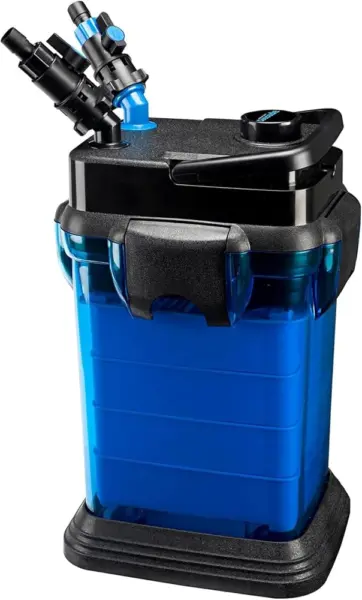
Penn-Plax Cascade 700 – Best Overall
Key Features
- Media: Two stackable baskets
- Mount: External canister
- Priming: Push-button primer
- Tank size: Up to 65 gallons
- Price: Premium
A turtle puts a filter through something a fish never does: bulky waste that breaks down fast and pulls oxygen out of the water as it goes. That’s the argument for a canister with real media volume. The Cascade 700 has two large stackable baskets that let you build a proper bed of sponge and floss, and its 65-gallon rating covers the 40- to 55-gallon tanks most adult sliders and painted turtles are kept in.
It’s the canister we recommend first, and setup is where it earns that. A push-button primer fills the canister without starting a siphon by mouth, and the two 360-degree valve taps let you shut off flow and carry the unit to the sink without undoing the hoses. The baskets lift out by their handles, so a rinse is minutes of work rather than an afternoon. For a tank you drain and refill constantly, that’s the difference between keeping up with maintenance and putting it off.
It isn’t silent. The pump gives off a low hum that disappears in a living room and doesn’t in a bedroom, and the flow is strong rather than adjustable, so aim the spray bar at the glass if your turtle gets pushed around. The seal is the part to watch over the years: water can seep past the O-ring and the tubing stiffens with age, so stand the canister in a tray and check the ring every time you open it. Neither issue changes our recommendation, because the media volume and the price are doing the work here — this sits well under what the premium canister costs.
Pros
- Two large baskets hold serious biological media
- Push-button primer and valve taps simplify cleanings
- Costs less than the other canister here
Cons
- Baskets fit loosely when you restack them
Our pick for most turtle tanks: two big media baskets, a 65-gallon rating and a primer that saves you a mouthful of tank water.
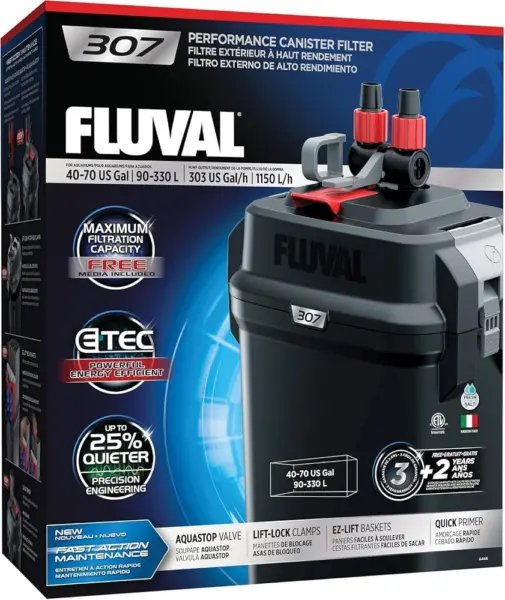
Fluval 307 Canister – Best for Large Tanks
Key Features
- Media: EZ-Lift stack with pre-filter
- Mount: External canister
- Flow rate: 1,150 liters per hour
- Tank size: Up to 70 gallons
- Price: Premium
If your turtle tank runs 60 gallons or more and it sits in a room where noise registers, the Fluval 307 is the canister we point to instead. It’s rated to 70 gallons, turns over 1,150 liters per hour through a stack of media baskets, and the pump is quiet enough that the water returning to the tank is the loudest thing about it.
The EZ-Lift stack is the design detail we appreciate most. A center handle lets you pull the whole basket stack out with one finger, and the vertical pre-filter cartridge catches coarse waste before it reaches the biological media — the right order of operations when the waste is turtle pellets and shed scutes rather than fish flake.
Two things hold it back. It’s the priciest filter here, and the plumbing — ribbed hose, rim connectors, an AquaStop valve — needs planning before you fill anything. The housing is the other weak point: cracked bodies and water collecting at the base of the canister are what to guard against, so stand it in a tray and check the seal at every cleaning. On a hard floor with room for that tray the leak worry mostly goes away, and what’s left is a canister that will outrun everything here on a big tank.
Pros
- Near-silent pump for a canister this size
- EZ-Lift baskets lift out with one finger
- Pre-filter catches coarse waste before the bio media
- Rated to 70 gallons with high turnover
Cons
- The priciest filter in this group
We think it’s the right canister for a 60- to 70-gallon turtle tank in a quiet room — the flow and near-silent pump justify the premium.
TARARIUM Turtle Tank Filter – Best for Shallow Water
Key Features
- Mount: Rim hook or suction cups
- Tank size: 3 to 20 gallons
- Filtration: 4-stage with bio balls
- Minimum water level: 1.9 inches
- Price: Budget
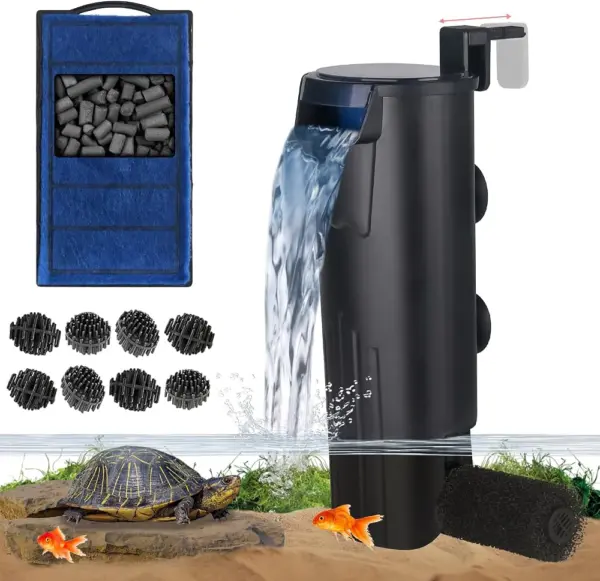
Most turtle setups don’t run brim-full. A hatchling or young slider is often in six or eight inches of water with a dock above it, and a hang-on-back built for a filled fish tank either won’t pull water or sprays it over the rim. This one is built for that: the listing puts its minimum water level at 1.9 inches, and the intake sits low enough to keep working in a tank that shallow.
It’s small, and that’s the point. The 3- to 20-gallon rating matches a starter or grow-out tank, the waterfall outlet aerates without a separate air pump, and it hangs on the rim or sticks to the glass with suction cups, so it moves when you rearrange the basking spot. The top lid lifts off for media changes — a small thing that stops being small when the filter is sitting in eight inches of water.
We treat it as the shallow-water specialist rather than an all-rounder, which is a fair trade for a tank no canister can serve. The media is a carbon plate, a sponge and a handful of bio balls, so biological capacity is modest and a grown turtle will overwhelm it. Buy it where a return is easy, and plan the upgrade for the year your turtle outgrows the tank. For a hatchling’s first setup, nothing else here works in that little water.
Pros
- Filters in as little as 1.9 inches of water
- Rim hook or suction-cup mounting
- Waterfall outlet adds aeration without a pump
Cons
- Motors can fail within the first months
We choose it for shallow, low-water turtle setups: it keeps filtering where a hang-on-back can’t, and it’s inexpensive enough to replace as your turtle grows.
AquaMiracle Internal Filter – Best Internal Filter
Key Features
- Power: 3.5 W
- Max flow: 130 GPH (500 L/H)
- Tank size: 10 to 40 gallons
- Filtration: 3-stage sponge
- Price: Budget
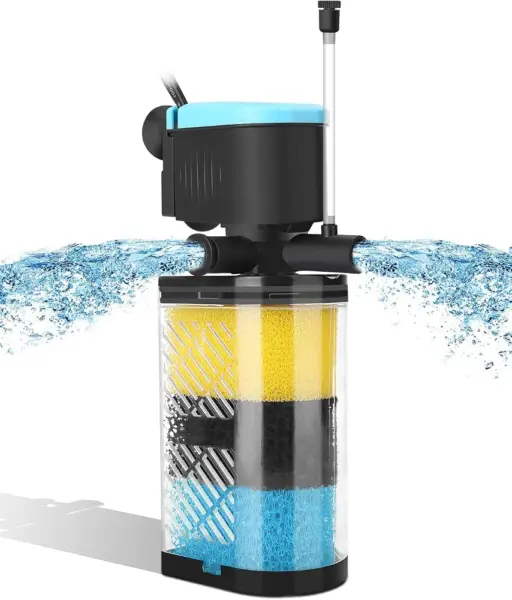
An internal filter costs you swimming room, and in a turtle tank that room is already contested by a basking dock, a ramp and a turtle that rearranges the furniture. This one is 8.5 inches tall and under 4 inches across, so it lies against the back corner instead of standing in the middle. What you get for the footprint is a 130 GPH pump rated for 10- to 40-gallon tanks, with two outlets you can angle apart to spread the flow.
Three sponge blocks do the filtering — coarse, carbonized and fine — and that’s the arrangement we prefer at this size, because you rinse sponges instead of buying cartridges every month. The venturi air line is a genuine bonus in a warm turtle tank, where dissolved oxygen runs low, and it saves a separate bubbler and its cord.
Installation is fully submerged, so the body sits under the waterline and the epoxy-sealed motor stays cool. Cleaning means pulling the sponge stack, rinsing it in water siphoned from the tank, and pressing it back into the housing — no cartridges, no media bags, no shopping.
We like it best in the middle of its range. At 3.5 watts it won’t churn a 40-gallon tank the way the canisters here do, so read the top of that range as one young turtle with frequent water changes. The sponge stack is a tight fit in its housing, too — the first few times you pull it out, you’ll wonder whether it’s meant to come. Once the routine is in place, it’s the least fussy filter here for a mid-size tank.
Pros
- 130 GPH for 10- to 40-gallon tanks
- Three rinseable sponges instead of cartridges
- Venturi air line adds oxygen
- Compact body fits a back corner
Cons
- Sponge stack is tight to pull out
For a 20- to 40-gallon tank where a canister won’t fit, we take this one: real flow, rinseable sponges and a small footprint.
Fluval AquaClear AC30 – Best Hang-On-Back
Key Features
- Mount: Hang-on-back
- Tank size: 10 to 30 gallons
- Filtration: 3-stage, fill-your-own media
- Flow control: Adjustable intake
- Price: Midrange
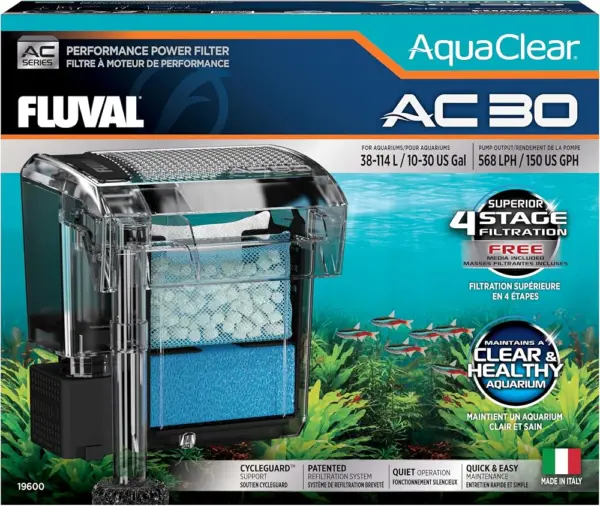
Hang-on-back filters have a poor reputation in turtle tanks, and most of it is earned: cheap ones clog, trickle and burn out. The AquaClear 30 is the exception we keep coming back to. It’s rated for 10- to 30-gallon tanks, holds a three-stage media stack you fill yourself, and the intake adjusts to cut flow by roughly half — useful in a 20-gallon long where a turtle wants calm water at the basking end.
The media bay is the reason to choose it over a cartridge filter. Foam, BioMax and carbon come in the box, and each can be replaced on its own, so the bacteria in the foam survive a carbon change. The intake sponge keeps debris out of the impeller, and the whole basket lifts out through the top for a rinse. It’s the quietest hang-on-back here: the impeller doesn’t rattle and the return is a soft spill rather than a splash.
We think it’s the right hang-on-back for a 20- to 30-gallon turtle tank, provided you accept weekly attention: the foam loads with turtle waste and the output drops until you rinse it. That’s the trade for the media flexibility that puts it ahead of every cartridge filter here, and it’s a small one in a tank you’re already cleaning every week.
Pros
- Fill-your-own three-stage media stack
- Adjustable intake cuts flow by half
- Quietest hang-on-back in this group
- Media rinses without losing the bacteria
Cons
- May not re-prime after a power outage
The hang-on-back we trust for a 20- to 30-gallon turtle tank: fill-your-own media, adjustable flow and quiet running.
Tetra ReptoFilter – Best for Terrarium Water Features
Key Features
- Design: Waterfall with basking lid
- Warranty: 2-year limited
- Dimensions: 8.25 x 11 x 9 inches
- Filtration: 3-stage cartridge
- Price: Midrange
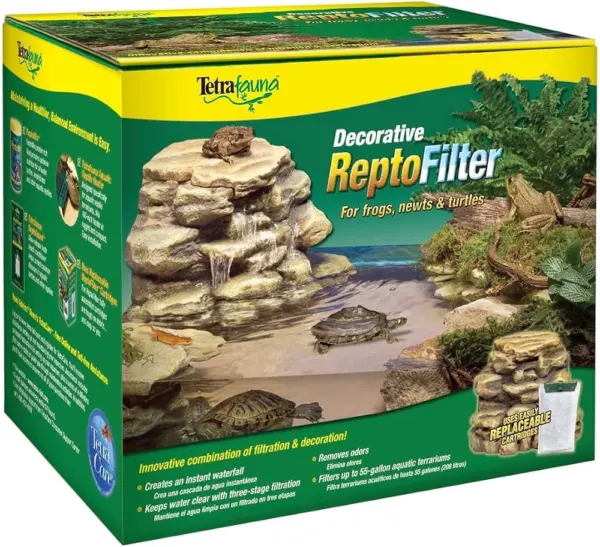
We rate this as a terrarium filter first: it isn’t built to polish 50 gallons of turtle water, and it doesn’t pretend to be. The ReptoFilter is a molded rock with a pump inside, a three-stage cartridge and a waterfall outlet, and its lid doubles as a basking platform — in a shallow paludarium or a terrarium with a water section, that combination does more for the setup than raw flow would.
The design earns its place. The stone texture gives a hatchling something to grip on the way up, the flat top gives it somewhere to dry off, and the waterfall moves the water without a current that batters a small turtle. The cartridge lifts out from the top, the pump comes apart for a rinse, and it’s UL listed with a two-year limited warranty — longer coverage than most of the filters here. Treat it as a display piece that filters and you’ll be pleased with it; treat it as the only filter on a 40-gallon tank and you won’t.
Pros
- Waterfall and rock housing double as a basking spot
- Cartridge lifts out from the top
- UL listed with a two-year limited warranty
Cons
- Too little media for a full turtle tank
- Painted finish needs gentle scrubbing
We like it in a shallow terrarium or paludarium, where the waterfall and basking lid do more for the setup than turnover would.
Tetra Whisper 85 Internal – Best for Hatchling Tanks
Key Features
- Mount: Internal rim clip
- Flow rate: 85 GPH
- Tank size: 5 to 10 gallons
- Dimensions: 4.25 x 3.92 x 7.87 inches
- Price: Budget
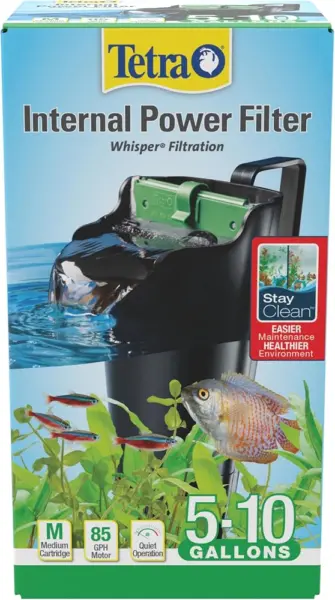
For a hatchling in a 10-gallon tank the arithmetic changes: you don’t need turnover so much as gentle flow and a filter you can clean without dismantling the tank. The Whisper 85 clips to the rim, sits inside the water, and pushes 85 GPH through a BioBag cartridge — enough for one small turtle and a few tankmates, and quiet enough that the water trickling back is the main sound. It weighs about a pound, and the cartridge lifts out without unclipping the housing.
We recommend it for exactly that job and no bigger. The pump is the gamble — these die, sometimes within months, so buy where an exchange is simple — but as a starter filter for a hatchling’s first year it does what a beginner needs: quiet, easy to service, and inexpensive enough to move on from when the turtle outgrows the tank. That’s a narrow case, and it’s the one it was built for.
Pros
- Quiet 85 GPH pump for a 10-gallon tank
- Small enough to clip inside the tank
- Cartridge lifts out without unclipping
Cons
- Rated only for 5- to 10-gallon tanks
- Clip and suction cups hold poorly
We recommend it for a hatchling’s 10-gallon tank and not much beyond: quiet, simple to service, with a lifespan that’s the gamble.
How We Tested Turtle Tank Filters
We built the shortlist from manufacturer flow ratings, then cut anything that couldn’t turn over twice the water volume of a typical 40- to 75-gallon turtle setup once loaded with media — a generous number on the box rarely survives a tank full of reptile waste. From there we filtered by footprint, media availability, and price. Twelve made the cut.
Each one went onto a real turtle tank and stayed for six months. We fed shrimp, pellets, and leafy greens that the turtles shredded on contact, did the weekly water changes, and let waste accumulate the way it does in a normal household. Every two weeks we photographed a white tile at the far end of the tank to compare water clarity side by side, and pulled the intake strainer to see how fast it loaded up with shed scutes and plant debris.
Noise was measured the way you’d actually notice it: a decibel reading from three feet away, then a night in a bedroom to hear whether the hum or an impeller rattle carried. For leakage, every canister sat on a paper towel on the stand, checked after 24 hours and again after each of the first five times we resealed the lid. We timed full teardowns, priming included, and noted which media baskets rinsed clean and which needed a scrub brush.
Flow got checked with a stopwatch and a marked bucket at setup, at one month, and at four, since a filter that starts strong and chokes by midsummer isn’t saving anyone anything. Durability showed up in the small things — hairline cracks at the hose fittings, impellers that began to chatter, clips that quit snapping. We weighed value as cost per rated gallon plus a year of replacement media, and looked at each unit sitting in the tank, because a bright blue intake is very visible in a living room.
How to Choose a Filter for a Turtle Tank
The filter on a turtle tank has to be sized for the animal’s waste rather than the tank’s gallon count, and it has to fit the depth of water you actually keep.
Size for the animal, not the water volume
A turtle is a messy, oxygen-hungry tenant. The rule of thumb in the hobby is ten gallons of water per inch of shell length for a slider or a painted turtle, and the filter needs to be rated for the top of that range rather than the bottom. Look at media volume as well as the tank rating: a canister with two baskets holds a bigger bacterial colony than a cartridge filter on the same tank, which is why the picks here skew that way. Between two sizes, take the larger one.
Match the mount to your water level
Water depth rules out more filters than flow rate does. A hang-on-back needs the waterline near its intake — drop the level and it gulps air and gets loud. A canister needs its intake fully submerged and the unit sitting below the tank, which suits deep setups and not shallow ones. Internal filters work at almost any depth, and the TARARIUM is rated down to 1.9 inches. If your turtle is in six inches of water with a dock above it, choose an internal or terrarium-style filter rather than fighting a hang-on-back into place.
Buy media you rinse, not cartridges you throw away
Every cartridge you replace takes a chunk of the bacteria colony with it — the same bacteria that turn turtle waste into something less toxic. Sponges, bio balls and ceramic rings are rinseable: squeeze them in a bucket of tank water during a change and put them back. That’s why we favor open media bays like the Cascade’s baskets, the AquaClear’s stack and the AquaMiracle’s sponges over sealed cartridges. Carbon is a finishing touch for odor, not the filtration itself.
Plan for the mess and the noise
A turtle filter soils faster than a fish filter, so access is a real specification: top-lifting baskets, a primer button and shut-off valves turn a chore into a few minutes at the sink. Noise usually tracks the water level, too — a filter that’s silent when the tank is full gets louder as water evaporates, so top off weekly before blaming the pump. If the tank is in a bedroom, pay for quiet operation; in a living room, put that money into media volume instead.
Frequently Asked Questions
How often should I clean a turtle tank filter?
Rinse the mechanical sponge or pad every week or two for a grown turtle, and leave the biological media alone until the flow noticeably drops. That’s the whole routine — the pads do the visible work and the bacteria look after themselves. If flow slows again within days of a rinse, the filter is undersized for the animal, and no cleaning schedule will fix that.
My turtle keeps knocking the filter off the glass. What helps?
Move it out of the traffic lane. Turtles push off whatever they can grip, and an internal filter near the basking ramp or the front glass gets shouldered until the suction cups let go. Mount it in a back corner below the waterline, run the cord through a clip so a falling filter can’t pull the plug loose, and if it keeps happening, switch to a rim-hung or canister model that doesn’t depend on suction.
Does a turtle tank filter need carbon?
It helps with smell, which is the honest reason most turtle keepers run it. Carbon adsorbs odor and discoloration for a few weeks and then stops doing anything, so replace it monthly if you use it — and don’t count on it to clear cloudy water, because the biological media does that work. Treat carbon as a finishing touch you can skip if you don’t want the refills.
Final Verdict
Start with the Cascade 700 unless something about your setup rules it out. Two baskets of media, a 65-gallon rating and a primer that spares you a mouthful of tank water cover what a turtle throws at a filter, and it costs less than the premium canister here. If the tank runs 60 gallons or more and noise matters, the Fluval 307 buys more flow and a quieter pump for the difference. And if the water is only a few inches deep, neither applies: that’s the TARARIUM’s job.