This post contains affiliate links. We may earn a small commission when you buy through our links — at no extra cost to you.
Many filters for 30-gallon tanks end up noisy, leaky, or dead within months – a frustration that wastes time and money. The difference often comes down to media design and pump quality, not just price.
Disposable cartridges seem affordable but drive recurring costs, while reusable media improves biological filtration and saves you money. Self-priming designs prevent the common post-power-outage startup failures that burn out motors, and adjustable flow prevents strong currents that stress fish.
This guide helps you pick a filter that fits your 30-gallon tank’s specific needs – whether you run a planted tank, a community setup, or a low-bioload quarantine – so you get clear water without the headaches.
Top Picks
Best for Planted Tanks
Fluval 107 Canister

Rating: 4.5 ★ | Price: Premium | Flow Rate: 145 GPH | Media Custom: 3 stackable baskets | Noise: Ultra-quiet | Self-Priming: Push-button primer | Media Cost: Reusable (sponge, biomax)
The Fluval 107 operates near-silently, making it a strong fit for planted tanks where filter hum would otherwise compete with the sound of running water. Its three stacking baskets allow custom media layouts for biological and mechanical filtration. Water clarity after installation improves noticeably over cartridge-based HOB units.
This canister suits aquascapers and hobbyists who want to tailor their filtration and are comfortable with the occasional maintenance cycle. The higher upfront cost and the need to reseat seals properly after cleaning are part of the ownership experience. Those looking for a simple plug-and-play filter may prefer a hang-on-back.
Pros
- Operates nearly silently in any aquarium setup.
- Customizable media baskets allow fine-tuned filtration for planted tanks.
- Consistent water clarity even under moderate bioloads.
Cons
- Leakage can occur if the canister lid seals are not firmly reseated after cleaning.
- Pump or primer failure has been noted in some units within months of use.
For the owner willing to invest in silence and media control, the Fluval 107 is a capable partner for a 30-gallon planted tank. Just keep an eye on the seals during maintenance.
Best for Messy Tanks
Seachem Tidal 35

Rating: 4.5 ★ | Price: Mid-Range | Flow Rate: 90–450 GPH | Media Custom: Large basket, Matrix included | Noise: Quiet (submerged motor) | Self-Priming: Yes (submerged) | Media Cost: Reusable media
Unlike typical hang-on-back filters, the Seachem Tidal 35 primes itself automatically after power outages and includes a surface skimmer that removes oily film. The media basket accepts custom layouts, and the submerged motor keeps noise low in most setups. However, a minority of units have experienced motor failure within a few months, and the flow adjuster responds to very small adjustments—fine once set but finicky during initial dial-in. This filter suits hobbyists who prioritize self-priming and surface skimming over absolute long-term certainty, and who can tolerate a sensitive flow control.
Pros
- Self-priming design eliminates the need to manually restart the filter after power interruptions.
- Surface skimmer pulls in surface debris and improves gas exchange at the water line.
- Submerged motor keeps operating noise low in most household settings.
Cons
- Early motor shutdown has been reported in a minority of units, making long-term dependability a consideration.
- Flow adjuster is sensitive; small turns produce large flow changes, requiring careful setup.
The Tidal 35 is a capable HOB for those who want self-priming and surface skimming, but consider a canister if absolute long-term dependability is a top priority.
Best for Media Customizers
Fluval (AquaClear) 30
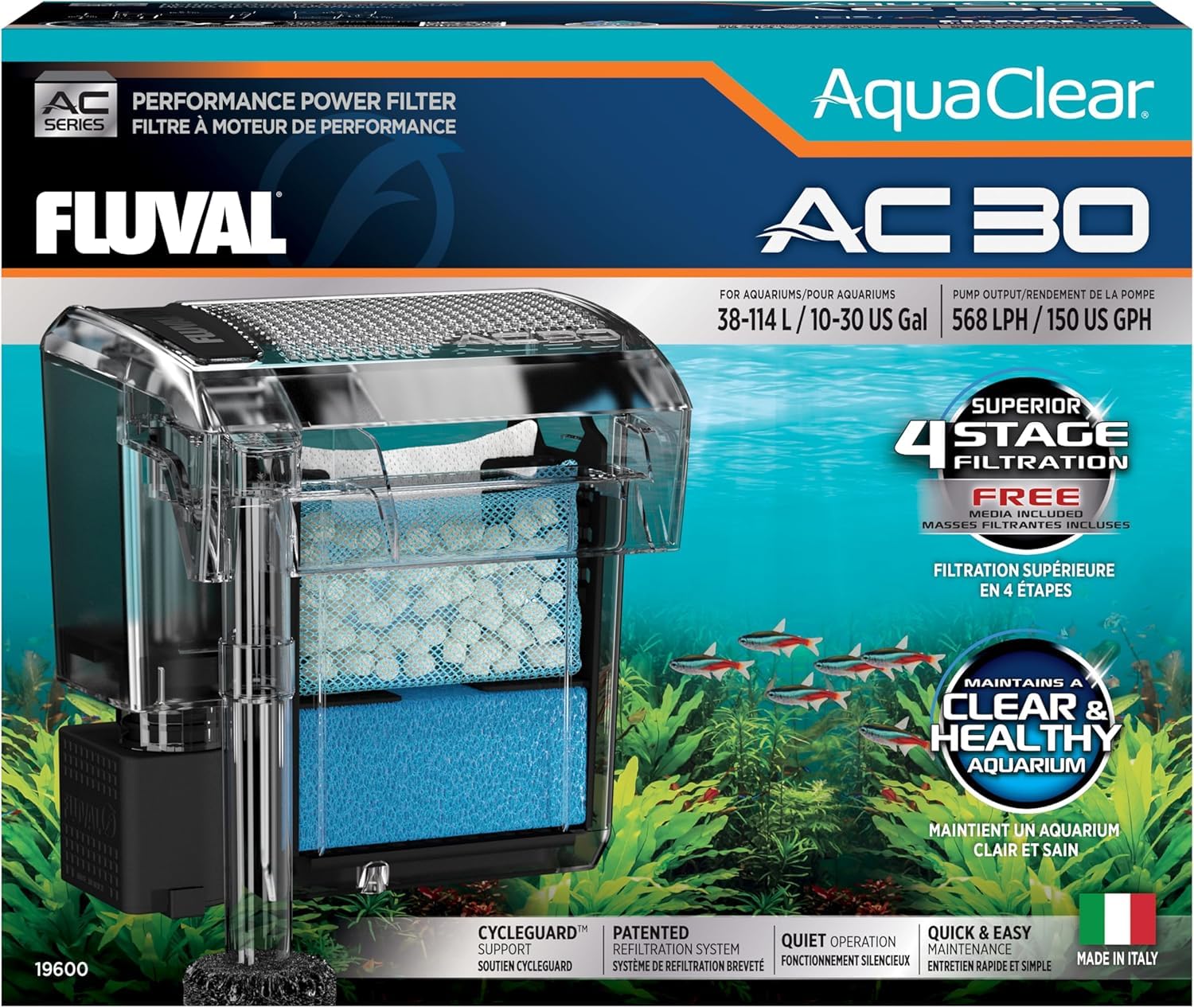
Rating: 4.2 ★ | Price: Mid-Range | Flow Rate: 150 GPH | Media Custom: Large basket – foam, carbon, BioMax | Noise: Noticeable (motor hum) | Self-Priming: Manual priming required | Media Cost: Reusable media
The AquaClear 30 delivers noticeable water clarity thanks to its large customizable media basket – you can pack your own foam, ceramic rings, or carbon for tailored mechanical and biological filtration. Manual priming is required after power outages, and the pump hum will be present in quiet rooms. This filter is for hobbyists who want strong filtration performance from a HOB and accept these tradeoffs.
Pros
- Customizable media basket accepts your preferred filter media for tailored mechanical and biological control.
- Visibly clearer water compared to cartridge-based filters.
Cons
- In quiet living spaces, the pump hum is noticeable – better suited to areas with ambient noise.
- Some units may develop motor issues; worth considering a protection plan.
For aquarists who prioritize water clarity and media flexibility over absolute silence, the AquaClear 30 is a capable HOB.
Best for Budget Canister
Penn-Plax Cascade 500

Rating: 4.3 ★ | Price: Premium | Flow Rate: 115 GPH | Media Custom: Two stackable baskets | Noise: Very quiet | Self-Priming: Push-button primer | Media Cost: Reusable (floss, sponge, carbon)
The Cascade 500 delivers the quiet operation and media capacity of a canister filter at a cost that undercuts premium models like the Fluval 107. Flow is gentle enough for a 30-gallon community tank, and the push-button priming simplifies startup. This filter suits budget-conscious aquarists who can accept occasional build inconsistencies — plastic housing cracks or seal leaks are possible over time, especially compared to more robust alternatives.
Pros
- Near-silent operation even in quiet living spaces
- Good water clarity with two media baskets for mechanical and chemical filtration
- Cost-effective entry into canister filtration vs. premium brands
Cons
- Plastic housing may develop cracks or seal leaks over time — a risk worth considering
- Some units can experience pump issues after months of use
A smart buy if you want canister performance on a budget and can accept the possibility of build quirks over the long haul.
Best for Turtle Tanks
TARARIUM Internal 290

Rating: 4.5 ★ | Price: Mid-Range | Flow Rate: 290 GPH | Media Custom: Sponge, ceramic bio-balls | Noise: Very quiet | Self-Priming: Submerged – self-priming | Media Cost: Reusable media
The TARARIUM Internal 290 sets itself apart from standard HOB filters by accommodating water levels as low as 2.6 inches, making it a natural fit for turtle and amphibian tanks where typical filters would run dry. However, long-term feedback is limited, and some units may cease operation after several months of use. This filter is best for keepers who prioritize shallow-water operation over decades-long performance certainty.
Pros
- Effective at keeping turtle and fish tanks clean
- Quiet operation won’t disturb a living space
- Simple setup and maintenance
Cons
- In some cases, the filter may cease operation after several months of use
The TARARIUM Internal 290 is the right choice for turtle keepers who need a filter that works in very shallow water and prefer internal placement over hang-on-back designs.
Best for Budget Beginners
Marineland Penguin 350

Rating: 4.4 ★ | Price: Budget | Flow Rate: 350 GPH | Media Custom: Disposable cartridges | Noise: Noticeable (motor) | Self-Priming: No (requires priming) | Media Cost: Disposable cartridges
The Bio-Wheel design effectively removes waste and maintains clear water. However, the 350 GPH flow rate creates strong currents in a 30-gallon tank, and the motor noise may be noticeable in quiet rooms. Those who can manage the flow—by redirecting the output or using it on a larger tank—get good value for the price.
Pros
- Clears water quickly with rotating Bio-Wheel biological filtration.
- Budget-friendly price for the flow rate provided.
Cons
- Motor hum may be noticeable in quiet spaces; worth checking if you keep the tank in a living area.
Best suited for larger tanks where the high flow won’t disturb inhabitants, or for aquarists who can mitigate current with spray bars or diffusers.
Best for Low Bioload
Tetra Whisper Internal 40i

Rating: 4.3 ★ | Price: Budget | Flow Rate: 170 GPH | Media Custom: Dual-sided mesh, no carbon | Noise: Very quiet (air-driven) | Media Cost: Disposable Bio-Bag
This internal filter delivers exceptional silence and water clarity for a 30-gallon tank, making it a strong pick for quiet environments where gentle flow is fine. The low cost and inexpensive replacement cartridges add to the appeal. However, the motor can stop working within two months, limiting this to use in low-bioload setups, emergency tanks, or quarantine tanks where failure is less critical.
Pros
- Among the quietest filters available for its size.
- Low upfront cost and cheap replacement cartridges.
Cons
- Motor durability is inconsistent; some units stop working within two months.
Best suited as a backup or quarantine filter for a 30-gallon tank where silence matters more than long-term reliability.
Best for Self-Priming
Aqueon QuietFlow 30

Rating: 4.2 ★ | Price: Mid-Range | Flow Rate: 170 GPH | Media Custom: Carbon cartridge, biomedia | Noise: Noticeable (motor) | Self-Priming: Yes (internal pump) | Media Cost: Disposable cartridges
The Aqueon QuietFlow 30 LED PRO self-primes after power outages and signals when to swap the cartridge, keeping maintenance simple. Filtration keeps water clear in 30-gallon tanks at a budget-friendly cost. However, noise can be noticeable in quiet rooms, and some units may develop motor issues within months, which limits its appeal for long-term use.
Pros
- Effective filtration keeps water clear and clean in 30-gallon tanks.
- Budget-friendly cartridge replacement saves money over time.
Cons
- Motor noise may be noticeable in quiet rooms, and some units can develop issues within months — a flexible return policy is advisable.
Best for budget-conscious aquarists with a 30-gallon tank who want self-priming convenience and don’t mind possible noise or durability tradeoffs.
Best for Simple Cartridge
AQUA-TECH 30-60

Rating: 4.3 ★ | Price: Mid-Range | Flow Rate: ~200 GPH (est.) | Media Custom: EZ-Change cartridge | Noise: Noticeable | Media Cost: Disposable cartridge
This filter provides solid mechanical and chemical filtration for 30-gallon tanks, and the cartridge swaps out in seconds without mess. The 3-year warranty adds some peace of mind, but motor noise can be present in quiet spaces and some units may stop working within months — it’s not as customizable as the top pick and better suited for budget setups or infrequent use.
Pros
- Keeps tanks clear with effective mechanical and chemical filtration.
- Tool-free disassembly makes cleaning quick and straightforward.
Cons
- Motor hum can be noticeable in quiet rooms; some units may stop working within months.
A cost-effective, low-maintenance filter for a non-display tank or backup setup, but skip it if you need quiet operation or plan to run it daily for years.
Best for Custom Media
Fluval (AquaClear) 50
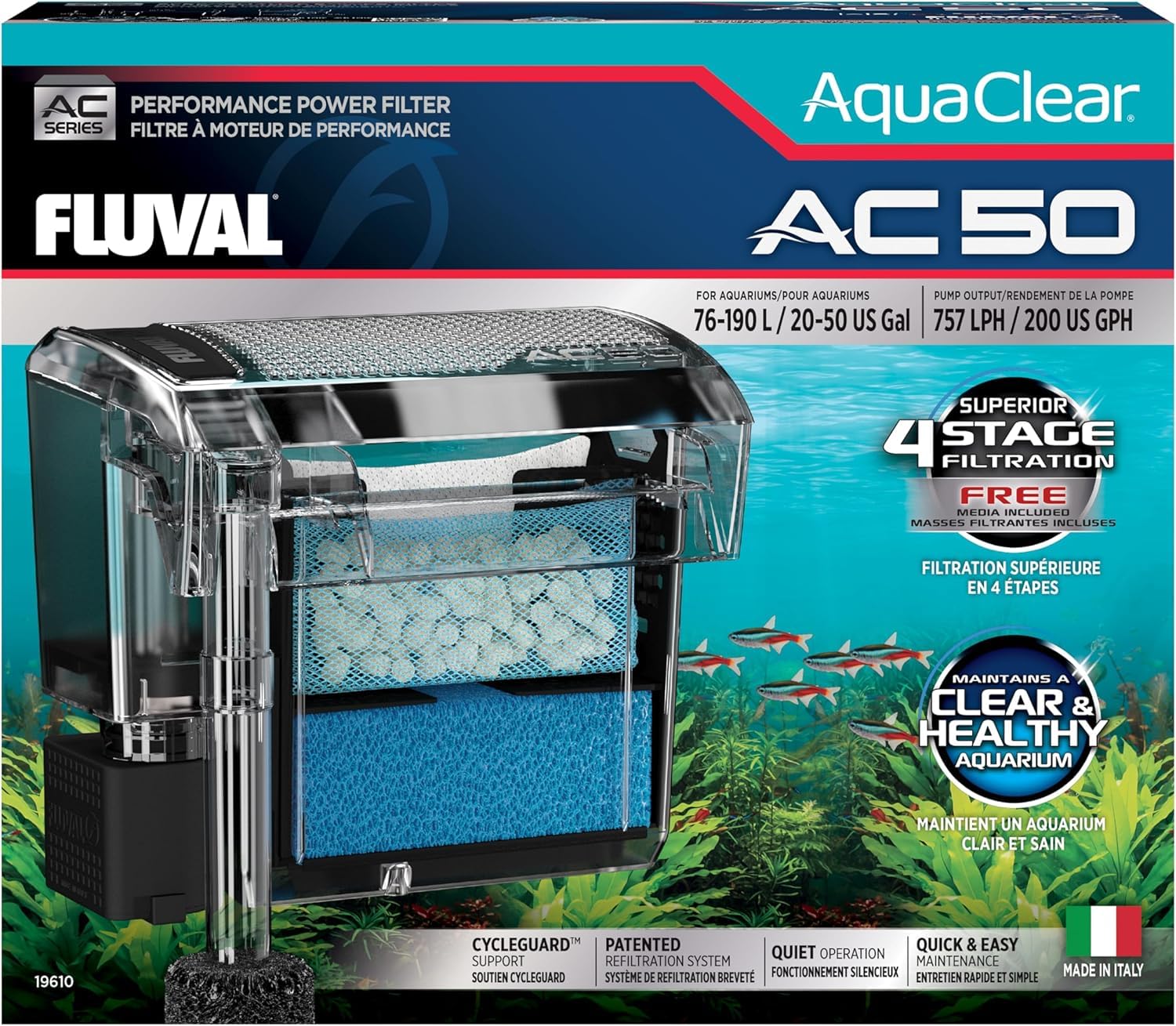
Rating: 4.2 ★ | Price: Mid-Range | Flow Rate: 200 GPH | Media Custom: Large basket – foam, carbon, BioMax | Noise: Noticeable (motor hum) | Self-Priming: Manual priming required | Media Cost: Reusable media
The generous media basket accommodates foam, carbon, and biomedia for tailored filtration, delivering strong water clarity. However, the unit’s size is generous for a 30-gallon tank, and noise output can vary between units—some owners find it noticeable. These factors, along with occasional motor inconsistencies, keep it from being the top recommendation for this tank size.
Pros
- Customizable media basket allows mixing foam, carbon, and biomedia for specific tank needs.
- Reusable media reduces long-term costs compared to disposable cartridge filters.
Cons
- Motor performance can vary between units, which may require a backup plan for extended use.
Best for aquarists who prioritize media flexibility and are willing to accept potential noise or motor variance in a 30-gallon tank.
Best for Breeding Fry
ALEGI Sponge Filter
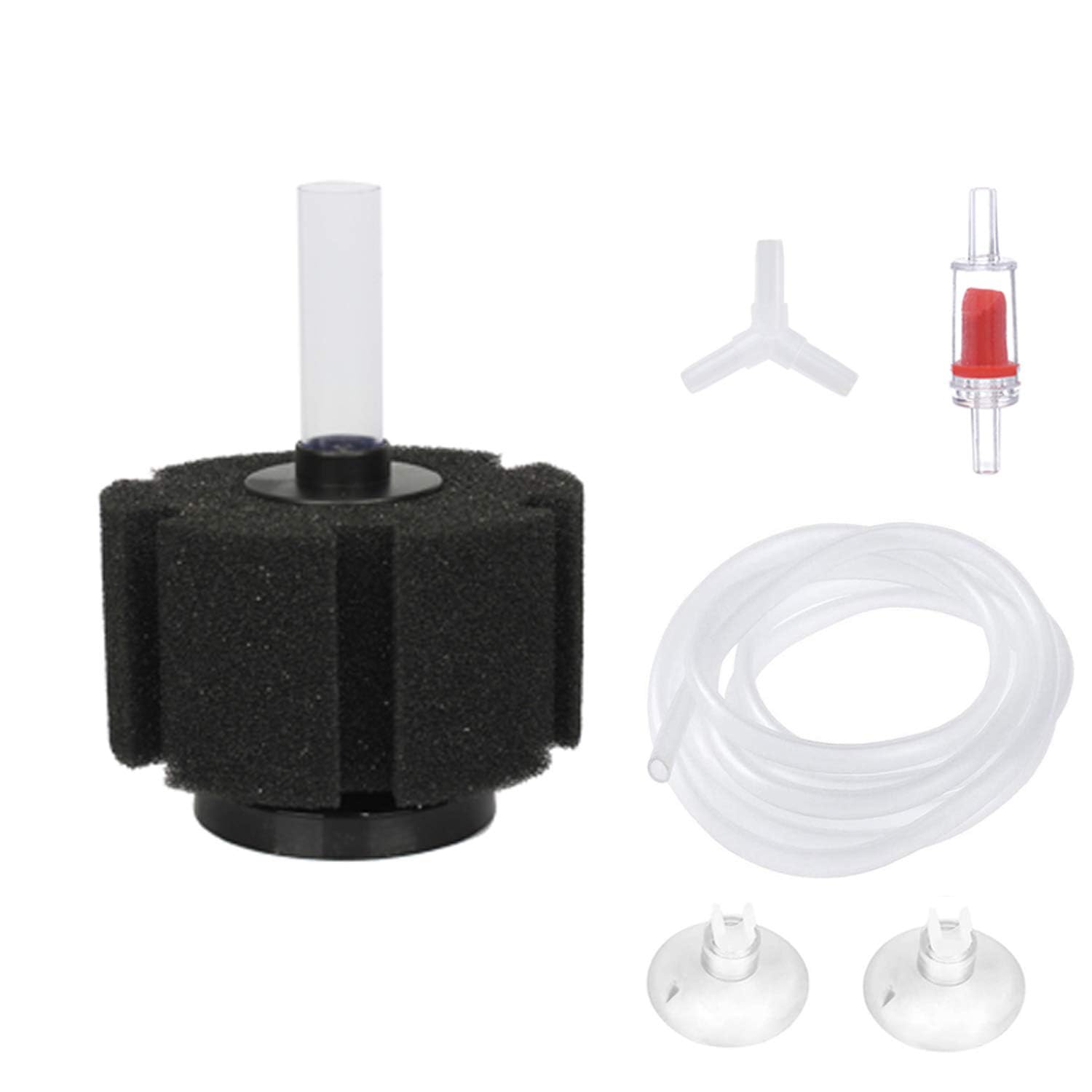
Rating: 4.6 ★ | Price: Budget | Media Custom: Sponge only | Noise: Very quiet (air pump) | Media Cost: Reusable sponge
This sponge filter is the cheapest way to add biological filtration, with gentle water movement ideal for breeding tanks, fry, and shrimp. However, it requires a separate air pump (not included) and is underpowered as a primary filter for a 30-gallon display – better suited as a supplemental unit or for low-bioload setups.
Pros
- Lowest cost biological filtration option; safe for delicate fry and shrimp.
- Includes airline, check valve, suction cups, and Y-connector for basic setup.
Cons
- Not a complete filter – requires a separate air pump to operate.
Best for breeding or fry tanks where gentle flow and low cost are priorities, not as a standalone filter for a 30-gallon display.
How to Choose
The biggest mistake 30-gallon tank owners make is buying a filter rated for a larger tank, which creates excessive current and stress for fish.
Flow Rate and Tank Volume
Aim for 4 to 6 times the tank volume in gallons per hour (GPH). For a 30-gallon tank, that means 120–180 GPH. Higher flow rates (250+ GPH) can create strong currents that stress slow-swimming fish and uproot plants.
Many filters advertise higher GPH than what you actually get after media is loaded. A filter rated for 50 gallons may push only half that flow when packed with sponge and biomedia. Always size down for real-world performance.
Media Capacity and Customization
Filters with disposable cartridges lock you into proprietary refills that cost more over time. Reusable media – sponge, ceramic rings, biomax – lets you adjust mechanical and biological filtration to your exact bioload. A larger media basket also means you can add filter floss or activated carbon when needed.
Noise Level
Noise comes from the motor, water splashing, or vibration against the tank rim. Canisters and submerged internal pumps are generally quieter than hang-on-back (HOB) filters, which draw air. If the filter sits in a living room or bedroom, look for models with sound-dampening features or submerged motors.
Self-Priming Capability
After a power outage, a non-self-priming HOB can lose its siphon and run dry, quickly burning out the motor. Self-priming models (submerged pump or built-in primer) restart automatically. Canisters with push-button primers also eliminate the need to manually fill the hose.
Filter Media Replacement Cost
Disposable cartridges cost $3–$8 each and need replacement every 2–4 weeks – that adds up to $50–$100 per year. Reusable media like sponge and biomax last for years with periodic rinsing in tank water. A filter that accepts reusable media pays for itself in the first year.
FAQ
Will a 350 GPH filter be too strong for a 30 gallon tank?
Yes, for most setups. A 350 GPH filter cycles the tank over 11 times per hour, which can create strong currents that stress small or slow fish and uproot plants. Stick to 120–180 GPH for a 30-gallon community tank. Use higher flow only if you have large, active fish or plan to use a spray bar to diffuse output.
How often should I replace the media in my aquarium filter?
Disposable cartridges should be changed every 2–4 weeks, but only if you also keep a seeded sponge or biomedia to preserve beneficial bacteria. Reusable sponge and biomax should never be replaced – just rinse them in old tank water every 4–8 weeks. Continuous replacement of all media can crash your biological filter.
Why does my aquarium filter stop working after a power outage?
Most hang-on-back filters lose their siphon when the power cuts, and when it returns they run dry, causing the motor to overheat and fail. A self-priming filter (submerged motor or built-in primer) will restart automatically. If your filter isn’t self-priming, fill the chamber with tank water before plugging it back in.
Can I use a canister filter on a 30 gallon tank?
Yes, and for planted or heavily stocked tanks it is often the best choice. Canisters offer larger media volume, quieter operation, and no flow restriction from a hang-on-back design. The main trade-off is higher upfront cost and more involved maintenance – you need to disconnect hoses and open the canister every 2–3 months.