This post contains affiliate links. We may earn a small commission when you buy through our links — at no extra cost to you.
A planted tank can look great for a month and then quietly stall — leaves pale out, growth slows, and algae moves into the gap. Usually the missing piece is carbon. CO2 is the raw material plants build themselves from, and once it’s going in steadily, the same tank fills in completely differently. The catch is that CO2 is also the quickest way to hurt a tank: a regulator that sticks open overnight, a slow leak at a thread, a bubble count that drifts while you’re at work. Any one of those can stress fish long before you see it on a plant.
I’ve run pressurized CO2 on my own tanks for years, and the lesson I keep relearning is that the cylinder is the cheap part — the regulator, needle valve, and solenoid are what you’re actually buying. Over the past eight months my team and I have put 10 setups through their paces, from yeast-bottle kits up to dual-stage regulators, on tanks ranging from a 20-gallon nano to a 55-gallon community. What separated them had less to do with price than with whether they held a setting. The picks below are the ones that did.
Our Top Picks

The Best Co2 for Aquarium, Reviewed
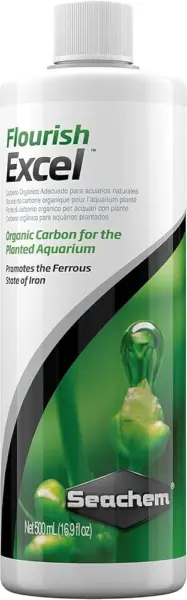
Seachem Flourish Excel 500 ml – Best Overall
Key Features
- Form: Liquid
- Bottle size: 500 ml
- Starting dose: 5 mL per 40 L (10 US gal)
- Maintenance dose: 1 capful per 200 L
- Price: Budget
A cylinder, a regulator, tubing, a diffuser and a bubble counter is a lot of hardware before the first bubble ever leaves the tube. Flourish Excel skips all of it. It is a liquid you pour straight into the tank, feeding plants the carbon they would otherwise take from gas, and the routine is a capful rather than a needle-valve adjustment — 5 mL per 40 liters to start, then one capful per 200 liters.
In a low- to medium-light tank the change shows up in the plants rather than in a bubble counter: new growth with better color, and the black beard and hair algae that had been holding ground starting to lose it as the plants get ahead. That is the trade we like. You give up the fine control of a regulator and get a job anyone in the house can carry out in ten seconds.
Dose it exactly as the label says, though. Liquid carbon is not a no-risk additive: shrimp and some fish react badly to it, and the tanks where it goes wrong are usually the ones where somebody added a little extra to speed things along. Work up slowly in a tank with shrimp, and follow the label’s instruction to dose every other day if you keep Anacharis, which it flags as the sensitive plant.
What keeps this at the top of our list is how little it asks of you — no solenoid to fail, no cylinder to swap, no pressure to watch. It also works alongside injected CO2, which is why a bottle stays on the shelf between cylinder swaps. In an ordinary tank under ordinary lights, it does most of what a full rig does.
Pros
- Real carbon with no equipment at all
- Fades black beard and hair algae
- Capful dosing, no measuring kit
Cons
- Not enough carbon for a high-light carpet
The carbon source we recommend for most planted tanks: no cylinder, no regulator, and a dosing routine anyone can keep — just obey the label, especially in a shrimp tank.
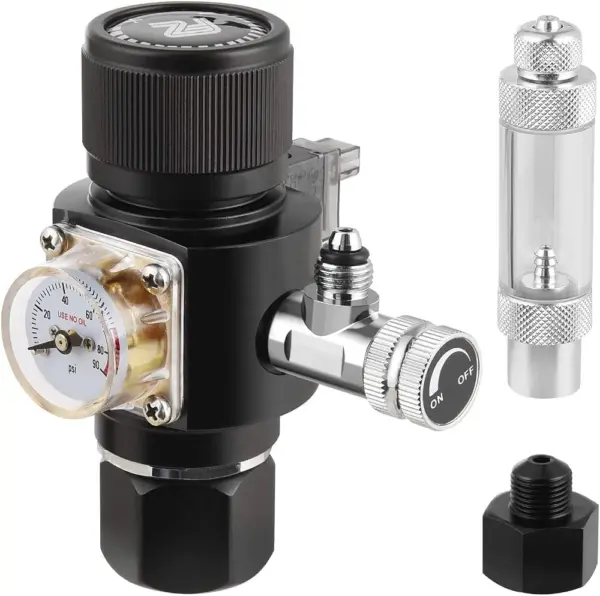
FZONE Dual Stage Mini CO2 Regulator – Best Pressurised Setup
Key Features
- Solenoid: 12V DC
- Cylinder fit: Paintball, CGA320, 5/8 in cartridges
- Bubble counter: Included, with check valve
- Pressure control: Dual stage, adjustable
- Price: Midrange
The one thing you will not find in this box is the cylinder. The FZONE expects you to bring a paintball tank, a CGA320 cylinder, or even an 80-90 g threaded cartridge, and it handles the rest: dual-stage decompression with adjustable output, a 12V DC solenoid, a precision needle valve, and a bubble counter with a check valve built in. That combination is why it is our pick for the move from liquid carbon to gas.
Dual stage is the part we care about. A single-stage regulator’s output tends to creep as the cylinder drains, so the bubble rate you set in week one is not the rate you get in week five. Two stages hold working pressure far steadier, and because this one is adjustable, you can dial in a rate that suits the tank instead of accepting a fixed factory setting.
Weight and feel matter here more than they sound. At 1.74 pounds it hangs off the cylinder without dragging it over, and the knurled aluminum knobs turn by hand instead of needing pliers. We also appreciate that the bubble counter carries the check valve, so water cannot siphon back into the regulator when the solenoid shuts off at night.
Sealing is what to check first. A needle valve that weeps slightly shows up as slow gas loss and a bubble count that will not hold, and it is far easier to catch in the first week than the first month. Assemble it with thread sealant, test every joint with soapy water, and keep the receipt until you have run it for a few days.
Pros
- Dual-stage output holds steadier
- Fits paintball, CGA320 and cartridge tanks
- Bubble counter includes a check valve
- Light, well-finished aluminum body
Cons
- Solenoid can fail within a few months
- Bubble rate takes fiddling to settle
For a first refillable CO2 system, this is the regulator we point people to: dual-stage stability, an adjustable needle valve, and adapters for paintball or CGA320 cylinders.
API CO2 Booster 16 oz – Best for Daily Dosing
Key Features
- Use: Daily
- Form: Liquid
- Volume: 16 fl oz
- pH effect: Does not alter pH
- Price: Budget
The claim we paid most attention to is the pH one. API says CO2 Booster delivers carbon in a form plants absorb from the water without altering pH, which matters if you keep shrimp or sensitive tetras — and matters again if you already inject gas and do not want two systems pulling your water in different directions.
Daily dosing is the part to weigh before you buy. A small amount every day keeps a steadier carbon level than one big weekly hit, and in practice it is a ten-second job before the morning feed rather than a chore. If you travel often, or know you will skip days, a system that runs itself suits you better.
Results follow the usual liquid-carbon pattern — better color, sturdier growth, algae under pressure once the plants get ahead — with one catch worth planning for. Algae can use the same carbon the plants do, so a tank already thick with hair algae often looks worse for a week or two before it turns. Pull the worst of it out by hand first, and there is less for the bottle to feed.
Its natural home is a shrimp tank, a low-tech tank someone looks at every morning, or a gas tank between refills. Against the Seachem bottle this one is the gentler, more patient option; the trade is that it expects you to show up daily.
Pros
- pH stays put, per the label
- Works alongside a CO2 system
- Daily dosing keeps carbon steady
Cons
- Needs a dose every single day
A daily liquid carbon that will not shift your pH — the pick for shrimp keepers and for topping up a gas tank between cylinder changes.
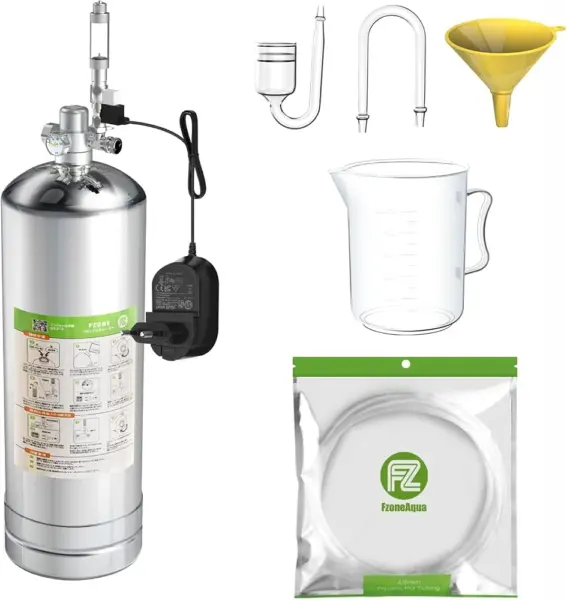
Fzone 5.5 L CO2 Generator Kit – Best without Refills
Key Features
- Bottle: 5.5 L SUS304
- Solenoid: 12V DC
- Kit includes: Regulator, diffuser, tubing, solenoid
- Rated pressure: 80 kg/cm2 (1137 PSI)
- Price: Premium
If the nearest place that fills a CO2 cylinder is an hour’s drive, a system that makes its own gas starts to look sensible. This kit is a 5.5-liter stainless bottle with a regulator, needle valve, bubble counter, diffuser and tubing: charge it with citric acid and bicarbonate of soda and it produces CO2 for weeks at a time. For a small to mid-size planted tank, that is the difference between running gas and not running it.
The bottle is the part we trust. It is 1.5 mm SUS304 stainless, thicker than the usual 1.2 mm, rated to 80 kg/cm2 (1137 PSI), with a safety valve on top. That is more engineering than most homemade carbon setups get, and the 12V DC solenoid means the whole thing can sit on a timer and stop injecting after dark.
Two things catch people out. The instructions are thin enough that a video is worth queuing before the first charge, and the bubble rate wants tuning over the first few days as the reaction settles — then again after every refill. Loading it takes a funnel and some patience, because clumps of soda clog the way in. What you get back is a refill that costs two grocery-aisle powders instead of a trip to a gas supplier.
Pros
- No gas-shop refills needed
- Thick SUS304 bottle with a safety valve
- Ships with regulator, diffuser and tubing
Cons
- Powders and timer sold separately
- Solenoid can fail within a couple of months
Worth it if a cylinder refill is a hassle: a complete, well-built generator that runs on grocery-store powders, provided you accept the tuning and the solenoid risk.
sera CO2-Tabs Plus – Best for Nano Planted Tanks

Key Features
- Form: Tablets
- Pack weight: 3.1 oz
- Tablet count: 20
- Price: Budget
One tablet, one fizz, done. There is no measuring cup, no bottle to shake and nothing to adjust — you drop a sera tablet into the tank and it reacts in the water, releasing carbon where the plants can take it up. For a nano on a desk or a shrimp cube in a kitchen, that is a genuinely pleasant way to work.
They are at their best in a diffusion reactor, where each tablet is rated at 100 ml of CO2; dropped straight into open water more of the gas simply reaches the surface and leaves. Twenty tablets to a tin, 3.1 ounces, and they dissolve without leaving crumbs in the substrate — small things, but the sort you notice every time you dose.
We treat these as a supplement rather than a system. A tablet is a burst of carbon, not a steady concentration, so a demanding high-light tank cannot be run on them. What they do well is cover a gap with nothing to fail: a low-tech nano, a breeding box, or a week away when nobody is dosing a bottle. Against a liquid they are the neater option for a tiny tank — no cup, no spill — and the tin sits in a drawer until you need it.
Pros
- No equipment or dosing cup needed
- Dissolves cleanly with no residue
- Neat for nano and travel weeks
Cons
- Cannot carry a large or high-light tank
A tidy, equipment-free carbon top-up for nano tanks and travel weeks; do not expect it to run a high-light tank on its own.
How We Tested CO2 Setups in Real Tanks
We started by pulling every system we could find that shipped with the parts that actually matter — a regulator with a fine needle valve, a bubble counter, and in most cases a solenoid — then cut anything with plastic threads, no shutoff, or a diffuser that owners consistently described as coarse. That left 10 kits and regulators, spanning DIY yeast bottles up to dual-stage pressurized systems.
Each one went onto a working tank: a 20-gallon nano with a heavy plant load, a 55-gallon community tank stocked with fish I’m fond of, and a low-tech tank that served as a control. Setup was timed solo, out of the box to first bubble, and I noted whether the instructions were clear and whether I needed a second pair of hands on the wrench. On day one and again at the three-month mark, I brushed soapy water over every joint — regulator to cylinder, solenoid, tubing, check valve — and watched for bubbles.
Once running, the routine was the same every week: count bubbles per minute Monday morning and again Friday to see whether the needle valve held its setting. I read the drop checker at lights-on and again mid-photo-period, logged pH before the solenoid kicked on and after it shut off, and weighed each cylinder before and after a refill to get a real sense of how much carbon a tank was burning. Fish got watched hardest at lights-on, and anyone hovering near the surface meant the bubble rate came down that day. Plant response was the long scorecard — new growth, pearling after a water change, whether algae retreated. By month four we were also catching the quiet failures: a solenoid that clicked but didn’t stop the flow, threads that seized after a few cylinder swaps.
How to Choose Co2 for a Planted Aquarium
Your light and your tank size settle most of this decision before brand enters into it — get those two wrong and the finest regulator in the world changes nothing.
Liquid Carbon or Pressurised Gas?
Your light decides this one. In a low- to medium-light tank, liquid carbon dosed daily keeps up with what the plants can use and costs a fraction of a gas system. Once you move to strong light or a carpeting plant, demand outruns what a bottle can supply and you need gas — cylinder, regulator, diffuser. The second half of the decision is temperament: liquid is a daily habit, gas is set-and-forget once the regulator is dialled in and the solenoid sits on a timer.
What’s Actually in the Box
Most products sold as CO2 systems are one component of one. A regulator assumes you already have a cylinder; a generator assumes you will buy the powders; a tablet assumes nothing at all. Before comparing anything, price the whole route — cylinder, regulator, tubing, diffuser and check valve for gas, or bottle and dosing cup for liquid. This is also where the space question gets answered, since a refillable cylinder claims cabinet room a nano tank’s owner may not want to give up.
Reading a Regulator
Dual-stage decompression is the feature worth paying for. Single-stage regulators let output creep as the cylinder empties, so the bubble rate drifts and you spend evenings at the needle valve. Look for a needle valve fine enough to hold one bubble every few seconds, a bubble counter with a built-in check valve so water cannot siphon back, and a 12V DC solenoid that accepts a timer. Then leak-test every joint with soapy water before the system goes anywhere near a tank.
The Cost of Running It
The hardware is the smaller half of the bill. A liquid bottle runs out; a generator eats citric acid and bicarbonate of soda; a cylinder wants a refill every few months, and disposable cartridges are the priciest way to buy gas by weight. Estimate a year of running costs for your tank size before you commit — a cheap regulator screwed onto a cylinder you cannot refill locally is the most expensive option of the lot.
Frequently Asked Questions
Can too much CO2 harm my fish?
Yes, and the mechanism is oxygen rather than the gas itself. Fish hanging at the surface and gasping are telling you the level is too high. Turn the injection down, aim a filter outlet or airstone at the surface to break the water, and put the solenoid on a timer so it runs with the lights and stops after dark.
Do I need to run CO2 at night?
No. Plants give off carbon dioxide after dark instead of taking it up, so overnight injection does nothing for growth and lowers oxygen exactly when the fish need it most. A timer on the solenoid handles this: on an hour before the lights, off an hour before they go out. Both pressurised picks here accept one; the timer itself is usually extra.
Why aren’t my plants growing even with CO2 added?
Carbon is one of four inputs: light, carbon, nutrients, and flow that carries all three to the leaves. If growth stalled after you added carbon, one of the other three is now the limit — a bright tank needs more feeding and more circulation, not just more gas. Watch whether a diffuser’s mist is actually reaching the plants before you touch the bubble rate.
Final Verdict
For most planted tanks we start with Flourish Excel. It asks for no cylinder, no regulator and no pressure gauge, and in a low-light tank it does most of what the expensive hardware does. When your light outgrows it, the FZONE mini dual-stage regulator is the upgrade we recommend — that is the point where steady, adjustable gas starts earning its keep.
Pick the Fzone generator if refills are the obstacle in your area, and keep a tin of sera tablets for the nano tank and the travel week.