This post contains affiliate links. We may earn a small commission when you buy through our links — at no extra cost to you.
Aquarium filter media is less about what it removes than what it grows. Ceramic rings, sponges, and floss are housing for nitrifying bacteria, and those bacteria are the reason a tank doesn’t turn cloudy or gas its fish overnight. Good media holds a large colony, lets water move through without choking the flow, and survives a rinse without losing everything you grew. My team and I ran 14 media types for four months to sort out which ones do that and which ones just take up space.
The first thing I’d tell any new fish keeper: the surface-area numbers printed on the bag are close to meaningless, since pore structure matters more than ring count. What separates these products is how fast debris loads them up and how easily they rinse clean without wiping out the bacteria. Rinsing is also where cheap media gives itself away—if a handful of rings crumbles into grit in your bucket, you’re buying replacements, not value. The picks below are grouped by what they’re genuinely good at: biological colonization, fine polishing, chemical cleanup. The right answer depends on the job your filter needs to do.
Our Top Picks
The Best Aquarium Filter Media, Reviewed
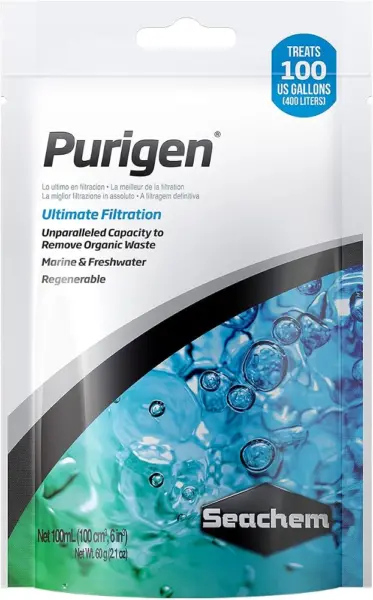
Seachem Purigen – Best Overall
Key Features
- Form: Granules
- Volume: 100 ml
- Controls: Ammonia, nitrites and nitrates
- Reusable: Regenerable
- Price: Budget
New driftwood is usually what starts the search: the tank turns tea-colored, water changes barely dent it, and no amount of floss pulls the tint out. Purigen is the media we point people to in that situation. It’s a synthetic polymer in small granules that adsorbs the dissolved organics behind the color instead of straining particles out of the water, and of everything in this guide it does the most for how a tank actually looks.
Running it is straightforward once you build in one habit. The granules arrive dusty, and that dust clouds a tank for a day if you skip the rinse, so give them a minute under the tap first. After that it sits in a fine mesh bag wherever water moves — a canister tray, a hang-on-back compartment, a sump — and it works in fresh and salt water, which the zeolite blends here can’t claim.
What separates it from carbon is what happens when it tires. A bleach soak followed by a dechlorinator soak puts it back in service, and it goes through that cycle again and again. The catch is timing: you can’t swap it for a fresh pouch on a Sunday afternoon, so a recharge means a day of running without chemical media unless you keep a spare bag charged and ready.
For a tank where clarity is the complaint, that’s a trade worth making. Buy it when the water looks yellow or dull and you’re tired of replacing carbon every few weeks, but check the label’s dose against your tank volume before ordering, because the pouch is small and a big canister may want more than one.
Pros
- Clears tannins and yellow tint
- Recharges instead of being replaced
- Works in fresh and salt water
- Fits canister trays and hang-on-back compartments
Cons
- Recharging needs a bleach and dechlorinator soak
We recommend Purigen as the first media upgrade for most tanks: it clears tannin-stained water, works on nitrogen waste, and recharges instead of being thrown away.
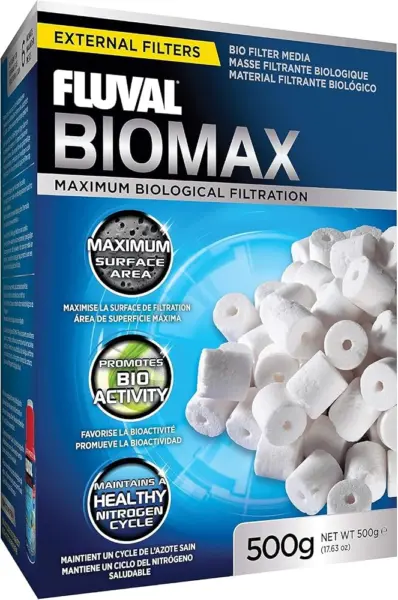
Fluval BioMax – Best Biological Media
Key Features
- Form: Porous granules
- Type: Biological media
- Weight: 1.1 lb
- Water type: Freshwater and saltwater
- Price: Premium
The best money in this guide goes on media you don’t throw away, and BioMax is exactly that. It’s 500 grams of porous biological media — the surface your bacteria colonize to process ammonia and nitrite — and one box fills a mid-size canister tray with enough left over to seed a second tank. If you’re currently buying cartridges by the month, this is the purchase that stops the bleeding.
The label says to replace it monthly. We don’t, and we don’t think you should: this is the media holding your cycle, and swapping the whole lot at once is how tanks crash. Rinse it in water you’ve just siphoned out during a change, put it back, and top up only half at a time when the pieces start breaking down. Give new media a rinse before it goes in, too, because a box can arrive gritty and that grit ends up in the tank.
The limitation is physical. The pieces are chunky, so they drop into canister trays and media bags easily but won’t slide into the narrow cartridge slot of a small hang-on-back filter. If that’s your setup, a cut-to-fit pad and a bag of carbon is the better route. For everyone running a canister, this is the part of the filter that keeps working quietly in the background.
Pros
- Holds bacteria through a filter clean
- 500 g fills a mid-size canister tray
- Rinses and re-seeds instead of being replaced
- Suits freshwater and saltwater
Cons
- Chunky pieces won’t fit slim cartridge slots
Buy BioMax once and stop paying for cartridges: it’s the biological half of your filter, and one box covers a mid-size canister tray with media to spare.
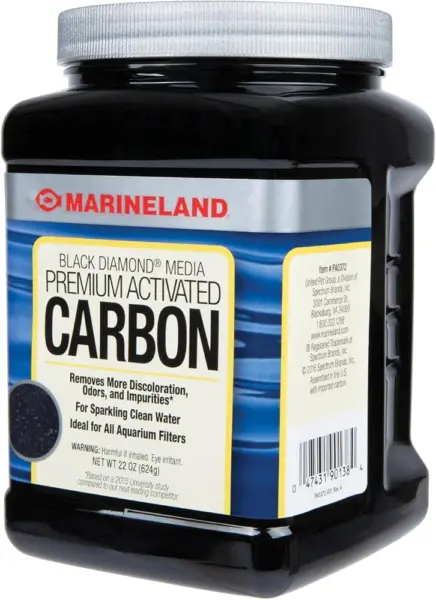
Marineland Black Diamond – Best Carbon
Key Features
- Fits: All aquarium filters
- Form: Flakes
- Weight: 22 oz
- Carbon type: Bituminous, heat-activated
- Price: Budget
Twenty-two ounces of activated carbon is a serious amount of chemical filtration, and it’s why this jar keeps turning up in our kit. It’s bituminous coal-based carbon, heat-activated, and it suits any filter type — you bag it yourself or refill a cartridge frame, and the jar carries you through a long run of monthly changes.
What we appreciate most is how cleanly it pours. Cheap charcoal throws a cloud of black dust the moment the bag opens, which means rinsing and rinsing before it goes anywhere near a tank; this one is light on dust and runs clear quickly. That sounds like a small thing until you’ve spent ten minutes at the sink, and it’s why we reach for it over pre-bagged carbon when we’re restocking.
It does the usual chemical work — odor, yellowing, the dull tint that builds between water changes — and it does it in a media bag set in the flow or in a refillable cartridge. The thing to accept is that it’s loose: keep a few bags on hand, and use a fine one so the granules stay where you put them.
Pros
- Low dust and rinses clean fast
- Enough media to refill cartridges for months
- Cuts odor and yellowing
- Works in any filter type
Cons
- Loose carbon needs bags or a refillable cartridge
If you want carbon that does the job without paying a premium for bags, Black Diamond is our pick: a big jar, little dust, and enough media to refill for months.
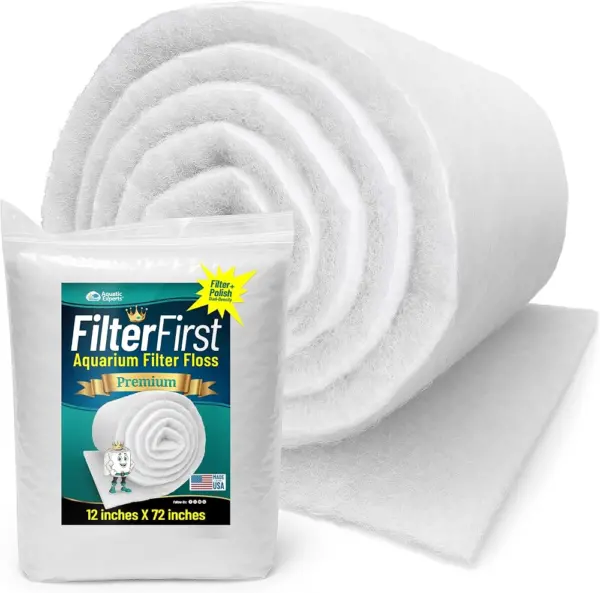
Aquatic Experts FilterFirst Pad – Best Cut-To-Fit Pad
Key Features
- Layers: Dual-density
- Thickness: 3/4 in to 1 in
- Dimensions: 12 in x 72 in
- Price: Premium
Pre-cut pads are convenient right up until you own a second filter, and then you’re storing three shapes that fit nothing else. This roll solves that. It’s 12 inches by 72 inches, three-quarters of an inch to an inch thick, with two fiber densities layered together so the outer face catches debris and the inner layers trap the fines that get past it.
Cutting takes a decent pair of scissors — the pad is thick enough that kitchen shears fight it. Trim slightly oversize, test the fit, then take off the extra, because a pad wedged into a slot will choke the flow and make the filter noisy. Once it’s in, it rinses and goes back; ours have been squeezed out several times before the fibers start to sag.
The economics are the reason to buy it. Per change it works out well below pre-cut pads for the same filter, and there’s no scramble when your size is out of stock. It’s the pick for anyone running more than one tank, or one tank and a habit of trying different filters.
Pros
- Trims to fit any filter shape
- Rinsable and reusable several times
- Two layers catch coarse and fine debris
Cons
- Thick material needs sharp scissors to cut cleanly
We keep this roll on the shelf for every filter we own: one length trims to fit all of them, and rinsing beats buying pre-cut pads.
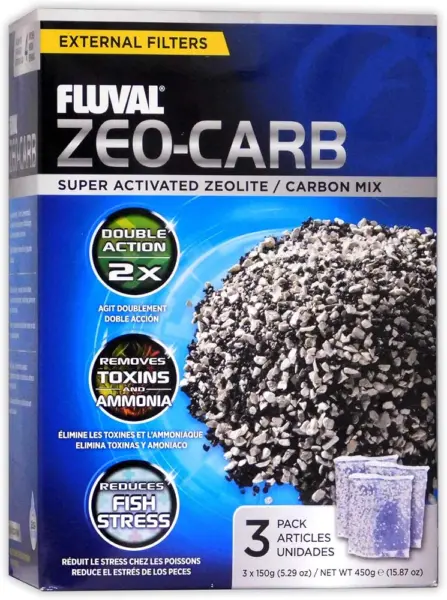
Fluval Zeo-Carb – Best for Ammonia Control
Key Features
- Media: Zeolite and carbon
- Weight: 3 x 150 g
- Water type: Freshwater only
- Price: Midrange
Zeo-Carb is freshwater only, and that’s the first thing to settle before you buy. Zeolite works by exchanging ions in fresh water; in a marine tank it doesn’t do the job, so reef keepers should look at the carbon or a regenerable resin instead.
On a freshwater tank it’s a tidy piece of kit. Each bag carries zeolite for ammonia alongside carbon for odor and color, so two jobs happen in one slot, and the three bags in a pack cover several changes. We like that the bags arrive sewn and ready — no funnel, no loose granules in the tray — and that they fold into a tight compartment without splitting.
Treat it as a response rather than a permanent plan. Zeolite adsorbs a set amount of ammonia and then stops, so it buys you the week you need to work out why the reading climbed: an overstocked tank, a filter cleaned too hard, a missed water change. Keep a pack in the cupboard for that week and let your bio media handle the long game.
Pros
- Zeolite and carbon in a single bag
- Pre-sewn bags, no loose granules
- Three bags cover several changes
Cons
Zeo-Carb is what we reach for when ammonia shows up in a freshwater tank: zeolite and carbon in one bag, ready to drop straight into the flow.
Tetra Whisper Bio-Bag – Best for Whisper Cartridges
Key Features
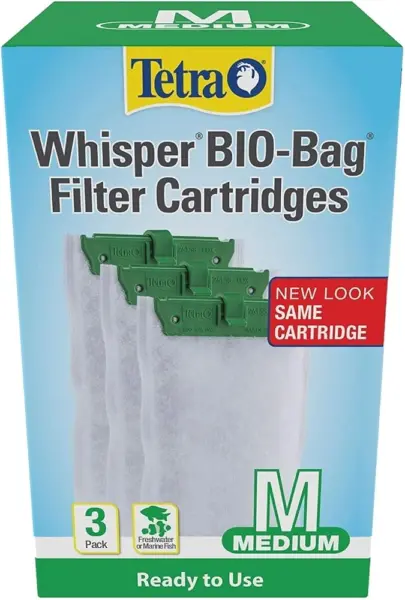
- Fits: Whisper 5-10 gal, PF-10, IQ 10
- Count: 3 cartridges
- Filtration: Carbon and dual-sided mesh
- Price: Budget
If your tank runs a Whisper 5-10 gallon, a PF-10 or an IQ 10, this is the cartridge to buy, and it’s the least expensive way we’ve found to keep one of those filters working properly. Three cartridges arrive assembled, color-coded so you grab the right size without reading the box, with carbon sandwiched between two layers of mesh.
A change takes a couple of minutes: lift the frame, slide the old cartridge out, drop the new one in. You can also stretch a pack further by tucking a little extra carbon or a pinch of zeolite into the bag before it goes in — a small thing, but it’s the difference between a cartridge doing one job and doing two.
Clarity is where these fall short in some tanks. There’s only so much carbon inside a mesh bag this size, so a small tank that’s overstocked or overfed can stay hazy on cartridges alone, and switching brands won’t fix it. Add a cut-to-fit pad or a bag of carbon behind the cartridge and the same filter does noticeably better.
Pros
- Pre-assembled and swapped in minutes
- Cheap enough to replace on schedule
- Color-coded to the correct filter size
Cons
- Small tanks can still run hazy
If your tank runs a Whisper, a PF-10 or an IQ 10, this is the cartridge we tell people to buy, and it’s the cheapest way to keep one of those filters going.
Aquatic Experts Polishing Pad – Fine Particle Haze
Key Features
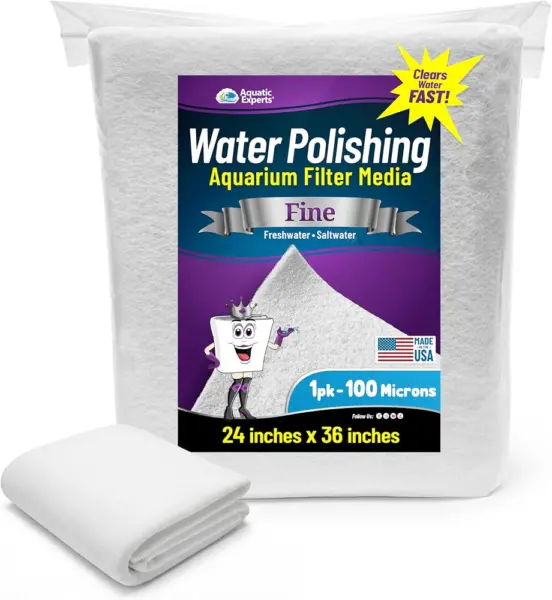
- Size: 24 in x 36 in
- Micron: 100
- Thickness: 1/8 in
- Price: Midrange
The other Aquatic Experts pad in this guide is the coarse worker; this one is the finishing pass. It’s a 100-micron sheet, an eighth of an inch thick, and its job is the particles the thicker media let through — the fine haze that leaves a tank looking dull even when the test strips read clean.
Put it after the coarse media, never before, or it loads solid in a day. Because it’s thin, it slips into slots a thick pad won’t: ahead of a cartridge, in the last canister tray, across a hang-on-back compartment. Cut it a little wider than the opening so the edges seal against the walls, and rinse it in a bucket of tank water whenever the flow drops.
We keep a sheet cut and waiting for the days a tank gets stirred up — a rescape, a substrate swap, a deep clean that leaves everything hazy. It isn’t media you run week in, week out; it’s the pad that gets the water polished when you need the tank to look right, and 100 microns is fine enough that you’ll know it’s working by how often it wants a rinse.
Pros
- Traps the fine haze coarse pads miss
- Thin enough for tight cartridge slots
Cons
- Clogs quickly and needs frequent rinsing
This is the pad we cut when a tank has to look right: 100 microns of fine polish for the last stage, provided you rinse it often.
What We Put These Filter Media Through
We started with a list of about 40 options and cut it down on size and price. Anything that came in only one dimension and wouldn’t drop into a standard hang-on-back chamber or a canister tray was out, and so was anything priced so high that replacing it on a normal schedule made no sense. That left 14 types—ceramic rings, bio balls, sponge pads, floss, carbon, and a few resin blends—which ran for four months in four tanks: a 55-gallon canister setup, two 20-gallon hang-on-backs, and a 10-gallon quarantine tank that got the heaviest feeding and the messiest fish.
Before anything went near water, I measured each piece with calipers and test-fitted it into three chambers, since media that’s a quarter inch too wide is useless in a basket. To judge effectiveness and water quality, I tested ammonia, nitrite, and nitrate twice a week with a liquid kit and timed how long a fresh tank took to cycle—three weeks for the best performers, closer to six for the worst. Clarity got checked the low-tech way: looking down the length of the tank at a white card and noting how much haze was left.
To see how well each one actually caught particles, I ground flake food into a slurry, dosed it into a bare tank, and checked at 4, 12, and 24 hours how much was still suspended. Every two weeks each media came out for a rinse in a bucket of tank water, where I watched for dust clouds, crumbling pieces, and packed-tight media that had visibly slowed the filter’s outflow. Because carbon and resin exhaust themselves, I tracked cost across three months of replacement rather than shelf price.
How to Choose Aquarium Filter Media
Buy media by the job you need done and the shape your filter accepts, because the brand matters far less than whether the stuff fits, flows, and stays wet with bacteria.
Start With the Format Your Filter Accepts
Cartridge, tray or cut-to-fit: the filter you already own decides which of the three you’re shopping for, and no amount of good media fixes the wrong shape. A molded cartridge is the easy path if your filter takes one, but measure the slot before you assume an off-brand pad will drop in. A sheet jammed into a slot that’s too tight restricts flow, which makes the filter noisy and the water worse. Loose media always needs a bag, so budget for a few.
Layer Coarse First, Fine Last
Water should meet the coarsest media first and the finest last, so the cheap material takes the hit and the fine pad doesn’t blind over in a day. A thick dual-density pad or coarse foam goes upstream; a 100-micron polishing pad goes downstream, after the debris has already been caught. Get the order backwards and you’ll be rinsing a clogged fine pad every other day and wondering why the flow keeps dropping.
Biological Media Is the Part You Keep
Bio media is a one-time purchase, whatever the packaging suggests. It holds the bacteria that process ammonia and nitrite, and replacing all of it at once restarts the cycle in a stocked tank. Rinse it in water you’ve just siphoned out during a change, never under the hot tap, and if it starts to crumble, swap half and leave the rest alone. Fluval’s BioMax is the bulk version of that idea, and a bag of it outlasts a stack of cartridges.
Buy Chemical Media by the Change, Not the Box
Carbon and zeolite exhaust on a schedule measured in weeks, and the expensive part isn’t the first purchase, it’s the twelfth. Work out cost per change rather than cost per jar: loose carbon plus a pack of bags usually beats pre-bagged media, and a regenerable resin beats both over a year because you recharge it instead of replacing it. Whichever route you take, buy enough for six months at once so a spent bag never becomes a missed change.
Frequently Asked Questions
Can I leave carbon in the filter while I’m treating a sick fish?
No. Activated carbon adsorbs medication the same way it adsorbs tannins, so a course run with carbon in place can be under-dosed and the problem comes back. Pull the carbon bag or cartridge for the length of the treatment, then run a fresh one for a week afterwards to clear what’s left in the water.
Will new filter media clear up cloudy water?
Only if the cloud is particles. If you can see specks drifting, a fine mechanical pad around 100 microns will pull them out within a day or two. If the water is milky white and nothing settles, that’s usually a bacterial bloom in a young tank, and no pad fixes it — water changes and time do.
My filter’s cartridges have been discontinued. What do I use instead?
Measure the slot — width, depth, and how much thickness the frame allows — then cut a dual-density pad to fit and put a bag of carbon or a pouch of resin behind it. Almost any hang-on-back or canister runs fine on cut-to-fit media, and it usually costs less per change than the cartridge it replaced.
Final Verdict
Most tanks don’t need a new filter; they need better media inside the one already hanging on the glass, and Purigen is the upgrade we recommend first. It’s the pick that changes how the water looks, it runs in fresh or salt, and recharging keeps the cost down to a soak and a day’s wait.
If you’re setting up a canister and want the biological half sorted once and for all, take BioMax instead. The two work well together, and neither one asks you to buy it again next month.