This post contains affiliate links. We may earn a small commission when you buy through our links — at no extra cost to you.
Drop a dried leaf into a tank and it does two jobs at once: it leaches tannins that tint the water the color of weak tea and nudge the pH down, and it gives shrimp, snails, and bottom-dwellers something to graze on. The catch is that catappa leaves are a natural product, so no two batches behave alike — one bag arrives whole and leathery, the next crumbles into confetti the moment it hits water. The right leaf softens the water and gives the tank that blackwater look; the wrong one clouds it, fuzzes over, or vanishes in three days.
Over the past four months, my team and I ran 16 batches through three tanks — measuring leaf size, watching how dark the water turned, and timing how long each held together before going to lace. A good bag comes down to unglamorous things: leaves big enough to matter in your tank, intact rather than shattered, and clean enough that you aren’t netting out fuzz a week later. Price per usable leaf says more than the number on the bag. The picks below are the ones that tinted properly and held up.
Our Top Picks
The Best Catappa Leaves for Aquariums, Reviewed
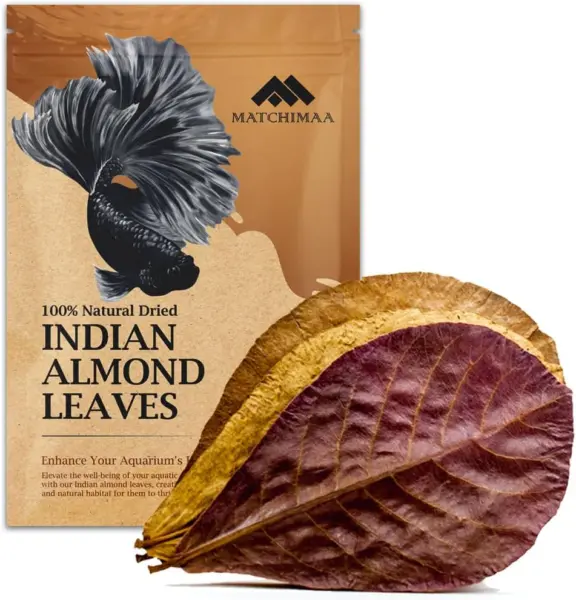
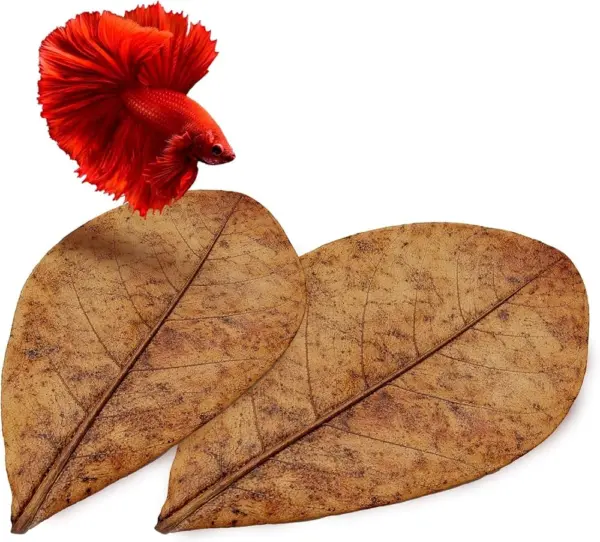
MATCHIMAA Indian Almond Leaves – Best Overall
Key Features
- Leaf size: 6–9 in
- Pack weight: 1.76 oz
- Leaves per pack: 20–25
- Price: Midrange
Six to nine inches is a big leaf, and it changes the dose more than any other detail here. In a five-gallon betta tank we use half a leaf, which means a 50-gram bag of twenty-odd leaves does the work of a bag twice its size. That efficiency is why this is our top pick. The leaves also arrive whole and properly dry — we sorted through the bag looking for chipped edges and split midribs and found almost none.
The tannins come out fast. A leaf dropped in at night had turned a small tank’s water a clear amber within a day, and the colour deepened from there. In a 20-gallon the same leaf is a much quieter presence, which is worth knowing before you buy: this is a bag for people who want to see the tint, not a subtle background effect.
Submerged, the leaves behave. Ours went soft rather than slimy, held their shape for a few weeks with shrimp working on them, and came out in one piece when we finally lifted them. Bettas use them the way you would hope — resting on top, cruising underneath, picking at the biofilm that builds on the surface. It is a small thing that makes a bare tank look like somewhere a fish actually lives.
The catch is simply that these are big leaves. In anything under about ten gallons you will be tearing or cutting them to a sensible size, and a whole one floating in a nano cube shades most of the tank. That is a minor annoyance, and it is the price of leaves that go twice as far as the small ones.
Pros
- 6–9 inch leaves go twice as far as small ones
- Arrives dry, whole and mostly unbroken
- Tints small tanks within a day
- Holds shape for weeks with shrimp on it
Cons
- Leaf size varies within the bag
Our pick for most betta and shrimp tanks: big, clean leaves that tint quickly, and one leaf split across two small tanks still does the job.
SunGrow Catappa Leaves, 10 Pack – Best Starter Pack
Key Features
- Leaf size: 4–7 in
- Pack weight: 0.78 oz
- Leaves per pack: 10
- Price: Budget
One betta tank, one small bag: that is the case for this ten-pack. The leaves run four to seven inches, big enough to give a betta a roof and small enough that a single leaf in a five- or ten-gallon does not take over the water column. If you have never used catappa before, this is a low-stakes way to find out whether you like the look.
They arrive clean and intact, and we did not need to boil them to get them waterlogged — a rinse and a few hours floating and they were on their way down. What sold us is how quickly fish take to them: bettas sit on top, shrimp work the edges, and both keep coming back. The tint is gentle, closer to weak tea than blackwater, so a single leaf in a big tank may barely register.
That gentleness cuts both ways. If you want visible colour in a 20-gallon, plan on two or three leaves at once, which makes the ten-pack shorter-lived than the count suggests. Ten leaves is still the right number for a first betta tank or a quarantine tub, where the point is trying the look rather than stocking a shelf.
Pros
- Ten leaves suit a single betta tank
- Bettas rest on them and graze within days
- Rinses clean; no boiling needed to sink
- Gentle tint won’t darken a display tank
Cons
- Leaf sizes vary a lot within a pack
The pack we hand to someone setting up a first betta tank: ten leaves, little waste, and fish using them for cover inside a week.
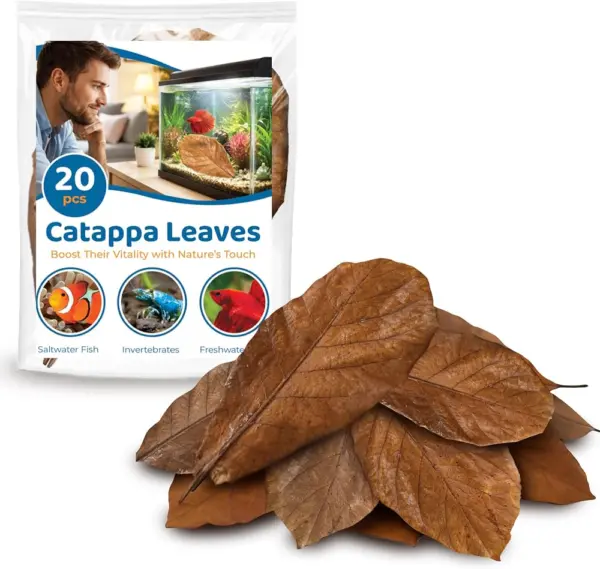
SunGrow Large Catappa Leaves, 20 Pack – Best for Large Tanks
Key Features
- Leaf size: 7–8 in
- Pack weight: 1.38 oz
- Leaves per pack: 20
- Price: Budget
Twenty leaves at seven to eight inches is more leaf than most single tanks will use while the leaves are still worth having. Catappa fades in storage — thin, soft leaves from an old bag give up far less colour than crisp new ones — so a big pack is only a bargain if you have the tanks to spend it in.
In a 29-gallon, one of these is close to the height of the tank, which makes it scenery rather than a dose. We like them for that: adult bettas shelter under a leaf this wide instead of balancing on top of it, shrimp work the surface for days, and the whole thing reads as leaf litter rather than decoration. The first leaf left obvious tannins within a couple of days in our tank, so start with one unless you want a dark tank.
Submerged, they last. One leaf kept its shape for weeks before it went soft enough to lift out in pieces, and shrimp spent most of that time on it. These are unprocessed leaves, dark and irregular, with the odd torn edge and thick midrib — which is what an unprocessed leaf looks like, and it has never bothered us in a tank.
Pros
- 7–8 inch leaves suit 29-gallon tanks and up
- Adult bettas shelter under a leaf this wide
- Holds together for weeks of shrimp grazing
- Twenty leaves cover a breeding rack
Cons
- Big leaves shade plants when floated
- Some leaves arrive torn or partial
The pick for a 29-gallon or a breeding rack: leaves big enough to shelter adult bettas, with twenty in the bag to spread across several tanks.
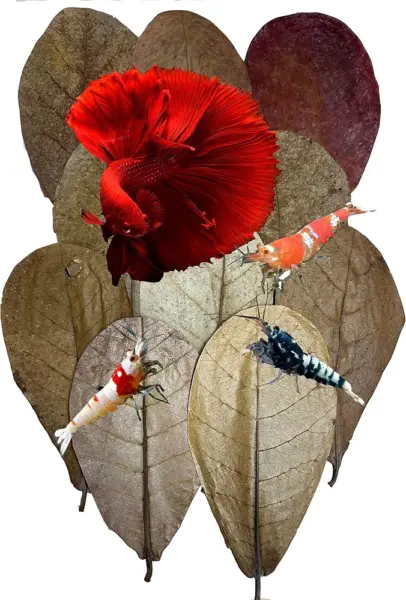
Awesome Aquatic Catappa Leaves – Light Tint
Key Features
- Leaf size: 4–6 in
- Pack weight: 1 oz
- Leaves per pack: 10
- Price: Budget
This costs about the same as the SunGrow ten-pack, and the difference is the leaf. Four to six inches is a flatter, more manageable size — it tucks around stems and driftwood without the trimming the six-to-nine-inch leaves need, and it fits a ten-gallon without dominating it.
Floated, one leaf does what you want it to. Ours turned the water a light brown rather than tea-dark, and within a day or two our betta was hanging underneath it instead of patrolling the glass. That is the effect people buy these for, and it is why we keep a small pack in the rotation for tanks where we want a tint without a full blackwater look.
The caveat is consistency between bags. Tannin output swings — some packs colour a tank quickly, others barely register without help — so if you want the full effect, crush a leaf or steep it in hot water first and pour that in. Treat this as a good cheap way to try catappa in one tank, not as the pack you buy when you need the same result every time.
Pros
- Cheap way to try catappa in one tank
- Light amber tint rather than dark tea
- Fits around plants without trimming
- Bettas nest under a floating leaf
Cons
- Leaves arrive brittle and crack easily
A low-commitment buy for one tank and a light amber tint, especially if you would rather not darken the water.
Sera Catappa Leaves, Small – Best for Nano Tanks
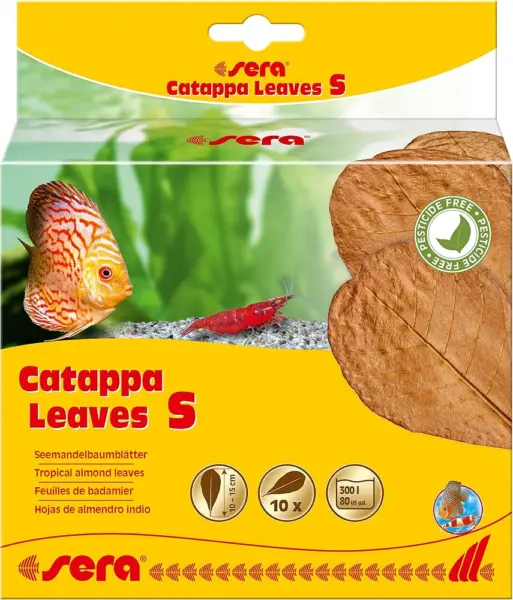
Key Features
- Leaf form: Dried leaves
- Leaf size: Small
- Pack weight: 1.06 oz
- Price: Premium
Small leaves are their own tool. Where a six-to-nine-inch leaf has to be torn in half for a five-gallon, these go in whole, stay where you put them, and lift out in one piece — exactly what you want in a nano tank or a quarantine tub you break down often. We keep small-leaf packs for those setups and reach for the big ones only when a tank has the volume to justify a big leaf.
The 30-gram pack also suits someone who wants to adjust the tint a leaf at a time: a small leaf makes a gentler brew, so you can add one, wait, and add another rather than committing a whole big leaf and living with the result. What it is not is a community-tank purchase — in a 40-gallon you would be dropping in a handful at once to see any colour at all, and the bag would be gone in a season.
Pros
- Small leaves fit nano tanks without trimming
- Lift out whole when you strip the tank
- Build the tint one leaf at a time
Cons
- Needs several leaves in a larger tank
The one to buy for nano tanks and quarantine tubs, where small leaves let you build the tint a leaf at a time.
How We Tested the Catappa Leaves
We gathered every batch of catappa leaves we could find that was sold in a reasonable quantity and claimed to be pesticide-free, then narrowed the field by leaf size, pack count, and price per leaf until 16 batches from 10 different sources were left. Everything was ordered and handled identically over four months.
Each batch went into real tanks: a 20-gallon betta setup, a 10-gallon neocaridina shrimp colony, and a bare quarantine tank where we could see what a leaf did without gravel in the way. I measured every leaf with a ruler and noted its shape and color, then dropped one in floating and one weighted down. To judge tannins, I held a white index card behind the glass and checked it on day one, day three, and day seven to see how deep the tea color went and whether it read brown or muddy.
Durability announced itself on its own schedule — one batch went soft and skeletal in nine days, while the toughest leaves still held their shape at five weeks. I sorted each bag into a white tray looking for dust, mold spots, broken fragments, and anything that shouldn’t be in there, and I watched how the shrimp responded: clustering on a leaf means it’s soft enough to graze, while leaves they ignored stayed stiff. For value, we counted how many leaves per bag were usable whole rather than torn or undersized, so a big cheap bag of shards didn’t score well.
Several batches are still sitting in tanks now, and I’ll keep checking them. Anything that fuzzes up within a week is out, no matter how well it tints.
How to Choose Catappa Leaves for Your Aquarium
Catappa leaves are sold as a cure-all, but the decision that actually changes your tank is leaf size and how fresh the leaves are when they reach you.
What Catappa Leaves Actually Do
Tannins are the point. They tint the water amber, soften it slightly and nudge pH down over weeks rather than hours — a handful of leaves in hard water will not move a reading much, so buy them for the environment rather than as a fix. The other half of the job is structural: a leaf’s surface grows biofilm that shrimp graze, and a floating leaf gives a betta somewhere to sit and build a nest under.
What they are not is medication. If a fish is sick, a leaf is not the treatment, and leaves will not remove ammonia or chlorine. Think of them as habitat and a slow cosmetic change to the water, which is what most keepers actually want from them.
Match Leaf Size to the Tank
Leaf size decides how much control you have. In a five- or ten-gallon, half of a six-to-nine-inch leaf is a sensible dose and a whole one is a shade problem; in a 29-gallon and up, a seven-to-eight-inch leaf is the right scale. Small leaves suit nano tanks and quarantine tubs, where you want to drop one in and pull it out without tearing the setup apart.
In a planted tank, remember that a big floating leaf is also a shadow. Float it in a corner or wedge it at the back, away from anything that needs light.
Inspect the Bag Before It Goes In
Leaves are an agricultural product, and the bag you get is not the bag someone else got. What you want is dry and crisp rather than leathery, mostly whole rather than crumbs, and no white fuzz or musty smell. A pack that arrives damp with mold growing between the leaves should go back, not into the tank.
Store the rest sealed and dry — a zip bag in a dark cupboard works. Leaves that sit soft and thin in the bag tint water weakly when you finally use them.
Decide How Dark You Want the Water
Tint is a preference, not a quality grade. One leaf gives a light amber, several give strong tea, and crushing or steeping a leaf in hot water draws colour out faster. Add one at a time over a week rather than committing three at once; you can always add another, but you cannot take the colour back out.
If you keep a light-hungry planted tank, that trade matters. A deep tint changes both the look and the amount of light reaching the plants, so choose the lighter end of the range deliberately rather than by accident.
Frequently Asked Questions
How many catappa leaves should I put in a 10-gallon tank?
Start with one four-to-seven-inch leaf, or half of a six-to-nine-inch one, and give it a few days to see what it does. Half a large leaf per five gallons is the ratio we landed on; if you want a deeper tint, add a second leaf later rather than starting with three.
Leaves can be pulled out, but the colour they have already released stays until a water change, so adding slowly is the safer order.
Should I boil catappa leaves before adding them?
A rinse is usually enough. A short soak in hot water sinks the leaf faster and pulls tannins out sooner, which is handy when you want colour on day one — let the water cool and pour that in too rather than tipping it away.
Skip the hot soak if you would rather the leaf stay intact in the tank for weeks.
Do catappa leaves replace a water conditioner?
No. They add tannins; they do not remove chlorine or chloramine from tap water. Dechlorinate as usual, then add the leaf.
The same caution applies to water quality in general: leaves will not fix an ammonia problem, and a heavy load of decaying leaf in a tank with weak flow uses up oxygen.
Can I use catappa leaves with carbon in my filter?
You can, but expect a paler result. Activated carbon strips the compounds that colour the water, so a tank running fresh carbon will look much lighter than the same leaves in a tank without it.
If the tint is the reason you are buying the leaves, run the carbon only when you need it and take it out for the week after you add a leaf.
Final Verdict
Buy the MATCHIMAA bag first. Whole, dry six-to-nine-inch leaves that tint a tank within a day, and a half-leaf dose that stretches the bag across two small tanks or one bigger one. It is the pack we would hand to almost anyone keeping bettas or shrimp.
If you keep a single betta tank, the ten-leaf SunGrow pack is sized to it. If you are running a 29-gallon or a breeding rack, the seven-to-eight-inch SunGrow leaves are the better fit, and the small-leaf Sera pack is the one for nano tanks and quarantine tubs.