This post contains affiliate links. We may earn a small commission when you buy through our links — at no extra cost to you.
Activated carbon is the quiet worker in an aquarium filter: water passes through, and it grabs odors, discoloration, and the organic bits that make a tank look tired. The catch is that not every bag of black granules behaves the same. Some cloud the water with dust no matter how long you rinse, some seem spent in a week, and some are mostly filler for the amount you get. You want carbon that clears the water, keeps the tank from smelling like a fish room, and feels worth the money once you see how much usable media is in the container.
Over four months, I ran 14 activated carbons in my freshwater tanks, from a hang-on-back filter on a busy community tank to a canister on a larger setup. I tracked how much dust came off and settled, how quickly the water cleared, whether odors faded, and how the granules held up. I also noted granule size and bag fit in the filter compartment. The best ones were not always the biggest containers; they delivered clean water without a fight.
Our Top Picks
The Best Aquarium Activated Carbon, Reviewed
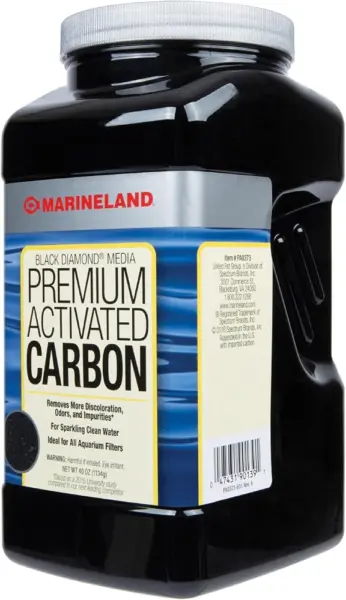
Marineland Black Diamond 40 oz – Best Overall
Key Features
- Filter fit: All aquarium filters
- Carbon form: Loose granules
- Carbon type: Bituminous coal
- Package size: 40 oz
- Price: Midrange
The container is the argument. Black Diamond is 40 ounces of loose, heat-activated bituminous carbon, and a jar that size outlasts the little pre-filled cartridges most of us started with by a wide margin. There’s no proprietary basket involved, so it goes into the canister you already own, the hang-on-back you’re about to refill, or a media bag dropped into a sump.
We recommend it as the default because it keeps doing the job without drama. The granules rinse quickly, the water in our tanks lost its leaf-litter tint and its sour smell and stayed that way until the next change, and nothing about the media called attention to itself afterward.
Value is the other half of the case. You aren’t paying for nylon and a cardboard sleeve, so the cost per change is lower than any of the pre-bagged picks here, and a jar this size puts the next reorder a long way off.
Where it gives ground is convenience — the bagged options win that. What it keeps is control: you decide how much goes into each tray, so a lightly stocked tank gets a light charge instead of a whole cartridge, and after a medication course you can run a heavy one to strip the treatment back out.
Pros
- Works in any filter you already own
- Big jar spreads the cost over many changes
- Clears tint and odor, not just color
Cons
- Loose form needs a separate media bag
Our default recommendation for most tanks: a big jar of loose bituminous carbon that fits any filter and costs the least per change.
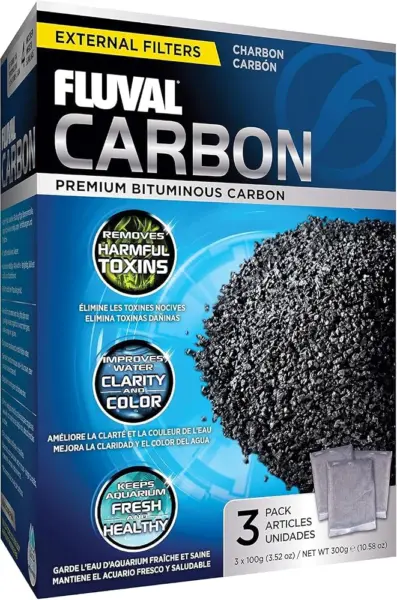
Fluval Carbon 100 g Bags – Best Pre-Bagged for Canisters
Key Features
- Filter fit: Fluval 100–400 series, FX5
- Carbon form: Pre-bagged, 100 g bags
- Package size: 3 bags (300 g)
- Price: Midrange
The bag is the product. Each of the three in the box is 100 grams of low-ash bituminous carbon already sealed in nylon, so a media change is a rinse and a drop rather than a scoop, a funnel, and a dust cloud over the sink. These are what we hand anyone with a Fluval canister who has better things to do than portion carbon.
Fluval lists them for its 100-, 200-, 300-, and 400-series canisters plus the FX5, and because the bag is a soft pouch rather than a molded cartridge, it also wedges into plenty of third-party baskets. The carbon inside is the same low-ash bituminous material the brand uses across its range, rated for fresh and salt water and meant to come out every four weeks.
What you’re paying for is the portioning. These cost more per change than the loose carbon here, so they suit the single tank where convenience wins — not a rack of five you change on the same afternoon.
The one wrinkle is cosmetic: the bag can stain rust-brown after a few weeks in the water. It looks worse than it is and the carbon keeps working, so don’t read a discolored bag as a spent one.
Pros
- Pre-measured 100 g bags, no scooping
- Fits Fluval 100–400 series and FX5
- Low-ash carbon for fresh and salt water
Cons
- Costs more per change than loose carbon
Buy these if you want a canister media change to take a minute; we think the portioning is worth the higher cost per change.
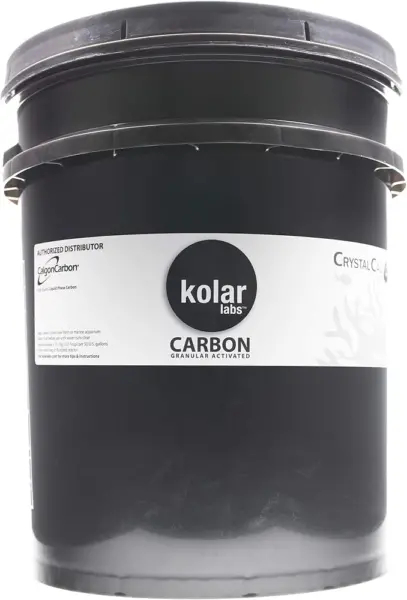
Kolar Labs Crystal Cal 5 Gal – Best for Ponds and Big Tanks
Key Features
- Dose: 1 cup per 50 gal
- Grade: Laboratory grade, FCC
- Carbon form: Loose granular
- Package size: 15 lb (6.8 kg)
- Price: Premium
Fifteen pounds of carbon is a commitment, not a purchase. Kolar packs it in a five-gallon pail aimed at people with a pond, a rack of grow-out tanks, or a display big enough that a cup of media disappears into the sump.
The specification sheet backs that up. The carbon is made to Food Chemicals Codex standards, described as laboratory grade, and sized as large granules so water moves through a bag or reactor instead of channeling around it. The label dose — one cup per 50 gallons, changed every two to four weeks — scales with water volume rather than filter size, which is the right way to think about carbon in a big system.
Our take is that this is a sensible buy for a big display or a koi pond and the wrong one for anything you can carry to the sink. Big systems go through media fast, the pail solves the reorder problem, and coarse granules hold up in a reactor where finer carbon compacts and channeling starts.
Dust is the price of the grind. Budget a colander and several minutes at the tap, and don’t be surprised when the first rinse still runs grey. Once a month on a system this size, that’s a minor nuisance.
Pros
- 15 lb pail suits ponds and big displays
- Lab-grade carbon made to FCC standards
- Coarse granules flow well in reactors
Cons
- Very dusty and needs a long pre-rinse
- Premium price only pays off at volume
We keep this one for ponds and big displays: lab-grade coarse carbon in a pail that suits real volume, not a 20-gallon tank.
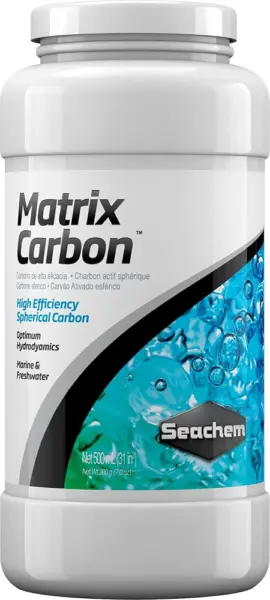
Seachem Matrix Carbon 500 ml – Best for Nano and Reef Tanks
Key Features
- pH effect: Will not raise pH over 7.0
- Carbon form: Loose spheres
- Package size: 500 ml
- Price: Midrange
Most carbon listings say nothing about pH. Seachem’s says the carbon won’t push your water above 7.0, which matters if you keep soft-water fish, shrimp, or a reef tank and have watched hardness climb after a cheap carbon went in.
That promise plus the shape of the granules is why this is our pick for nano and reef tanks. The carbon is formed into uniform spheres that rinse clear quickly and sit in a mesh bag without slipping through the openings, and in a 20-gallon system that’s the difference between a five-minute change and twenty minutes of chasing black specks off the sand.
Five hundred milliliters is the limitation. That’s a small tub — a couple of months on a nano tank, not a season on a 75. The other claim, no binding or packing, is about the granules staying loose rather than fusing into a brick, which is what lets you lift a bag out and shake it clean instead of chiseling it apart.
Set against the Black Diamond jar, you’re paying more for less carbon and getting cleaner media and a pH guarantee in return. In a 10- or 20-gallon reef that’s a fair swap; in a 125-gallon community tank it isn’t.
Pros
- Will not raise pH above 7.0
- Uniform spheres stay put in mesh bags
- Rinses clean faster than bulk carbon
Cons
- Small 500 ml tub is costly on big tanks
Our pick for nano and reef tanks, where pH stability and clean, dust-free spheres matter more than buying carbon by the pound.
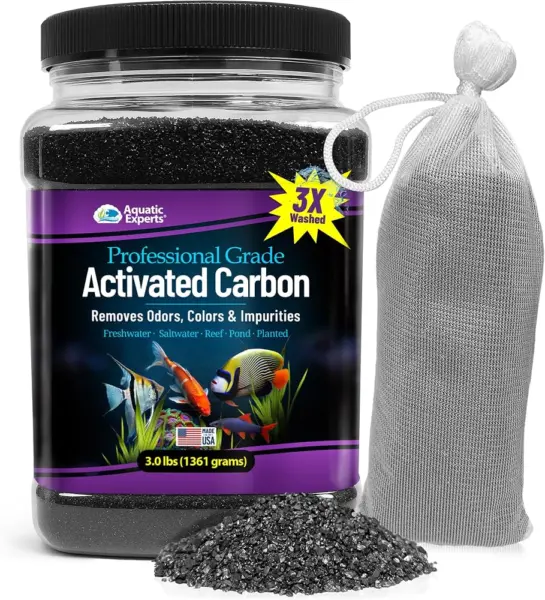
Aquatic Experts 3 lb Carbon – Best Bulk Pick with a Media Bag
Key Features
- Included: Reusable fine mesh bag
- Carbon form: Loose granules
- Package size: 3 lb
- Price: Midrange
Rinsing carbon is the chore the product photos never show, and it’s the reason this one caught our eye. Aquatic Experts sells three pounds of granular carbon with a reusable fine-mesh bag in the box, and the pitch — carbon cleaned of the ash packed into its pores — shows up where it counts, in a shorter stretch at the tap before the runoff runs clear.
The granules are fine, and we mean that literally. In the included bag they stay contained and behave; in an open tray or a coarse-mesh bag they migrate, and the smaller pieces end up as grit on the substrate. This is carbon for a fine bag, a packed media tower, or a canister tray that already holds its media snugly.
Three pounds is a sensible middle quantity: enough for a few months of changes on a mid-size tank, small enough that you aren’t storing a pail under the stand. The bag is reusable, which is the part we came to appreciate most — by the third swap, not hunting for a bag is a real convenience.
Against the Marineland jar you’re paying more per pound and getting a bag and a shorter rinse for it. Against the Fluval bags you’re doing the portioning yourself and spending less per change. It’s the middle path, and a good one if your filter already has a fine basket.
Pros
- Includes a reusable fine-mesh media bag
- Shorter rinse than most bulk carbon
- Fine granules pack into small baskets
Cons
- Fine granules escape coarse bags and open trays
- Costs more per pound than plain bulk carbon
We like it for fine mesh baskets and packed media towers; the granules are small, so a coarse bag is the wrong home for them.
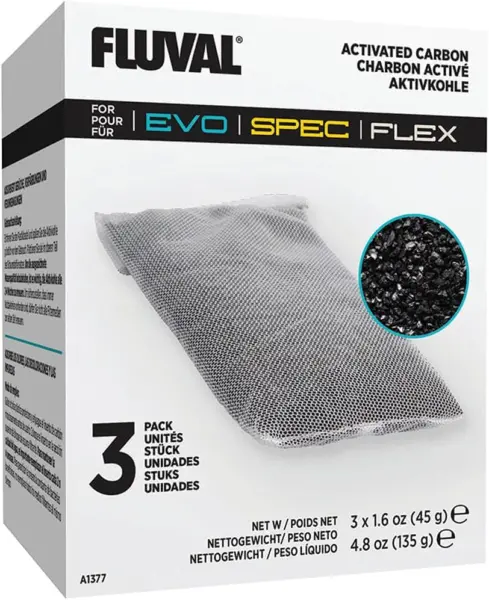
Fluval Spec/Evo/Flex Carbon – Best for Fluval Desktop Tanks
Key Features
- Filter fit: Fluval Spec, Evo, Flex
- Carbon form: Carbon inserts
- Package size: 3 inserts
- Price: Budget
Three tanks, one box, no decision to make: these inserts are cut for the Fluval Spec, Evo, and Flex desktop aquariums, and if one of those is on your counter, the sizing question is already answered.
Each insert is a small charge of Fluval’s research-grade carbon that drops into the tank’s own media chamber. Fluval credits it with pulling heavy metals, odors, and discoloration out of the water, and the practical benefit in a desktop kit is turnover — three in a box means a monthly change is affordable enough that you’ll actually do it.
Cheap and frequent beats expensive and stretched. A desktop tank has a shallow chamber and a small volume of water, so the amount of carbon in one insert is never the limiting factor; the schedule is. What we like is that the calendar becomes the only thing to remember.
The insert is small on purpose: it’s matched to a chamber the size of a card, and in a 40-gallon hang-on-back it’s a token amount of media. Expect discoloration too — the insert can pick up rust-colored spots after a few weeks, which looks alarming and doesn’t mean it has stopped working.
Pros
- Drop-in fit for Fluval desktop tanks
- Three inserts per box, easy to change monthly
Cons
- Only fits Fluval Spec, Evo and Flex tanks
Buy these if you own a Fluval Spec, Evo, or Flex — the small inserts make a monthly change cheap enough to keep up with.
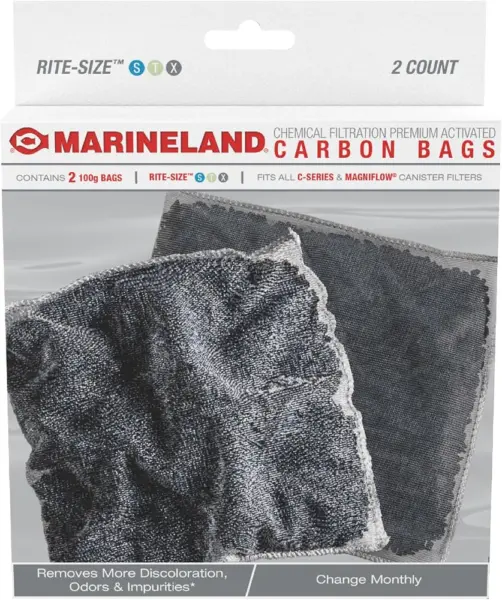
Marineland Rite-Size Carbon Bags – Best for Marineland Canisters
Key Features
- Filter fit: Marineland C-series, Magniflow
- Carbon form: Pre-filled bags
- Package size: 2 bags
- Price: Budget
A canister media change is a five-minute job that stretches to twenty when the carbon isn’t already in a bag of the right shape. These are pre-filled Rite-Size bags of the same Black Diamond carbon we recommend at the top of this list — the low-effort version for anyone running a Marineland canister.
Marineland lists them for its C-series and Magniflow filters in three fittings, S, T, and X, and the shape matters more than it sounds: the bag has to lie flat in the tray without blocking flow around it. Match the letter to your filter before you order, because that’s the one mistake that turns a convenience into a return.
Performance is the Black Diamond performance. Discoloration and odor go, the water clears, and the bag holds together through a month in the tray. Where these win is on the calendar: a bag that goes in without touching loose carbon is a bag that gets changed on time.
Our reservation is flexibility. The bags are shaped for one family of filters, and if yours isn’t a C-series or a Magniflow, a loose jar plus a bag of your own is the same carbon with none of the fit risk. For Marineland owners, though, this is the simplest route to clear water in the group.
Pros
- Pre-filled bags sized for Marineland trays
- Same Black Diamond carbon as our top pick
Cons
- Sized only for Marineland C-series and Magniflow
For Marineland canister owners, we think the pre-filled bags are the least fussy way to keep carbon on schedule.
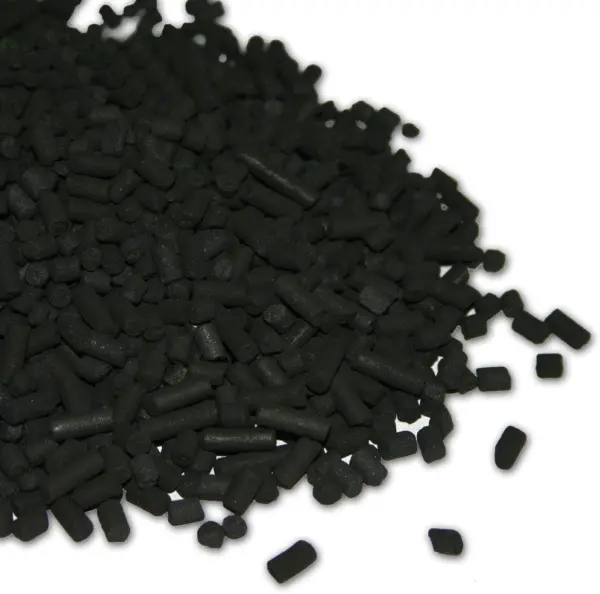
Aquapapa 6 lb Carbon Pellets – Best for Large Reactors
Key Features
- Phosphate: Phosphate free
- Carbon form: Pellets
- Pellet size: 4 mm diameter
- Package size: 6 lb
- Price: Midrange
Open the bag and the first hour of ownership is decided: black dust on your hands, the sink, and anything within arm’s reach. Aquapapa’s pellets are chunky, inexpensive, and genuinely dirty out of the package, and no amount of wishful thinking changes that.
Get past the rinse and the 4 mm pellets are the reason to buy. They’re large enough to sit in a coarse media bag without washing through, which makes them a good match for a reactor or a wide-slot canister tray where finer granules would end up in the tank. Six pounds is a lot of media, and phosphate-free means no extra nutrient load in a reef or a planted tank.
Results are decent but not uniform. Clarity is the reliable half — a fresh charge knocks the tint out of the water and keeps it out for the usual month. Odor is the half that doesn’t always deliver, so if a smelly tank is the specific problem, spend more on one of the picks above.
Volume is where it earns its place. This is the cheapest way here to fill a big reactor or a multi-tray sump, and the dust is a one-time annoyance if you have a bucket, a colander, and somewhere outdoors to work. For a rinse you can do at the kitchen sink without a production, buy the Marineland jar instead.
Pros
- 4 mm pellets stay put in coarse bags
- Six pounds at a low cost per change
- Phosphate free for reef and planted tanks
Cons
- Very dusty straight out of the bag
- Odor control is inconsistent
We buy it for volume — six pounds of 4 mm pellets for big reactors — and accept the dust and inconsistent odor control as the trade.
How We Tested Aquarium Activated Carbon
We started with the carbon brands aquarists mention most often, then narrowed the list by checking whether each label stated carbon type, granule size, and net weight. That left 14 products, which we tested over four months in established freshwater tanks. We poured each container through a kitchen sieve first, noting how much dust and crushed material fell through and how uniform the remaining granules looked. That gave us a read on carbon quality, carbon content, and how much of the container was likely to end up as dust in the tank.
For each product, I measured an equal volume into a media bag, rinsed it under running water, and counted rinses until the runoff ran clear; I also checked the bottom of the rinse bucket for grit that had settled out. Then I ran the bags in hang-on-back and canister filters on stocked community tanks. Twice a week, I checked water clarity against a white card, smelled the tank for stale fish-room odors, and watched whether flow through the bag slowed. I logged how long each carbon kept clarity up and odor down before it needed changing, and whether the granules broke down or the bag clogged.
At the end, I compared how much usable carbon each container delivered against how long it performed, not just the size of the package. I also noted whether granule size and bag shape fit common filter compartments without cramming, and how much dust remained after the first rinse versus what kept accumulating in the filter. The products that scored best rinsed clean quickly, held their structure, kept water clear, and still looked like a sensible value once the dust was washed away.
How to Choose Aquarium Activated Carbon
Carbon is close to a commodity — what separates one box from another is whether it fits your filter, how long you spend rinsing it, and how much of it you’ll still be storing next year.
Match the form to your filter, not the brand
Loose granules, pre-filled bags, and molded inserts all do the same chemical job; the difference is how they sit in your filter. With a standard media basket or tray, loose carbon plus a mesh bag is the cheapest way to buy it and lets you charge lightly or heavily as your stock changes. With a proprietary chamber — a Fluval Spec, an AquaClear, a Marineland canister — the matching insert or bag saves you improvising. The trap is buying a desktop-tank insert for a 40-gallon hang-on-back: it fits, but it’s a token dose of carbon in a lot of water.
Granule size has to match the bag
Carbon has to stay in the bag; if it doesn’t, you’re picking black grit off the substrate for a month. Fine granules need fine mesh, while 4 mm pellets and coarse granules work in loose bags and reactors where water moves hard. If you’re buying carbon and a bag at the same time, check the mesh against the grind before ordering, or buy a product that ships with its own bag — Aquatic Experts’ three-pound tub does — and skip the guesswork.
Budget for the rinse
Every carbon is dusty; the question is how many minutes at the tap it costs. Pre-bagged and pre-cleaned carbons cost more precisely because someone else did part of that work, and in a small tank that premium buys a change you’ll actually do on a weeknight. Rinse in a colander or bucket until the runoff is mostly clear rather than perfectly clear. Chasing the last of the dust wastes water and tells you nothing about how the carbon will perform.
Buy the quantity your tank will use
Carbon doesn’t improve with age, and an open pail sits there picking up whatever the room’s air carries. A 15-pound container makes sense for a pond or a large display that goes through cups of media a month; on a 20-gallon tank it’s years of storage and a much bigger upfront bill. Match the package to a few months of changes rather than a few years, and replace the charge on the four-week mark that both Fluval and Marineland print on their packaging.
Ash, pH, and what carbon can’t fix
Low-ash carbon matters more in a reef or a shrimp tank, where ash can leave residue and some carbons push pH or phosphate. Seachem’s promise that its carbon won’t raise pH past 7.0 is the clearest statement of that boundary among these picks. Carbon also adsorbs medication, so pull it during treatment and run a fresh charge afterward. What it won’t do is replace water changes or biological media — if ammonia is reading above zero, carbon is not the fix.
Frequently Asked Questions
Does activated carbon remove ammonia or nitrite?
No. Carbon adsorbs dissolved organics — the tannins that yellow the water, the compounds behind aquarium smell, and medication — but ammonia and nitrite are the biological filter’s job. If your test kit is showing color, fix the filter and the stocking first. Buy carbon for clarity and odor, not for a nitrogen problem.
How much carbon should I use per gallon?
A workable ratio is one cup per 50 gallons, or about a tablespoon for every three gallons, which is the dose Kolar Labs prints on its pail. Treat it as a starting point: a heavily stocked tank or one clearing medication takes a full charge, while a lightly stocked nano needs only a small bag in its chamber.
Don’t overfill a small filter. Packing a chamber tight slows flow, which costs you more in filtration than the extra carbon gains.
Can I just drop the carbon into the tank?
Put it in the filter, not the water. Carbon needs flow through it to work, and a bag sitting on the substrate mostly blocks flow and collects debris. If your filter has no spare chamber, hang the bag in the outflow or tuck it into a media basket so water passes through the media rather than around it.
Will carbon clear green water?
Usually not. Green water is suspended algae, which responds to light and nutrient control rather than adsorption; carbon is the tool for yellow, tea-colored water and for dissolved odors. A milky bacterial bloom also clears on its own.
Shorten the photoperiod, cut back feeding, and step up water changes before you buy more media.
Final Verdict
Buy the Marineland Black Diamond jar. It’s the carbon we keep coming back to because it fits whatever filter you already own, costs little per change, and handles both the tint and the smell — the two reasons people go looking for carbon in the first place.
Choose differently for a reason: the Fluval bags if you want the swap to take a minute, Seachem Matrix if you keep a nano reef and care about pH, and Kolar’s pail if your system is measured in hundreds of gallons rather than tens.