This post contains affiliate links. We may earn a small commission when you buy through our links — at no extra cost to you.
A filter is the one piece of aquarium gear you can’t afford to get wrong. It’s not just about clear water; it’s about keeping fish healthy, keeping the living room quiet, and not dreading maintenance because a seal might fail or a media basket might fight back. I’ve kept tanks for years, and the difference between a good filter and a frustrating one shows up in small moments: the hum from the couch, the drip under the stand, the sponge that won’t come out of a cramped chamber. The right 50-gallon filter handles all that quietly, so you enjoy the tank instead of babysitting the hardware.
Over eight months, I ran 12 filters on a 50-gallon community tank in my living room, with a second tank in the utility room for leak checks. I noted which stayed quiet over time, which kept their flow without fiddling, and which were easy to clean during weekly water changes. A filter that costs more but spares you noise, leaks, and scrubbing time is usually the better value—and the picks below reflect that.
Our Top Picks
The Best 50 Gallon Aquarium Filters, Reviewed
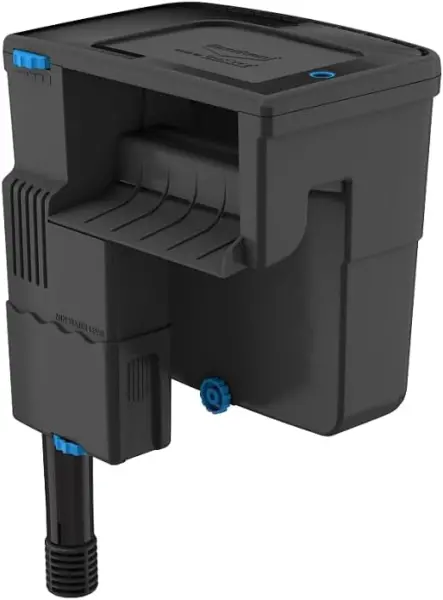
Seachem Tidal 55 – Best Overall
Key Features
- Media: Fill-your-own basket
- Dimensions: 9.06 x 10.04 x 7.09 in
- Tank rating: 55 gallons
- Flow control: Adjustable intake
- Price: Midrange
Fifty-five gallons is an odd number to get excited about, but it is exactly why the Seachem Tidal 55 is the filter we point most people with a 50-gallon toward. Its stated ceiling sits just above the tank instead of well below it, and that margin is what you notice a year in, when the fish have grown and the filter is not already running flat out. Adjustable intake flow, a pump that primes itself after a water change, and a basket you fill with whatever media you like make this the easiest default in the group.
The basket is the part we appreciate most. It lifts out as one piece and takes loose sponge, ceramic rings, or a bag of chemical media, so nothing about maintenance depends on a manufacturer’s cartridge shape. Running costs stay close to zero, and you can rinse the biological media in tank water instead of binning the bacteria with the floss every month. The intake also skims the surface film that gathers on a still tank — a small thing until you have watched a slick of protein sitting on top of the water.
Hang-on-backs live or die on how they sound at two in the morning, and this one is among the quieter models here. What noise does show up tracks the water level: as the tank evaporates, the return turns into a little waterfall, so top off before you blame the impeller. Give it room behind the tank as well. The body is about ten inches wide and wants a few inches of clearance for the intake tube and the rim lip.
Longevity is where we hold a reservation. Motor feedback on this model is mixed rather than damning, with long-running units on one side and pumps that quit inside a year on the other, so buy it somewhere the return window is usable and keep the receipt. That is the only thing standing between this and an unqualified recommendation. On fit, adjustability, and media freedom together, nothing else here does all three.
Pros
- Rated for 55 gallons, with headroom over a 50
- Adjustable intake tames current for calm-water fish
- Fill-your-own basket cuts cartridge costs
- Self-priming pump restarts after water changes
Cons
- Mixed long-term motor feedback
The Tidal 55 is the filter we recommend first for a 50-gallon: sized just above the tank, adjustable, and cheap to run because you fill the basket yourself.
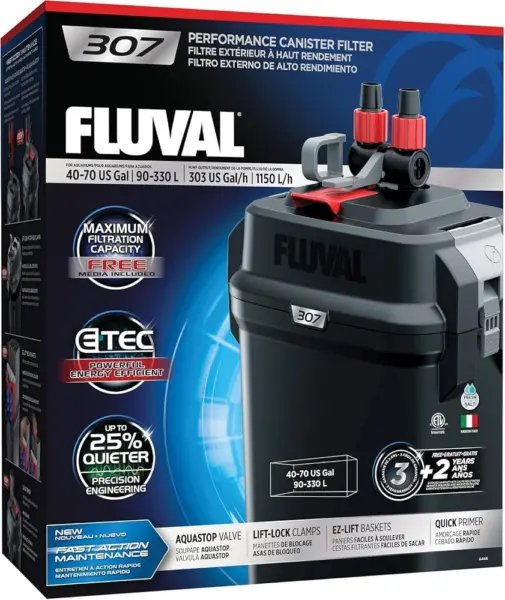
Fluval 307 Canister – Best Canister
Key Features
- Media: Lift-out basket stack
- Flow rate: 1,150 liters per hour
- Power draw: 16 watts
- Tank rating: Up to 70 gallons
- Price: Premium
Moving the filter out of the tank changes what the tank looks like. A canister sits on the floor or in the cabinet, sends water down two hoses, and gives back the corner of glass a hang-on-back occupies — plus a media volume no clip-on box can match. That is the Fluval 307: a 70-gallon-rated canister with a stack of baskets, 1,150 liters per hour of claimed flow, and a 16-watt pump.
The details we noticed are the ones that make maintenance less of a chore. The baskets lift out by a center handle, so you pull the stack one basket at a time rather than tipping the whole unit over the carpet. The shutoff valve closes the hoses at the head, which means no priming ritual and no bucket under the cabinet every time you open it. Setup is straightforward for a canister, and once the air is out of the housing the running noise is close to nothing.
It earns its place on a 50-gallon carrying a heavy load — goldfish, big cichlids, a turtle, anything producing waste faster than a sponge can process it. The caveat is the bottom seal, which is the classic canister failure point and the one that shows up on this model, so stand the unit in a tray and keep it where you can see the floor. Measure your hose run before ordering, too: the supplied length is not generous, and this is comfortably the most expensive filter in this group.
Pros
- Canister media volume for heavy bioloads
- Quiet enough for a living-room cabinet
- Baskets lift out by a handle
- Shutoff valve keeps cleaning mess-free
Cons
- Bottom-seal leaks are the known failure
- Costs far more than the hang-on-back picks
For a heavily stocked 50-gallon, the Fluval 307 is the one we reach for: canister media volume, near-silent running, and the hardware out of sight.
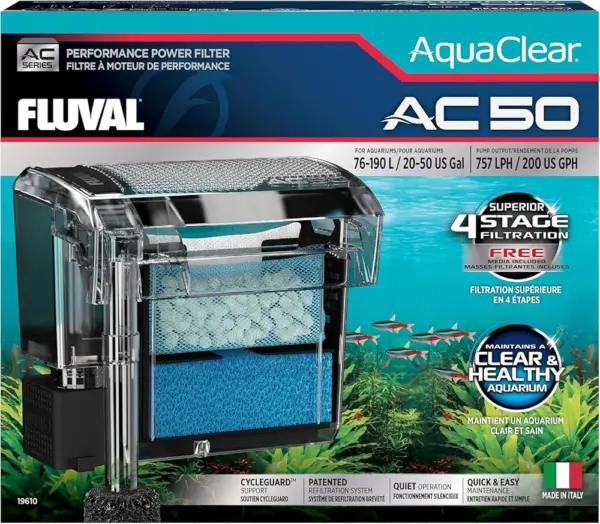
Fluval AquaClear 50 – Best for Large Media Volume
Key Features
- Media: Foam, carbon, BioMax, Cycle Guard
- Warranty: 2 years
- Dimensions: 7.09 x 6.29 x 10.63 in
- Tank rating: 20 to 50 gallons
- Price: Midrange
The AquaClear 50 is a box with a hole in the top, and that is the appeal. Where most hang-on-backs sell you a cartridge in a proprietary shape, this one hands you an open chamber: a foam block, a bag of carbon, a bag of BioMax, and enough spare room to add your own floss. If you want to decide what your filter runs instead of buying whatever fits, this is the pick — and it is rated from 20 to 50 gallons, which puts a 50-gallon tank right at the top of its range.
Media freedom pays off twice. The foam block and the BioMax come out, get squeezed in a bucket of tank water, and go back in, so the colony survives a cleaning instead of leaving with the cartridge floss. The chamber is big for the footprint as well; Fluval puts the filtration volume at up to seven times comparable hang-on-backs, and looking at the size of the stack that is not a stretch. The two-year warranty is the longest of any hang-on-back here.
What holds it back is the motor. Impeller and pump failures come up on this model more than on our top pick, and that is the real difference between the two: the Tidal is easier to live with, while the AquaClear gives you a bigger box of media, a longer warranty, and a slightly higher price. If the media chamber is the thing you care about, that trade is worth making; if you want the filter you think about least, it is not.
Pros
- Large open chamber takes loose media
- Foam and BioMax rinse and go back in
- Two-year warranty, longest of the hang-on-backs
Cons
- Motor and impeller failures are the weak point
- Costs more than our top pick
If you want to run your own media in a hang-on-back, the AquaClear 50 gives you the biggest chamber here — just accept a motor that may not outlast it.
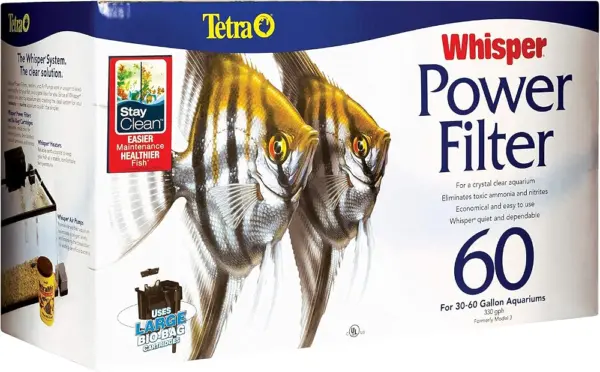
Tetra Whisper PF60 – Best Cartridge Filter
Key Features
- Stages: 3-stage
- Cartridge: Large Bio-Bag
- Dimensions: 5.81 x 13.63 x 7.88 in
- Tank rating: Up to 60 gallons
Cartridge filters get dismissed as the expensive way to run a tank, and mostly that is fair — but there is a reason the format survives. On the Whisper PF60 a media change is: flip the lid, slide out the frame, drop in a new Bio-Bag, close it. No trays, no bags of ceramic, no hands past the wrist in cold water. If the filter you will actually maintain is the one that is easy to maintain, that counts for something.
It is rated to 60 gallons, which gives a 50 some headroom, and it runs three stages: a dual-sided mesh bag catching debris, activated carbon for odor and discoloration, and a Bio-Foam block behind it holding the bacteria. The flow is adjustable, which we care about more than raw turnover on a tank with a betta or long-finned tetras in it. Assembly is quick and the whole thing hangs on the back rim without tools.
Two things to know going in. The cartridges are a subscription and a 50-gallon tank will go through them faster than the box suggests, so never swap out the foam block with the floss — that block is where most of your bacteria live. The second is noise. This is a filter you notice in a quiet room, with a pump hum that the quietest models here do not have.
Our verdict lands on the buyer rather than the spec sheet: if you want filtration you can service in under a minute and you would rather not think about media at all, the PF60 is a sensible, generously sized hang-on-back for a 50. If the idea of buying cartridges for the next five years bothers you, the AquaClear or the Tidal will save you the trouble. What tips it for us is the headroom — a 60-gallon rating on a 50-gallon tank leaves room for a heavy feeding day or a fish that is still growing.
Pros
- Cartridge changes take seconds
- Rated to 60 gallons, so a 50 has margin
- Adjustable flow for calmer water
- Bio-Foam holds bacteria between changes
Cons
- Cartridges are an ongoing cost
- Louder than the quietest picks here
The PF60 suits the keeper who wants a media change to take thirty seconds: a 60-gallon rating, adjustable flow, and cartridges you will be buying again.
AquaMiracle 225 GPH – Best In-Tank Filter
Key Features
- Max flow: 225 GPH
- Dimensions: 3.94 x 2.55 x 8.5 in
- Power draw: 8.2 watts
- Tank rating: 40 to 70 gallons
- Price: Budget
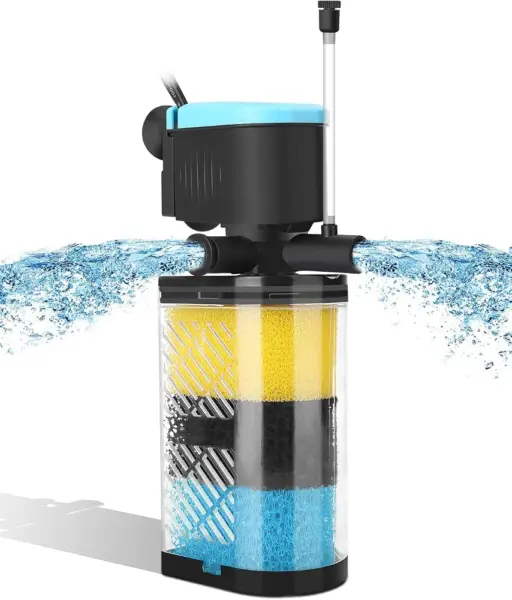
Some 50-gallon tanks have nowhere to hang anything. A corner build, a rimless tank under a lid, a turtle setup with a basking dock across the top — in those, every hang-on-back is a compromise and a canister means hoses across the floor. That is the gap this AquaMiracle fills: it goes in the water, clips to the glass, and disappears behind a rock or a clump of vals.
For the money it moves a lot. Two hundred and twenty-five gallons per hour, rated for 40 to 70 gallons, drawing 8.2 watts. Three sponge blocks do the work — coarse, carbonized, fine — and the venturi line adds a stream of bubbles you can dial in or leave off entirely. We rate it the in-tank pick of this group for exactly that reason: it is the only filter here that adds circulation and aeration without taking up a single inch outside the tank, and the epoxy-sealed motor is built to run fully submerged.
The sponges are the weak point in daily life. They sit stacked in a housing that takes some figuring out to open, and the first cleaning is a fight you only win by reading the box carefully first — rinsing them is easy once they are out, but getting them out is the fussy part. Motor life gives us pause too, with a run of units quitting within months. Buy it for a corner tank or a turtle tank where nothing else fits, and treat it as a part you may replace rather than an heirloom.
Pros
- Moves 225 GPH from inside the tank
- Adds aeration without a separate pump
- Fully submersible sealed motor
- Cheap to run at 8.2 watts
Cons
- Sponge housing is awkward to open
- Short motor life on some units
When nothing can hang outside the tank, the AquaMiracle is the answer: 225 GPH of circulation and aeration from a box that hides behind the decor.
AQUANEAT Sponge Filter – Best for Fry and Shrimp
Key Features
- Sponge size: 3.5 in deep x 8.0 in tall
- Tank rating: Up to 50 gallons
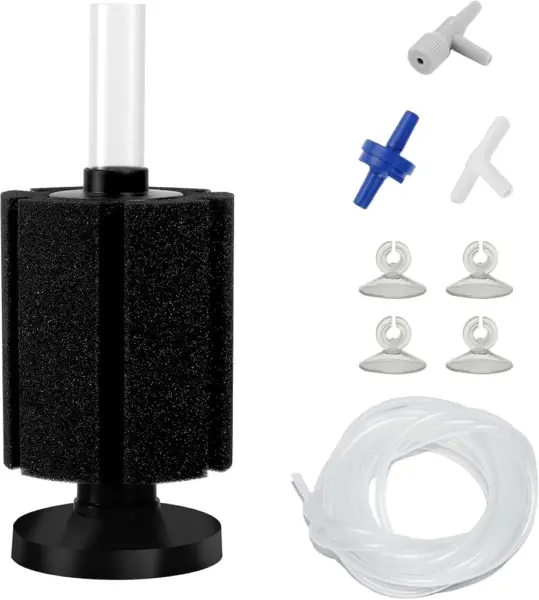
- Kit includes: 4 ft airline, control valve, tee, check valve, suction cups
- Price: Budget
A sponge filter is the least glamorous thing in this guide and, for a breeder or a shrimp keeper, often the right one. This AQUANEAT kit is rated to 50 gallons and arrives with four feet of airline, a control valve, a tee, a check valve, and suction cups — everything but the air pump. Air-driven means no impeller to jam, no intake to suck up a fry, and a current gentle enough for a betta to sit in. It is the cheapest complete filter here and the easiest to keep running.
Be realistic about the size of the job, though. The sponge is 3.5 inches across and 8 inches tall, and most of the tanks it is happily used on are far smaller than 50 gallons: it is a superb biological filter and a weak mechanical one. On a stocked community 50, run it alongside a hang-on-back rather than instead of one. In a grow-out, a quarantine, or a shrimp colony it is all the filtration you need, and we keep coming back to sponges for exactly those jobs because there is nothing in them to break. Rinse it in tank water, never tap water, and it runs for years without a cartridge purchase.
Pros
- Cheapest complete kit in this group
- No impeller, so fry and shrimp are safe
- Comes with tubing, valve, and check valve
- Rinses clean in a bucket of tank water
Cons
- Too little mechanical filtration for a stocked 50
- Needs a separate air pump
A sponge filter this complete, at the bottom of the price range, is the right first filter for a grow-out or shrimp tank — not the only filter on a stocked 50.
Aqua-Tech 30-60 – Best for Budget Setups
Key Features
- Warranty: 3 years limited
- Cartridge: EZ-Change #3
- Dimensions: 6 x 14.25 x 7.8 in
- Tank rating: 30 to 60 gallons
- Price: Midrange
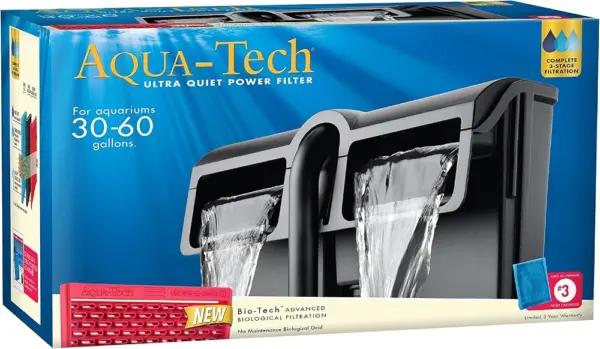
Three years. That is the warranty on the Aqua-Tech, and it is the longest of any filter in this group — long enough that it changes how the purchase feels. It is rated from 30 to 60 gallons, runs a three-step flow through an EZ-Change #3 cartridge, and hangs on the back rim with no priming. Nothing about it is fancy: one cartridge, one flow rate, no dial.
That last part is the catch. There is no flow control, so you take what the pump gives you: fine on a 50 with peaceful mid-water fish, more current than a betta or a tall planted tank wants, and thinner than you would like on a heavy stock. The pump hum is the other thing we noticed — it sits under the water noise in a quiet room rather than disappearing into it, which is not true of the Tidal.
Where it earns a place is the combination: headroom over a 50, a cartridge you can buy anywhere, and coverage that outlasts everything else here. If you want set-and-forget filtration on a lightly stocked 50 and you value a warranty you might actually use, this is a defensible buy. If you keep a planted tank or heavy waste producers, spend the difference on a filter with a flow dial.
Pros
- Three-year warranty, the longest here
- Rated 30 to 60 gallons, so a 50 fits mid-range
- Simple EZ-Change cartridge
Cons
- No flow adjustment
- Louder than the top pick
Choose the Aqua-Tech if a long warranty and a simple cartridge matter more to you than a flow dial on your 50-gallon.
How We Tested These 50-Gallon Filters
I started with a shortlist of 20 filters for 50-gallon tanks, then narrowed it to 12 based on tank-size claims, media capacity, replacement-part availability, and price relative to what you get. Each went on a 50-gallon freshwater community tank in my living room; a second 50-gallon tank in the utility room served for leak and flow checks. I ran every filter continuously for at least three weeks, with the full test stretching over eight months, to see how they behaved once the newness wore off.
Noise was the first thing I checked, because a humming filter in the living room is one you resent. I sat on the couch during quiet evenings and listened for rattles, pump drone, and splashing, then checked again after a few weeks to catch bearings that got louder with age. I also watched flow at the return, timed how long it took to turn over the tank, and noted whether output dropped when the media started loading up—a sign that a filter is fussy about maintenance or underpowered for a 50-gallon load.
For ease of use and cleaning, I did weekly water changes the way a normal keeper would: unplugged the unit, removed the intake and media baskets, rinsed sponges in tank water, and reassembled everything without tools or an instruction manual. I paid attention to how easily the lid came off, whether the media tray lined up cleanly, and how much water spilled during service. Leak checks came next: after every cleaning I dried the connections, ran the filter briefly, and looked for drips at the seals, hoses, and impeller housing. I kept notes on durability, reliability, and value—whether parts felt flimsy, whether replacements were easy to find, and whether the price made sense compared with options that did the same job.
How to Choose a Filter for a 50-Gallon Tank
A 50-gallon tank is the size where a cheap filter stops keeping up, and the choice that shapes your ownership most is where you want the hardware to live.
Use the tank rating as a floor, not a target
A filter sold as "up to 50 gallons" is being asked to work at its ceiling from the day you fill the tank, and it has no reserve for a heavy feeding week or a fish that grows. We look for a stated rating above the tank, which is why a 55- or 60-gallon model sits at the top of this list and a 40-gallon one does not.
Flow figures deserve the same suspicion. Gallons per hour is measured with an empty filter; add foam and biological media and the real number drops. For a 50-gallon community tank we want a nominal 200 gallons per hour or more, with a dial to back it off if the current starts pushing fish around.
Decide where the hardware lives
Hang-on-back filters are the simplest to own, but they need clearance behind the tank for the body and intake tube, and a rim the lip can grip — lids often need a notch cut for the housing. Canisters give you the most media volume and nothing visible in the tank, but they must sit below the water line for the siphon to work, which means cabinet space and a hose run you can hide.
In-tank filters suit a corner build, a rimless tank, or a turtle setup where nothing can hang. Sponge filters are the cheapest and gentlest of all, but they run off an air pump and provide biological filtration far better than mechanical, so on a stocked 50 they work best as a partner to something with real flow.
Cartridges or loose media
A cartridge filter is fast and foolproof: pull the frame, drop in a new bag, done. The catch is the subscription. You are buying floss and carbon every month or two, and you throw away a slice of your bacteria colony each time you do it.
An open chamber takes a foam block, a bag of ceramic rings, and a wad of your own floss. You rinse them in a bucket of tank water and put them back, so the colony survives and the annual cost falls to almost nothing. If you want the lowest running cost over five years, choose the open chamber.
What makes a filter loud
Very little of the noise comes from the pump itself. Most of it is water falling from the return into a tank that has evaporated below the outlet, or vibration from the housing buzzing against the rim of the glass, or a dirty impeller that has picked up a strand of plant matter.
So before you decide a filter is too loud, top the tank off, check the housing is not resting hard against the rim, and pull the impeller for a rinse. A filter that is still noisy after those three steps is genuinely a noisy design; one that quieted down was never the problem.
Plan the cleaning interval
On a 50-gallon tank, expect to rinse the coarse mechanical media every two to four weeks and to leave the biological media alone apart from a gentle squeeze. Rinsing in tank water matters: tap water chlorine kills the bacteria you are trying to keep.
Never replace all the media in one go, even when a cartridge change suggests you should. Clean half, leave half, and the tank will not cycle back to cloudy water every time you do maintenance.
Frequently Asked Questions
Can I run two smaller filters instead of one on a 50-gallon tank?
Yes, and a lot of experienced keepers do. Size the two so their ratings add up to more than 50 gallons, put one at each end of the tank, and you get better circulation plus a spare if one motor quits — the surviving filter keeps the bacteria alive while you sort out a replacement.
A common pairing is a hang-on-back for mechanical pickup and flow with a sponge filter for biological capacity and gentle surface movement.
Do I need to unplug the filter during a water change?
Unplug anything with a motor before the water level drops near the intake. A hang-on-back that runs dry will scorch its impeller in seconds, and an in-tank unit left half exposed can overheat.
Refill first, then plug back in. Self-priming models pick up on their own; a canister may need its primer pumped a few times before it catches.
What does a filter cost to run and maintain?
Electricity is the small part. The canister here draws 16 watts and the in-tank unit 8.2, which is pennies a day at typical rates. Media is where the money goes: cartridge models need a fresh bag roughly monthly, while a loose-media chamber costs almost nothing after the first fill.
Budget for the media, not the plug.
Final Verdict
The Seachem Tidal 55 is what we tell a friend with a 50-gallon to buy. It is rated above the tank rather than at it, the intake dials down for calm-water fish, and the fill-your-own basket keeps running costs close to zero.
Spend the extra on the Fluval 307 only if your 50 carries a heavy load — big cichlids, goldfish, a turtle — and choose the AquaMiracle when the tank is going into a corner where nothing can hang on the glass.