This post contains affiliate links. We may earn a small commission when you buy through our links — at no extra cost to you.
Most air pumps on the box promise to handle huge tanks, yet many struggle to push bubbles deeper than two feet. The quiet hum you expected can turn into a rattle, and that pump you bought for a 40-gallon tank may not even agitate the surface in a 30-gallon that’s a few inches taller.
This guide ignores the exaggerated gallon claims and zeroes in on what matters: pressure at your tank’s actual depth, how many outlets you need, and how long the pump is likely to last. Whether you want near-silent aeration for a bedroom nano tank or a workhorse that runs four sponge filters in a fish room, you’ll know the trade-offs before you buy — silence versus a decade-long track record, or a budget dual-outlet versus a pump that may need replacing sooner.
Top Picks
Best for Mid-Size Freshwater
Tetra Whisper 40

Rating: 4.5 ★ | Price: $$ | Noise Level: Low hum | Air Flow Rate: 3.3 L/min | Max Tank Size & Depth: 40 gal | Outlets: Single | Durability & Lifespan: Diaphragm may need yearly replacement
The Tetra Whisper 40 moves 3.3 liters of air per minute, enough to drive a sponge filter or air stone in mid-size tanks. Diaphragm lifespan varies; some units may need replacement after a year or two. The pump emits a low hum — noticeable in quiet rooms but manageable in a living space with ambient noise.
Best suited for freshwater aquarists with 20-40 gallon setups who want consistent aeration without spending extra for silence. The hum and occasional diaphragm care are expected trade-offs for the mid-range price.
Pros
- Steady airflow maintains oxygen levels in 20-40 gallon tanks
- Compact footprint fits most aquarium cabinets
- Cost-effective aeration for budget-conscious setups
Cons
- Low hum may be present in quiet rooms, especially at night
- Diaphragm wear may require replacement within a year or two
For freshwater tanks between 20 and 40 gallons, this pump delivers consistent aeration at a budget-friendly price — just plan for occasional diaphragm maintenance and a mild hum.
Best for Quiet Medium Tanks
AQQA Tubby Air Pump

Rating: 4.7 ★ | Price: $$ | Noise Level: <35 dB | Air Flow Rate: 100 GPH | Max Tank Size & Depth: ~80 gal | Outlets: Dual stainless steel
This pump delivers truly quiet aeration with a stepless dial that lets you fine-tune output from a whisper to full power—something the proven workhorse in this category can’t match without audible hum. The 200-gallon claim doesn’t hold up; the spec sheet indicates an 80-gallon ceiling, so it’s best for medium freshwater tanks up to 75 gallons and setups where silence is critical. Those who value decades-long reliability history may still prefer the louder top pick, but for a bedroom or office tank, the quiet operation and precise control justify the mid-range price.
Pros
- Whisper-quiet even at full power — suitable for bedrooms and offices.
- Precise 0–100% airflow knob adjusts from a trickle to strong aeration.
- Stainless steel dual outlets and a solid, vibration-resistant housing.
Cons
- The 200-gallon tank rating is inflated; actual limit is around 80 gallons.
If silent operation and granular airflow adjustment matter more than a multi-decade track record, this pump delivers for tanks up to 75 gallons—just ignore the inflated size claim.
Best for Budget Small Tanks
Uniclife 64 GPH Air Pump

Rating: 4.5 ★ | Price: $ | Noise Level: Quiet on low | Air Flow Rate: 64 GPH | Max Tank Size & Depth: ~40 gal | Outlets: Dual with knob | Durability & Lifespan: Common early motor failures
The Uniclife delivers whisper-quiet operation on its low setting and includes air stones, tubing, and connectors — everything needed for a budget dual-airline setup. The adjustable airflow lets you fine-tune output for sponge filters or air stones. That said, this pump is realistically suited for tanks under 40 gallons, and motor failure can occur within months. Treat it as a short-term option for quarantine or temporary tanks.
Pros
- Ultra-quiet on low setting — barely audible in most rooms.
- Complete accessory kit offers great value for a quick setup.
- Adjustable airflow works well for multiple configurations.
Cons
- Motor failure can occur within months — best considered a short-term pump.
- Struggles to aerate tanks larger than 40 gallons despite the higher rating.
A capable starter pump for temporary or small setups, but count on replacing it within a year.
Best for Nano Tanks
Pawfly Compact Air Pump

Rating: 4.4 ★ | Price: $ | Noise Level: Variable; some loud | Air Flow Rate: 40 GPH max | Max Tank Size & Depth: 5–20 gal | Outlets: Single | Durability & Lifespan: Diaphragm failure common
The Pawfly Compact Air Pump is a 2W pump bundled with an air stone, 5-foot tubing, and a check valve, sized for nano tanks from 3 to 20 gallons. It offers enough output to drive a small sponge filter, a step up from the stick-on pumps designed only for gentle bubbling. For quarantine tanks or desktop nanos under 10 gallons, it saves space without the bulk of a larger air pump. Noise is not a guarantee — some units run quietly while others produce a low hum that may be distracting in silent rooms. This is a pump for setups where a tiny footprint is the priority and occasional noise is not a dealbreaker.
Pros
- Compact and lightweight, ideal for nano tanks.
- Good value for money with included air stone and tubing.
Cons
- Noise level may vary; some units produce a distracting hum.
- Motor or diaphragm can fail early, sometimes within weeks.
For nano aquariums where a compact, low-cost air pump is needed and a faint hum is acceptable, the Pawfly fits the bill.
Best for Fish Rooms
Active Aqua 4-Outlet

Rating: 4.5 ★ | Price: $$$ | Noise Level: Audible hum | Air Flow Rate: 15 L/min (240 GPH) | Max Tank Size & Depth: Multi-tank systems | Outlets: 4 independent | Durability & Lifespan: Built for heavy use
Delivering 15 L/min through four independent outlets, this 6W pump can power multiple sponge filters across several tanks—each outlet adjustable. Unlike compact air pumps that struggle with back-pressure, this one handles continuous operation in fish rooms and hydroponic setups without fading, though the motor hum is ever-present.
Place it in a basement, utility room, or dedicated fish room where the audible hum won’t disrupt living spaces. That noise is the trade-off for the sustained high-volume airflow that keeps multiple tanks oxygenated. If you’re running a rack of aquariums, this pump delivers the air you need.
Pros
- Powers several sponge filters across multiple tanks at once.
- Handles continuous operation in fish rooms and hydroponic setups.
- Sturdy construction holds up under heavy-duty use.
Cons
- Audible hum from the motor will be noticeable in living spaces.
For fish rooms or hydroponic setups where noise isn’t a concern, this pump delivers the airflow that multiple tanks demand.
Best for Temporary Water Features
CWKJ 400 GPH Water Pump

Rating: 4.3 ★ | Price: $ | Noise Level: Noticeable hum | Air Flow Rate: 400 GPH | Max Tank Size & Depth: 6.5 ft lift | Outlets: 3 nozzles | Durability & Lifespan: Motor failure common
Three interchangeable nozzles and a tool-free setup make this 400 GPH pump a straightforward pick for quick fountain or aquarium projects. Its 25W motor lifts water to 6.5 feet, and the low cost aligns with its temporary-use design. It shines in DIY water features, seasonal ponds, or short-term aquarium circulation where a permanent pump isn’t required. The motor may stop working after a few months, so view it as a replaceable component rather than a long-term solution.
Pros
- Simple setup with three interchangeable nozzles, no tools required.
- Low-cost pump that provides sufficient flow for short-term fountain or aquarium circulation.
Cons
- Audible motor hum can compete with water sounds, especially in quiet settings.
- Motor may stop working after a few months, limiting the pump’s useful life.
A disposable pump for short-term projects — ideal for a seasonal fountain or intermittent water transfer, and replace it when the motor stops.
Best for Large Ponds
Pawfly 254 GPH Air Pump
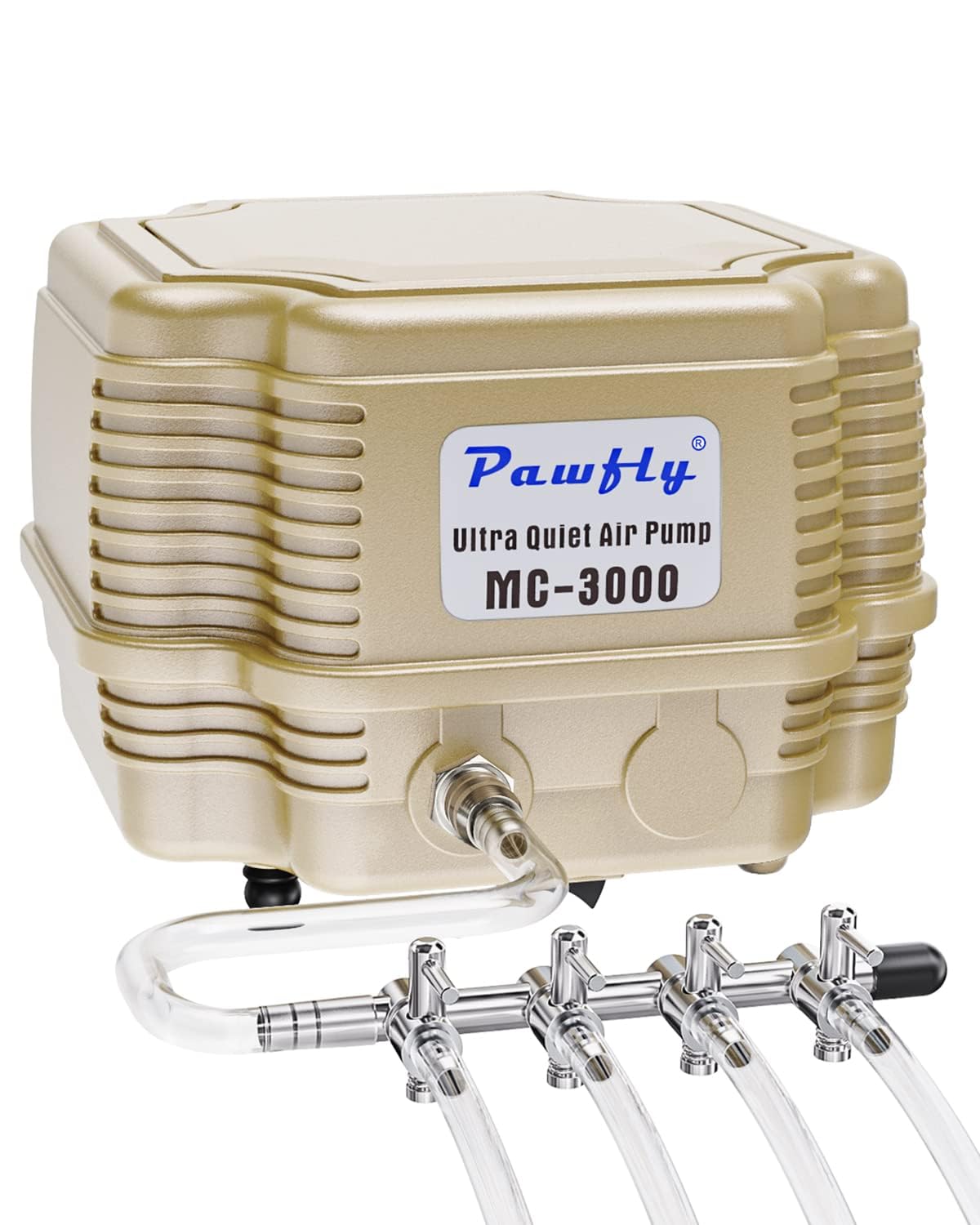
Rating: 4.5 ★ | Price: $$$ | Noise Level: Quiet | Air Flow Rate: 254 GPH | Max Tank Size & Depth: 300 gal | Outlets: 4 with valve | Durability & Lifespan: Diaphragm tears possible
The Pawfly pushes 254 GPH through four adjustable outlets, driving multiple sponge filters in a 300-gallon pond or fish room. It’s notably quieter than typical high-output pumps, but diaphragm wear can occur after months of heavy use. That makes it a consumable power source for buyers who prioritize quiet, high-volume aeration over long-term durability.
Pros
- Quiet operation atypical for a high-output air pump
- Drives multiple sponge filters simultaneously without pressure drop
Cons
- Diaphragm tear may occur after extended heavy use, requiring replacement
For fish rooms or large ponds where quiet, powerful aeration matters more than multi-year durability, the Pawfly is a cost-effective workhorse that should be budgeted as a replaceable component.
Best for Nano Tanks
hygger Mini Air Pump

Rating: 4.4 ★ | Price: $ | Noise Level: Extremely quiet | Air Flow Rate: 420 ml/min | Max Tank Size & Depth: 1–15 gal | Outlets: Single | Durability & Lifespan: Motor failure possible
This pump excels at whisper-quiet, gentle aeration in betta bowls and nano shrimp tanks. However, its 420 ml/min airflow can’t overcome the back-pressure of a sponge filter, and some units may stop after a few months — it’s strictly for low-resistance bubbling.
Pros
- Often inaudible in quiet rooms
- Compact stick-on mount saves shelf space
Cons
- Airflow collapses with sponge filters or any back-pressure device
If your nano setup only needs a soft stream of bubbles, the hygger Mini is a quiet, compact pick — just don’t expect it to run a sponge filter or last beyond a year.
Best for Tiny Bowls
NICREW Nano Pump

Rating: 4.4 ★ | Price: $ | Noise Level: Incredibly quiet | Air Flow Rate: 0.3 L/min | Max Tank Size & Depth: Up to 10 gal | Outlets: Single | Durability & Lifespan: Common early failure
It delivers whisper-quiet aeration for nano bowls with a stick-on design that saves desk space. The 0.3 L/min flow is too gentle for sponge filters or water deeper than a few inches, and early motor wear can occur — so it’s a disposable solution for the tiniest setups.
Pros
- Incredibly quiet — often inaudible over background noise in a calm room.
- Compact body and suction-cup mount fit unobtrusively on small tanks.
Cons
- Air output too weak to drive sponge filters; limited to gentle bubbling in very shallow water.
A quiet, space-saving bubbler for a betta bowl or 1–3 gallon nano tank, best bought with the expectation of a limited service life.
Best for Entry-Level Dual
AQQA 3.5W Dual Outlet Pump

Rating: 4.6 ★ | Price: $ | Noise Level: Quiet | Air Flow Rate: 5 L/min | Max Tank Size & Depth: ~50 gal | Outlets: Dual with knob | Durability & Lifespan: Tubing pop-off, motor issues
The AQQA 3.5W dual-outlet pump runs quietly, adjusts smoothly, and includes air stones. But the tubing can disconnect and durability is limited. It’s a budget starter for shallow, small aquariums where these quirks won’t disrupt, not a long-term main pump.
Pros
- Runs quietly, suitable for desks and living rooms.
- Adjustable airflow dial provides precise bubble control.
Cons
- Airflow weakens in tanks deeper than 2 feet.
- Tubing can pop off at connections, needing zip ties or clamps.
For shallow, small aquariums where a quiet, adjustable pump is needed and the occasional tubing fix is acceptable, this budget kit fits as a starter — just don’t expect it to last.
Best for Budget Small Dual
HITOP Dual Outlet Air Pump

Rating: 4.5 ★ | Price: $ | Air Flow Rate: 5 L/min | Max Tank Size & Depth: 100 gal claimed | Outlets: Dual with dial | Durability & Lifespan: Tubing detaches constantly
The HITOP pump bundles air stones, tubing, and check valves at a low price, with adjustable flow for 20–100 gallon tanks. The included tubing can pop off the outlets, though a zip-tie fixes it. A similar-priced alternative avoids this hitch, so the HITOP fits hobbyists willing to tinker for the savings.
Pros
- Complete starter kit with air stones, tubing, check valves, and T-connector included.
- Adjustable dial tailors airflow for 20–100 gallon aquariums.
Cons
- Included airline tubing can detach from the pump outlets unless secured with zip-ties.
Best for tinkerers who don’t mind securing the tubing with zip-ties and need an affordable pump for small-to-medium tanks.
Best for Water Changes
VIVOSUN 800 GPH Water Pump

Rating: 4.4 ★ | Price: $$ | Air Flow Rate: 800 GPH | Max Tank Size & Depth: 10 ft lift | Outlets: 3 nozzles | Durability & Lifespan: Early motor death common
The VIVOSUN pump delivers strong flow for the price, ideal for water changes and hydroponics. However, durability can be an issue: the motor may stop after months, and actual output may not reach 800 GPH. Best for intermittent use, not continuous aquarium operation.
Pros
- Strong flow rate at a mid-range price, making quick work of large-volume water changes.
- Good value for hydroponic or fountain applications, with three included nozzles for flexibility.
Cons
- For continuous operation like main aquarium circulation, the motor may stop working after several months.
A capable pump for water changes or temporary tasks where you don’t mind the possibility of replacement; for round-the-clock aquarium use, consider a more durable option.
How to Choose
Ignore the tank-size sticker on the box and focus on the pump’s ability to push air to your tank’s actual depth, plus its real-world durability record.
Noise Level
Even pumps labeled ‘whisper’ produce a hum from the vibrating diaphragm that can amplify on hard surfaces. A decibel rating under 35 dB is nearly inaudible in a living room; above 40 dB often becomes a distracting background noise in bedrooms.
Place the pump on a foam pad or hang it to reduce vibration. If noise suddenly increases after months, a worn diaphragm is usually the culprit.
Air Flow Rate and Pressure
Flow ratings in GPH or L/min tell only part of the story. The pump must overcome water pressure at depth to push bubbles through an air stone or sponge filter. A pump rated for 64 GPH at the surface may produce barely a trickle at the bottom of a 24-inch tank.
For sponge filters, look for pumps that explicitly state they can drive a filter at a given depth, not just open-air flow. Cheaper pumps often fall short when back-pressure increases.
Tank Size and Water Depth
Advertised tank capacity is frequently inflated. A pump claiming to handle 200 gallons often can’t aerate a 40-gallon tank that’s deeper than 18 inches. Always check the manufacturer’s actual depth specification, and when in doubt, round down.
For aquariums taller than 20 inches, prioritize pumps with higher pressure or choose a model proven to run a sponge filter at your tank’s height.
Outlets and Splitting Lines
A dual-outlet pump lets you run two independent devices without extra splitters, which can reduce airflow. Multi-outlet pumps (four or more) are ideal for fish rooms and hydroponics, but each outlet may share total output.
When splitting a single outlet, use a gang valve that lets you adjust flow to each branch. Ensure the pump has enough surplus flow to maintain strong bubbling after the split.
Durability and Lifespan
A diaphragm air pump typically lasts 1–2 years with continuous use. Budget models often fail within months due to motor burnout or diaphragm tears. Look for pumps that offer replacement diaphragms or have a history of surviving past the return window.
Water pumps in this price range are even more disposable; treat them as consumables you’ll replace annually. If reliability is critical, invest in a higher-tier air pump with a proven track record.
Adjustability
A knob or dial that lets you fine-tune airflow is invaluable. Many pumps only have a high/low switch or no adjustment at all, forcing you to choose between too much and too little agitation. Stepless adjustability lets you dial in exactly the bubble curtain you want without additional valves.
FAQ
Why does my aquarium air pump make a buzzing noise when it’s supposed to be quiet?
Most ‘quiet’ pumps still produce a hum from the vibrating diaphragm. Placing the pump on a hard surface amplifies it; set it on a foam pad or hang it to dampen vibrations. If you hear a mechanical clicking, the diaphragm likely needs replacement.
How long should an aquarium air pump last before it needs replacing?
With continuous use, a diaphragm pump typically lasts 1–2 years before the rubber diaphragm stiffens or tears. Budget pumps often fail sooner, while higher-end models may only need a $5 diaphragm replacement annually. If airflow drops suddenly or noise increases, check the diaphragm first.
How do I stop air tubing from popping off the pump?
The smooth plastic outlets on many cheap pumps let tubing slip. Dip the tubing ends in hot water before attaching for a tighter grip, or use small zip ties as hose clamps. For a permanent fix, replace the included tubing with slightly smaller-diameter airline that grips more securely.
Can I run multiple sponge filters on one air pump?
Yes, if the pump has enough pressure to overcome the combined back-pressure of all filters. Use a multi-outlet pump or airline splitters, but verify that airflow remains sufficient at the deepest filter. A pump that barely bubbles at the surface won’t drive a sponge filter in deep water.