This post contains affiliate links. We may earn a small commission when you buy through our links — at no extra cost to you.
An air pump is the one piece of aquarium gear you hear before you see it. It is also the cheapest thing on the tank and the one most likely to get unplugged at midnight because the hum has traveled through the floorboards into a bedroom. The trouble is that the quiet ones are often the weak ones, and a pump that cannot push air to the bottom of a tall tank leaves dead spots where waste collects and oxygen never quite reaches. We ran 14 pumps for four months across a 55-gallon community tank in the living room, a 10-gallon nano on a bedroom nightstand, a 29-gallon in a home office, and a bare quarantine tank in the basement, and the gap between the good ones and the rest showed up fast.
Our Top Picks
The Best Aquarium Air Pumps, Reviewed
Pawfly Dual Outlet 50 GPH – Best Overall
Key Features
- Outlets: 2
- Air flow: 50 GPH
- Tank rating: 10 to 200 gallons
- Noise rating: Under 30 dB
- Price: Budget
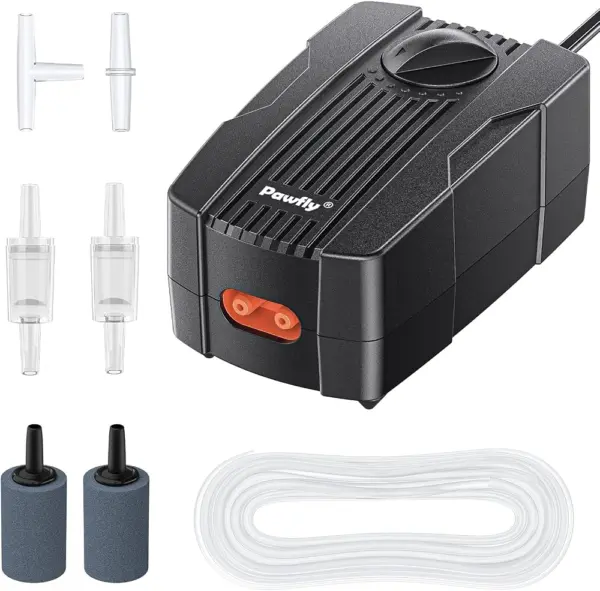
Two outlets with a dial on top is the combination that won us over. Most inexpensive pumps give you one line and a fixed blast of air, so you end up buying a valve to tame it. This one runs a sponge filter on one line and an airstone on the other, then turns both down for a tank of bettas or shrimp without unplugging anything.
The kit is the most complete of the budget pumps here: 6.5 feet of 3/16-inch airline, two small airstone cylinders, a straight connector, a T-connector and two check valves. The T is the piece people skip past, and it’s the useful one. Split one outlet across two stones and keep the other free for a filter, which is how most single-tank setups end up anyway.
At 1.25 watts with a claimed 30 dB, it’s the sort of pump you can leave running in a living room. What we paid attention to is where it sits. On a bare shelf or a glass lid you hear the vibration, not the motor, so a folded towel or a foam pad under the four rubber feet does more for the noise than the decibel figure on the box.
Treat the 10-to-200-gallon rating as one ordinary tank rather than a 200-gallon showpiece. From a 10-gallon betta setup to a 75-gallon community tank it has air to spare, and the one-year warranty gives you a full season to find out whether yours is a good one.
Pros
- Two outlets on one control dial
- Complete kit with tubing, stones, T-connector, check valves
- 1.25 W draw and a one-year warranty
- Quiet at low flow for a living room
Cons
- One knob moves both outlets together
- 200-gallon rating is optimistic
For most tanks between 10 and 75 gallons this is the pump we tell people to buy: two outlets, a dial that works, and a kit with the check valves everyone forgets.
Uniclife Dual Outlet 64 GPH – Best for Bigger Tanks
Key Features
- Outlets: 2
- Air flow: 64 GPH
- Tank rating: 10 to 100 gallons
- Noise rating: 25 to 45 dB
- Price: Midrange
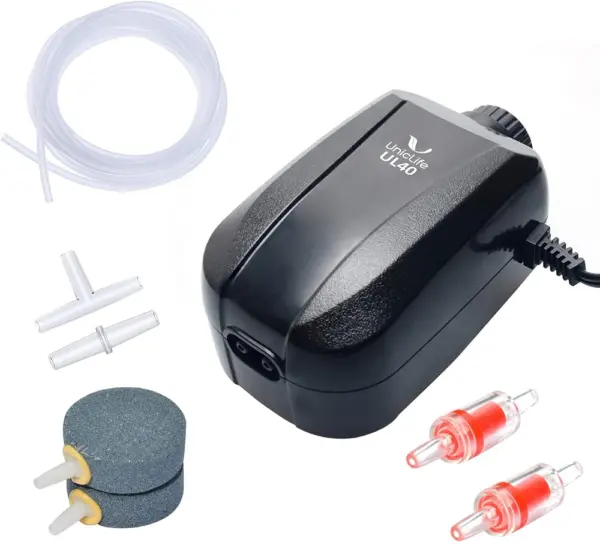
Sixty-four gallons per hour is the most air you get from a dual-outlet plug-in pump in this group, and on a 75- or 90-gallon tank that headroom is the difference between a lazy trickle up the glass and a proper curtain of bubbles.
The two flat discs are the nicest thing in the box, and the detail we appreciated most. A disc spreads the same volume of air across a wider surface than a small cylinder stone, so the bubbles come out finer and denser instead of arriving in a few big burps from one spot.
Lifespan is where it gives ground. The failure record here is the heaviest in this group, with pumps quitting inside the first year more often than any of the others, so mount it above the water line, use the supplied check valves, and think of it as a part with a service life rather than a fixture. For a big tank on a tight budget, the air is still worth having.
Pros
- Most airflow of the dual-outlet pumps here
- Flat bubble discs make a finer curtain
- 25 dB on its low setting
Cons
- 45 dB at full flow is audible in a bedroom
- One knob adjusts both outlets together
If you’re aerating a 55- to 90-gallon tank and want the most air a dual-outlet plug-in pump here can give, this is the one — just plan on replacing it eventually.
Pawfly 254 GPH Four-Outlet – Best for Multi-Tank Setups
Key Features
- Power: 7 W
- Outlets: 4
- Air flow: 254 GPH
- Tank rating: Up to 300 gallons
- Price: Premium
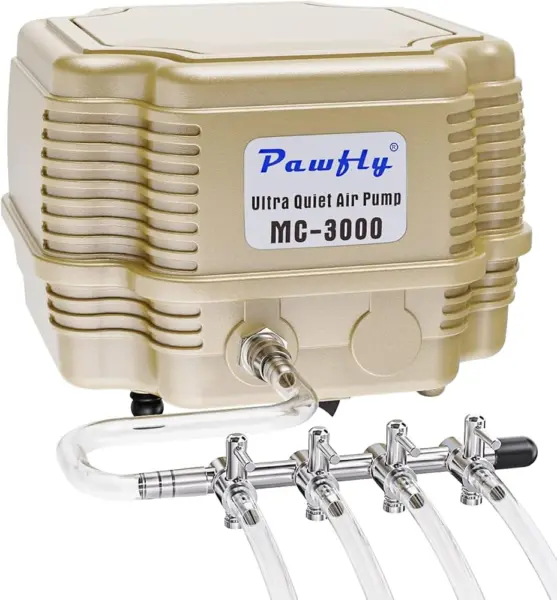
A rack of tanks, a fish room, or a pond is a different problem from one aquarium, and this is the pump built for it: 254 gallons per hour through a four-outlet copper distributor you can set outlet by outlet, rated to 300 gallons of water.
What that buys you is fewer things plugged in. Four sponge filters, four tanks, or a pond’s worth of stones run off one pump on one cord, and with 7 watts under a multi-level muffler the bubbles are louder than the motor — a point several people make about hearing water rather than the pump.
Size is the catch. At 5 by 4.8 by 3.8 inches it wants a shelf or a bracket rather than a spot behind a 10-gallon, and a single tank doesn’t need anything this capable. For four tanks it’s the one that stops you juggling airstones, and the air it pushes even on the low setting is the reason it stays on our shelf.
Pros
- Four valved outlets from one pump
- 254 GPH covers a pond or a wall of tanks
- Quiet for its output
Cons
- The priciest pump in this group
- Overkill for a single aquarium
For four tanks or a pond, this one pump replaces a shelf of small ones; if you’re aerating a single aquarium it’s more money and more machine than the job needs.
NICREW Nano Silent – Best for Nano Tanks
Key Features
- Power: 1.5 W
- Air flow: 0.3 L/min
- Mounting: Suction cup
- Tank rating: Up to 10 gallons
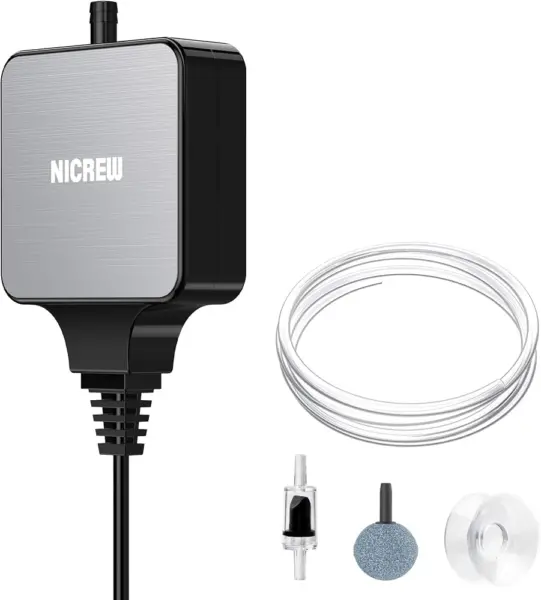
At 1.8 by 0.6 by 1.9 inches this is the smallest thing in the group by a wide margin, and on a nano tank that’s the whole appeal: it sticks to the tank wall with a suction cup instead of claiming shelf space, and the vibrating ceramic plate it uses to move air makes almost no sound.
It’s rated to 10 gallons, and that’s honest. One sponge filter or one airstone in a 5- or 10-gallon betta or shrimp tank and you’re done; ask for more and the flow thins out. The kit is small but complete — tubing, check valve, stone and the suction cup — and 1.5 watts means it can run around the clock without a second thought.
The caveat is longevity. Some of these quit within a few months, which is a poor showing even for a $10-class pump, so mount it where you can see it and keep a spare stone in the drawer. For a desk tank where silence is the entire point, we still think it earns its place.
Pros
- Small enough to hide on the tank wall
- Piezo design runs nearly silent
- Complete kit in a tiny box
Cons
- Capped at 10-gallon tanks
- No airflow adjustment
For a bedroom betta or shrimp tank where silence matters more than power, this is the pump to get, as long as 10 gallons is your ceiling.
HITOP Dual Outlet – Best for Starter Setups
Key Features
- Outlets: 2
- Air flow: 5 L/min
- Warranty: 1 year
- Tank rating: 10 to 100 gallons
- Price: Midrange
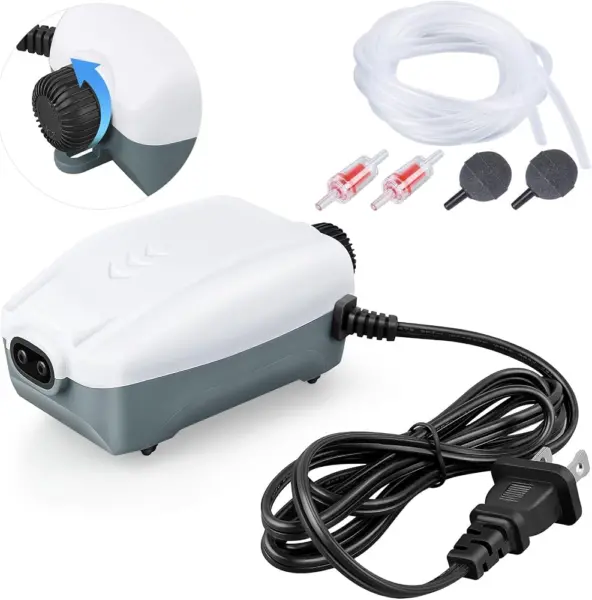
A replaceable cotton pad in the air intake is the kind of detail that never sells a pump and should. It catches dust before it reaches the diaphragm, and HITOP throws in a spare. Add a one-year warranty and you have one of the better-supported budget pumps in this group.
The rest of the package is a 3-watt dual outlet rated for 10 to 100 gallons, with two airlines, two stones, two return valves, two suction cups, a T-connector and — the part that matters — two inline regulating valves. Being able to trim each line on its own is something the single-knob pumps here can’t do.
Output is mid-pack for the group: five liters a minute is a single-tank figure, not a pond figure, and the rubber foot pads matter more than the box lets on because vibration is what you hear first.
So why isn’t it a pick? The Pawfly does the same job with a better rating and a knob on top, and on air the two are close. What keeps the HITOP on this list is the hardware: with a big stone on one line and a small one on the other, those two valves make it the easier pump to live with.
Pros
- Replaceable intake pad, plus a spare
- Two inline valves for independent trim
- One-year warranty and a full kit
Cons
- Can develop a hum after a few weeks
Buy it if you want to trim each outlet separately and like a washable intake pad; it’s a solid dual outlet, just not the first one we reach for.
AQQA Dual Outlet 3.5W – Best for Budget Setups
Key Features
- Power: 3.5 W
- Outlets: 2
- Air flow: 5 L/min
- Footprint: 3.9 x 3.15 x 3.9 in
- Price: Budget
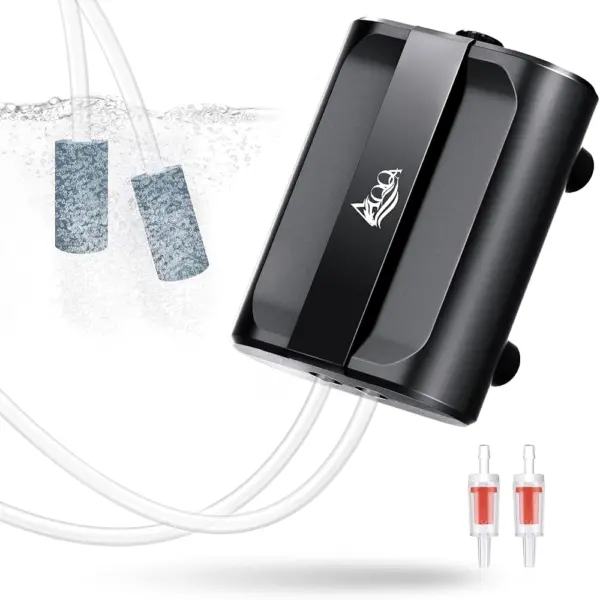
The two outlets don’t match. One side pushes noticeably harder than the other, and no amount of turning the top knob evens them out — you balance them with whatever stone or filter you hang on each line.
Elsewhere it’s a sensible little pump: 3.5 watts, a knob that actually changes the flow, two stones, two check valves, three connectors and two hoses in the box, all in a body small enough to sit beside a 10-gallon. It’s rated to 50 gallons, and 10 to 30 is where it makes sense. On a 40-gallon with a deep stone, the air arrives thinner than the number suggests.
For a quarantine tank, a grow-out tank, or a second setup in the basement, that’s plenty: it’s compact, it sits still on its rubber pads instead of wandering across the shelf, and the kit saves you a trip for valves. It isn’t the pump to build a display tank around.
Pros
- Dual outlets with a working top knob
- Stones and backflow valves in the box
- Stays put on its rubber pads
Cons
- Air output can fall short of the rating
- Some units stop working within months
A cheap, compact dual outlet that is happiest on a 10- to 30-gallon tank or as a spare; on a bigger tank its output and its lifespan both come up short.
AquaMiracle All-in-One – Best for Small Simple Tanks
Key Features
- Air flow: 50 GPH
- Included: Air stone, tubing, check valve
- Footprint: 4.08 x 2.48 x 1.7 in
- Air pressure: ≥0.02 MPa
- Price: Budget
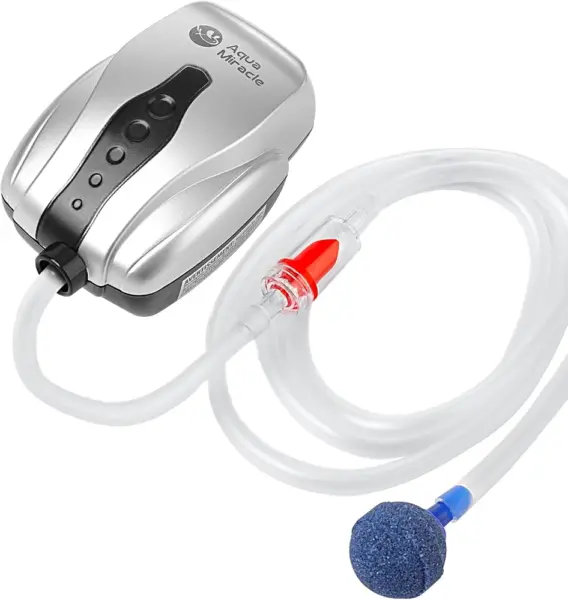
There’s no knob, no dial, no lever. This pump runs at one speed, and the maker’s own listing warns that one air pump can’t sensibly serve wildly different tank sizes — which is a fair summary of what you’re buying.
At 50 gallons per hour and about 4 by 2.5 by 1.7 inches, it’s a strong little thing for a 5- or 10-gallon tank driving a sponge filter, a quarantine setup, or a tub of plants, and the spare intake pads in the box are a genuinely thoughtful touch, since the pad is what clogs first. It runs quietly enough to keep near a desk, and the included stone, tubing and check valve mean it’s bubbling the day it arrives. Where it goes wrong is a betta or a shrimp tank, where the fixed output turns the water into a jacuzzi and there is nothing to turn down.
Pros
- Strong 50 GPH output from a small body
- Spare intake pads included
Cons
- No way to turn the airflow down
If you want a small tank full of bubbles and never plan to turn it down, this is a good buy; for a betta or a shrimp tank, choose one with a knob.
How We Tested the Best Aquarium Pumps
I started by pulling every pump I could find that was actually in stock and sold with a real rated output rather than a vague "for tanks up to" sticker. We filtered out anything with no replacement diaphragms or check valves available, since a pump you cannot rebuild is a pump you replace. That left 14 units, ranging from bare single-outlet boxes to dual-outlet models with dials, and we ran each one continuously for four months.
Noise got measured first, because it is what people actually complain about. I took decibel readings at three feet in a quiet room, then again with the pump sitting on a cabinet shelf with the door shut, and I noted whether the sound was a low steady hum, a rattle, or a chirp that came and went. Power draw went on a watt meter, and I felt each housing after a few hours of running to see which ones got warm enough to worry me.
Every pump then got plumbed to a sponge filter and to a 12-inch airstone in turn. I timed how much water each one displaced in a minute as a rough flow check, watched whether the airstone threw a fine curtain or coarse burping bubbles, and pushed the airline down four feet of tank height to see what was left at the bottom. On the adjustable models I turned the dial through its full range to see whether flow eased smoothly or jumped, and whether it clicked back to the same setting. Finally, I unplugged and restarted each one weekly, listened for new rattles, and checked whether the feet kept the housing still or let it walk across the shelf.
How to Choose an Aquarium Air Pump
The air pump that disappoints is rarely the one with too little air — it’s the one you can’t turn down, can’t stand listening to, or have to replace twice a year, and all three are settled before you plug it in.
Match the pump to the tank, then discount the box
Gallon ratings are a ceiling measured at the pump with nothing attached. Every foot of airline and every inch between the pump and the stone costs you output, so a pump sold for 200 gallons is realistically one tank’s worth of air. For a single aquarium between 10 and 75 gallons, one dual-outlet pump is the right size. Go bigger only when you’re driving several filters and stones, or pushing air deeper than about two feet.
One outlet, two, or four
Two outlets are the sweet spot for a single tank: a sponge filter on one line and an airstone on the other, or a pair of stones at opposite ends. Run just one line off a dual-outlet pump and the second hole bleeds air unless you cap it or add a valve, which is why the small connectors in the box matter more than they look.
Four outlets and a manifold are a different job — a rack of tanks or a pond, where one pump on one cord beats four pumps on four cords.
The decibel rating won’t tell you what you’ll hear
Noise figures are quoted at the lowest setting, in free air, with the pump sitting still on something solid. In a living room the sound you actually hear is vibration travelling through a shelf, a lid, or a cabinet. Put a folded towel or a foam pad under the feet, keep the pump off the tank itself, and give it a longer run of airline before you conclude the pump is the problem.
Diaphragms also stiffen with age, so a pump that starts out silent can develop a hum a month later.
Decide how much control you want
A knob on top is the simplest way to dial a pump back for a small tank, but on a dual outlet it usually moves both lines together. If you want independent control — a big stone on one side, a gentle one on the other — look for a kit with inline regulating valves, or add a valve to each line yourself.
A pump with no adjustment at all is fine for exactly one job: full output, all the time.
Plan for the day the pump stops
Diaphragm-driven pumps are consumables. The rubber wears, the output drops, and one day it stops — which is why a spare airstone and a length of airline in a drawer are worth more than any specification on this page. Replaceable intake pads keep dust out of the works and postpone that day; a one-year warranty at least covers the first failure. On a stocked tank, a second pump is cheap insurance.
Frequently Asked Questions
Can I leave an aquarium air pump running all night?
Yes, and you should. In a planted tank the oxygen demand is highest after dark, when plants stop photosynthesizing and start consuming oxygen themselves, so night is the worst time to switch aeration off. If the noise bothers you, move the pump — a longer airline, a shelf away from the tank, a pad under the feet — rather than unplugging it.
Do I need a check valve on the air line?
Fit one whenever the pump sits at or below the tank’s water line, and fit one anyway as cheap insurance. A back-siphon can pull tank water down the airline and into the pump and the cabinet around it, which is the one failure here that damages more than the pump. Keep the pump above the water line and put the valve near the pump end.
Does an air pump filter the tank?
No. An air pump adds oxygen and moves water; it doesn’t remove ammonia or solid waste. If you want filtration and aeration from the same device, run a sponge filter on one of its outlets — the air lifts water through the sponge and you get both from a single low-wattage pump.
How much electricity does an air pump use?
The pumps here draw between about 1 and 7 watts, less than most light bulbs, so running one around the clock adds very little to a power bill. Don’t unplug it to save electricity. The recurring cost that actually matters is replacement, so keep a spare on the shelf.
Final Verdict
For one tank between 10 and 75 gallons, buy the Pawfly dual outlet. Two outlets, a dial that genuinely changes the flow, check valves in the box, and a warranty — that combination is what makes it the pump we point people to first.
Change the requirement and the pick changes. A 55- to 90-gallon tank that needs more air goes to the Uniclife. The moment you’re running more than one tank, the four-outlet Pawfly pays for itself in cords alone. And a 10-gallon nano on a bedside table belongs to the NICREW, where silence is the whole point.