This post contains affiliate links. We may earn a small commission when you buy through our links — at no extra cost to you.
Plugging a heater, pump, and LED light into a standard power strip often ends with half the outlets blocked by oversized adapters. Many aquarium owners discover this frustration only after setting up their tank, then hunt for a strip that actually fits behind the stand.
Budget strips look appealing at first—dozens of outlets and USB ports for under $20—but a significant number stop working within months. The real choice is between a strip that accommodates bulky plugs without wasting outlets and one that offers a longer cord or fast charging. Both have trade-offs, and the right pick depends on your tank’s layout and the number of devices you run.
This guide highlights the features that matter most for aquarium gear: outlet spacing, surge protection that actually covers heater and pump surges, and a plug profile that fits tight spaces. No strip is perfect for every setup, but matching the right spec to your equipment saves you from replacing a dead strip—or worse, a fried controller.
Top Picks
Best for Bulky Adapters
Belkin 12-Outlet Pivot

Rating: 4.8 ★ | Price: Premium | AC Outlets: 12 (8 rotating) | Surge Protection: 4320J | USB Ports: 0 | Flat Plug & Cord: Rotating flat, 8 ft
The rotating outlets are the standout feature here—each of the eight pivots up to 90 degrees, letting you plug in oversized adapters for LED lights, pumps, and heaters without losing access to the neighboring socket. This eliminates the usual frustration of stacking bricks or leaving half the strip unused. Combined with four fixed outlets, the layout handles a fully loaded aquarium setup without crowding.
Surge protection comes in at 4320 joules, a rating that covers not just pumps and heaters but pricier controllers and lights. The 8-foot cord and flat pivot plug make it easy to route behind a stand without pushing the strip into a corner. Build quality matches the premium price—thick casing and tethered screws give a solid feel that budget strips lack.
User feedback consistently points to durability that holds up over years of daily use. The rotating mechanism can feel stiff when new, but that tightness translates to secure connections over time. No units have shown the early failures seen in cheaper alternatives—this strip is built for the long haul.
This is the right choice for aquarists running multiple pieces of equipment with bulky power bricks—LED arrays, canister filters, and CO2 controllers all fit side by side. The price runs about double that of basic strips, but the combination of adapter-friendly layout and real surge protection justifies the investment for anyone with expensive gear to protect.
Pros
- Rotating outlets swivel to fit bulky adapters without blocking adjacent ports
- 4320J surge protection for peace of mind with expensive equipment
- Rugged construction rated consistently across thousands of long-term users
- Twelve outlets total handle fully loaded aquarium setups
- Flat pivot plug and 8-foot cord fit behind stands easily
Cons
- Premium-priced compared to basic strips, which may deter budget-focused buyers
- Rotating outlets may require firm initial pressure to adjust to the desired angle
For aquarists who need to accommodate bulky power adapters and want real surge protection, this is the right call—no other strip combines that layout with this level of field-tested durability.
Best for Simple Lighting Timer
BN-LINK Timer Strip
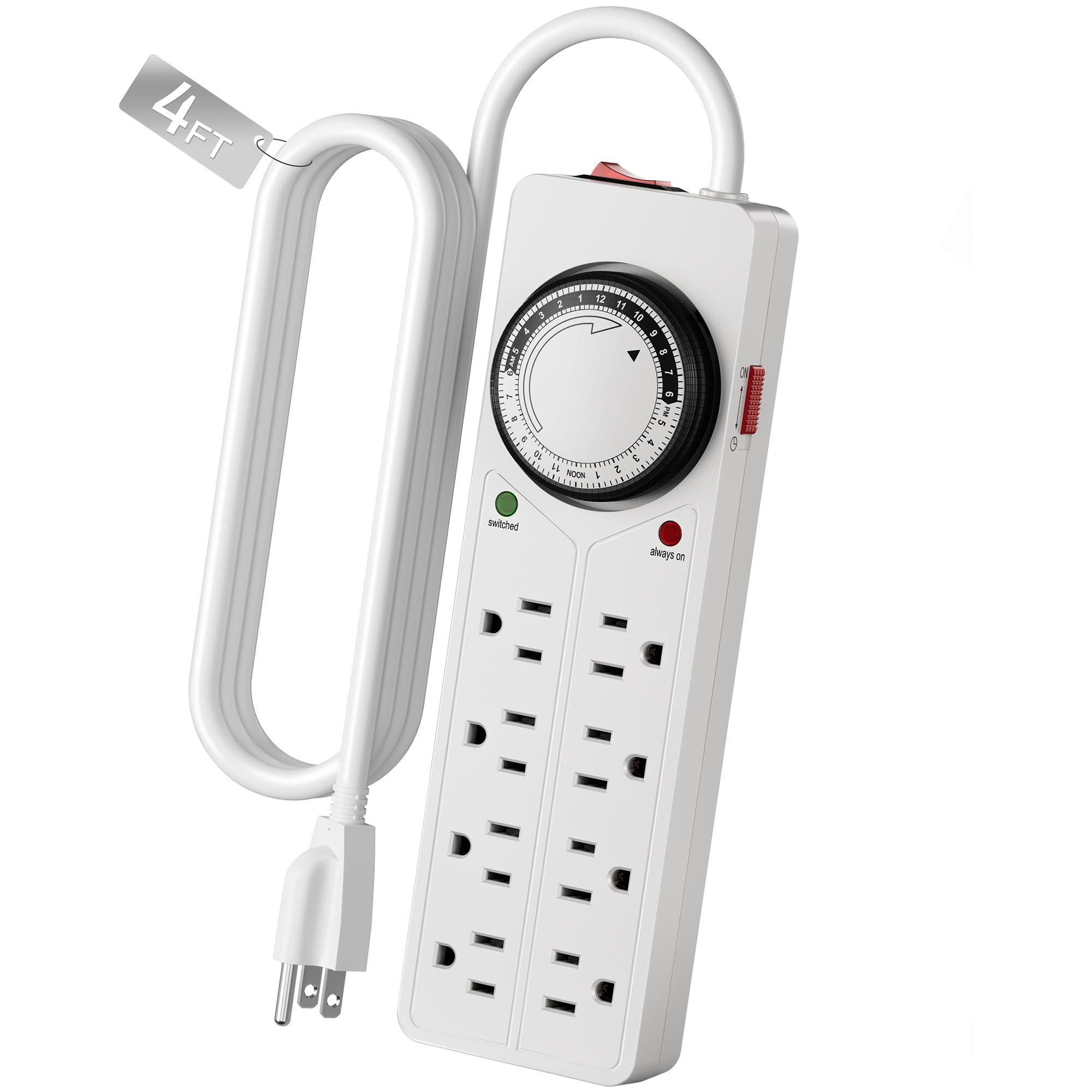
Rating: 4.4 ★ | Price: Mid-Range | AC Outlets: 8 (4 timed) | Surge Protection: Not specified | USB Ports: 0 | Flat Plug & Cord: Standard plug, 4 ft
The BN-LINK combines a mechanical timer and an 8-outlet surge protector, automating aquarium lights without a smartphone or separate timer module. The timer dial works in 15-minute increments, controlling four outlets, while the other four remain constantly powered for heaters, filters, or pumps — no app setup or Wi-Fi required.
Setting the timer is straightforward: push down the pins for desired on-times and rotate the dial to the current hour. The always-on outlets are spaced well enough for standard plugs. The mechanical timer produces a soft ticking that can be noticeable in a very quiet bedroom, though it often fades into background noise in a living space. The timer mechanism may drift or stop advancing after months of use, which can interrupt lighting schedules.
This strip fits aquarists who want a single device for automatic lighting and constant equipment power without networking. It works well if you can tolerate the faint mechanical tick or place the strip out of earshot. Those needing silent operation for a bedroom tank or long-term timer precision will prefer a separate digital timer or a smart strip.
Pros
- Integrated timer makes aquarium lighting automatic and straightforward.
- Simple dial programming with push-pin 15-minute scheduling.
- Four always-on outlets keep filters and heaters running independently of the timer.
Cons
- Audible ticking may be intrusive in silent bedrooms.
- Timer mechanism can drift or stop advancing, risking missed light cycles.
An all-in-one timer strip that streamlines basic aquarium automation; the audible tick and possible long-term drift are acceptable trade-offs for a simple, standalone schedule.
Best for Large Complex Tanks
TROND 13-Outlet 4000J

Rating: 4.8 ★ | Price: Mid-Range | AC Outlets: 13 | Surge Protection: 4000J | USB Ports: 4 (includes USB-C) | Flat Plug & Cord: Flat plug, 5 ft
13 AC outlets with generous spacing accommodate bulky power adapters from heaters, filters, and pumps without blocking adjacent ports. The 4000J surge protection and 14AWG heavy-duty wiring are well-suited for high-current devices. The top pick’s rotating outlets offer similar adapter-friendly layout, but the TROND provides nearly the same protection at a lower price point. The tradeoff is a shorter 5-foot cord, which may require the strip to sit closer to an outlet compared to the top pick’s 10-foot version.
This strip is best for aquarists with a large tank and multiple oversized plugs under a stand where the outlet is within reach. The flat, low-profile plug helps fit behind furniture, and the wall-mountable design with keyhole slots keeps cords organized. The USB ports are standard speed—fine for low-power devices like air pumps or LED lights but not for fast-charging phones. A minority of units may show durability issues over extended use, so purchasing with a flexible return policy is advisable.
Pros
- 13 outlets with wide spacing that fits bulky power adapters without blocking adjacent ports.
- 4000 joule surge protection safeguards sensitive aquarium equipment from voltage spikes.
- Wall-mountable design with keyhole slots simplifies cable management under aquarium stands.
- 14AWG heavy-duty wiring handles high-current devices like heaters and pumps reliably.
Cons
- USB ports provide standard charging speeds—adequate for trickle charging but slow for modern phones or tablets.
- A small number of units may develop issues after months of continuous use, so a flexible return policy is sensible.
For aquarium setups where the outlet is within 5 feet, the TROND strip offers unmatched outlet density and robust surge protection at a competitive price—just verify the placement before buying.
Best for Serious Aquarists
Anker 12-Outlet + USB-C

Rating: 4.8 ★ | Price: Mid-Range | AC Outlets: 12 | Surge Protection: 2100J | USB Ports: 3 (1 USB-C 20W) | Flat Plug & Cord: Standard plug, 10 ft
A 10-foot extension cord sets this Anker strip apart for aquarium setups where the wall outlet is far from the tank. While the top pick’s rotating outlets better accommodate large power bricks, the long cord here allows the strip to sit hidden behind the cabinet and still reach a distant socket. Outlet spacing is generous enough for most adapters, and the 20W USB-C port reduces the need for a separate phone or device charger.
This strip is a strong match for aquarists who need to route power from a far-off outlet to a tank stand or cabinet. The long cord gives placement flexibility, and the fast USB-C is a convenience bonus. If your setup relies heavily on oversized power adapters, the rotating outlets of the top pick will serve you better.
Pros
- High build quality with consistent performance across setups
- Well-spaced outlets accommodate large power adapters
- 20W USB-C charging reduces need for separate phone chargers
Cons
- USB-A ports may stop charging after months of use in some cases
- Fixed outlet orientation offers less flexibility for very large adapters compared to rotating designs
If a 10-foot cord is your priority and you’re comfortable relying primarily on the USB-C port, this Anker strip delivers solid build quality and fast charging.
Best for Budget-Conscious Aquarist
GE 6-Outlet 800J

Rating: 4.8 ★ | Price: Budget | AC Outlets: 6 | Surge Protection: 800J | USB Ports: 0 | Flat Plug & Cord: Flat plug, 10 ft
The GE 6-Outlet 800J stands out with its 10-foot extension cord, giving aquarists the flexibility to place the strip far from the wall outlet. Compared to the top pick’s rotating outlets for bulky adapters, this model trades adapter-friendly spacing for a longer reach and a lower price.
This surge protector fits best for aquarists with small to medium tanks using standard-sized plugs—heater and filter plugs, air pumps, and LED lights. The six outlets and tight spacing mean larger power adapters, like those on some canister filters or multi-plug timers, will block adjacent ports. It’s a budget-friendly choice when you don’t need to accommodate oversized transformers.
Pros
- 10-foot cord reaches across most tank stands or rooms without needing an extension.
- Twist-to-close safety covers keep unused outlets protected from dust and splashes.
- Flat plug sits flush against the wall, reducing strain on the outlet and fitting behind furniture.
Cons
- With only six outlets, expanding equipment requires another strip or socket.
For budget-conscious aquarists who need a long cord and standard plugs, this GE strip delivers basic surge protection without excess cost.
Best for Smart Home Enthusiast
Kasa HS300 Smart Strip

Rating: 4.6 ★ | Price: Premium | AC Outlets: 6 (individually controlled) | Surge Protection: Not specified | USB Ports: 3 | Flat Plug & Cord: Standard plug, 6 ft
The Kasa HS300 gives you independent scheduling for each of its six outlets, so you can program aquarium lights, pumps, and heaters to run on separate timers from a single strip. Energy monitoring adds the ability to track power draw, which helps spot unusual consumption from a failing heater or pump.
Setup is quick through the Kasa app, and voice control via Alexa or Google Home works once connected. This strip fits naturally into an existing smart home ecosystem, letting you integrate tank schedules into broader routines.
WiFi connectivity can be intermittent—some owners report dropouts, especially when the strip is far from the router—and a minority have found outlets become unresponsive after months of use. This makes the HS300 better suited for aquarists who are comfortable with occasional connectivity quirks and want the convenience of app-based automation over absolute reliability.
Pros
- Schedule each outlet independently for lighting and pump cycles
- Easy setup with intuitive app and voice control integration
- Energy monitoring tracks power usage of aquarium equipment
Cons
- WiFi connection may drop in some setups, interrupting remote control
- Outlets can stop responding after several months of use in some units
For aquarists who prioritize scheduling automation and can accept occasional WiFi hiccups, the Kasa HS300 delivers a level of control that simpler strips can’t match.
Best for Many Outlets & Usb
Alestor 12-Outlet + 4 USB

Rating: 4.8 ★ | Price: Budget | AC Outlets: 12 | Surge Protection: 2700J | USB Ports: 4 (1 USB-C) | Flat Plug & Cord: Standard plug, 6 ft
This strip delivers the highest outlet-to-dollar ratio in the set, with wide spacing that fits bulky power bricks for heaters and pumps. The integrated USB ports (including one USB-C) are convenient for charging a phone or topping off filter media. Where it falls short is long-term endurance: some units have been noted to stop working within months, and USB charging functionality can degrade over time. For budget-conscious aquarium setups where replacing a strip after a year is acceptable, the value is hard to beat. If you need something that will hold up through years of continuous use, look to a model with a stronger durability record.
Pros
- 12 AC outlets plus 4 USB ports at a budget-friendly price
- Outlets are well-spaced to fit large adapters without blocking adjacent plugs
- Includes a USB-C port for modern devices
Cons
- Some units may stop working within a few months of use
- USB ports can lose charging capability over time
A strong value pick for the aquarist who needs many outlets on a tight budget and is comfortable with the possibility of replacing the strip within a year.
Best for Maximum Outlet Density
POWSAV 18-Outlet

Rating: 4.8 ★ | Price: Budget | AC Outlets: 18 | Surge Protection: 2100J | USB Ports: 4 | Flat Plug & Cord: Flat plug, 6 ft
The POWSAV packs 18 AC outlets into a footprint that fits behind most aquarium stands, giving you room to plug in filters, heaters, lights, and air pumps simultaneously. At this price point, no other strip offers this many outlets. The trade-off is variability in build quality: some units may develop issues after extended use, making this a better fit for hobbyists who prioritize sheer outlet count over long-term certainty and can accept that occasional unit variance.
Pros
- 18 outlets in a compact layout for powering many aquarium devices
- Low price for 18 outlets, freeing budget for other tank equipment
- Works well with desktop and entertainment setups, plus aquarium gear
Cons
- USB-A ports charge slower than modern wall adapters
- Build quality can vary between units, with some showing issues after months of use
If you need maximum outlet density for a multi-device aquarium setup on a tight budget, the POWSAV delivers — just keep a flexible return window in mind due to potential build quality variance.
Best for Smaller Aquarium Setups
Anker 8-Outlet Compact

Rating: 4.8 ★ | Price: Mid-Range | AC Outlets: 8 | Surge Protection: 2000J | USB Ports: 3 (1 USB-C 20W) | Flat Plug & Cord: Flat plug, 5 ft
The Anker 8-Outlet Compact brings a useful flat plug and slim profile that tuck behind aquarium stands, freeing counter space. Eight outlets are spaced adequately for standard plugs, and the USB-C port delivers 20W charging. However, the 5-foot cord limits placement relative to the outlet, and 2000J surge protection is modest for larger tanks with heaters and pumps. This is best suited for desktop nano tanks where you need a few standard plugs and occasional USB charging.
Pros
- Compact footprint slips behind aquarium stands and furniture.
- Flat plug reduces strain on outlets in tight corners.
- USB-C port delivers 20W fast charging for devices.
Cons
- 5-foot cord may be too short for setups where the outlet is far from the tank.
- USB ports can stop delivering power after several months of use.
For a small desktop tank where the strip can sit close to the outlet and you value the flat plug profile, this Anker offers a practical solution.
Best for Basic Automation
Kasa KP303 3-Outlet

Rating: 4.6 ★ | Price: Mid-Range | AC Outlets: 3 | Surge Protection: Not specified | USB Ports: 2 | Flat Plug & Cord: Standard plug, 6 ft
The Kasa KP303 brings app-controlled scheduling to three AC outlets in a footprint small enough to tuck behind a nano tank. Each outlet can independently manage a light and a heater, with setup that integrates quickly into Alexa or Google Home routines. However, the three-outlet count is the ceiling — a heater and one light is the realistic max, leaving no room for additional pumps or filters. WiFi connectivity may be intermittent, which can disrupt automated schedules in some cases. This strip works well for a minimalist aquarium setup, but anyone expecting to expand equipment will hit its limits fast.
Pros
- Individual outlet control for scheduling aquarium lights and heaters
- Quick setup and reliable app integration with Alexa and Google Home
- Compact footprint fits behind tanks without blocking other equipment
Cons
- Only three AC outlets limit expansion for larger aquarium setups
- WiFi connectivity can be intermittent, which may disrupt scheduled automations
A good fit for nano tanks running just a light and heater, but anyone planning to add pumps, filters, or extra lights should consider a strip with more outlets.
Best for Tight Spaces
Belkin 6-Outlet Rotating

Rating: 4.7 ★ | Price: Budget | AC Outlets: 6 | Surge Protection: 600J | USB Ports: 0 | Flat Plug & Cord: Rotating flat, 6 ft
The 360-degree rotating flat plug makes this strip one of the easiest to position behind a fish tank stand, where outlet orientation can be awkward. With only 6 outlets and a 600-joule surge rating, it’s a sensible match for nano tanks running air pumps, small filters, and LED lighting—but not for setups with heaters or canister filters that draw higher current. For a full-scale aquarium, stepping up to the 12-outlet Belkin with its far higher 4320J protection is a better long-term investment.
Pros
- 360-degree rotating flat plug maneuvers into cramped spaces behind tank stands.
- Belkin build quality holds up to daily use, with a heavy-duty cord and UL listing.
- Budget pricing that doesn’t sacrifice the Belkin name, making it a value pick for low-wattage setups.
Cons
- 600J surge protection is adequate for LED lights and air pumps but too low for aquarium heaters and powerful pumps.
- After months of daily use, some units may no longer provide surge protection.
If you’re running a small aquarium with only an air pump and LED light, and need a strip that fits behind a stand without blocking outlets, this Belkin is a practical and affordable short-term solution. For any tank with a heater or high-current equipment, invest in a higher-joule model.
Best for Workshop or Garage
CRST Metal 10-Outlet

Rating: 4.8 ★ | Price: Mid-Range | AC Outlets: 10 | Surge Protection: 2800J | USB Ports: 0 | Flat Plug & Cord: Standard plug, 15 ft
The metal housing and 15-foot cord provide durability and placement flexibility that most plastic strips lack. However, the bulky design makes it a poor fit for small tank stands or indoor living areas where aesthetics matter. Despite ‘garden’ marketing, this strip is not rated for outdoor or damp use—it belongs in a garage, basement, or workshop where rough handling is expected.
Pros
- Metal housing withstands bumps, drops, and years of heavy use in a workshop environment.
- 15-foot power cord provides generous reach from distant outlets to tank setups.
- 2800-joule surge protection guards pumps, heaters, and lights against voltage spikes.
Cons
- Large size takes up significant space—not ideal for small tanks or tight equipment stands.
- Not suitable for outdoor or damp environments despite ‘garden’ packaging—intended for dry indoor use only.
Best suited for large aquarium setups in garages, workshops, or basements where its rugged build and long cord are assets and its bulk is not a problem.
Best for Fast Usb-C Charging
Anker 8-Outlet 35W USB

Rating: 4.9 ★ | Price: Mid-Range | AC Outlets: 8 | Surge Protection: 900J | USB Ports: 4 (2 USB-C 35W) | Flat Plug & Cord: Flat plug, 5 ft
This Anker strip delivers 35W USB-C fast charging that can power a laptop while keeping a small tank’s lighting and air pump running. The compact body and flat plug fit behind standard aquarium stands without protruding. However, with only 900 joules of surge protection, it’s not suitable for heaters or filters that need real voltage-spike defense. This makes sense only for nano or desktop tanks where equipment draws minimal power and surge risk is low – the kind of setup where you also want to charge a tablet or laptop next to the glass.
Pros
- 35W USB-C charging handles laptops and tablets near the tank
- Build quality and finish are above average for this price tier
- Flat plug and compact footprint fit tight spaces behind furniture
Cons
- USB-C ports may stop charging after extended continuous use
- 900-joule surge protection is too low for aquarium heaters, pumps, or sensitive electronics
Best for a small, low-risk tank setup where fast USB-C charging for a laptop matters more than robust surge protection – consider a higher-joule strip if heaters or filters are in the equation.
How to Choose
The single most important factor for an aquarium power strip is whether its outlets can physically fit the oversized power bricks that come with LED lights and canister pumps.
Number of AC Outlets
Count the devices you plug in now, then add two for future upgrades. A heater, pump, filter, and light use four slots, but each may need its own outlet if adapters are bulky. Strips with 12 or more outlets give you room to expand without daisy-chaining multiple strips.
However, more outlets don’t always help if they’re spaced too closely. The physical layout matters—wide spacing or rotating outlets let you use every port, while tight rows leave half of them unusable with larger plugs.
Surge Protection Rating
Joules measure how much energy the surge protector can absorb before failing. For aquarium equipment—heaters, pumps, lights—a rating between 1000 and 3000 joules covers most household voltage spikes. Higher ratings (4000+ joules) offer extra headroom for areas with frequent storms or for expensive controllers.
Be wary of strips with very low ratings (under 1000 joules). They may protect a phone charger but won’t handle the surge from a heater cycling off and on, leaving your gear exposed.
USB Ports for Accessories
USB ports are convenient for charging a phone, tablet, or small filter media next to the tank, but they add a failure point. Many strips—budget and premium alike—have USB ports that stop working after months of continuous use. If USB charging is essential, choose a strip where the USB section is separate from the AC outlets so a dead USB doesn’t kill the whole strip.
Fast USB-C (20W or higher) can charge a laptop, but that feature often comes with a lower surge rating on the same strip. Decide whether you need fast charging or better AC surge protection—rarely do both excel in one product.
Flat Plug and Cord Length
A flat plug sits flush against the wall, letting you push the stand or cabinet closer without bending the cord or stressing the outlet. This is critical when the strip lives behind a tank stand where clearance is minimal. Some flat plugs also rotate 90 degrees, which helps if the outlet is oriented sideways.
Cord length determines where you can place the strip. A 10-foot cord can reach a distant outlet while keeping the strip hidden under the stand. Shorter cords (5 feet) force the strip closer to the outlet, which may limit placement options and create a tangled mess behind the tank.
FAQ
Can I use a regular power strip for my aquarium equipment?
Yes, but a standard power strip without surge protection leaves your equipment vulnerable to voltage spikes from heater cycling or power grid fluctuations. For the cost of your pump and heater, a surge protector with at least 1000 joules is cheap insurance. Avoid strips with very low joule ratings (under 600).
How many joules surge protection do I need for an aquarium?
For most home aquariums, 1000–3000 joules is sufficient. If you live in an area with frequent electrical storms or have expensive controllers, aim for 4000 joules or more. Don’t pay extra for 6000+ joules unless you have high-value gear—the extra capacity won’t change day-to-day protection.
Will a smart power strip work for aquarium lighting timers?
Smart strips like the Kasa HS300 let you schedule each outlet individually, which is ideal for lighting cycles and feeding pumps. However, they rely on WiFi—if your network drops, schedules may fail. Mechanical timer strips (like the BN-LINK) don’t need internet but can be noisy and less precise. Choose based on whether you prefer app control or offline reliability.
Why does my power strip keep tripping when I plug in a heater and pump?
Aquarium heaters draw high startup current (surge) that can exceed the strip’s rated amperage (usually 15A). If the strip is already loaded with other devices, it may trip the internal breaker. Check the total wattage—heaters and pumps combined should stay under 1800W (15A at 120V). Use a dedicated strip for high-draw equipment if needed.