This post contains affiliate links. We may earn a small commission when you buy through our links — at no extra cost to you.
The first bag of gravel I ever rinsed ran cloudy for 25 minutes and then turned the tank milky anyway. Substrate is the one aquarium purchase you can’t really judge until everything else is already in place: it anchors plants, hosts the bacteria your cycle depends on, and sets the color of the entire tank. The right bag rinses clean in a few passes, holds its color under LEDs, doesn’t budge your pH, and covers the footprint without a second trip to the store.
My team and I have spent the past five months living with 14 different gravels and sands, and the differences showed up fast — mostly at the sink. One thing I’d tell any first-time buyer: coverage claims on the bag assume a thin one-inch layer, so a bag that swears it’s enough for a 20-gallon tank rarely is once you start planting. Sand versus gravel matters too, and it usually comes down to how you like to clean. The picks below are grouped by what each one is genuinely good at, because a shrimp nano and a cichlid tank don’t want the same substrate.
Our Top Picks
The Best Aquarium Gravel, Reviewed
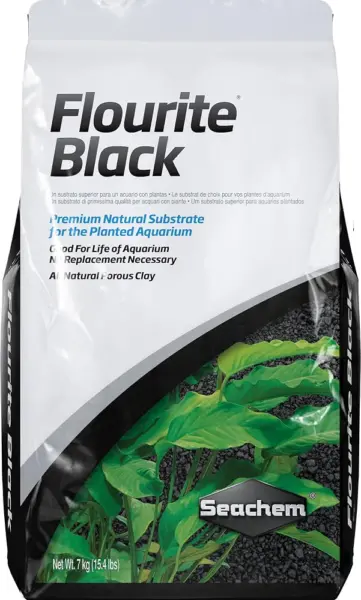
Seachem Flourite Black – Best Overall
Key Features
- Bag weight: 15.4 lb
- Replacement: Not required
- Water chemistry: Does not alter pH
- Price: Premium
Aquarium gravel is one of those purchases where the chemistry matters more than the color. Flourite Black is uncoated porous clay — no dye, no chemical treatment — and Seachem states plainly that it does not alter the pH of the water and will not soften or decompose into something unsuitable down the line. That is the first thing we check on anything going under a fish for years, and it is why this bag sits at the top rather than the middle.
At 15.4 pounds it is the largest bag here, and the only one that beds a whole tank in a single go. For a planted setup it is the obvious default: the grains are porous, so roots get something to grip instead of sliding across smooth quartz, and you do not need laterite or any other amendment underneath. A tank with rooted plants is exactly what this was built for.
Setup is the part to plan around. It is pre-washed, but clay travels badly, and Seachem’s own directions assume a rinse and a slow fill — water poured onto a bowl rather than straight onto the bed — with some haze at first that mechanical filtration clears. We do not count that against it. It is an hour on the day you set up, and afterwards the bed is stable and stays where you put it. If you want to tip a bag in and fill from the tap, one of the quartz or pebble options suits you better.
So the decision is really about plants. If the tank has them, or will, there is no reason to look past this bag. If it is a plain setup with plastic ornaments and a weekend siphon, you are paying for plant performance you will not use, and the fine dark quartz below buys you much the same look for less.
Pros
- Won’t alter pH or water chemistry
- 15.4-pound bag beds a whole tank
- Porous clay gives roots something to grip
- Doesn’t soften or need replacing
Cons
- Premium price against the other picks
Our default for a freshwater tank, planted or soon to be: an uncoated clay gravel that leaves your pH alone and beds a whole tank from one bag.
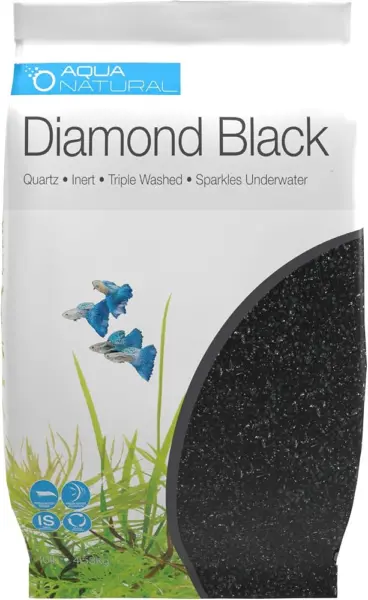
Aqua Natural Diamond Black – Best Fine-Grain Bed
Key Features
- Material: Natural quartz
- Bag weight: 10 lb
- Grain size: 1-2 mm
- Price: Midrange
The first thing to know about Diamond Black is that ‘gravel’ is doing a lot of work in the name. At 1-2 mm the grain sits closer to a heavy sand than to the chunky pea gravel most people picture, and that single fact decides which tanks it belongs in.
Where it fits, it looks fantastic. Fine quartz packs into a flat, dense bed, and the facets catch the light so the surface sparkles instead of reading as a black hole in the middle of the room. Against green plants it is the strongest contrast in this group. Expect variation in the mix, though: it is not a uniform inky black, and lighter grains show once it is wet.
The catch is in the maker’s own directions, which do not recommend it for snails or bottom feeders. Corydoras and loaches sift substrate for a living and want something they can move; 1-2 mm quartz is not it. In a tank of mid-water fish that limitation simply does not apply, and that is the setup where we rate it highest: a dark planted bed under a school of tetras is the best-looking version of this bag.
Coverage is modest for the size of the bag. Ten pounds spreads thinner than it sounds once you are aiming for an inch or two of depth, so buy for the footprint rather than the gallon figure in your head. Rinse it until the water runs clear and fill slowly — fine grain clouds faster than pebbles do.
Pros
- Fine 1-2 mm grain packs into a flat bed
- Quartz facets sparkle under tank light
- Strong dark contrast behind green plants
Cons
- Not for snails or bottom feeders
Our pick for a dark, fine bed under plants and mid-water fish — as long as nothing in the tank sifts the bottom, which the maker says this grain is not for.
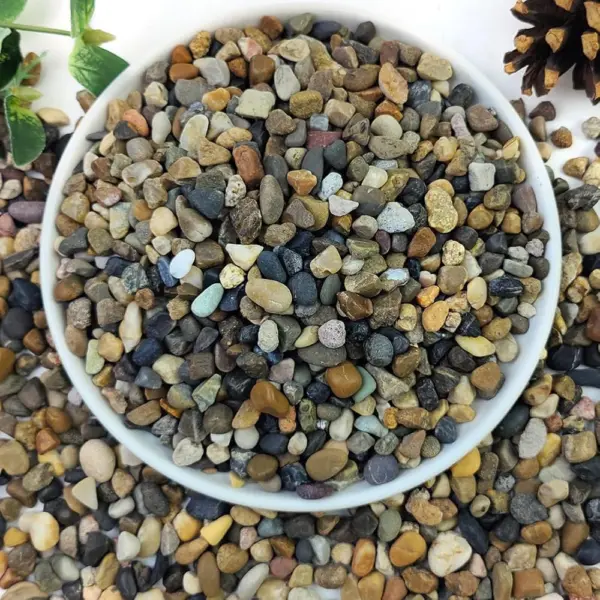
YISZM Natural River Gravel – Best Natural Riverbed Look
Key Features
- Material: Polished natural stone
- Bag weight: 5 lb
- Stone size: 1/4 inch
- Price: Midrange
Quarter-inch stone leaves gaps. That is the first thing you notice about a bed of these: it does not knit into a single surface the way fine gravel does, and the mixed natural colors read as a stream bottom rather than a design decision. It is the pick here for anyone who wants the tank to look found rather than styled, and we like it for exactly that.
The stones are smooth and undyed, with no filler or oil mixed in, which answers the safety question before you rinse the bag. Rounded edges also mean nothing in the tank has a corner to catch a fin. They do arrive dusty and the dust needs a proper rinse, but the stone underneath is clean.
Coverage is the honest catch. Five pounds beds a small tank and no more, so measure the footprint before you order and expect to buy twice. It also works out costlier per pound than the bulk clay and quartz bags here, which is the premium you pay for a natural look you cannot get from a dyed mix.
Pros
- Undyed natural stone, no oils or filler
- Smooth rounded stones won’t catch fins
- Reads as a river bottom, not a color scheme
Cons
- Five pounds beds only a small tank
- Costlier per pound than the bulk bags
For a natural riverbed look in a small tank, this is the bag we reach for; buy two, rinse them well, and don’t expect fine gravel coverage from quarter-inch stone.
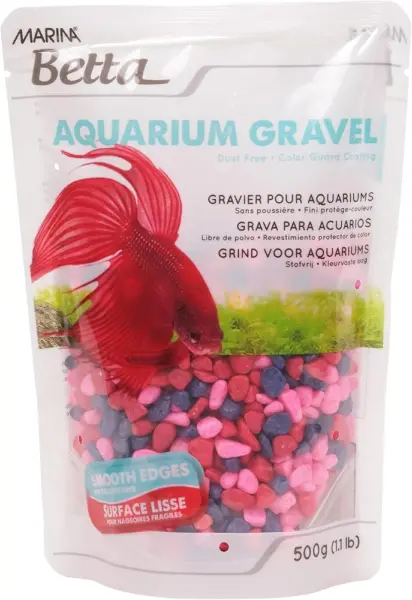
Marina Jellybean Gravel – Best for Nano Betta Tanks
Key Features
- Finish: Epoxy-coated, pre-rinsed
- Bag weight: 1 lb
- Stone size: 4-5 mm
- Price: Budget
A one-pound bag tells you what this is for. The Jelly Bean mix is a nano-tank product — enough to bed a small betta tank or a desktop three-gallon, and nowhere near enough for a ten. The stones are 4-5 mm, rounded, and colored in pinks, purples and blues that look more like candy than geology.
What we appreciate most is the finish. It is epoxy-coated and pre-rinsed, so there is no bucket session before the fun part, and the coating is stated not to affect water chemistry. For someone setting up a first small tank, a child’s especially, that is the difference between a project and an afternoon — we think it is the easiest bag here to start with.
The rounded edges are the other half of the argument, since bettas are long-finned fish that rest on the bottom, and the coating keeps its color rather than washing out to pastel inside a month. Just do the arithmetic before you buy: past a small tank you are buying several bags, and at that point a bulk bag is the smarter purchase.
Pros
- Pre-rinsed and dust-free out of the bag
- Rounded 4-5 mm stones suit betta fins
- Epoxy coating won’t affect water chemistry
Cons
- One-pound bag covers only a nano tank
For a betta or nano tank where the color is the point, this is the easy buy: pre-rinsed, fin-safe and bright — just size the tank before you order.
How We Tested the Best Aquarium Gravel
We started by pulling every bag we could find that was labeled for freshwater tanks and sorting them by grain size, bag weight, and whether the packaging actually said the material was inert. Anything with vague or missing specs, or a per-pound cost far above the rest of its size class, got dropped. That left 14 gravels and sands, which we’ve run in real tanks over five months — a 20-gallon long with a sponge filter and a single betta, a 10-gallon planted nano, and a grow-out tank we emptied and reset for each new substrate.
Every bag got the same rinse test: two cups into a white bucket, cold water, a full stir, and a count of how many passes it took before the water ran clear enough to read newsprint through. We also soaked a sample of each in tank water for two weeks and tested pH, carbonate hardness, and general hardness before and after, since a substrate that buffers your water will quietly undo months of careful stocking.
For plant growth we set stem cuttings and a patch of dwarf hairgrass into each one, then gave the stems a firm tug after two weeks to see what had actually rooted. Appearance got judged wet and dry, under a white LED and a blue one, and again at the five-month mark to catch color that faded or flaked. And because bag claims are optimistic, we weighed every bag and measured the floor area it covered at a two-inch depth — the depth most rooted plants need — to get a real cost per inch of tank.
How to Choose Aquarium Gravel
The decision comes down to what the material does to your water, whether the grain suits your fish, and how many bags it takes to bed the tank — the color is the easy part.
What the gravel does to your water
Anything in the tank stays in the tank, so the first question is whether the material is inert. Uncoated natural stone and fired clay are the safe ground: Flourite Black is untreated and stated not to change pH, the quartz and river stone bags here are undyed, and where a decorative mix gets its color from a coating, the maker needs to say it will not affect chemistry — Marina does, explicitly. When nothing on the listing says either way, keep looking.
The trap is buying something sold for a different job. Pebbles packaged for planters or landscaping can carry a wax or dye finish, and ‘natural’ in the title says nothing about what is safe underwater. Start every substrate question on the aquarium shelf, not the garden one.
Match the grain to the fish
Grain size decides which fish the bed suits, and it is the specification worth reading twice. Something in the 1-2 mm range packs into a dense, sand-like surface that suits mid-water fish and plants; quarter-inch stone gives you an open riverbed that works for most community tanks; a rounded 4-5 mm mix is chunky enough for a betta to rest on with no sharp edge anywhere.
Bottom feeders are the exception that settles it. Corydoras and loaches sift substrate through their gills, and Aqua Natural’s own directions say its fine quartz is not recommended for them or for snails. If your tank has either, choose a rounded pebble or a quarter-inch stone instead — the fine bags are for tanks where nobody roots around.
Buy for footprint, not for gallons
Bag sizes here run from a single pound to 15.4, and that is not a rounding difference — it is whether you can bed the tank at all. One pound is a nano tank, five is a small one, and ten or fifteen is where a standard community tank starts. Work from the footprint in front of you and the depth you want rather than the gallon figure you remember from the box, and remember that fine grain covers more area per pound because it packs tight.
Buying short is the easy mistake. A skimpy bed leaves plant roots and bare glass showing, and topping up later from a different batch can leave a visible seam across the front of the tank.
Rinsing, and the first fill
Almost everything needs a rinse, pre-washed or not. Rinse in a bucket until the water runs clear, add the substrate, then fill onto a bowl or a plate so the stream does not drill into the bed — Seachem’s directions describe exactly that sequence, and it is the difference between a clay substrate that clouds and one that settles. Some haze in the first hours is normal; filter floss clears it.
The pre-rinsed decorative mixes are the exception, and for a small tank that is a real convenience — no bucket, no hose, no waiting.
Frequently Asked Questions
Do I actually need gravel, or can I leave the tank bare?
Bare glass is easier to clean and perfectly fine for a quarantine or hospital setup you strip and wipe down. A display tank gains from gravel in ways that show up later: surface area for the bacteria that process waste, an anchor for plants, and a bottom that looks like somewhere a fish would live.
If you go bare, plan on more frequent siphoning rather than less.
Can I mix two different gravels in one tank?
You can, and a mix hides debris better than one flat color does. Keep the grains within a similar size range, though: fine quartz under quarter-inch stone eventually works its way to the surface and leaves the bed uneven, and a mixed bed is harder to siphon clean.
Two bags of the same product is the safer way to fill a tank.
How often do I have to replace the gravel?
You do not. Uncoated clay and natural stone do not wear out, and Seachem states Flourite need not be replaced — you siphon the mulm out and top up whatever you lose. Coated decorative gravel behaves the same until it starts to chip.
Budget for substrate once, then for the extra bags you add at the next rescape.
How do I vacuum gravel without sucking it up the tube?
Kink the hose to cut the flow while you work over a patch, then release it to lift the debris. Keep the siphon mouth an inch above a fine 1-2 mm bed so the grain settles back instead of traveling up the tube.
With quarter-inch stone you can push the tube into the bed and let the stones rattle — they are heavy enough to stay put.
Final Verdict
Most freshwater tanks should start with Seachem Flourite Black. It is the only bag here that states plainly it will not touch your water chemistry, the 15.4 pounds beds a whole tank in one go, and if you ever plant it, the substrate is already the right one.
Not planting, and want a fine dark bed? Aqua Natural Diamond Black looks better than anything else here, provided nothing in the tank sifts the bottom. Setting up a betta’s small tank, where the point is color and speed, Marina’s one-pound bag is pre-rinsed and ready in minutes. Buy the gravel for the tank you are actually keeping, not the one you might upgrade to.