This post contains affiliate links. We may earn a small commission when you buy through our links — at no extra cost to you.
Betta fish are happiest in calm, still water, but an unfiltered tank quickly becomes a health hazard. The trick is finding a filter that keeps water clean without creating a current strong enough to exhaust your betta or a motor hum that ruins a quiet room.
Sponge filters are the go-to for gentle flow, but they need a separate air pump and can produce coarse bubbles that some owners find noisy. Meanwhile, hang-on-back filters plug in easily but often lack flow adjustment, turning a 5-gallon tank into a washing machine.
The filters here were chosen to sidestep those trade-offs. Each one matches a specific tank size and noise tolerance, so you can keep your betta healthy without introducing new frustrations.
Top Picks
Best for Betta Tanks ≤10 Gal
AQUANEAT Bio Sponge

Rating: 4.7 ★ | Price: $ | Type: Sponge | Flow Control: No (air pump dependent) | Tank Size: Up to 10 gal | Noise Level: Moderate (bubbles)
The AQUANEAT Bio Sponge delivers gentle mechanical and biological filtration for betta tanks up to 10 gallons. Its slow water flow won’t stress delicate fins, and the sponge material is dense enough to trap debris without clogging quickly. Combined with a separate air pump, this setup keeps water clear while preserving the calm environment bettas need.
This filter suits budget-conscious beginners and shrimp or fry keepers who value low cost and easy upkeep. The sponge body measures about 2 inches by 4.75 inches, which can feel bulky in tanks under 5 gallons — it may crowd the interior more than expected. Bubble noise in quiet rooms is the main tradeoff, but that’s easily addressed with a simple add-on.
Pros
- Gentle flow safe for betta fins while keeping water clear.
- Budget-friendly price for a functional sponge filter.
- Sponge rinses out quickly under tap water for easy maintenance.
Cons
- Takes up more interior space than expected in very small tanks.
For betta keepers on a budget with a 5–10 gallon tank, this filter does the job without fuss — just add an air pump.
Best for Betta Tanks Up to 10
Marina S10 Power

Rating: 4.4 ★ | Price: $$$ | Type: HOB | Flow Control: Adjustable | Tank Size: Up to 10 gal | Noise Level: Quiet
The Marina S10 Power Filter stands out with its adjustable flow control, allowing a gentle current safe for betta fins while maintaining effective mechanical, chemical, and biological filtration for tanks up to 10 gallons. Some units may develop a vibration hum over time, but this can often be resolved by adjusting the filter’s position — a minor inconvenience for the quiet operation it otherwise delivers. It suits beginner aquarists and betta keepers with a quiet space in mind.
Pros
- Very quiet operation
- Adjustable flow control ideal for bettas
- Easy to set up and maintain
Cons
- Some units may develop a vibration hum over time; placement adjustment can help
For betta tanks under 10 gallons that need a gentle, adjustable flow, the Marina S10 is the most suitable HOB option — quiet and easy to maintain.
Best for Multi-Tank Budgets
Pawfly Sponge 3-Pack

Rating: 4.6 ★ | Price: $ | Type: Sponge | Flow Control: No (air pump dependent) | Tank Size: Up to 10 gal each | Noise Level: Moderate (bubbles)
The Pawfly 3-pack delivers three functional sponge filters at a cost that makes outfitting several small tanks practical. Each filter is small (2-inch diameter, rated up to 10 gallons) and suits light bioloads best – in more heavily stocked tanks, you’ll need to rinse them more often.
This pack works best for breeders, shrimp keepers, or anyone running multiple fry tanks where gentle flow and low cost are priorities. For a single 10-gallon betta tank with light stocking, one filter does the job but expect more frequent maintenance than with a larger sponge.
Pros
- Three filters for the price of one – ideal for multi-tank setups.
- Simple setup: attach airline tubing and submerge – no moving parts.
Cons
- Bubble noise can be noticeable in quiet rooms with a stronger air pump.
This three-pack is a practical buy if you run several small tanks or need a backup. For a single setup, a larger filter may be less work.
Best for 10-20 Gal Tanks
AQUANEAT Double Sponge

Rating: 4.6 ★ | Price: $ | Type: Sponge | Flow Control: No (air pump dependent) | Tank Size: Up to 20 gal | Noise Level: Moderate (bubbles)
The AQUANEAT Double Sponge filter uses two sponges to provide extra surface area for beneficial bacteria compared to single-sponge alternatives. This makes it a suitable choice for medium betta tanks (10–20 gallons) or shrimp setups where higher biological load is expected. However, the suction cups may struggle to keep the filter in place, and the sponges arrive vacuum-sealed, requiring a soak to regain full shape before use.
Pros
- Dual sponges trap debris while hosting beneficial bacteria for biological filtration.
- Cost-effective option with double the sponge real estate compared to single-sponge filters.
- Suits medium betta tanks and shrimp setups up to 20 gallons with gentle flow.
Cons
- Suction cups may lose grip over time, requiring reinforcement or replacement.
- Sponges arrive compressed and need several hours of soaking to expand fully.
For betta keepers with tanks in the 10–20 gallon range, the AQUANEAT Double Sponge delivers extra biological filtration at a low cost, if you’re prepared to reinforce the suction cups and presoak the sponges.
Best for Nano Tanks ≤3 Gal
Pawfly Mini Sponge

Rating: 4.5 ★ | Price: $ | Type: Sponge | Flow Control: No (air pump dependent) | Tank Size: Up to 3 gal | Noise Level: Low (small bubbles)
The Pawfly Mini Sponge Filter’s 1.5-inch diameter footprint fits into betta bowls and shrimp nano tanks without crowding the interior. Its small size limits use to tanks under 3 gallons, and the sponge surface area is modest — not suitable for heavily stocked setups or larger aquariums. Bubble noise can be noticeable depending on the air pump, though a control valve helps manage that. Best for single-betta bowls, shrimp tanks, or fry nurseries where gentle filtration matters more than high capacity.
Pros
- Compact size fits tight spaces in bowls and nano tanks.
- Provides adequate biological filtration for lightly stocked setups under 3 gallons.
- Kit includes airline tubing and control valve for flow adjustment.
Cons
- Bubble popping noise may be audible in quiet rooms — use a control valve or airstone to reduce it.
For nano tanks under 3 gallons, this is the most space-efficient sponge filter available — just pair it with a quiet air pump.
Best for Planted/shrimp Tanks
hygger Double Sponge

Rating: 4.4 ★ | Price: $$ | Type: Sponge | Flow Control: No (air pump dependent) | Tank Size: 10–40 gal | Noise Level: Moderate (bubbles)
The hygger Double Sponge stands out by including removable media baskets filled with ceramic bio balls — a step up in biofiltration compared to standard sponge filters. For planted tanks and nano communities up to 20 gallons, this provides space for beneficial bacteria to handle higher waste loads. However, the suction cups can lose grip over time, so resting the filter on the substrate is a reliable alternative. Noise level varies with the air pump used; pairing it with a quiet pump keeps things peaceful in a living room or office.
Pros
- Dual sponges plus ceramic media basket support robust mechanical and biological filtration.
- Tool-free disassembly makes routine cleaning quick and simple.
- Comes with two spare sponges, extending the time between replacements.
Cons
- Suction cups may lose hold over time; placing the filter on the tank bottom is a practical workaround.
- With some air pumps, the filter produces noticeable noise — a quiet pump resolves this.
A capable sponge filter with added biofiltration for hobbyists who want more biological capacity, provided you’re comfortable managing suction cup placement and pump noise.
Best for Short-Term Use
Tetra Whisper Internal
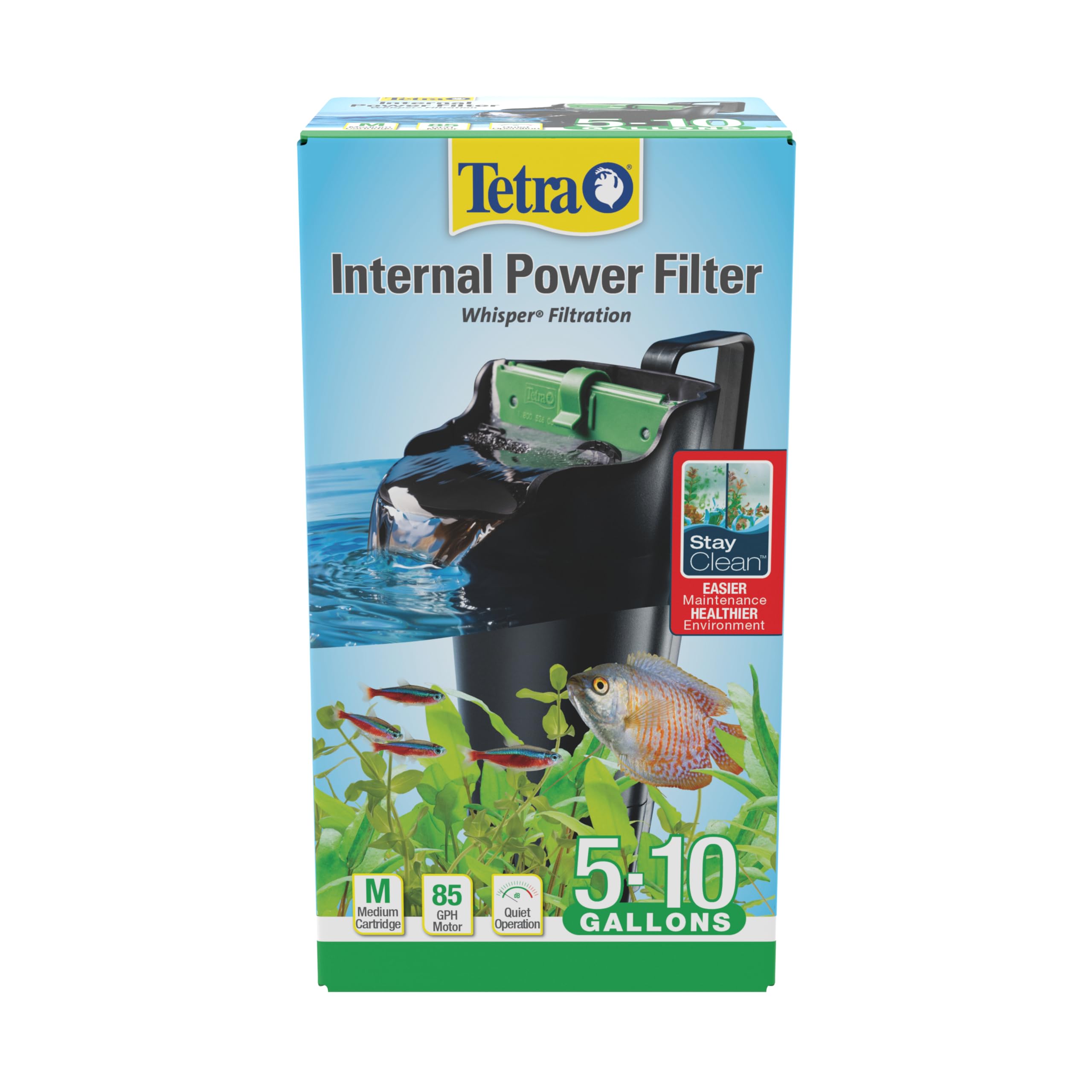
Rating: 4.3 ★ | Price: $ | Type: Internal | Flow Control: No | Tank Size: 5–10 gal | Noise Level: Quiet
One of the quietest small power filters, the Tetra Whisper stays near-silent in small tanks and cleans effectively for tanks up to 10 gallons. However, durability can vary – some units may stop working within months, limiting this filter to short-term use or backup tanks.
Pros
- Very quiet operation – no motor hum in small tanks
- Effective water cleaning for tanks up to 10 gallons
Cons
- Durability varies; some units may stop working within months – best for temporary setups.
A good short-term filter for quiet small tanks, but plan to replace within months.
Best for Short-Term Use
Tetra Whisper IQ 20

Rating: 4.2 ★ | Price: $$$ | Type: HOB | Flow Control: No | Tank Size: Up to 20 gal | Noise Level: Quiet (shield)
The Tetra Whisper IQ 20 runs quietly enough for a bedroom, and its self-priming design simplifies setup. Water clarity improves quickly. However, the motor unit may leak over time, and consistency can vary. This suits temporary or backup use, not long-term betta setups.
Pros
- Sound shield keeps motor noise below 40 dB — quiet enough for a bedroom.
- Easy to assemble and install with a self-priming pump.
Cons
- Motor unit may leak water onto flooring, creating a risk near sensitive surfaces.
Best for hobbyists who need a temporary filter or a backup unit and can monitor for leaks. Not recommended for permanent installation near electronics or wood surfaces.
Best for Extreme Budget
Aqua-Tech Ultra Quiet

Rating: 4.3 ★ | Price: $$ | Type: HOB | Flow Control: No | Tank Size: 10–20 gal | Noise Level: Moderate (hum)
At under $20, this is the most affordable power filter for 10–20 gallon tanks. However, motor performance can vary — some units may hum in quiet rooms or stop working after a period of use. Best for temporary setups where noise isn’t a concern and a short service life is acceptable.
Pros
- Effective filtration for the cost
- Simple to disassemble and clean
Cons
- In a quiet bedroom, the motor hum can be audible, contrary to the ‘Ultra Quiet’ marketing
Pick this only for a quarantine tank or backup filter when the absolute lowest price matters more than quiet operation or longevity.
Best for Large Tough Fish
Marineland Penguin 200

Rating: 4.3 ★ | Price: $$$ | Type: HOB | Flow Control: No | Tank Size: 20–30 gal | Noise Level: Noisy
This HOB power filter moves 200 gallons per hour, enough to keep a medium community tank clear. The Bio-Wheel adds biological filtration, and the price is reasonable for the cleaning power. However, the flow is too strong for betta fins, the motor can become noisy over time, and some units may stop working within months. It fits tanks with active fish that can handle current.
Pros
- Cleans water effectively in medium tanks
- Good value for the price
Cons
- In a quiet room, the motor hum and water splash may be noticeable
For a 20–30 gallon community tank with hardy fish that don’t mind current, this filter offers solid mechanical and biological filtration at a mid-range price.
How to Choose
Choosing a betta filter is less about power and more about matching flow gentleness to your tank size and noise tolerance.
Filtration Type: Sponge vs. HOB vs. Internal
Sponge filters use an air pump to draw water through a porous block, providing gentle mechanical and biological filtration. They produce zero current inside the tank, making them safe for long-finned bettas, but they require an external air pump and can bubble loudly if the pump is too strong.
Hang-on-back (HOB) filters hang on the rim and use a motor to pull water through cartridges. They offer chemical filtration and are easier to service, but most models have a fixed flow rate that can stress bettas. Only a few HOBs include a flow dial, which is essential for controlling the current.
Flow Rate and Adjustability
A betta’s ideal flow is a gentle ripple, not a current. Filters rated for tanks larger than your actual tank often push too much water. Adjustable flow lets you dial down the output to a trickle, which is why the Marina S10 stands out among HOBs.
Sponge filters depend on the air pump’s output – a simple control valve lets you reduce bubbles and flow. Without adjustability, you may need to add a diffuser or switch to a weaker pump.
Tank Size Capacity
A filter rated for a tank twice your size won’t clean better – it will just create more current. For a 5-gallon betta tank, look for filters designed for 5–10 gallons. Oversized filters take up interior space and can trap fish against the intake.
Sponge filters specify a max tank size (e.g., up to 10 gallons). Exceeding that capacity means less effective mechanical filtration, especially in heavily stocked tanks.
Ease of Cleaning
Sponge filters are the simplest to clean: squeeze the sponge in dechlorinated water during water changes. HOB filters require replacing carbon cartridges every few weeks, which adds ongoing cost. Internal filters need disassembly to clean the impeller and media.
Neglecting cleaning leads to reduced flow and nitrate buildup. Choose a filter you’re willing to maintain regularly – a sponge filter’s low maintenance is a major reason experienced keepers prefer it.
Noise Level
Noise comes from three sources: the motor hum, water trickling, and bubbles popping. HOB filters often hum, especially if the water level drops below the outflow. Sponge filters are silent except for bubbles – coarse bubbles pop louder than fine bubbles from an airstone.
If the filter sits in a bedroom, look for models with sound-dampening features (like the Tetra Whisper IQ’s shield) or use a sponge filter with a control valve to reduce bubble size.
FAQ
Can I use a sponge filter without an air pump?
No – sponge filters rely on an air pump to draw water through the sponge. Without one, the filter won’t pull water and provides no mechanical or biological filtration. You’ll need an air pump and tubing; some beginner kits include these, but many budget sponge filters do not.
Why is my sponge filter making loud bubbling noises?
Loud bubbles usually mean the air pump’s output is too strong for the sponge’s resistance, or the bubbles are too coarse. You can add a control valve to reduce airflow or attach an airstone inside the sponge to break bubbles into finer, quieter ones.
How often should I clean a sponge filter in a betta tank?
Clean the sponge every two to four weeks, but only in a bucket of dechlorinated aquarium water – never tap water, which kills beneficial bacteria. Gently squeeze the sponge until the water runs clear. Over-cleaning disrupts the biofilter, so avoid scrubbing.
Is a hang-on-back filter too strong for a betta fish?
It depends on the model. Many HOB filters push 150+ GPH, which creates a strong current that exhausts bettas. Look for HOBs with adjustable flow, like the Marina S10, or choose a sponge filter to keep the water nearly still.
Why do my sponge filter’s suction cups keep falling off?
Suction cups are a common weak point on sponge filters. They tend to lose grip over time, especially on textured glass or if the tank has temperature fluctuations. You can secure the filter with a suction cup adhesive pad or simply let it rest on the tank bottom.