This post contains affiliate links. We may earn a small commission when you buy through our links — at no extra cost to you.
A return pump that dies after six months isn’t just an inconvenience — it can crash a reef tank. Across the budget and mid-range market, early failure is the norm rather than the exception. The problem isn’t a single bad brand; it’s a category-wide trade-off between price and long-term reliability.
This guide cuts through the noise by matching pumps to real-world use: nano builds, standard 50-75 gallon sumps, and large reef systems. You’ll know which ones hold up, where you can save, and where a higher upfront cost buys actual peace of mind.
The key is matching advertised flow to your actual head height and plumbing — not just tank volume. A pump that loses 50% of its GPH at 5 feet won’t move your sump water effectively, no matter how quiet it is.
Top Picks
Best for Mid-Size Sumps
Jebao DCP-2500 660GPH

Rating: 4.5 ★ | Price: $ | Use: Submersible only | Power: 23W DC | Max Head: 8.2 ft | Flow Rate: 660 GPH | Controller: DCP 30-100%
The DCP-2500 pushes 660 GPH at just 23W, running quietly enough that you’ll need to check it’s on. Its sine-wave controller lets you dial flow from 30–100%, making it easy to match the turnover rate your sump needs.
This pump suits aquarists with tanks up to 75 gallons who want DC efficiency without spending premium money. Some units may stop running within the first year, and the controller buttons can feel unresponsive — less of a concern if you set the speed once and leave it.
Pros
- Nearly silent operation — a clear upgrade from hummy AC pumps
- Strong flow and pressure for its compact size
- Outstanding value for the price
Cons
- Some pumps may stop running within the first year
- Controller buttons can be unresponsive or confusing
For a small to mid-size sump on a budget, the Jebao delivers quiet, adjustable flow — just accept that longevity may require a backup plan.
Best for 75-125 Gal Tanks
Hygger 1060GPH DC

Rating: 4.4 ★ | Price: $$ | Use: Submersible/Inline | Power: 33W DC | Max Head: 13.1 ft | Flow Rate: 1060 GPH | Controller: 71 speeds, no LCD
The Hygger 1060GPH DC pump pairs a compact footprint with 71 speed settings, giving aquarists fine control over return flow in 75–125 gallon setups. Its quiet operation and strong output per watt make it a direct alternative to the top pick for those who want more adjustability without paying a premium.
This pump suits hobbyists who prioritize speed customization and quiet performance over long-term certainty. Quality control varies between units – some may stop producing rated flow within months, so it works best as a primary pump on tanks where a spare is at hand or for non-critical circulation duties.
Pros
- Very quiet operation – nearly silent during normal use
- Strong water flow for its size and power draw
Cons
- Some units may lose flow or stop operating after a few months
- Occasional build defects can appear within the first weeks
A solid mid-range choice if you want maximum speed control and quiet flow for a medium tank – just budget for a backup pump if failure would be disruptive.
Best for Nano Tanks 5-15
IOAOI Nano 185GPH
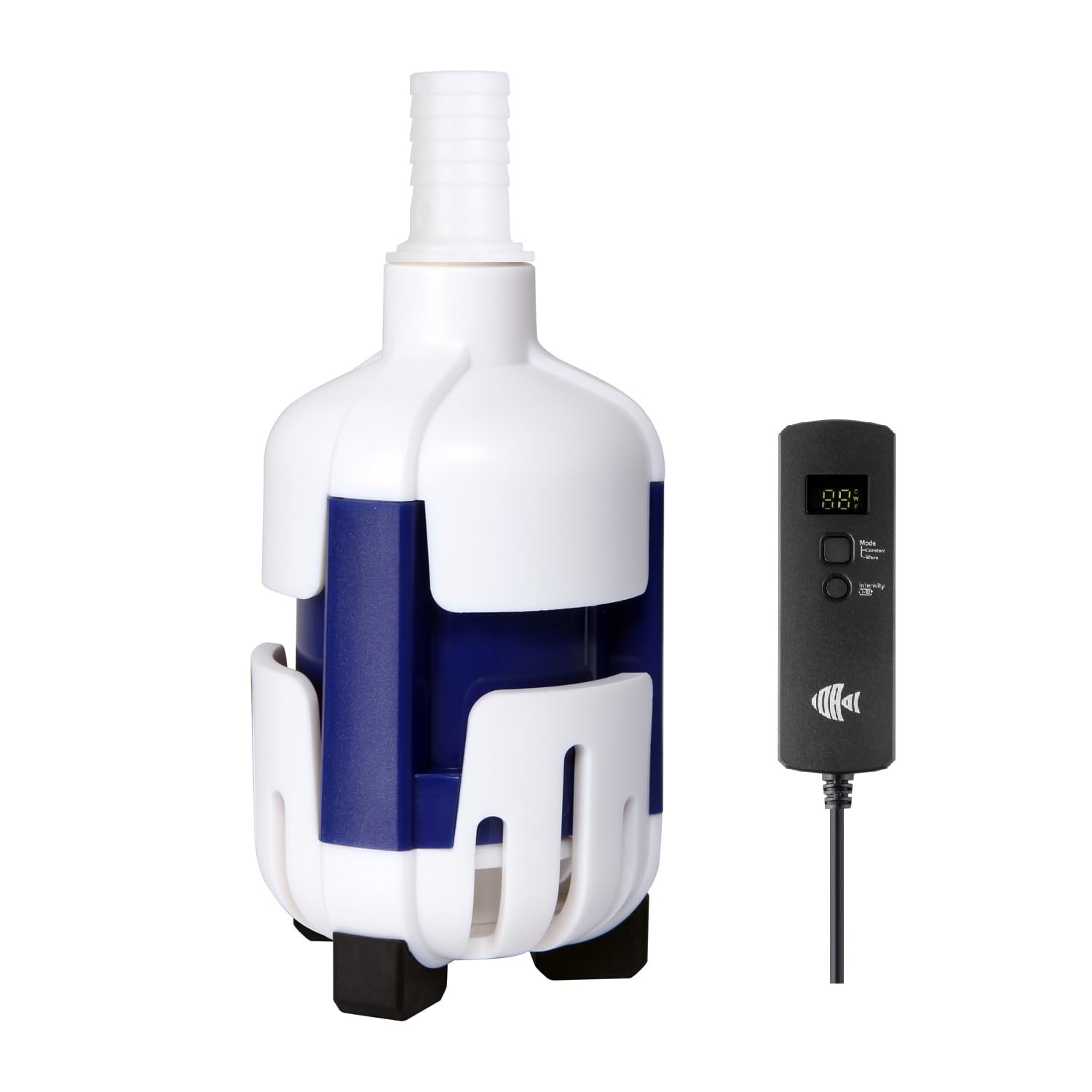
Rating: 4.4 ★ | Price: $$ | Use: Submersible only | Power: 9W DC | Flow Rate: 185 GPH | Controller: 10 speeds, 3 modes
This nano pump delivers near-silent, adjustable flow for small sumps. Where the top pick handles larger tanks, the IOAOI Nano is purpose-built for 5-15 gallon setups. Its 10-speed controller and wave mode give precise flow matching, and build quality consistently earns praise. Flow is limited to nano applications – perfect for nano reef tanks and all-in-one upgrades, but not for tanks over 20 gallons.
Pros
- Operates so quietly it’s barely audible in a living room
- Build quality feels solid and well-finished
- 10-speed controller plus wave mode for fine flow tuning
Cons
For nano reef tanks and small sumps, this pump offers everything needed with no notable flaws at a mid-range price.
Best for Large Reef 100-200
Hygger 2120GPH DC

Rating: 4.2 ★ | Price: $$$ | Use: Submersible/Inline | Power: 65W DC | Max Head: 18 ft | Flow Rate: 2120 GPH | Controller: 71 speeds, LCD
The Hygger 2120GPH delivers more flow and higher head pressure than the top pick, making it a strong candidate for tall sump setups or larger systems. While the other high-flow option in this roundup offers even more raw flow, its reliability track record is less consistent. This pump suits aquarists who need the extra head pressure and don’t mind the premium price, though some units may stop working early – a risk worth considering for critical systems.
Pros
- Delivers 2120 GPH at 18 ft head – enough for 100-200 gallon reef tanks with tall sumps.
- 71-speed LCD controller allows precise flow adjustment.
- Operates very quietly – often described as silent in use.
Cons
- Some units may stop working within 6 months, so it’s not a set-and-forget purchase.
- Premium pricing – costs more than the top pick without a proportional reliability increase.
Choose this Hygger if your tank demands high head pressure and you prefer a simple LCD controller – just budget for a backup pump to cover the occasional early stoppage.
Best for Very Large Tanks
Orlushy dc-12000 3100GPH

Rating: 4.4 ★ | Price: $$ | Use: Submersible/Inline | Power: 80W DC | Max Head: 16.5 ft | Flow Rate: 3100 GPH | Controller: Sine wave, 20 speeds
The Orlushy dc-12000 delivers the most flow per dollar among pumps we tested, with a sine-wave controller offering 20 speeds for precise return flow in large tanks. Its 80W DC motor runs quietly even at full output. However, some units may stop operating within months, and corrosion or impeller wear has been reported. A marketing claim of ‘no copper’ is contradicted by product details, making this unsuitable for copper-sensitive saltwater tanks. This pump fits aquarists who prioritize high flow and variable control over long-term predictability and are willing to accept the possibility of early replacement.
Pros
- Very quiet operation
- Excellent performance and flow control
- Good value for money
Cons
- Some units may stop operating within months of use
- Marketing claim of ‘no copper’ is contradicted by product details, limiting use for copper-sensitive tanks
Ideal for large reef tanks needing high flow and variable control, but only if you’re comfortable with the possibility of early replacement.
Best for Small Tanks Backup
JEREPOND 660GPH DC

Rating: 4.5 ★ | Price: $ | Use: Submersible/Inline | Power: 25W DC | Max Head: 10 ft | Flow Rate: 660 GPH | Controller: LCD display, 20 speeds
The JEREPOND 660GPH DC pump brings an LCD controller at a lower price than comparable models, and runs quietly with solid build quality. However, the plastic outlet thread can crack if overtightened, and occasional early pump stoppages have been noted. This makes it best suited as a secondary or backup pump for small tanks rather than a primary return pump.
Pros
- Solid build quality for the price
- Very quiet operation – nearly silent
Cons
- Plastic outlet thread may crack if overtightened by hand
A suitable budget option for a quarantine tank or emergency spare where reliability is less critical.
Best for Nano Reactors
Tunze 1073.008

Rating: 4.5 ★ | Price: $$ | Use: Submersible only | Max Head: 4 ft
This pump runs nearly silent and is built to last, but flow is very low — suited for nano tanks, media reactors, or skimmer replacements where brand trust matters. It lacks speed control and its output is too weak for any main return duty beyond 20 gallons. If your setup is small and quiet operation is critical, this is a dependable choice; for larger systems, look elsewhere.
Pros
- Nearly silent operation suited for quiet living spaces
- Dependable build quality from a German manufacturer known for longevity
Cons
- Flow output is too low for use as a main return pump on tanks over 20 gallons
Ideal for aquarists running nano cubes or media reactors who prioritize whisper-quiet operation and long-term dependability over raw flow.
Best for Temporary Backup
JEREPET 1250GPH

Rating: 4.1 ★ | Price: $ | Use: Submersible/Inline | Power: 32W DC | Max Head: 13.1 ft | Flow Rate: 1250 GPH | Controller: 6 speeds
The JEREPET 1250GPH pump delivers quiet operation and good flow for medium tanks at a budget-friendly price. However, durability can be inconsistent — some units may stop working within months, which makes this pump better suited as a temporary or backup option rather than a primary return pump for a valued aquarium.
Pros
- Quiet operation
- Good water flow for medium tanks
Cons
- Durability can be inconsistent; some units may have a short lifespan
A usable spare or temporary pump for low-risk freshwater setups where failure won’t be catastrophic.
Best for Ponds Fountains
Uniclife 800GPH AC

Rating: 4.2 ★ | Price: $ | Use: Submersible/Inline | Power: 55W AC | Max Head: 8 ft | Flow Rate: 800 GPH | Controller: None (AC)
The Uniclife 800 GPH AC pump delivers solid water movement for small ponds or fountains at a budget-friendly price. Its simple submersible/inline design gets the job done where flow adjustment isn’t needed. However, there’s no speed control, the power cord is only 6 feet, and durability can be inconsistent — some have stopped working after a few months. This makes it a poor fit for a critical aquarium return, especially in saltwater setups.
Pros
- Decent build quality for the low price
- Straightforward operation that serves its purpose
Cons
- Short 6-foot power cord may require an extension cord for placement flexibility
A workable spare or dedicated pond pump if you don’t mind the cord length and accept that it may not last years under continuous duty.
Best for Emergency Spare
Uniclife 320GPH AC

Rating: 4.2 ★ | Price: $ | Use: Submersible/Inline | Power: 22W AC | Max Head: 5 ft | Flow Rate: 320 GPH | Controller: Sliding knob
This Uniclife pump hits the lowest price point in the roundup, making it a cheap option to keep on hand as a backup for a very small tank or a temporary mixing station. Flow maxes out at 320 GPH with only 5 feet of head, so it won’t handle a typical sump return job. Noise can vary between units, and some owners note the pump may stop working after a few months of use, so it’s best left in the drawer until needed rather than relied upon daily.
Pros
- Budget-friendly enough to buy as a spare without second-guessing.
- Simple sliding-knob control for basic flow adjustment.
Cons
- In a quiet living-room tank setup, the motor hum or grind may be noticeable.
Keep one in the closet for emergencies or a tiny holding tank — not for everyday return-pump duty.
How to Choose
The GPH rating on the box often drops by 40-50% once you account for head height and plumbing friction — match pump to your actual return pipe height, not just tank volume.
Flow Rate and Head Height
Flow rate is listed at zero head, but every foot of vertical rise reduces output. A pump rated 1000 GPH at 0 ft may deliver only 500 GPH at 5 ft. Check the pump’s flow curve on the manufacturer’s site or look at real user reports.
For a typical sump, aim for 5-10 times tank volume turnover after head loss. A 75 gallon tank with 4 ft of head needs a pump that moves 375-750 GPH at that height — not at the box rating.
DC vs AC Motor
DC pumps are quieter, more energy-efficient, and offer variable speed control. AC pumps are simpler and cheaper but lack adjustability and often hum or vibrate. The trade-off is reliability: DC controllers can fail, and replacement parts are not always available.
If you need absolute silence and flow tuning, DC is the way. For a simple, non-critical setup where noise doesn’t matter, an AC pump can save money up front.
Variable Speed Controller
A controller lets you dial in the exact flow for your tank, reducing excess turbulence or noise. More speed steps (e.g., 71 vs 6) give finer control but add complexity. Controllers with LCD screens are easier to read, but buttons can become unresponsive over time.
Budget controller models are the most common failure point. If your use case is critical, consider a pump with a separate, replaceable controller or a warranty that covers it.
Submersible vs Inline
Submersible pumps sit inside the sump and are cooled by the water, making them quieter and easier to install. Inline pumps sit outside the water and require proper plumbing, but they eliminate heat transfer and allow easier servicing.
Many DC pumps are rated for both, but inline use may void the warranty if not sealed correctly. Submersible is the safer bet for most home aquariums.
Noise Level
Noise is subjective, but DC pumps at low speeds are nearly silent. AC pumps or DC pumps at high speed produce vibration that can resonate through the stand. Look for user feedback about ‘silent’ or ‘quiet’ operation specific to your tank size.
The most common noise complaint is from air trapped in the impeller housing after startup — bleed air out during installation to avoid grinding sounds.
FAQ
Why does my aquarium return pump keep stopping after a few months?
Most early failures are due to impeller wear, seal leaks, or controller electronics dying in budget DC pumps. The controller is often the weakest link. To avoid this, choose a pump with a proven reliability record or invest in a brand with better quality control like Tunze for small tanks.
Can I run a DC return pump inline (external) or does it have to be submerged?
Many DC pumps are rated for both submersible and inline use, but check the product specs carefully. Inline installation requires the pump to be placed outside the water and may need different plumbing connections. Submerged operation is generally quieter and easier to maintain.
What size return pump do I need for a 75 gallon reef tank with a sump?
For a 75 gallon reef, aim for a pump that delivers 600-800 GPH after accounting for head loss (typically 4-5 ft). The Jebao DCP-2500 (660 GPH) or Hygger 1060GPH are solid matches. Always use the pump’s flow curve to verify output at your actual head height.
Is the ‘no copper’ claim on budget return pumps trustworthy for saltwater?
Not always. Some budget pumps list copper in their materials despite marketing claims of ‘copper-free’. For reef tanks, verify with user reviews or invest in a test kit. Safer bets include brands like Tunze or Hygger that have consistent feedback from reef hobbyists.