This post contains affiliate links. We may earn a small commission when you buy through our links — at no extra cost to you.
A planted tank lives or dies by what’s under the roots. The right sand gives stems something to grip, keeps the aquascape looking natural, and stays put when you siphon around carpeting plants; the wrong one clouds the water every time you touch it. I’ve kept planted tanks for years, and over the past five months my team and I have set up and maintained 14 different aquarium sands.
The differences show up fast: some bags are nearly dust-free and rinse clean in a bucket, while others send a milky plume through the tank for days. Color is just as variable—some sands keep their warm tone under LEDs, and others wash out to flat gray once wet. What matters is sand quality in the tank, not the bag: whether grains stay suspended during filling, whether debris sits where a siphon can lift it, and whether a bag goes far enough to justify the cost. A sand that needs endless rinsing and still clouds the glass is not a bargain.
Top Picks
Best for Planted Community Tanks
Aqua Natural Sugar White Sand

Rating: 4.7 ★ | Price: Budget | Color: Off white | Bag Weight: 10 lb | Grain Size: 0.5-1 mm | Preparation: Triple washed and kiln dried
Grain size is the number that matters here: 0.5 to 1 mm, dense, with the fines screened out. Push a stem into that and the sand closes back around it instead of sliding away, which is the whole difference between planting in sand and fighting it. In a tank with any turnover at all, sand that lifts and drifts is worse than gravel; this one stays where it lands.
Of the bags here, this is the one we reach for first. It is inert, so it grips roots without pretending to feed them — a sword or a crypt wants root tabs, and we prefer to add those ourselves than inherit someone else’s nutrient mix. Triple washed and kiln dried means two rinses get the water clear rather than twenty, though we still rinse every bag; a little grit always settles out of the bucket.
Color is the part to settle before you order. In the bag it reads off white, and under tank lights it warms to a light tan — more beach than snow. That flatters green leaves, and it forgives the mulm that appears between cleanings far better than a bright white sand does. If you are matching a white stand or a snow-white background, expect a visible difference.
By the pound it is the cheapest sand we recommend, and a 10 lb bag covers a small tank properly rather than leaving you an inch short at the front glass. Buy one bag more than the math says. A spare bag in the cupboard beats a thin bed that shows the glass for the next two years.
Pros
- Fine 0.5-1 mm grains hold stems in place
- Triple washed, so rinsing is quick
- Cheapest per pound of the sands here
- Off-white tone flatters green plants
Cons
- Inert; heavy root feeders need root tabs
We think this is the sand most planted tanks should start with: fine, dense and clean, and it leaves budget for root tabs and plants.
Best for Dedicated Planted Tanks
Seachem Flourite Black Sand
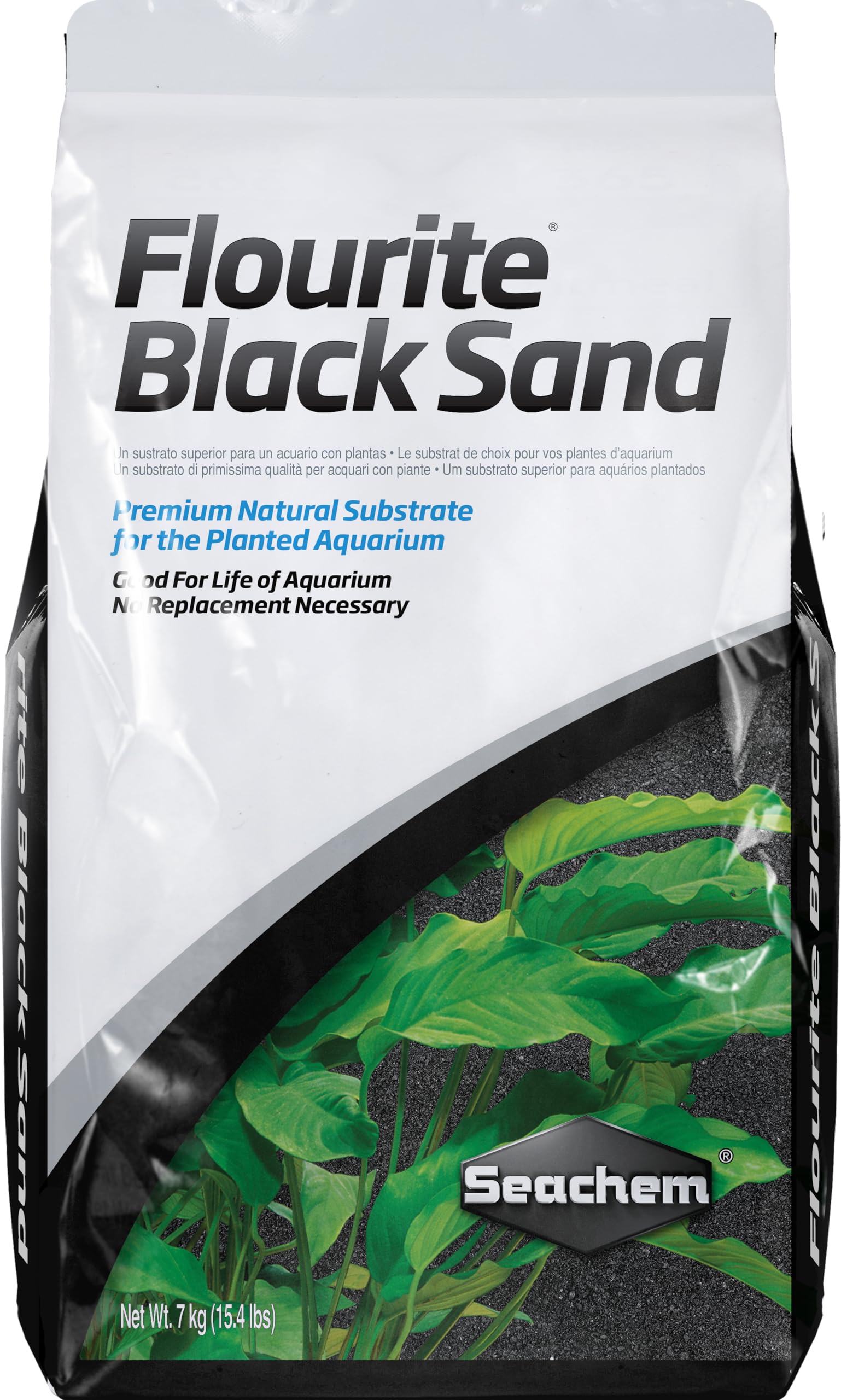
Rating: 4.5 ★ | Price: Premium | Color: Black | Material: Porous clay | Bag Weight: 15.4 lb | Water Chemistry: Will not alter pH
Flourite is the odd one out here, and that is exactly why it stays on the list: a fracted porous clay rather than a natural sand, built for the planted aquarium first and the look second. If your plants are the project rather than the backdrop — a heavy sword, a wall of crypts, a tank you are aquascaping rather than decorating — this is the substrate we choose and pay for.
The mechanism is worth understanding. The clay grains are porous, so they draw nutrients out of the water column and hold them where roots can reach, which is as close as anything here gets to soil without the mess of one. Seachem describes it as uncoated and pH-neutral, so it does not fight the water you are trying to keep, and it never needs replacing — you buy it once rather than swapping it out every couple of years.
What you give up is feel and money. It is a clay gravel, not a soft fine sand: coarser in the hand, heavier on a slope, and not the bed we choose for a tank built around corydoras. It is also the most expensive bag in this group. In a display aquascape where the plants carry the tank, both are fair trades; in a low-key community tank with a few ferns, the Aqua Natural sand does the job for far less.
Pros
- Porous clay holds nutrients at the root zone
- Will not alter the pH of the water
- Never needs replacing
- Black background makes green leaves pop
Cons
- Clay gravel, not a soft fine sand
- Most expensive bag in this group
Buy this when the plants are the project: porous clay that stores nutrients at the roots, stays pH-neutral and never needs replacing.
Best for New Tank Setups
Aqua Natural Galaxy Bio-Substrate

Rating: 4.6 ★ | Price: Midrange | Color: Black | Seeding: Live nitrifying bacteria | Bag Weight: 5 lb | Preparation: Do not rinse
Every other bag on this page expects a bucket and a hose. This one says do not rinse, and it means it: the sand arrives wet and seeded with live nitrifying bacteria, and washing it sends the useful part straight down the drain.
Read the directions closely and the bag is smaller than it looks. The mix is one part live substrate to four parts dry, at about a pound of the blend per gallon, so five pounds is a nano-tank dose or a seed for a bigger bed — not a full substrate for a 29-gallon. That is not a flaw, but it changes what you are buying: this is the bag for starting something small, or for kicking off a cycle in a setup you will top up with dry sand later.
Where it earns its place is a new nano or 10-gallon planted tank. The grain is fine and holds plants, and it does not get pulled out quite as readily as lighter substrates during a water change. The catch is the flip side of no rinsing: the black fines go in with the water, and the tank can run cloudy for a day or two. Plan a water change and a fresh filter pad instead of a rinse you are not allowed to do.
Pros
- Live bacteria seed a new filter
- Goes straight in with no rinsing
- Fine black grain holds plants in place
Cons
- Can cloud the water, since it cannot be rinsed
- Five pounds treats only about five gallons
The bag we reach for when a small tank needs starting, as long as you accept that five pounds covers about five gallons and cannot be rinsed.
Best for Bottom Dwellers
CaribSea Moonlight Sand
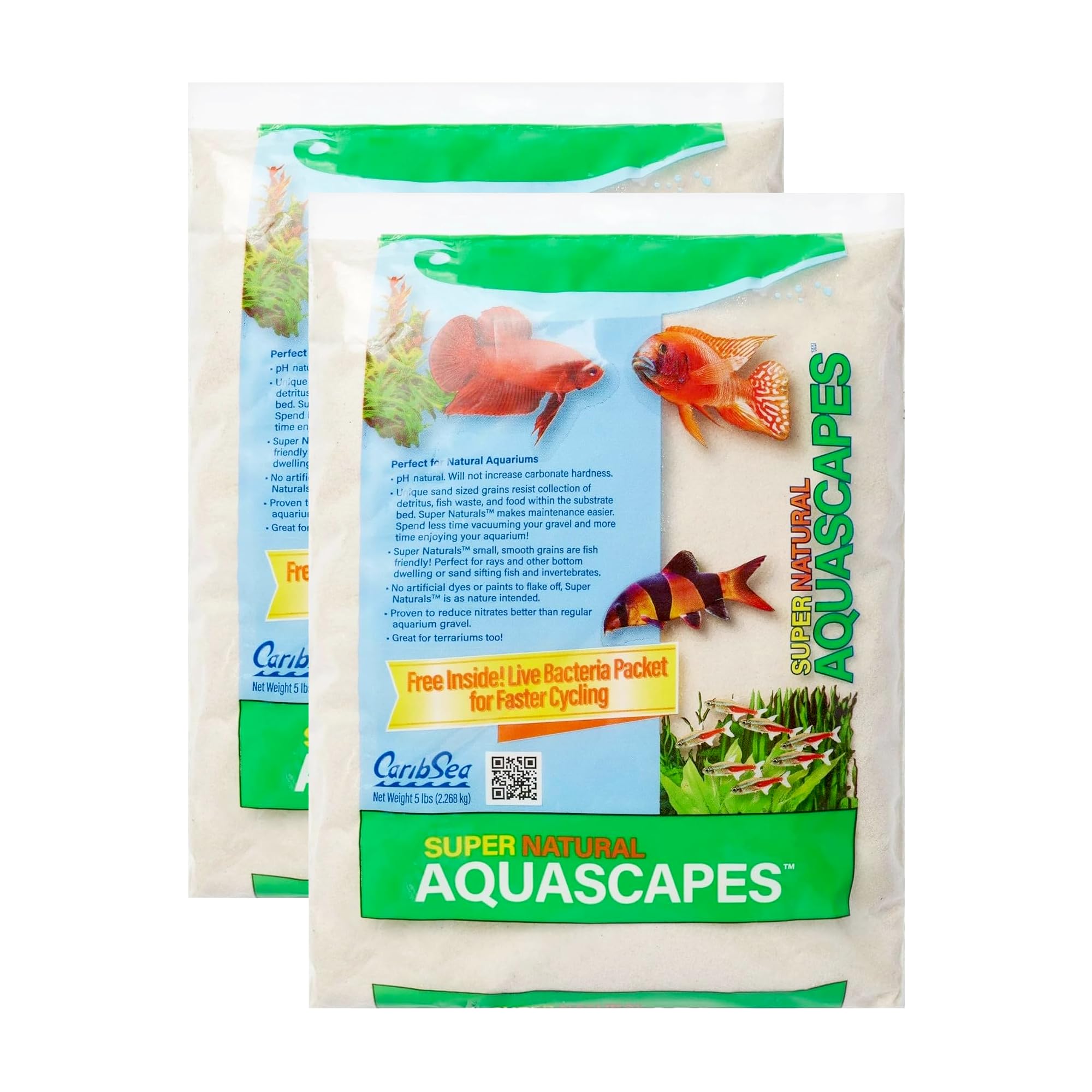
Rating: 4.6 ★ | Price: Premium | Coverage: At least 1 lb per gallon | Pack Size: 5lb (Pack of 2) | Water Type: Freshwater
Run a hand through this and the first thing you notice is how soft it is — closer to the sand on a quiet beach than to the bagged gravel most tanks start with. For corydoras, loaches and anything else that sifts or digs, that softness is the point: fine, rounded grains do not wear on barbels the way angular gravel can.
This is our pick for a tank built around bottom dwellers, with plants alongside rather than as the main event. Two 5 lb bags give you the 10 lb that CaribSea’s own one-pound-per-gallon guidance implies for a 10-gallon, and the sand settles quickly with very little clouding. Planting takes more care than with a heavier grain — set stems deeper and pinch the siphon when you vacuum, or you lift the bed along with the waste.
Two things to know before you commit. It is the priciest of the fine sands here, so a large tank gets expensive quickly, and the color varies from bag to bag — some arrive a clean natural white, others with darker patches that read grey under the lights. Neither is a dealbreaker for a soft-sand setup; both are reasons to buy all the bags you need at once so they match.
Pros
- Soft rounded grains suit catfish and loaches
- Settles with very little clouding
- Easy to siphon and maintain
Cons
- Priciest fine sand in this group
- Color varies between bags
Our pick for a tank built around catfish and loaches: very fine, soft grains that clear quickly, though you pay more per bag.
Best for Nano Tanks
YISZM Aquarium Sand

Rating: 4.5 ★ | Price: Budget | Color: Beige | Bag Weight: 2 lb | Water Type: Freshwater and saltwater | Sizes Available: 2, 5, 10 and 20 lbs
Two pounds of sand sounds generous until you pour it into a ten-gallon and watch it disappear under an inch at the front corner. That is the honest framing for this bag: it is a top-up, a quarantine-tank fill, or a budget way to see whether you like beige before committing to a full bed.
The dust is the real story. It arrives properly dusty — a dry, fine powder that needs several rinses and a good stir before the water runs anywhere near clear, and the filter intake is worth covering while the last of it settles. Once it is in, the grains are smooth and rounded, the beige reads warm rather than yellow, and it looks better wet than dry, which is the version that matters.
We keep it on the list for small jobs: a shrimp tank, a grow-out tank, a top-up where the bed has thinned at the front glass. The same sand comes in 5, 10 and 20 lb bags, and for anything larger than a desktop tank we start with those — the two-pound bag is a sample size pretending to be a substrate.
Pros
- Smooth rounded grains suit shrimp and small fish
- Natural beige tone looks better when wet
- Comes in four bag sizes
Cons
- Very dusty — needs repeated rinsing
- Two pounds barely covers a desktop tank
A small bag for topping up a nano tank or trying a color first, but it arrives genuinely dusty and takes real rinsing.
How We Tested Aquarium Sands for Planted Tanks
To build the shortlist, I started with sands sold for planted aquariums and compared grain size, color consistency, and visible dust in the bag. I ruled out anything that read as gravel in disguise or smelled chemical, then ordered 14 bags across a range of textures and tones. Testing ran for five months—long enough for roots to take hold and for the novelty of a new substrate to wear off.
Each sand went into its own planted setup. Before it went wet, I rubbed a pinch between my fingers and noted whether the grains were uniform or sharp. I rinsed every bag in a white bucket, changing the water until it ran clear enough to read a plant label through, and counted the rinses—my first read on dustiness and cleanliness. Then I filled the tank slowly onto a plate, noted how cloudy the water looked immediately and again 24 hours later, and checked for a fine film on leaves.
For color, I viewed each tank under room lighting and full LEDs, wet and dry, because sand color often shifts once submerged. Once plants were in, I siphoned around rooted stems and carpeting plants, watched whether sand got sucked up or clogged the hose, and disturbed the surface to see how quickly it clouded again. I also checked how well stems stayed anchored after a water change and whether debris sat on top of the grains or disappeared into them.
Value came down to coverage as much as bag size—how far each sand stretched in a given footprint, and how many rinses and re-scapes it took before the tank looked right. By the end, the differences were less about a pretty label and more about how the sand held up through a normal month of planting, trimming, and cleaning.
How to Choose Sand for a Planted Aquarium
Sand earns its place in a planted tank on grain size and rinsing behavior, not on the color printed on the bag — get those two right and the aquascape largely takes care of itself.
Start With Grain Size, Not Color
A dense 0.5 to 1 mm sand grips a stem the moment you let go of it. Coarser gravel lets the stem wobble until roots take hold, and very light fine sand shifts every time a fish swims past. Fine sand does compact, so keep the bed to a couple of inches and stir it lightly now and then; deep, undisturbed sand can turn anaerobic and sour. Plant with tweezers, angle the stem in, and release once the grains close over.
Sand Holds Roots; It Doesn’t Feed Them
Almost every sand here is inert. It gives a plant something to anchor to and leaves you in full control of feeding, which suits stems, ferns and anubias that take nutrients from the water column. Heavy root feeders — swords, crypts, vals — need root tabs pushed in beside them, or a nutrient layer under an inch or two of sand. Seachem Flourite takes the other route, with porous clay that stores nutrients in the grain itself for a tank where the plants are the project.
Rinsing, Clouding, and the Bag You Must Not Wash
Triple-washed sand takes two or three passes; ordinary bagged sand can take a dozen, and a thin haze on day one is normal either way. Rinse in a bucket under running water, stir, pour off the milk, repeat until it is mostly clear — chasing perfectly clear water wastes an afternoon. The trap is live bio-substrate: it is packed wet with nitrifying bacteria and labeled do not rinse, and washing it throws away the reason you bought it.
Color Is an Upkeep Decision
White brightens a dark room and makes green leaves glow, and it also shows every bit of mulm and every uneaten pellet. Black gives the most dramatic contrast and hides some waste, but it shows dust and reads grey under weak lighting. Off-white and beige sit in the middle and forgive the most. Whichever you pick, buy the whole bed at once — shades shift between batches, and a patchwork of two batches shows from across the room.
Frequently Asked Questions
Will sand hurt my corydoras or loaches?
Rounded, fine sand is gentler on barbels than coarse gravel, and sifting it is natural behavior for corydoras rather than a risk. Avoid sharp, angular grains. Keep the bed to around two inches and pinch the siphon when you clean so you lift waste without stripping the whole surface. The softest option here is CaribSea Moonlight Sand.
How much sand do I need for a 20-gallon planted tank?
Plan on about 1 lb per gallon, which puts a standard 20-gallon at 20 to 30 lb for a bed an inch to an inch and a half deep. Three 10 lb bags of the Aqua Natural sand is a realistic starting point for a 20-gallon long. Buy the extra bag — a thin bed that shows the glass at the front is something you look at every day.
Will aquarium sand change my pH?
Inert freshwater sands won’t move it, and Seachem lists Flourite as pH-neutral. The trap is marine sand: aragonite and crushed coral dissolve slowly and push pH and hardness up, the opposite of what a planted freshwater tank wants. Check that the bag says freshwater before you order, especially when the sand is sold in reef-style colors.
Final Verdict
For most planted freshwater tanks, start with Aqua Natural Sugar White Sand. The 0.5 to 1 mm grain holds stems, stays put in the flow, rinses in a couple of passes and costs less per pound than anything else here, which leaves money for root tabs and the plants themselves.
Choose Seachem Flourite Black Sand when the aquascape is the project and you want a substrate that feeds roots and never needs replacing. Starting a nano tank from scratch, the Galaxy bio-substrate saves you a cycle. And if the tank is built around corydoras and loaches, put CaribSea’s soft sand under them instead — the plants will manage.