This post contains affiliate links. We may earn a small commission when you buy through our links — at no extra cost to you.
Five gallons is a small room with a big ask: the filter has to clear waste, keep the water moving, and not turn a betta’s fins into a wind sock. Strong flow is great for a tank with a heavy bioload, but in a nano tank it can blow shrimp across the glass and stress fish that prefer still water; too little flow and waste settles into the gravel. The best five-gallon filters split that difference, and they do it without sounding like a coffee grinder on your desk.
I’ve kept five-gallon tanks on kitchen counters and bedside tables, and the wrong filter is obvious within a week—either the water never clears or the hum gets into your head. My team and I ran 14 filters over four months in betta, shrimp, and planted setups, paying attention to media quality, real flow, noise, footprint, power draw, and how each one held up after repeated cleanings. The short version: the right filter for a five-gallon tank is the one you forget is running—until you see how clean the glass is.
Our Top Picks
The Best 5 Gallon Aquarium Filters, Reviewed
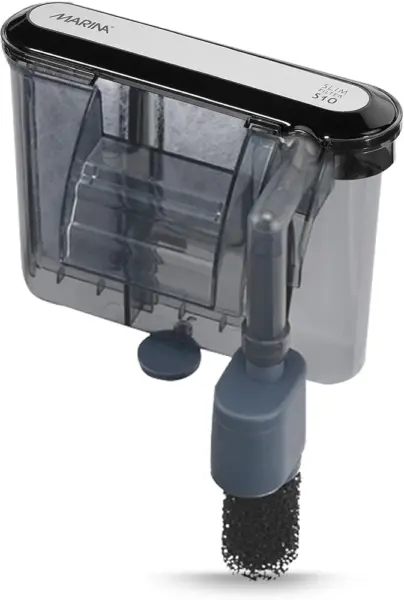
Marina S10 Power Filter – Best Overall
Key Features
- Filter type: Hang-on-back power filter
- Flow control: Adjustable
- Self-priming: Yes
- Rated tank size: Up to 10 gallons
- Price: Midrange
The flow dial is the reason the Marina S10 is our top pick. Five gallons is a small body of water, and the current decides more about the tank than the gallon rating on the box: a filter that turns the water into a whirlpool will wear a long-finned betta out in a way no test kit tells you about. Turned down, the S10 keeps the surface moving and leaves the middle of the tank swimmable. The intake also comes with a sponge already on it, which matters more than it sounds if you keep shrimp or fry.
Where it hangs is the other half of the appeal. Clipped over the back rim, the only thing inside the tank is the intake tube, so you are not surrendering the little floor space a five-gallon has. The media compartment takes the stock cartridge or your own floss and ceramic, and self-priming means a water change doesn’t leave you sucking on a tube to get it going again. We also appreciated how little there is to hear: the sound is water spilling back into the tank, not a motor grinding under a lid.
Two things to know. Flow falls off as the cartridge loads up, so rinse it on a schedule instead of waiting for the water to look tired, and keep the level within an inch of the lip, where the spill is a murmur rather than a splash. Dial the flow back until the plants stop swaying and the tank mostly runs itself between water changes.
Pros
- Adjustable flow calms current for small fish
- Hangs outside the tank, preserving swimming room
- Compartment takes your own media
- Quiet spill rather than motor noise
Cons
- Flow fades as the cartridge loads
For most five-gallon tanks we point people to the Marina S10: the flow dial calms the current to what a small tank can live with, and the body hangs slim outside the glass.
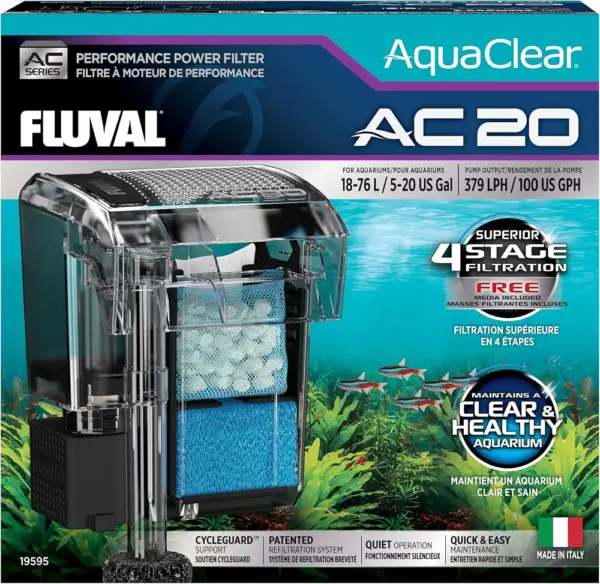
Fluval AC20 Power Filter – Best for Custom Media
Key Features
- Filter type: Power filter
- Media included: Pre-filter sponge, biofoam, BioMax, carbon insert
- Rated tank size: 5–20 US gal (18–76 L)
- Price: Premium
The AC20 is the most expensive filter here, and for a five-gallon with one betta that is worth a flinch. What the money buys is media you choose: a pre-filter sponge, a biofoam insert, BioMax and carbon all come in the box, and the clear housing lets you see when the floss is spent instead of guessing from the flow.
On noise it is the strongest of the power filters in this group, with an impeller that stays quiet enough for a desk tank. The flow control does what a small tank needs, bringing the output down without choking the pump to a trickle. And when the media is ready to change, the basket lifts out in one piece — a five-minute job we have come to appreciate on a tank this small.
It is still a lot of filter for five gallons. Even at its lowest setting the output can be more than a long-finned betta wants, so plan on aiming it along the back glass or adding a baffle. The housing is the other thing to watch: cracks where the impeller mounts are what ends this filter early, so handle it gently at water changes. Replacement inserts cost more than a single cartridge, and that is the honest trade — you are paying for the right to decide what is in the water.
Pros
- Four media types included, no cartridges needed
- Quietest power filter in this group
- Clear body shows when media is spent
- Flow adjusts for a small tank
Cons
- Output can still be strong at the lowest setting
- Housing can crack at the impeller mount
We think it’s worth the premium if you want to run your own media: four inserts, a clear body, and the quietest motor among the power filters here.
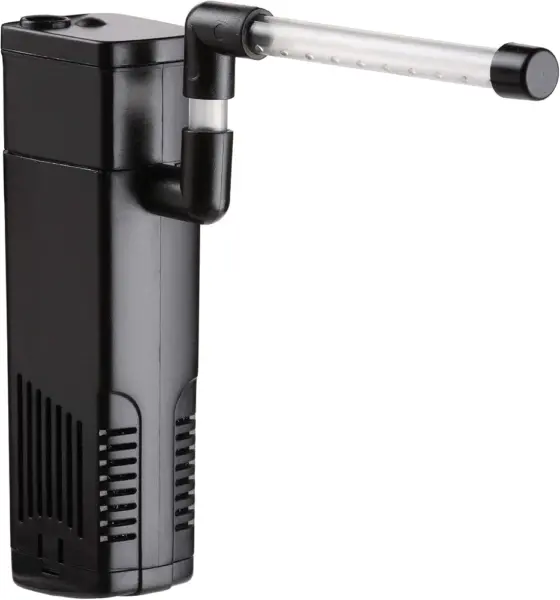
NICREW Magi Mini Filter – Best Budget Pick
Key Features
- Mounting: Four suction cups
- Flow rate: 40 GPH
- Air control: Adjustable regulator
- Rated tank size: 2–5 gal
- Price: Budget
Rated to five gallons and 40 gallons per hour, the Magi mini sounds like an exact match for the tank in the search bar. In practice we found it pushes more current than a small tank’s fish usually want: behind a long-finned betta, the spray bar can pin him to one end until you go hunting for the air valve. That valve is the control that makes this filter work at five gallons.
Bled back to a gentle roll, it is a tidy piece of kit. It takes up less room inside the tank than any of the power filters here, the four suction cups hold it where you put it, and the foam and carbon come with it. At low air settings the noise is bubbles rather than motor, about as much as you can ask from something this small.
The catch is that the spray bar’s output isn’t adjustable on its own — you are tuning the whole pump with the air valve, so the calmest setting is also the least filtration. Strip it down for a rinse every couple of weeks and it stays ahead of a five-gallon’s waste. For a quarantine tank, a first betta tank, or a desk setup where the filter has to disappear, that is a fair trade, and it is the least expensive powered option here.
Pros
- Smallest powered footprint in this group
- Adjustable air regulator softens the flow
- Four suction cups hold it in place
- Foam and carbon included, strips down for rinsing
Cons
- Pushes more current than a five-gallon betta wants
- Noisy at higher air settings
Our budget pick: the cheapest powered filter here, small enough to vanish in a five-gallon if you dial the air back for a betta.
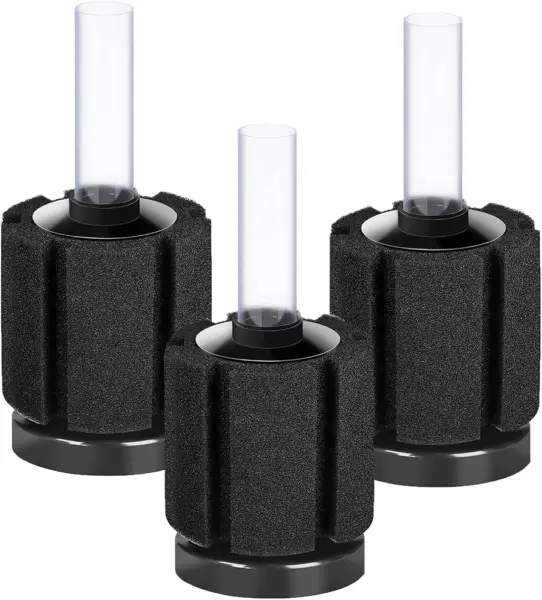
AQUANEAT Sponge Filter 3-Pack – Best for Bettas and Fry
Key Features
- Type: Air-driven sponge filter
- Pack size: 3 filters
- Rated tank size: Up to 10 gal
- Sponge dimensions: 2.0"D X 4.75"H
- Price: Budget
Nothing in this box moves water on its own. All three sponges need an air pump and airline, and the pump is the part that costs real money — if you don’t already own one, a small internal filter will be less fuss. Once it is bubbling, though, a sponge is the gentlest filtration you can put in a five-gallon: air lifts water through the foam, and the outflow won’t blow a betta across the tank.
We like what three of anything buys you: redundancy. One sponge goes in the display tank, one in a quarantine or fry tank keeps a cycle alive when you need it in a hurry, and one sits on the shelf. At two inches across and under five inches tall, a single one tucks behind a clump of plants in a small tank and leaves the swimming space alone.
Maintenance is a squeeze in a bucket of tank water and that is it — no cartridges, no recurring bill. The foam is a wear item, though: it clogs over months and eventually crumbles, so treat the set as replaceable rather than permanent. And because the flow comes from the pump, a weak air pump means weak circulation, which matters more in five gallons than in a bigger tank. Size the pump generously; a single undersized pump is the usual reason a sponge underperforms.
Pros
- Gentle enough for fry, shrimp and bettas
- Three units seed and back up multiple tanks
- Rinse-and-squeeze cleaning, no cartridges
- Two-inch sponge hides behind plants
Cons
- Air pump and airline sold separately
- Foam is a wear item that needs replacing
We keep coming back to these three air-driven sponges for bettas, shrimp and fry — the gentlest option here, provided you add an air pump.
AQUANEAT Corner Sponge Filter – Best for Planted Nano Tanks
Key Features
- Type: Air-driven corner filter
- Dimensions: 4"L x 3.125"W x 3.25" to 6"H
- Rated tank size: Up to 20 gal
- Filter media included: Yes
- Price: Budget
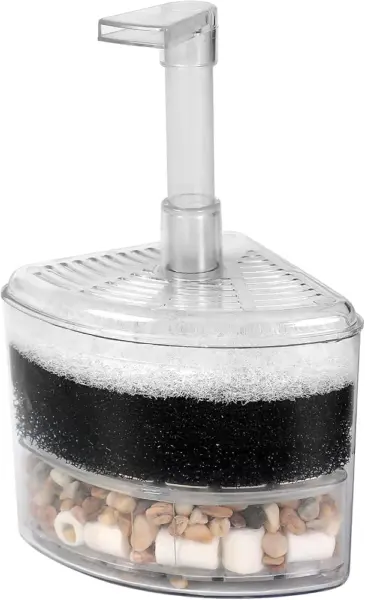
A corner is the one spot in a five-gallon where a filter doesn’t cost you swimming room, and this one is shaped to use it: roughly four inches along each face, a few inches tall, easy to tuck behind a stem plant. Set against the glass it reads as part of the hardscape rather than a piece of equipment floating in the middle of the tank.
The reason we reach for this over a plain sponge is the box at the top. There is a media compartment you can stack with floss, ceramic or the mix that ships with it, so the biological work happens in a basket you lift out and rinse instead of a sponge you have to squeeze. For a small tank that is a real convenience — you can swap a dirty layer of floss without disturbing the media underneath.
Turnover is the trade. Air-driven means the flow is gentle by design, which suits a betta, fry or shrimp and suits a tank full of floating debris less well; the 20-gallon rating is generous for what this moves in practice. It also floats until it is soaked, so squeeze it underwater until the bubbles stop before you let go. In a planted five-gallon with one fish, the calm current and the hidden corner are worth more than the turnover you give up.
Pros
- Corner shape keeps the middle of the tank clear
- Media compartment holds floss and ceramic
- Very gentle output for bettas and fry
Cons
- Floats until the sponge is fully soaked
- Low turnover limits mechanical filtration
A corner filter with a media basket inside: our pick for a single small tank where you want biological filtration without a sponge parked in the middle of the view.
How We Tested Five-Gallon Aquarium Filters
We started by narrowing a long list of five-gallon filters to models that actually fit a five-gallon footprint—inside and out—and that used replaceable media rather than sealed cartridges you throw away whole. We ruled out anything with no published flow rate, vague power specs, or a clip design that looked likely to pop loose during a water change. That left 14 filters, which we ran for four months across betta tanks, shrimp tanks, and a planted desk tank.
Each filter spent at least three weeks on a stocked five-gallon setup. We measured flow by timing how long it took to fill a quart container at the outflow, then watched where the current landed: Did it push a betta into a corner? Did shrimp get pulled toward the intake? We checked water clarity and ran ammonia and nitrite tests twice a week, so a filter that looked busy but wasn’t moving waste got flagged. We also noted how media fit—whether floss sat flat, whether the basket was easy to rinse—because a filter that’s fussy to clean is one you’ll clean less often.
Noise got checked at night, when a bedroom or office tank is quietest: we listened for impeller rattle, hum, and the occasional gurgle, and used a decibel app as a backup rather than the final word. Power draw went on a watt meter for a week per unit. We tracked durability through repeated cleanings and restarts—unplugging, refilling, and seeing whether each one caught prime without a fight. Value came down to replacement media: we compared what a year of cartridges or sponges would cost against the filter itself, and whether the housing and clips felt like they’d survive that year.
How to Choose a Filter for a 5-Gallon Tank
In a five-gallon tank, the gallon rating on the box tells you less than two things you can’t see in a photo: how hard the filter pushes water, and how much of the tank it takes up.
Match the flow to the tank, not the gallon rating
The gallon figure on the box is a maximum, not a promise. A filter rated to ten gallons running flat out can turn five gallons into a washing machine, and a long-finned betta is the first thing to suffer. What you want is a filter you can turn down — a flow gate on a power filter, an air valve on a sponge — and the patience to set it by watching the fish and the plants instead of the packaging. Aim the output along the back glass; a current that hits the front pane bounces straight back into the swimming space.
Powered or air-driven
Power filters move more water and hold more media, and hang-on-back models keep most of their bulk outside the tank. Air-driven sponges trade turnover for gentleness and very low running cost, which is why they suit fry, shrimp and long-finned bettas. The catch is the air pump and airline, which are sold separately — price those in before you compare a sponge against a powered filter, and expect a low hum from the pump itself, often the loudest part of the whole setup. A pump with its own flow control is worth the small step up.
Count the space inside the tank
A five-gallon has very little floor. A hang-on-back filter keeps almost everything outside, with only an intake tube in the water; an internal or sponge filter sits in the tank and eats into the room your fish actually swim in. Measure what you’d give up before you choose. In a tank this small, a filter you can hide behind plants is worth more than a slightly higher flow rate you can see from the sofa — and one that crowds the glass makes cleaning harder too.
Media, and what it costs to keep
Cartridges are convenient and add up over a year. Loose media — sponge, floss, ceramic — costs less and lets you rinse rather than replace, which is also better for the bacteria you are trying to keep. Whatever you run, clean it in tank water, not tap, and never replace all the biological media at once or the tank has to cycle again with fish in it. A sponge squeezed every few weeks and a bag of ceramic that only gets rinsed is all the maintenance most five-gallon tanks need.
Frequently Asked Questions
Can my 5-gallon tank go without a filter?
Not comfortably, and not for a beginner. Five gallons is a small volume, so a couple of fish push ammonia up faster than a bigger tank would, and water changes alone don’t provide surface movement or the colony of bacteria a filter houses. If you want to try a heavily planted, lightly stocked tank without one, test ammonia daily for the first month and keep a sponge filter and air pump on the shelf.
Will a filter suck up fry or shrimp?
Yes, if the intake is bare. Shrimp and fry get pulled against an open intake and don’t always get off it. A sponge filter avoids the problem entirely, and on a power filter you can slide a pre-filter sponge over the intake — most are a slip fit, and it is the cheapest upgrade you can make to a small tank. Check it weekly, because a loaded pre-filter clogs quickly.
What do I do with the filter during a water change?
Unplug it first, then leave the media in the filter and keep it wet — drying out kills the bacteria you have spent weeks growing. A self-priming hang-on-back restarts on its own once the tank is refilled; if yours doesn’t, pour a cup of tank water into the filter body before plugging it back in. Don’t rinse the media in tap water during the same session.
Final Verdict
Most five-gallon tanks should get the Marina S10. The adjustable flow is what makes a small tank livable for the fish in it, the body stays outside the glass, and the media compartment means you are not locked into cartridges. Choose the Fluval AC20 if you want to build your own media stack and don’t mind paying for it, and the AQUANEAT sponges if the current — or the budget — argues for air over electricity.
Whichever you pick, set the flow by watching the fish rather than the box, and keep the media wet between cleanings.