This post contains affiliate links. We may earn a small commission when you buy through our links — at no extra cost to you.
Keeping a saltwater tank at a stable temperature is harder than it looks. Many aquarium heaters drift a few degrees after a few months, and a stuck thermostat can cook an entire reef overnight. That risk is real enough that most experienced marine aquarists don’t rely on a single heater alone.
The best solution isn’t always the most expensive all-in-one heater. An external temperature controller adds a second layer of monitoring that can shut off a runaway heater before coral or livestock are harmed. It also improves accuracy because the probe sits directly in the water, away from the heater’s own heat.
This guide separates heaters that are safe enough for sensitive saltwater tanks from those that are best left to freshwater setups. You’ll see why pairing a basic heater with a controller often beats any single unit, and which all-in-one heaters earn their place in a marine tank.
Top Picks
Best for Controller for Reef
Inkbird ITC-306T

Rating: 4.6 ★ | Price: $$ | Wattage: Controller only | Adjustability: Adjustable (probe) | Safety: Overheat alarm, probe | Reviews: 695
The Inkbird ITC-306T uses a submersible probe to track tank temperature within ±0.5°F, then cuts power to your heater if it overshoots or fails. Dual day/night cycles let you drop the temperature a few degrees after lights out, which mimics natural conditions and can trigger spawning or reduce algae growth. For saltwater aquariums where a single-degree swing stresses corals, this extra layer of control is what separates stable tanks from constant crisis management.
This is not a heater — it’s an external controller that requires a separate heater (up to 1200W) to function. Reef keepers who already own a reliable heater will get the most out of it, using it as a failsafe against runaway temperatures. The included suction cup for the probe can detach over time, and the unit itself may develop issues after several years of continuous use. Those looking for a plug-and-play all-in-one should look elsewhere; this is for hobbyists who value redundancy and are willing to manage two devices.
Pros
- Probe-based temperature accuracy keeps marine tanks within tight tolerances
- Dual day/night cycles allow natural temperature variation for breeding or coral health
- Acts as a failsafe to prevent heater malfunction from cooking the tank
Cons
- Requires purchasing a separate heater — adds complexity and cost vs. all-in-one units
- Probe suction cup may lose grip over time, allowing the probe to drift out of position
For reef keepers who already own a solid heater and want fail‑safe temperature control, this controller delivers precision that no all‑in‑one can match — just be prepared for the extra setup.
Best for Medium-Large Tanks
HiTauing 300W

Rating: 4.5 ★ | Price: $$ | Wattage: 300W | Adjustability: Adjustable | Safety: Water sensor, overheat | Build Quality: Explosion-proof quartz | Reviews: 2,343
Safety-focused aquarists gain automatic shut-off when exposed to air and overheat protection – features that typically require an external controller. The tradeoff: you lose the redundancy of a separate thermostat, but gain a simpler setup with one device to mount and plug in.
This suits medium to large saltwater tanks (40–75 gallons) where adjustability and built-in cutoffs matter more than long-term track record. Occasional temperature sensor drift may require setting the heater a few degrees above target, and some units show wear after months of use – worth buying with a flexible return window in mind.
Pros
- Auto shut-off when out of water and overheat protection give peace of mind.
- Digital controller allows easy adjustment across a wide temperature range.
- Delivers steady heating for tanks up to 75 gallons.
Cons
- Temperature sensor may drift, requiring an offset of a few degrees.
- Durability can vary – some units may show signs of wear after several months of use.
A practical option for saltwater aquarists who want built-in safety redundancies without additional gear, provided you’re comfortable with occasional sensor adjustment.
Best for Large Digital Tank
Fluval E300

Rating: 4.3 ★ | Price: $$$ | Wattage: 300W | Adjustability: Adjustable 0.5° | Safety: Low flow alarm, dual sensors | Build Quality: Shatter-resistant | Reviews: 6,155
The Fluval E300 delivers precise 0.5°F temperature adjustments with a clear LED display and a comprehensive safety suite, backed by a 5-year warranty – a strong pitch for saltwater aquarists wanting digital control. That said, the low flow alarm can be overly sensitive, and some units may develop operational issues early on, making a separate thermometer a practical addition. This heater is best for tech-savvy hobbyists who value precision and can handle occasional warranty claims.
Pros
- Precise 0.5°F temperature increments with a color-coded LED display for easy monitoring.
- Dual-sensor safety system with overheat protection and low flow warning.
- Sufficient heating power for aquariums up to 100 gallons.
Cons
- The low flow alarm can trigger nuisance alerts, potentially shutting down the heater in lower-flow setups.
- Temperature consistency may vary between units, so verifying with a separate thermometer is wise.
For aquarists who prioritize digital accuracy and warranty length over independent safety redundancy, the Fluval E300 is a capable choice – provided you accept its quirks and use a backup temperature monitor.
Best for Nano Safety Tanks
hygger 50W Mini
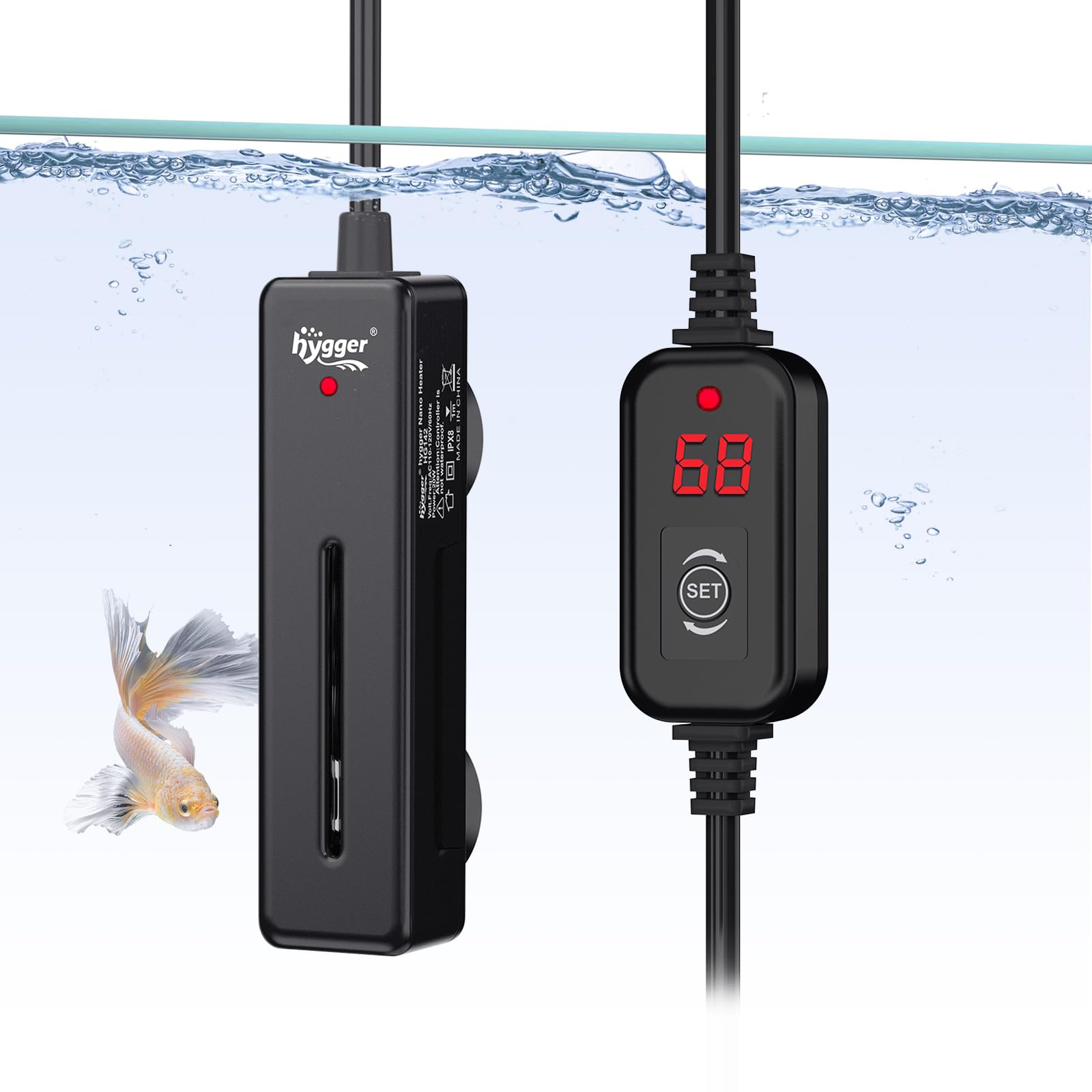
Rating: 4.5 ★ | Price: $$ | Wattage: 50W | Adjustability: Adjustable | Safety: Low water, error alarm | Build Quality: Glass with guard | Reviews: 309
Unlike a separate controller setup, the hygger integrates heater and digital controller into one unit, adding a protective guard and low-water shut-off tailored for 5-10 gallon tanks. This all-in-one approach suits nano saltwater aquariums where space is limited and safety is a priority.
Temperature accuracy can vary between units, and some units may stop heating after a few months of use — tradeoffs to weigh against the convenience and safety features. Best for betta, shrimp, or small reef setups where gentle heat and a guard are needed, not for larger tanks or those requiring a proven long-term performer.
Pros
- Low-water sensor and error codes give early warning of issues
- Protective guard prevents burns to fish and snails
- Digital controller retains settings after power loss
Cons
- Temperature accuracy may vary between units, with an occasional offset of 2-3°F
- Some units may stop heating after a few months of use
For small saltwater tanks where space and safety are priorities, this heater offers a well-designed package; it is not suited for larger tanks or those needing a long-term track record.
Best for Small Freshwater
Tetra HT 100W

Rating: 4.4 ★ | Price: $ | Wattage: 100W | Adjustability: Preset 78°F | Build Quality: Quartz glass | Reviews: 16,734
The Tetra HT 100W is one of the most-reviewed aquarium heaters on Amazon, backed by thousands of owners who found it adequate for small freshwater tanks where temperature precision isn’t critical. Its compact size and plug-and-play preset at 78°F make it a low-effort solution for beginner setups. However, the fixed temperature and absence of overheat shut-off or low-water cut-out mean it cannot serve marine or sensitive species. For saltwater aquariums requiring stable, adjustable heating with safety redundancy, the Inkbird ITC-306T external controller is the better approach.
Pros
- Compact size fits well in 5–10 gallon tanks without crowding equipment.
- Simple plug-and-play operation maintains a steady 78°F automatically.
- Budget-friendly price point for entry-level freshwater builds.
Cons
- Preset 78°F cannot be adjusted for species needing warmer or cooler water.
- No overheat shut-off or low-water cut-out — adds risk for tanks with valuable livestock.
If your setup is a small freshwater community tank and budget is the priority, the Tetra HT 100W is a functional choice. For marine or temperature-sensitive species, look to the Inkbird external controller instead.
Best for Accuracy-Focused Tanks
HiTauing Upgraded 300W

Rating: 4.7 ★ | Price: $$ | Wattage: 300W | Adjustability: Adjustable | Safety: Auto stop, overheat | Build Quality: Explosion-proof quartz | Reviews: 367
The HiTauing Upgraded 300W delivers accurate temperature management with a clear digital display and automatic shut-off when exposed to air – a refinement over simpler designs. For saltwater aquarists who prioritize convenience, this all-in-one heater simplifies setup compared to the top pick’s separate controller and heater. The tradeoff is that there’s no independent failsafe; if the internal thermostat drifts, you won’t have a second check.
This heater suits hobbyists who want the latest safety features and are comfortable with a shorter reliability history. Early units have occasionally shown plastic warping or glass breakage, so periodic inspection is wise. For those who prefer proven long-term performance, the separate controller route remains the safer bet.
Pros
- Digital display with real-time temperature readout simplifies monitoring and adjustments.
- Auto shut-off when exposed to air adds a layer of safety for maintenance or water changes.
- Consistent heating with low temperature drift – important for sensitive marine species.
Cons
- Housing may warp or glass can crack in isolated cases – requires periodic visual checks.
A compelling option if you value accuracy and safety features over a decades-long reputation, but keep a backup heater and inspect regularly.
Best for Small Adjustable
FREESEA 50W

Rating: 4.3 ★ | Price: $ | Wattage: 50W | Adjustability: Adjustable | Safety: Auto shut-off, overheat | Build Quality: Glass | Reviews: 7,511
The external digital controller and adjustable temperature range (63–94°F) make this compact heater convenient for small tanks, and the price is hard to beat. However, reports of units stopping working or overheating, along with occasional whining or clicking sounds, mean this isn’t suited for a permanent marine setup where stability matters. It works best as a temporary solution for quarantine or turtle tanks.
Pros
- External digital controller with clear temperature display adds convenience.
- Adjustable temperature from 63°F to 94°F covers most small-tank needs.
Cons
- Some units may stop working or overheat, and a low humming or clicking sound can be present during operation.
Good for temporary small tanks or turtle setups where budget and adjustability matter, but not for permanent marine aquariums.
Best for Budget Adjustable
Orlushy Adjustable 300W

Rating: 4.4 ★ | Price: $ | Wattage: 300W | Adjustability: Adjustable | Safety: Auto shut-off, overheat | Build Quality: ABS shell | Reviews: 8,216
The Orlushy provides adjustable temperature control and a free digital thermometer at a budget price, making it a reasonable option for temporary or quarantine saltwater setups. Temperature consistency can vary between units, and some owners have noted durability concerns with the glass body or holder within the first few months — worth planning with a backup heater in place.
Pros
- Adjustable temperature range and included digital thermometer at a budget price.
- Works in both freshwater and saltwater aquariums without corrosion issues.
Cons
- Temperature consistency can vary between units, which may require an external controller for sensitive marine species.
Best suited for budget-conscious aquarists setting up a quarantine or temporary saltwater tank where a backup heater is already in place.
Best for Compact Digital
HITOP 100W Digital

Rating: 4.6 ★ | Price: $$ | Wattage: 100W | Adjustability: Adjustable | Build Quality: Glass | Reviews: 358
The HITOP 100W Digital offers a clear external controller and straightforward setup at a moderate price point – a practical option for smaller saltwater tanks. However, it lacks overheat protection found on similarly priced alternatives, so it’s best suited for tanks where temperature deviations won’t risk sensitive inhabitants.
Pros
- Digital external controller with clear temperature display
- Good value for a digital heater at this price
Cons
- Temperature monitoring may be inaccurate; overheating possible in some units
A functional digital heater for budget-oriented saltwater setups where precise temperature control isn’t critical – consider pairing with an external thermometer for safety.
Best for Aesthetic Tanks
Fluval M200

Rating: 4.4 ★ | Price: $$$ | Wattage: 200W | Adjustability: Adjustable (dial) | Build Quality: Borosilicate glass | Reviews: 5,571
The Fluval M200 offers a mirror finish that visually disappears in decorated saltwater tanks – a rare aesthetic advantage among heaters. Its temperature dial can be imprecise, and glass breakage has been noted in some cases; the control head must stay above the waterline. Best for display-focused aquarists who accept these limitations for the visual payoff.
Pros
- Mirror finish hides well in aquascaped saltwater displays.
- 3-year warranty covers replacement if issues arise.
Cons
- Temperature dial accuracy can vary, and glass breakage has been noted – a risk in saltwater where stability matters.
Best for display-focused saltwater tanks where a clean aesthetic matters more than spot-on temperature control.
Best for Digital Safety
HiTauing 300W LED

Rating: 4.5 ★ | Price: $$ | Wattage: 300W | Adjustability: Adjustable | Safety: Water sensor, overheat | Build Quality: Explosion-proof quartz | Reviews: 790
The HiTauing 300W offers a clear digital temperature readout and a suite of safety features including overheat protection and a water sensor shut-off – useful for maintaining stable conditions in a medium-to-large marine tank. However, some units have shown durability concerns such as short circuits or plastic melting, which is worth factoring in if you prioritize long-term dependability. This heater suits hobbyists who can monitor it closely and are comfortable with a potential need for early replacement.
Pros
- Digital display and LED controller make temperature setting and reading immediate
- Multiple safety layers: water sensor auto shut-off and overheat protection
Cons
- Occasional early failure reports (short circuit, plastic melting) may affect some units
Best considered by aquarists who want digital controls and are willing to pair this heater with an external temperature controller for added safety.
How to Choose
The single most important buying insight: an external temperature controller can save your livestock from a heater malfunction, and it costs far less than replacing a tank of coral.
Wattage Matching Tank Volume
A 3-5 watts per gallon rule works for most tanks, but saltwater aquariums often benefit from the higher end of that range because they lose heat faster through open tops and high-flow sumps. For a 50-gallon reef, a 200-300W heater is common.
An even better approach is to use two smaller heaters totaling the required wattage. If one fails stuck on or off, the other can still keep the tank from a deadly temperature swing. Two 150W heaters in a 75-gallon tank provide redundancy without a single point of failure.
Adjustability
Preset heaters are simple and cheap, but they lock you into 78°F. Many marine fish and corals need slightly different temperatures, and a 2°F difference can affect metabolism and algae growth. Adjustable heaters let you dial in exactly what your system needs.
The trade-off is that the adjustment mechanism matters. Digital controllers with buttons or a touch screen are far easier to set precisely than a stiff dial that drifts when bumped. Some analog dials require a screwdriver and repeated checking against a separate thermometer.
Safety Features
The two safety features that matter most are an automatic shut-off when the heater is exposed to air (prevents cracking and fires) and overheat protection that kills power if the internal thermostat fails. Without these, a low-water level or a stuck relay can lead to disaster.
For saltwater tanks, an external controller adds a third layer: it monitors water temperature independently and cuts power if the heater overshoots. This is the insurance that keeps a faulty heater from cooking your tank.
Build Quality
Saltwater is corrosive, so the heater body and seals must resist degradation. Borosilicate glass or quartz glass handles thermal stress better than standard glass. Look for fully sealed electronics and stainless steel or titanium probes in external controllers.
Some budget heaters use plastic end caps that can crack or leak after a year of saltwater exposure. Spending a little more on a heater with a solid build saves you from sudden failures that always seem to happen on a holiday weekend.
Reliability Track Record
Star ratings are misleading. A heater with 4.4 stars and 16,000 reviews can still have a 15-20% early failure rate hidden in the negative reviews. The real signal comes from reading reviews that mention the heater’s age and specific failure mode.
Look for patterns: do many users report failure after 6-12 months? Is the failure mode a stuck thermostat (overheating) or a dead unit? Overheating is the more dangerous and should push you toward an external controller. A unit that dies cold is an inconvenience, not a crisis.
FAQ
Can I use a freshwater heater in a saltwater aquarium?
Most submersible aquarium heaters are labeled for both fresh and saltwater, but the real concern is corrosion. Heaters with stainless steel probes or exposed metal parts will degrade quickly in saltwater. Stick to heaters with fully sealed glass or titanium bodies and plastic end caps. If in doubt, an external controller with a separate probe adds an extra layer of isolation.
How often should I replace my aquarium heater to avoid failure?
Plan to replace any heater after 2-3 years of continuous use, even if it still seems to work. Thermostats drift and seals degrade. Many failures happen after the first year, especially in budget models. A good practice is to replace both heaters in a dual-heater setup on a staggered schedule so you never lose both at once.
Why does my heater keep flashing ‘LF’ or ‘E1’ — is it broken?
The ‘LF’ error on Fluval E-series heaters means low flow — the heater detected insufficient water circulation and shut off to prevent overheating. This usually happens because the heater is in a dead spot, the pump is too weak, or the flow is blocked. Relocate the heater to a higher-flow area or clean the pump. ‘E1’ on some models indicates a sensor fault; if the error persists, the heater likely needs replacement.
Do I really need an external temperature controller if my heater has a built-in thermostat?
If your tank holds valuable livestock, yes. Built-in thermostats are the most common failure point — they can stick on or off without warning. An external controller like the Inkbird ITC-306T monitors temperature independently and cuts power if the heater fails to shut off. It’s a low-cost insurance policy that can save a reef worth hundreds of dollars. For a simple freshwater tank with hardy fish, the built-in thermostat is usually sufficient.