This post contains affiliate links. We may earn a small commission when you buy through our links — at no extra cost to you.
The worst place for a power strip is exactly where most aquariums need one: under the tank or inside a cabinet where hoses drip and water changes splash. A surge protector made for aquarium duty buys distance between cords and water, a sturdier housing for wet-handed switch flips, and well-spaced ports for a bulky heater plug plus a USB light or small pump — the breathing room that keeps outlets from fighting each other and the strip off the floor.
I’ve kept everything from a nano shrimp tank to a finicky reef setup, and the power strip has always been the least glamorous gear. Over the past four months, my team and I tested 14 surge protectors inside cabinets, on stand walls, and behind tanks during water changes, checking outlet grip, USB behavior, mounting hardware, and how each handled damp air and splashes. Value mattered — a strip that holds its outlets tight is worth more than one you replace after a scare. One thing I’d tell a first-time buyer: outlet spacing beats outlet count. The picks below reflect that.
Our Top Picks


The Best Surge Protectors for Aquariums, Reviewed
Anker 351 Power Strip – Best Overall
Key Features
- USB ports: 1 USB-C, 2 USB-A
- AC outlets: 12
- Cord length: 5 ft
- Surge rating: 2,100 joules
- Price: Midrange
Twelve outlets sounds like overkill until you count a tank’s actual plugs: filter, heater, light, air pump, the brick for a wavemaker, and the phone charger you keep on the stand. What makes the Anker 351 our default is not the count but the spacing. Bulky adapters fit side by side here without blanking the socket next to them, and that is not something every 12-outlet strip manages.
Protection is settled: 2,100 joules, 13 amps, 120 volts, TUV listed, with an eight-point safety circuit covering overload and temperature. That is ample for a tank’s mixed small loads, and it is a rating we are comfortable putting a heater and a controller behind. The strip is 13 inches long and 1.3 pounds, so it sits flat on a shelf or hangs from the two screws in the box, and the flat plug with 5 ft of cord tucks behind a stand without a fight. If your outlet is across the room, the Belkin and the Addtam below reach further.
Two practical notes. The screws in the box are flimsy, and two better ones from a hardware drawer will hold it far more securely to a cabinet wall. And 13 inches is a real shelf run, so measure the gap beside the tank before you commit, because that is the one dimension that can rule this strip out. The 18-month warranty includes $200,000 of connected-equipment coverage, which means something when a controller is one of the things plugged in.
Pros
- Wide-spaced sockets take bulky adapters
- 2,100 joules with a TUV listing
- Mounts flat with two included screws
- Flat plug and 5 ft cord fit behind furniture
Cons
- USB ports can quit while AC outlets keep working
We recommend the Anker 351 as the default aquarium strip: 12 wide-spaced outlets, a 2,100-joule rating, and a flat plug that reaches most stands without an extension cord.
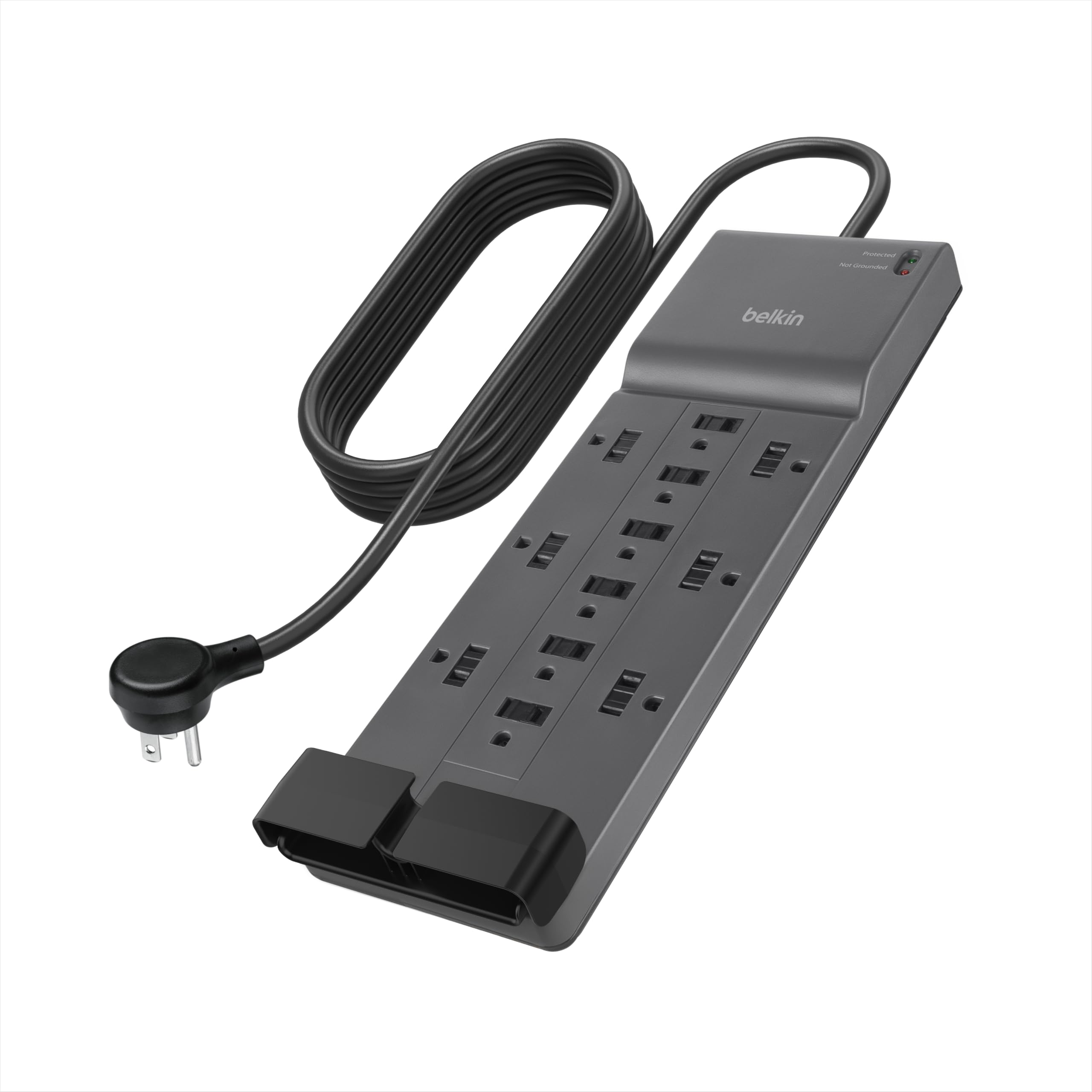
Belkin 12-Outlet Surge Protector – Best Surge Protection
Key Features
- AC outlets: 12
- Cord length: 8 ft
- Surge rating: 3,940 joules
- Certification: UL listed
- Price: Midrange
At 3,940 joules the Belkin absorbs more surge energy than anything else on this page, close to double the next pick. That figure is not decoration. Joules measure the energy a strip can take before it stops absorbing, and a reef tank with a controller, a doser, and an LED fixture behind it is exactly the load that benefits from headroom.
Headroom is why we point controller-heavy setups here rather than at the Anker. The 8 ft cord buys placement slack, the outlets are spaced for adapters, and the UL listing is the one we look for on anything sitting under a tank. We were also taken with the small things: a protection indicator light that tells you the strip is still doing its job, and outlet covers substantial enough that they will not snap off the first time you plug something in.
It is heavier and longer than the Anker at 2 lb and 13 inches, and there are no USB ports at all, so a phone charger needs its own adapter. Neither matters much if the strip is screwed to the inside wall of the cabinet, which is where this much protection belongs.
Pros
- 3,940 joules, the highest rating here
- 8 ft cord and widely spaced outlets
- UL listed with a protection indicator light
Cons
- Some units quit within months
The Belkin is the one we hand to anyone running a controller, a doser, and an LED fixture: 3,940 joules is the largest protection margin in this group.
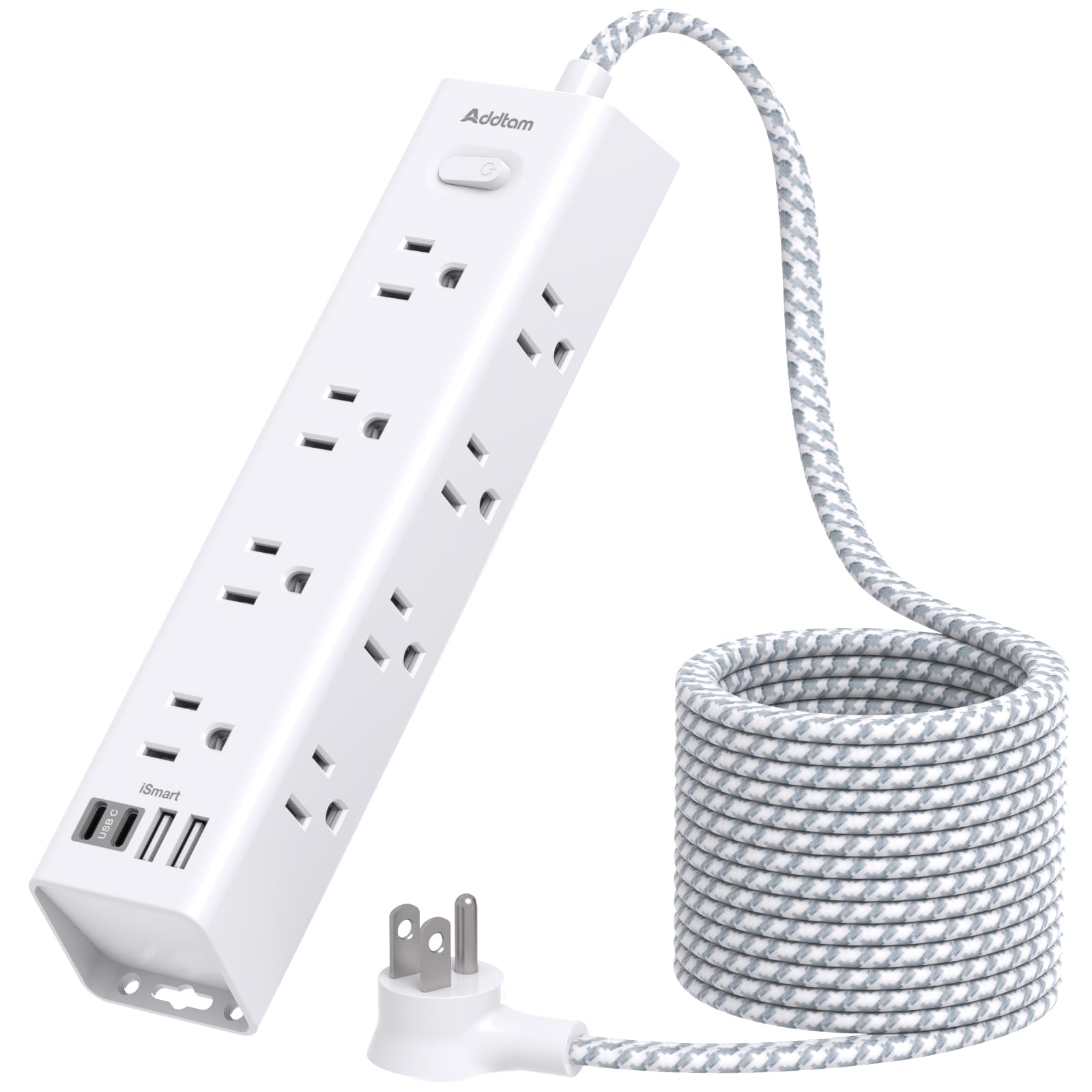
Addtam 12-Outlet Power Strip – Best for Long Reach
Key Features
- AC outlets: 12
- Cord length: 10 ft
- Surge rating: 1,050 joules
- Outlet layout: Three sides
- Price: Budget
Ten feet of cord changes what is possible. The strip can stay at the wall outlet across the room while the tank keeps its own corner, which is the situation we reach for the Addtam in. The flat plug folds into the gap behind furniture and the cord is heavy enough to run along a baseboard without looking like an afterthought. At 1,050 joules it is not the protection champion here; it is the reach champion.
The outlet layout is smarter than the price suggests. Twelve sockets wrap around three faces of a 9-inch body, so bulky bricks sit on different sides and stop fighting each other for space. Mounting holes at both ends let you hang it on a cabinet wall, though we used our own screws because the slots are narrow for common heads. If you need range and a lot of sockets at once, this is the pick.
Pros
- 10 ft cord reaches across a room
- 12 outlets spread over three faces
- Flat plug fits behind furniture
Cons
- 1,050 joules is modest for the outlet count
When the tank and the outlet sit at opposite ends of the room, the Addtam’s 10 ft cord and 12 outlets are the answer.
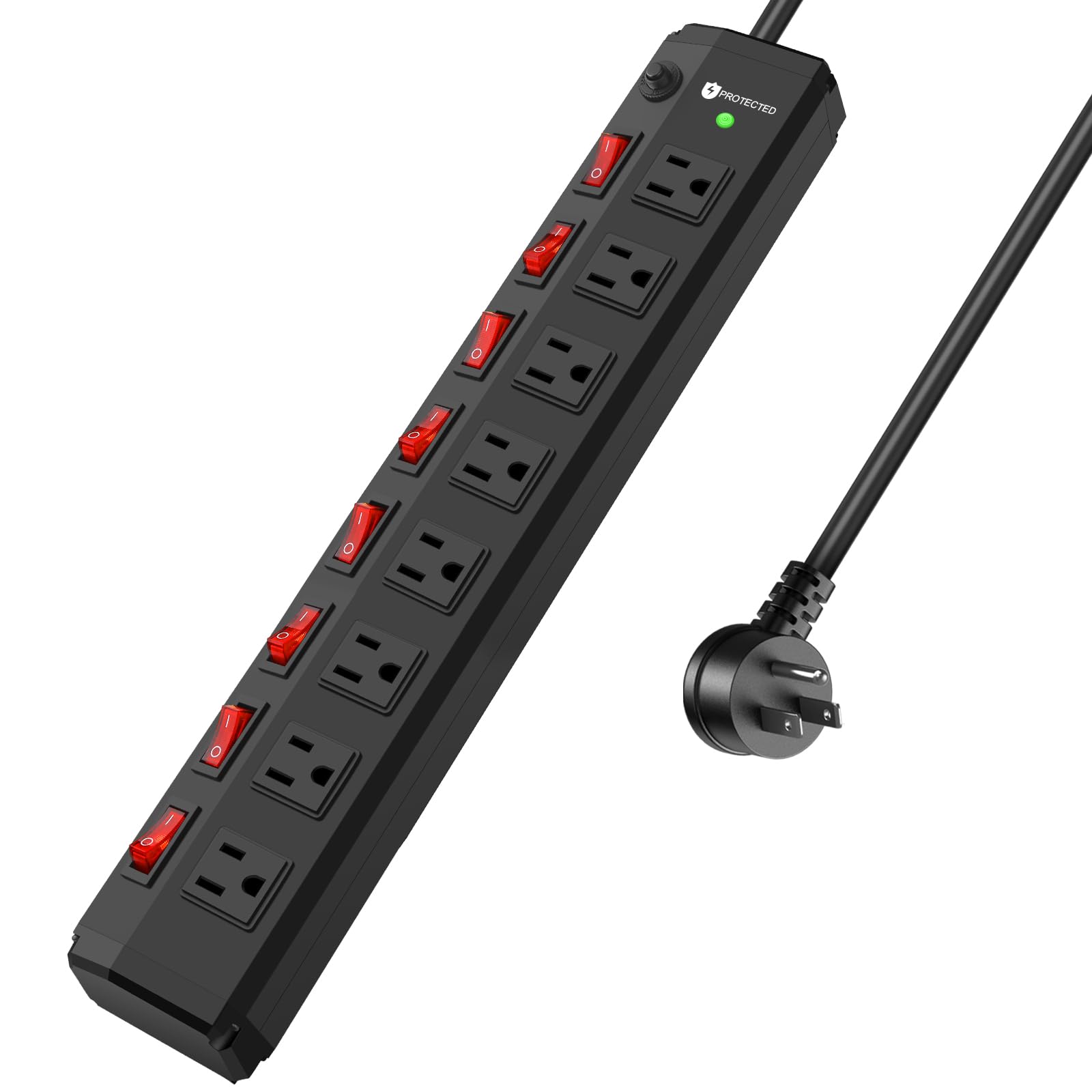
ANNQUAN 8-Outlet Switch Strip – Best for Maintenance
Key Features
- Switching: 8 individual switches
- AC outlets: 8
- Cord length: 6 ft
- Surge rating: 1,200 joules
- Price: Midrange
A water change is the moment a plain power strip gets annoying. You want the filter off, the heater off, and the light on, and you are doing it with wet hands. The ANNQUAN puts a rocker switch on every one of its eight outlets, so each piece of equipment goes down on its own without a plug being pulled. The switches are large enough to hit deliberately, and the row reads clearly enough that you can see what is live from across the room.
We rate it as the maintenance strip in this group rather than the everyday one. The aluminium body is stiffer than the plastic housings elsewhere and shrugs off knocks in a fish room, 1,200 joules covers a modest setup, and the 6 ft cord gives some placement slack. Eight outlets fill up fast once a filter, heater, light, and air pump are in, and there is no USB here at all. This is for the person who switches things constantly, not the person who needs to charge a phone beside the tank.
Pros
- Switch each outlet on its own
- Aluminium housing feels sturdier than plastic
- 1,200 joules and a 6 ft cord
Cons
- Eight outlets fill up on a big tank
Eight individual switches make the ANNQUAN the handiest strip for a tank you switch off constantly for feeding and water changes.
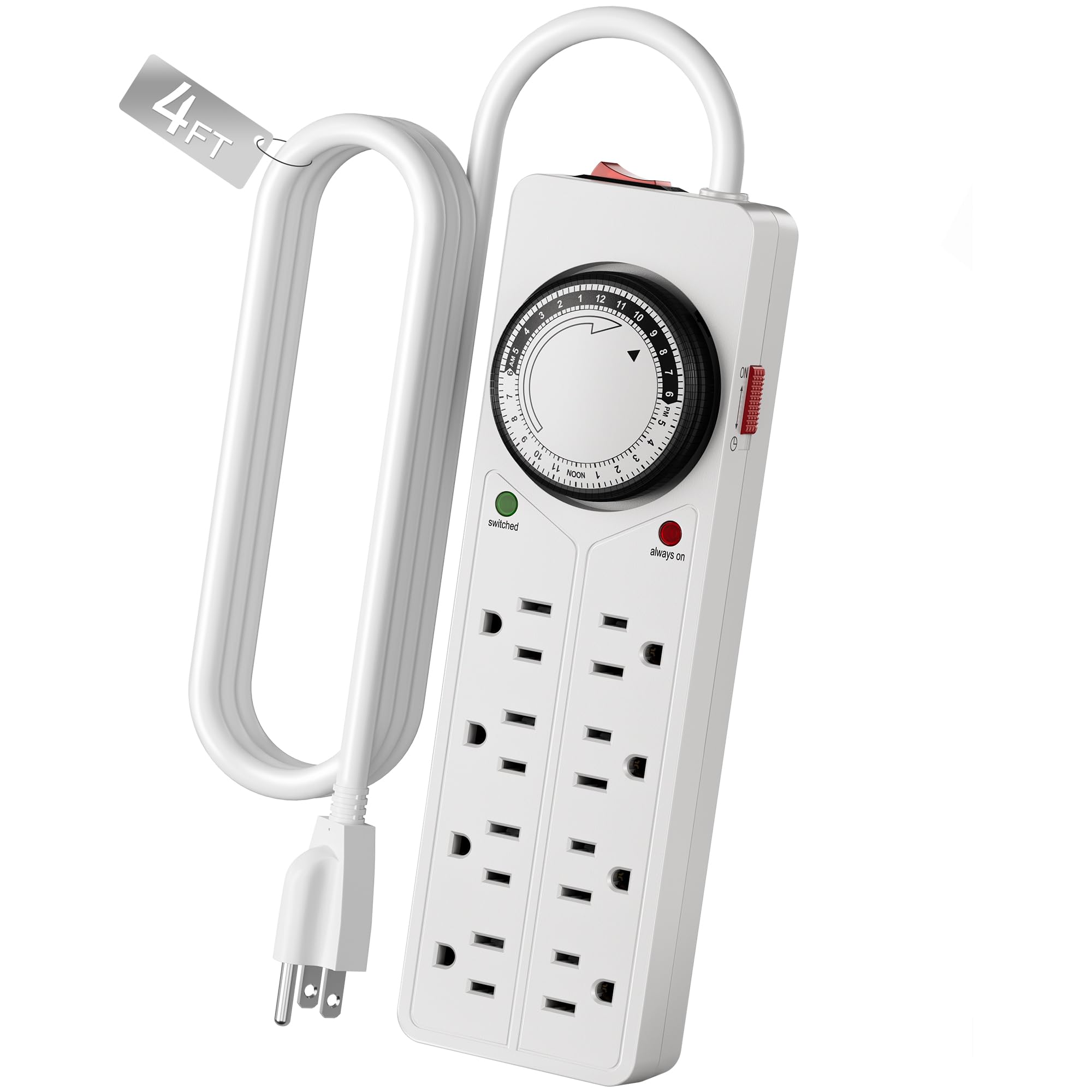
BN-LINK 8-Outlet Timer Strip – Best with a Built-In Timer
Key Features
- Timer: 24-hour pin dial
- Outlets: 8 (4 timed, 4 always on)
- Certification: ETL listed
- Price: Budget
An aquarium light on a fixed daily cycle is the best possible use for a timer strip, and the BN-LINK splits its eight outlets into two rows to do exactly that: four sockets that follow a 24-hour pin dial, four that stay live no matter what. A light on one side, a filter and heater on the other, all from a single plug.
Setting it is a physical job. You push pins down around the dial, and there is an override switch that holds the timed row on when you want the light outside the schedule, which we appreciated during long maintenance sessions. Each row carries its own LED, so a glance tells you which half is live. It is ETL listed and built to UL 1449, the certification baseline we look for on anything powering a heater.
Where it gives up flexibility is the schedule itself. All four timed sockets share one dial, so a second light on a different photoperiod needs its own timer, and a knock to the dial means resetting the whole cycle by hand. For a single-light tank it is the cleanest way to get a lighting schedule and constant filtration out of one outlet, and it saves buying a strip and a plug-in timer separately.
Pros
- Four timed and four always-on outlets
- Override switch holds the light row on
- ETL listed and built to UL 1449
Cons
- All four timed outlets share one schedule
You get a light schedule and always-on filtration from one outlet with the BN-LINK’s four timed sockets and four constant ones.
POWSAV 18-Outlet Power Strip – Best for Multiple Tanks
Key Features
- USB ports: 4
- AC outlets: 18
- Cord length: 6 ft
- Surge rating: 2,100 joules
- Price: Midrange
Outlet arithmetic gets ugly fast in a fish room. Six devices per tank across three tanks is 18 plugs, and the POWSAV is the only strip here with exactly that many. One mounting point on the wall instead of three strips fighting for two sockets is worth more than any single feature on this page.
It is not just a big block. The 2,100-joule rating matches the Anker’s, the outlets are spread across an 11.7-inch body with room for the transformer on a heater controller, and the flat plug plus 6 ft cord make it easy to hang near a rack. A 15-amp rating and ETL listing are what we expect at this size, and both are here.
The four USB ports are a convenience for a phone or the test kit’s charger rather than a reason to buy, and the included cable ties are the sort of small extra that keeps a rack tidy. What you give up is refinement: 18 sockets make a wide strip, and the rows are dense enough that bulky adapters belong on the ends where they have room.
For a single tank we rank it below the Anker, where its size is a liability and 12 well-spaced outlets are easier to work with. For two or three tanks sharing one wall, nothing else here replaces this many strips with one.
Pros
- 18 outlets cover a multi-tank wall
- 2,100 joules with ETL listing
- Cable ties and a flat plug in the box
Cons
- Individual outlets can stop working
Two or three tanks on one wall is the case the POWSAV was built for: 18 outlets where you would otherwise need three strips.
TESSAN Timer Power Strip – Best for Planted Tank Lights

Key Features
- Plug: 45-degree flat plug
- Outlets: 8 (4 timed, 4 always on)
- Cord length: 4 ft
- Surge rating: 900 joules
- Price: Midrange
TESSAN labels this one for aquarium lighting, and the layout backs the label up. Four outlets run off a daily timer dial, four stay powered, and two separate switches control the rows. For a planted tank with a single fixture, that is the whole job: light on a schedule, filter and heater never interrupted.
The details suit a tank stand. A 45-degree flat plug leaves the second wall socket usable, two mounting holes let you hang it clear of the cabinet floor, and 900 joules is real protection rather than a token figure. We were less taken with the timer dial, which is shallow enough that setting the time takes a couple of tries with a fingernail, and the sockets sit close enough that a wall wart placed badly will cover its neighbour.
We place it behind the BN-LINK for the same job. You get four fewer outlets and less surge capacity, and the 4 ft cord is the shortest reach in this group, which rules it out of any setup where the outlet is not right beside the stand. What it has going for it is a plug-and-play fit for a small planted setup where the light is the only thing that needs a clock.
Pros
- Four timed and four always-on outlets
- Flat plug keeps the second socket free
- Mounts to the cabinet wall
Cons
- 4 ft cord limits where it can sit
A tidy fit for a small planted tank: the TESSAN puts one light on a daily dial and keeps the filter live on the other four outlets.
Qiyuan Outdoor Power Strip – Best for Ponds and Sumps

Key Features
- AC outlets: 6 wide-spaced
- Cord length: 6 ft
- Weather rating: IPX6
- Price: Midrange
Water and power strips do not mix, which is why most of this list belongs on a cabinet wall well above the water line. The Qiyuan takes a different approach: a sealed housing with spring-loaded covers over each outlet, an IPX6 rating, and a weather-sealed master switch. If your equipment sits in a humid sump room, on a covered porch, or beside a pond, that is a feature nothing else here can offer.
The practical side holds up. Six wide-spaced sockets take timers and transformer blocks side by side, the three USB ports mean a phone or a test light does not need an adapter, and the master switch shuts the whole row down for maintenance. It is ETL listed and rated 13 amps at 1,625 watts.
Be precise about what IPX6 means: protection against powerful water jets, not immersion. It is not a licence to leave the strip where a filter can spray or a hose can pool water on it. Mount it under cover with the cord running down in a drip loop, and check that each cover springs shut, because a hinged cover that stays open is just a hole.
Against the indoor picks it gives up outlet count and published surge capacity to buy weather sealing, so it earns its place only where moisture is the deciding problem. In a basement fish room with condensation on the walls, that is a fair trade. Next to a covered tank in a dry living room, an Anker or an Addtam is the better buy.
Pros
- IPX6 sealed housing with outlet covers
- Six wide-spaced sockets plus three USB ports
- Master switch cuts everything at once
Cons
- No joule rating is published
For a pond, a covered porch, or a dripping sump room, the Qiyuan’s sealed IPX6 housing is the protection nothing else here offers.
How We Tested Aquarium Surge Protectors
We started with a long list of surge protectors sold for aquarium and home-office use, then narrowed it by outlet count and spacing, USB ports, cord length, mounting hardware, surge rating, and price. That left 14 units, which we tested for four months. We did not chase every strip on the market; we focused on models that made sense around a tank, whether that meant a compact cabinet mount or a longer strip for a multi-plug sump setup.
Each unit spent time mounted inside a cabinet under a freshwater tank, screwed to the side of a stand, and set on a shelf behind a saltwater tank during water changes and filter maintenance. We plugged in a heater, canister filter, LED light, air pump, and phone cable, then noted whether bulky adapters blocked neighboring outlets and whether the USB ports stayed live when the main switch was off. We also checked switch action, surge indicator lights, plug fit, and whether the housing flexed or outlets loosened after repeated plugging and unplugging.
For water resistance, durability, and mounting, we wiped each strip with a wet towel, let condensation collect near the sump, and checked for water pooling in unused outlets after splashes. We hung each one with its included screws, adhesive strips, or keyhole slots and noted sag, hardware quality, and whether the strip stayed reachable. At the end, we compared outlet count, USB ports, and build quality against price to judge value — not just which strip was cheapest. The ones that held up shared tight outlet grips, socket wells that didn’t collect water, and mounts that didn’t rely on foam tape alone.
How to Choose a Surge Protector for an Aquarium
The right strip for a tank is settled by three things before joules ever come up: how many plugs you actually have, where the strip can safely live, and whether you need to switch equipment without unplugging it.
Count plugs, then measure the bricks
Add up the devices, then look at the shape of their plugs. A heater cord ends in a slim plug, but a heater controller, a wavemaker brick, and a light transformer each eat two sockets’ worth of space. That is how a 12-outlet strip ends up holding eight things. Wide-spaced sockets, which the Anker, Belkin, and Qiyuan all make a point of, matter more than the raw count for most tanks.
Our rule of thumb: count your devices, add one for the brick you forgot, and if two of your plugs are transformers, choose a widely spaced strip over one with more outlets. A strip you can use every socket on beats a bigger one you cannot.
Joules and the listing behind them
A joule rating is how much surge energy the strip can absorb before it sacrifices itself. More is better for expensive gear: the Belkin’s 3,940 joules sits at the top of this group and a 900-joule strip at the bottom. For a heater and a filter, around 1,000 joules is defensible; for a controller, a doser, and an LED fixture, the extra absorption is worth paying for.
Check the certification beside the number. A UL, ETL, or TUV mark means an independent lab tested the strip, and we treat it as the floor rather than a bonus. Surge strips also degrade as they absorb spikes, so a protection indicator light, like the one on the Belkin, is worth having: it is the only way to know the strip is still doing anything.
Cord length decides where it lives
The safest place for a strip is mounted above the water line and off the cabinet floor, so a spill or a leaking filter runs past it rather than into it. That makes cord length a placement decision. Measure from the outlet to the inside wall of the cabinet, add a foot for the drip loop, and choose from there. A 4 ft cord suits a stand beside an outlet; 8 to 10 ft is what you need when the outlet is across the room.
Hang the strip on its screws or keyhole slots rather than laying it flat on the cabinet floor, and leave a loop of cord hanging below it so water runs off instead of tracking down into the sockets.
Switches, timers, and maintenance day
Where a strip earns its keep is on maintenance day. Individual rocker switches, as on the ANNQUAN, let you cut the filter and heater one at a time while the light stays on. A master switch, as on the Qiyuan, is faster when everything should go off at once. A timed row, as on the BN-LINK and the TESSAN, handles the light schedule and saves you a separate plug-in timer.
Pick the switching you will actually use. If you run one light and never touch anything else, a plain strip plus a timer is fine. If you do weekly water changes with both hands in the tank, individual switches are the feature you will notice every time.
What a weather rating really means
An IP rating describes water resistance, not waterproofness. IPX6, which the Qiyuan carries, means the housing survives powerful jets; it does not mean the strip can sit in a puddle or under a dripping filter outlet. For a normal indoor tank, a plain strip mounted high and dry beats a sealed one living in the splash zone.
If your setup is genuinely wet, a pond, an open sump in a humid room, or a covered patio tank, buy the sealed housing and still mount it under cover with the covers closed. If it is a living-room tank, spend the difference on joules instead.
Frequently Asked Questions
How many watts can one aquarium power strip handle?
A 15-amp strip on a 120-volt circuit is rated for 1,875 watts; the 13-amp picks here top out around 1,625 watts. Add up the figures on each device’s label: a 200 W heater, a 30 W filter, a 60 W light, and a 5 W air pump come to under 300 W, which leaves far more headroom than most tanks need.
The limit you will hit first is outlets, not watts. Keep the total under the strip’s own rating and you will run out of sockets long before you run out of capacity.
Do I need a GFCI with an aquarium surge protector?
Yes, and the surge strip is not a substitute. A surge protector limits voltage spikes; a GFCI cuts the circuit when current leaks to ground, which is the fault that happens when water reaches a connection.
If the outlet behind the tank is not GFCI protected, a plug-in GFCI adapter is the simple fix. Press its test button monthly to confirm it still trips.
Will a surge protector keep my filter running during a power outage?
No. A surge strip passes power through and absorbs spikes; it has no battery in it. If an hour without flow is a real risk where you live, the device you want is a small UPS sized to the filter’s wattage, plugged between the wall and the strip.
Even then, expect minutes to hours of run time, not days. Test it once by pulling the plug and timing how long the filter keeps moving.
Final Verdict
The Anker 351 is the strip we point most aquarium owners to: 12 outlets spaced for the adapters a tank actually uses, 2,100 joules of protection, and a flat plug that reaches the outlet behind a stand. It is the least fussy way to power a filter, a heater, a light, and the bricks that come with them.
If the tank runs a controller, a doser, and a display light, the Belkin’s 3,940 joules and 8 ft cord buy real margin. And if the outlet sits clear across the room, the Addtam’s 10 ft cord solves a problem nothing else here does.