This post contains affiliate links. We may earn a small commission when you buy through our links — at no extra cost to you.
The worst part of fishkeeping isn’t the water change you’ve been putting off — it’s noticing a white spot on a fin and realizing the clock is ticking. A good medicine has to do two things at once: knock back the infection and leave the rest of the tank, including the beneficial bacteria you’ve spent months cultivating, intact. Over four months, my team and I tested 14 medications, treating a stubborn fin rot case on a betta and a full-blown ick outbreak in a community tank. The right formula shortens recovery without tinting every surface blue or sending your water chemistry into a tailspin.
Most fish meds are not set-and-forget. I learned to pull carbon, test ammonia daily, and brace for that sharp medicinal smell that lingers in the room. Quality varied wildly: some formulas separated in the bottle or left a yellow ring on silicone, while others mixed clean, dosed easily by the gallon, and didn’t waste half a bottle on one course. I cared most about whether a fish actually recovered — appetite back, fins unclamped — and whether the tank stayed safe for everyone else. The picks below are the ones that earned a permanent spot in my fish cupboard.
Our Top Picks
The Best Aquarium Fish Medicine, Reviewed
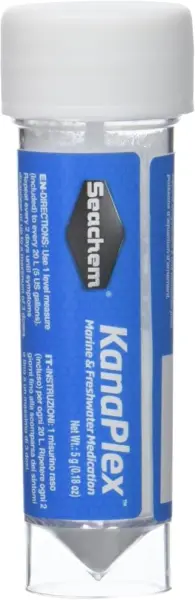
Seachem Kanaplex – Best Overall
Key Features
- Form: Powder, 5 g
- Treats: Bacterial and fungal
- Removal: Carbon
- Water types: Freshwater and marine
- Price: Midrange
Dropsy, popeye, fin and tail rot, septicemia — Kanaplex’s label covers four of the problems people find on a fish at eleven at night, and that range is why ours lives on the shelf rather than in a shopping cart. It is absorbed through the skin and gills as well, which matters more than it sounds: a fish sick enough to need treating has usually stopped eating, and a medication that has to be swallowed has already lost half its usefulness.
Two details make it easy to live with. It is labeled as not adversely affecting the filter bed and as easily removed with carbon, so a course run in the display tank does not leave you wondering about the bacteria you spent a month growing. And the powder comes with its own small scoop, a more forgiving way to measure into a hospital tank than counting drops into a bucket.
The part we did not expect to like as much as we do is the food route. Mixed into a medicated feed, it treats a bacterial infection in a tank that holds invertebrates, which answers the problem of the shrimp you cannot catch and the snail you would rather not lose. Start the course as soon as you are sure what you are looking at; this is a medicine that works best on a fish that still has some fight in it.
Pros
- Covers several bacterial and fungal diseases
- Absorbed through skin and gills, no eating required
- Leaves the filter bed and clears with carbon
- Can be mixed into food for tanks with invertebrates
Cons
- Hard on fish that are already failing
We keep Kanaplex on the shelf as the default: broad bacterial and fungal coverage, absorbed without the fish having to eat, and it leaves your filter bed intact.
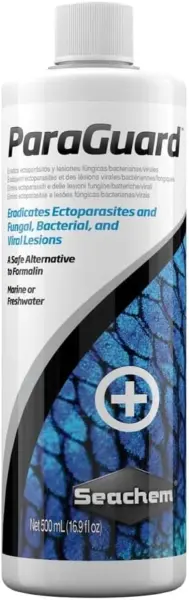
Seachem ParaGuard – Best for Parasites
Key Features
- Form: Liquid
- Treats: Parasites and ich
- Plant safe: Yes
- Bottle size: 500 mL (16.9 fl oz)
- Price: Premium
ParaGuard’s selling point is not the disease list, it is the guest list. Plants stay, shrimp stay, the filter keeps running and the tank does not have to be stripped, which is not something we can say about most of the parasite treatments here. Snails are the exception — lift them out before the first dose, because this is one of the products that will kill them.
Where it earns its place for us is the symptom that could be three things. A fish scraping itself on the gravel, or wearing a fine dusting that might be ich, might be velvet, might be flukes: ParaGuard covers the lot, so you can start treating without a positive identification. It is not a dye either, so the water stays clear and you can watch the spots on the fish rather than peering at them through blue.
The catch is arithmetic. It is dosed daily while the parasite is active, and on a large tank that empties a bottle faster than you expect, so the 500 mL size is the one to buy. It is also a parasite medication first and a general one second: a torn fin or a red sore needs a different bottle, and a week of ParaGuard will not touch it.
Pros
- Plants, shrimp and the filter stay put
- Covers ich, velvet and flukes without a firm ID
- No blue dye in the water
- Large 500 mL bottle suits a long course
Cons
- No antibacterial action at all
Our pick when you cannot tell ich from velvet from flukes: it covers all three and will not cost you the plants, the shrimp or a blue-stained tank.
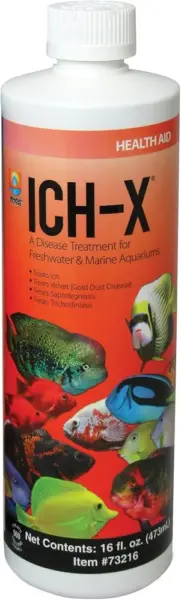
Hikari Ich-X – Best for Large Tanks
Key Features
- Treats: Protozoan and fungal
- Bottle size: 16 fl oz
- Treats up to: 960 gallons
- Scaleless fish: Labeled safe
- Price: Premium
Sixteen ounces treats up to 960 gallons, which tells you most of what matters: this is the ich treatment for a big tank, a stock tub or a pond, not for the little hospital tank on the shelf. The other half of the pitch is the part that decides it for a lot of keepers — it is labeled as safe for scaleless fish, which covers the loaches, catfish and eels that catch ich first and tolerate harsh cures worst.
That scaleless-fish line is why we rate it near the top of this set for anyone with bottom-dwellers. Built on a form of malachite green the label describes as safer, it treats the protozoan diseases including ich and controls fungal problems at the same time, so an outbreak that has brought a secondary fungus with it does not need a second bottle.
It is still a dye. The water goes blue, silicone seals and suction cups can keep a tint afterwards, and the snails should come out first because this will kill them. None of that changes the arithmetic on a big system: one bottle, one course, and the fish that usually suffer most from ich medicine are the ones this was made for.
Pros
- One bottle treats up to 960 gallons
- Labeled safe for scaleless fish
- Also controls fungal problems
Cons
- Blue dye can tint silicone and decor
- Oversized for a small quarantine tank
Keep loaches, catfish or a tank measured in hundreds of gallons? This is the ich cure we reach for: labeled for scaleless fish and sized for a real outbreak.
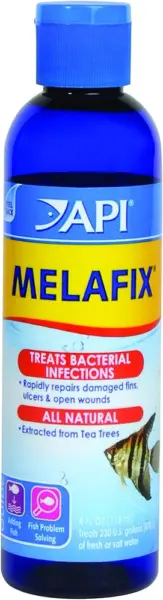
API Melafix – Best for Fin Repair
Key Features
- Active: Tea tree extract
- Course: 7 days
- Water type: Freshwater
- Bottle size: 4 fl oz
- Price: Budget
We want this on the record before anything else: tea tree oil and bettas are a bad pairing. Melafix is a melaleuca product, the oil can affect the labyrinth organ a betta uses to breathe air from the surface, and it has no place in a betta tank. For everyone else in a freshwater community tank it is the mildest useful antibacterial on this list, and that is exactly why we keep a bottle.
It is aimed at tissue rather than at wiping out an infection: frayed fins, a tail torn up by a tankmate, an open wound starting to look ragged. The label runs daily doses for a week, which is about the minimum worth giving fin tissue to start growing back, and nothing about the routine is dramatic. That is the appeal.
It will not tint the water, which after a week of blue dye feels like a small luxury, and it is safe with snails, shrimp and plants — more than most of the treatments here can claim. It is the one product in this group you can run in a planted community tank without rearranging anything first.
Pros
- Mild enough for snails, shrimp and plants
- Aimed at fin and wound repair
- No water tint at all
Cons
- Strong tea tree scent
- Too mild for dropsy or septicemia
We reach for Melafix for torn fins and small wounds in a community tank and we keep it away from bettas; for everything else it is the gentlest antibacterial here.
API Super Ick Cure – Fast Ich Knockdown
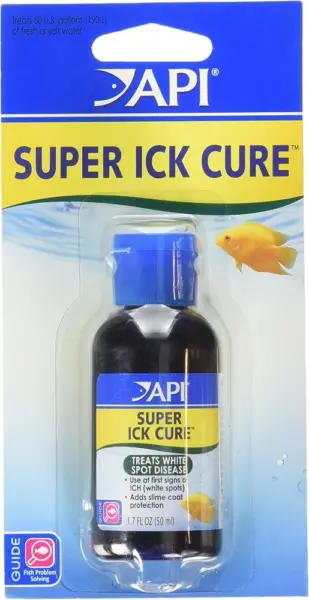
Key Features
- Course: 5 daily doses
- Treats: Ich and secondary bacterial
- Reef safe: No
- Bottle size: 1.7 fl oz
- Price: Budget
The label promises ich killed typically within a day of the first dose, and that speed is the entire argument for this bottle. When spots are multiplying across a tank, a fast knockdown is worth having, and none of the other labels in this group promise it.
The five-day course is the part people skip. The drug hits the free-swimming stage of the parasite, not the white spots attached to the fish, so each daily dose catches the next generation as it hatches. Stopping on day two because the tank looks better is how the same outbreak returns a week later.
Treat it with respect. It is the hardest of the ich cures here on the fish themselves, which is why it sits lower on this list than its popularity suggests, and the fish that do badly on it tend to be the ones already weakened. Used in a bare quarantine tank with one fish and time to watch it, it does what it says. Expect the water to go blue; that is the dye working, not a problem, and it clears with carbon after the last dose.
Pros
- Fast ich knockdown, typically within a day
- Also treats secondary bacterial infections
- Simple five-dose routine
Cons
- Hardest of these on weakened fish
- Not for reef aquariums
Buy it for a fast knockdown in a bare tank with one fish in it, and know that it is the hardest of these on a fish that is already weak.
Kordon Methylene Blue – Best for Quarantine and Eggs
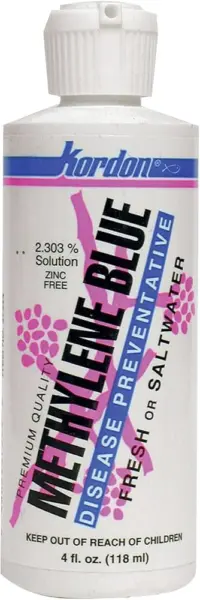
Key Features
- Form: Liquid
- Treats: Fungal and parasites
- Bottle size: 4 fl oz
- Water types: Freshwater and saltwater
- Price: Budget
It stains. Hands, silicone, airline tubing, sand, the countertop it dripped on — anything the blue touches keeps a memory of it, and that reputation is earned. It is also the least interesting thing about a bottle that does a job almost nothing else here does.
That job is fungus on eggs. A clutch that has fuzzed over in a breeding tank, or a batch you want to get as far as hatching, is where methylene blue earns its place, because it works as a preventative as much as a treatment. It is labeled for fresh and salt water both, so it is not a bottle that only works in one kind of tank, and a little goes a long way.
Dose it in a bare tub rather than through a mature filter, and wear gloves. The water should look blue, not black, and if it looks black you have used more than you needed. For a planted display tank with a filter full of bacteria we leave it out; for eggs and a quarantine tub, it is the inexpensive bottle that keeps proving its worth.
Pros
- The treatment for fungus on eggs
- Works in fresh and salt water
- Concentrated, so the bottle lasts
Cons
- Stains everything it touches
The bottle we keep for fungus on eggs and a quarantine tub rather than the display tank: it works, and it stains everything it touches.
How We Tested Aquarium Fish Medicines
We built a shortlist from formulas recommended in hobbyist forums, fish-club newsletters, and vet-written care guides, then filtered by active ingredients, clear dosing instructions, and whether the label explained how to protect beneficial bacteria. Over four months, we tested 14 medications in quarantine tanks and two established home aquariums. Each product started with a confirmed symptom, a full panel of water tests, and a logbook.
Fin rot cases were photographed at the same angle every morning so we could compare ragged edges and new growth. For ick, we counted white spots on fins and gills, watched for flashing, and noted how many days passed before spots dropped off. We checked ammonia and nitrite daily, because a medicine that clears an infection but crashes the tank is not a fix. Ease of use got judged at the sink: how hard the bottle was to shake, whether the dose was measured in drops or capfuls, and how clearly the instructions scaled to our water volume.
We watched for staining on silicone seams, plastic plants, and white filter floss, and noted scent during dosing and two days later. Fish safety meant watching tankmates for clamped fins, labored breathing, or lost appetite, and pulling snails or shrimp when the label warned against invertebrates. We judged quality by how evenly powders dissolved and whether liquids stayed mixed between doses. We tracked how far each bottle went across a full treatment course to judge value, and logged water tint at 24 and 72 hours. The medications that made the final cut cleared symptoms without leaving the tank looking or smelling like a chemistry experiment.
How to Choose an Aquarium Fish Medicine
Almost nobody shops for fish medicine before they need it, so the useful question is not which brand wins but which of three or four problems your fish actually has.
Start With the Symptom, Not the Bottle
Three buckets cover most of what you will see. White spots, a fine gold or grey dusting, or a fish scraping itself on the gravel points to parasites. Frayed fins, red streaks at the base of the tail, a bulging eye or a swollen belly points to bacteria. Cottony tufts and fuzz on eggs or an open wound are fungal. Get the bucket right and the shortlist writes itself.
The classic mistake is buying an antibiotic for a parasite. Ich is the most common thing you will meet and no bacterial medicine touches it, while the parasite treatments here are gentle enough that guessing wrong costs you days rather than a fish. If a symptom does not fit any bucket, treat for parasites first and watch for a second problem to declare itself.
Look at Everything Else in the Tank Before You Dose
Most treatments are aimed at the fish, but the casualty list is usually the invertebrates. Snails are the common victims of the dye-based ich cures, so lift them out before the first dose. A reef tank should not see those products at all, and if you keep loaches, catfish or eels, look for a treatment labeled for scaleless fish before you buy anything else.
Bettas are their own case. The tea tree oil in Melafix and Bettafix can affect the labyrinth organ a betta uses to breathe at the surface, which is the opposite of what you want in a fish that is already unwell. For a betta, buy a bacterial treatment instead and leave the botanicals on the shelf.
Know What It Does to Your Filter
The bacteria in your filter are doing a job, and some medications knock them back while the fish is already under stress. A product labeled as not adversely affecting the filter bed and easily removed with carbon afterward, like Kanaplex, is the easier kind to run in a display tank you have spent months cycling.
The trap is running carbon during the course rather than after it. Carbon does not distinguish between a medication and a contaminant, and it will pull the drug out of the water before it has had time to work. Leave the chemical media out until the last dose is in, then use it to clear the residue.
Buy Enough to Finish the Course
The most common way a treatment fails is stopping early. Courses run from four to seven days depending on the product, and the fish usually looks better on day two, which is exactly when people quit and exactly how a half-treated infection comes back.
Multiply your tank’s gallons by the days in the course and check that against what the label says the bottle treats. A 16-ounce bottle covering up to 960 gallons is built for a big system, and a small ich cure is a small-tank bottle; buying the little one for a large tank means running dry mid-course and starting over.
Expect the Water to Turn Blue
Most of the classic ich and fungus treatments are dyes, and dyes dye things. The water goes blue, silicone seals and airline tubing pick up a tint, and a pale sand bed may never come all the way back. None of that means the dose failed, so do not panic and re-dose on the strength of the colour.
Wear gloves, shift what you can live without, and run carbon after the course to pull the colour out. If a treatment leaves the water clear, as ParaGuard does, you have one less thing to explain to the rest of the household while you are watching a sick fish.
Frequently Asked Questions
Do I need a separate hospital tank to treat a sick fish?
For one fish with a wound, fin rot or a localized infection, it helps. A bare tank lets you dose exactly the volume you are treating, keeps medication off the display’s filter, and means the invertebrates never see the drug. Use the smallest bare tank the fish can turn around in, with a sponge filter and nothing else.
For ich or velvet, treat the whole system. The parasite is in the water and the substrate, not only on the fish, so a hospital tank leaves the next generation behind to reinfect everything the moment the fish goes back in.
Can I use two fish medicines at the same time?
Treat one problem at a time. Stacking a dye and an antibiotic in the same water gives you no way to tell which one worked, and it doubles what an already sick fish has to survive. Finish the course, run carbon, do a water change, and start the second product only if the fish still needs it.
Is it worth medicating new fish before they show symptoms?
Only with something labeled for it. Melafix lists a three-day preventive course for new arrivals, and methylene blue is the traditional dip for a fish straight out of a shipping bag; both are preventives rather than cures. Antibiotics are different. Using one on a healthy fish spends the one advantage it has, which is being saved for a real diagnosis.
Final Verdict
If you buy one medicine before you need it, make it Kanaplex. It covers the bacterial and fungal problems that send most people looking for help, it works through the skin and gills instead of the stomach, and it leaves the filter bed you spent months cycling.
Pair it with ParaGuard and you have parasites covered too, without turning the tank blue. Running a big system or keeping loaches and catfish changes the answer: that is Ich-X, the ich cure sized for the volume and labeled for the fish most treatments punish.