This post contains affiliate links. We may earn a small commission when you buy through our links — at no extra cost to you.
Cloudy water is the first thing most betta keepers notice after adding a new substrate—you rinse a bag until your arms ache, fill the tank, and still end up with a milky haze. Substrate is more than decoration in a betta tank: it’s the bed your plants root into, the surface where waste settles, and part of what keeps water quality steady between changes. The right one rinses clean, settles quickly, and looks natural under a betta’s fins; the wrong one clouds the tank, traps food, or leaves plants floating every morning.
I’ve kept bettas in everything from bare-bottom tanks to planted setups, and I’ve learned that the bag matters as much as the tank. Over the past three months, my team tested 14 substrates side by side in small betta tanks, watching how each one rinsed, whether the water stayed clear, how well plants rooted, and how the color looked against a betta’s fins. A few bags surprised us. The picks below are the ones that held up.
Our Top Picks
The Best Substrate for Betta Fish, Reviewed
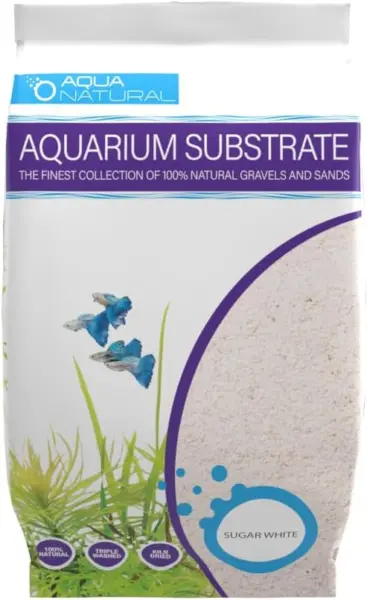
Aqua Natural Sugar White Sand – Best Overall
Key Features
- Color: Off-white
- Bag weight: 10 lb
- Grain size: 0.5–1 mm
- Water chemistry: Inert natural sand
- Price: Midrange
The grain is what sold us. At 0.5 to 1 mm it’s fine enough to look soft under a fish trailing a body length of fin, and dense enough to hold its place when the filter outflow crosses the bottom of a small tank. Fine sand has a reputation for ending up in the intake; this one is graded with no fines, and in a five- or ten-gallon it stays where you spread it.
It behaves on setup day too. It’s triple washed and kiln dried, and while we still rinse any sand before it goes in, this one settles out quickly instead of leaving the water milky for days — which in a small tank is the difference between a betta moving in this weekend and waiting through a week of water changes. The color is a warm off-white rather than the bright sugar white in the photos. We like that: it reads as natural under most lights instead of chalky.
One thing to plan around is that it’s inert. There are no nutrients in it and it won’t move your pH, which is the safer starting point in five or ten gallons of water, but plants will want root tabs, or you use it as the cap over a thin layer of aqua soil. That’s how the planted setups we like best here use it: soil underneath for the roots, sand on top for the fish.
Pros
- Fine 0.5–1 mm grain that stays put
- Settles quickly with little clouding
- Easy to siphon without losing much sand
- No additives to shift water chemistry
Cons
- Two to three bags to bed a 10-gallon
Our default for a betta tank: a fine, dense, inert sand that settles fast, siphons cleanly, and won’t move the water chemistry in a small volume.
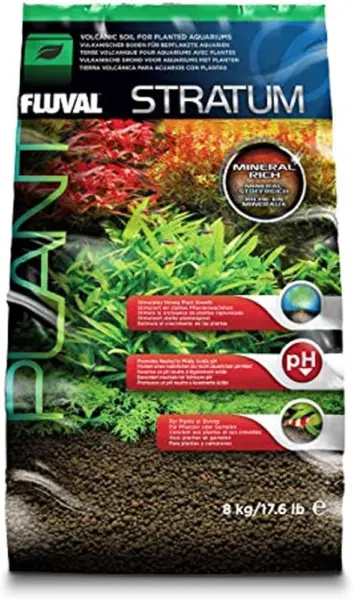
Fluval Plant & Shrimp Stratum – Best for Planted Tanks
Key Features
- pH effect: Neutral to slightly acidic
- Bag weight: 17.6 lb
- Granule form: Porous granules
- Root support: Plant-focused soil
- Price: Premium
If the tank is going to be planted first and stocked second, this is where we start. Stratum is a porous granular soil rather than a gravel, so roots push into it instead of being deflected by it, and the granules host a colony of nitrifying bacteria that takes some of the load off a small filter.
Two things we look for in a betta tank are here. It holds a neutral to slightly acidic pH, which is a comfortable place for a betta’s water to sit, and it holds it steadily rather than drifting between water changes — worth more in five gallons than in fifty, where there’s little volume to absorb a swing. And it does the job it’s sold for: roots take hold quickly, and the porous surface gives shrimp and fry somewhere to disappear into.
The catch is the first week. Rinse it in small batches until the runoff is mostly clear, fill over a bowl rather than straight onto the bed, and run filter floss for a day. Siphon with a light hand and press stems back in gently; this is a bed that shows every disturbance.
Pros
- Roots spread easily through loose granules
- Holds neutral to slightly acidic pH
- Porous granules host beneficial bacteria
- Big bag covers a ten-gallon generously
Cons
- Clouds the water for a day or two
- 17.6 lb is more than a five-gallon needs
For a planted betta tank this is the soil we reach for: roots spread easily, pH sits slightly acidic, and the big bag covers a ten-gallon.
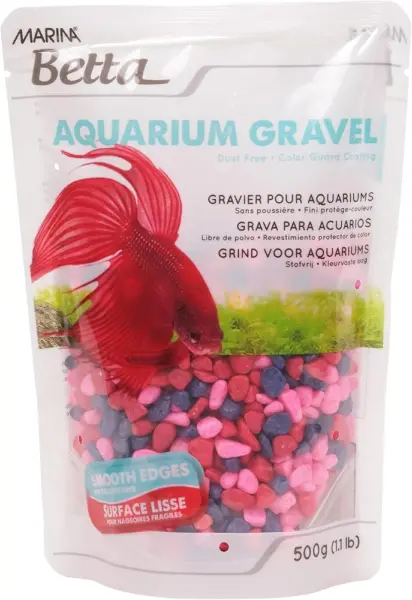
Marina Jellybean Gravel – Best Budget Pick
Key Features
- Coating: Epoxy-coated
- Bag weight: 1 lb
- Edge shape: Smooth, rounded
- Grain size: 4–5 mm
- Price: Budget
Rounded rather than crushed is the detail that earns this gravel its place. The stones are 4 to 5 mm with soft edges, and a betta that noses along the bottom or wedges itself into a corner won’t catch a fin on them the way it can on angular gravel. It’s the one bag here that names bettas on the label, and for once the marketing matches the design.
It’s pre-rinsed and close to dust-free — we rinsed a bag out of habit and the water ran nearly clear — and the epoxy coating means it won’t push your pH or hardness around. The colors are loud and they stay loud, which is the part that usually disappoints with coated gravel.
Where we land: for a small, fish-first tank the appeal is obvious — a bright floor, no snag risk, nothing leaching into five gallons of water, and color that is still bright weeks later. It’s the cheapest way here to stop worrying about edges altogether.
Pros
- Rounded 4–5 mm edges spare long fins
- Pre-rinsed and nearly dust-free
- Epoxy coating won’t move pH or hardness
- Bright color that holds up
Cons
- One-pound bags, so bigger tanks need several
- No planting value
Our pick for a small, fish-first tank where fins matter more than planting: rounded edges, no effect on water chemistry, and color that lasts.
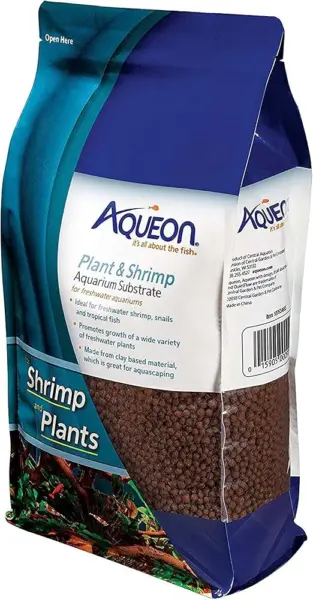
Aqueon Plant & Shrimp Substrate – Best for a Five-Gallon Tank
Key Features
- Color: Brown
- Material: Clay
- Bag weight: 5 lb
- Pellet form: Spherical
- Price: Midrange
Five pounds is the number that makes this bag useful: it’s sized for the tank a betta actually lives in rather than a 40-gallon aquascape. A five-gallon takes one bag, a ten-gallon takes two, and neither leaves you storing half a sack in the garage. The pellets are fired clay, roughly spherical, and they hold their shape in water instead of breaking down into sludge the way pressed soils can.
That shape is the quiet advantage. Rounded clay balls give roots something to wrap around, and they keep their structure, so a stem that goes in stays in and a rescape doesn’t leave you with mud. We found the bed vacuums without collapsing under the siphon, which is more than we can say for the finer soils here.
Where it gives ground is volume. Five pounds is a five-gallon answer; a bigger tank wants a stack of bags, at which point one large sack of soil makes more sense. For the small planted betta tank this guide is mostly about, it’s the tidy choice: one bag, one afternoon, done.
Pros
- Five-pound bag sized for small tanks
- Clay pellets keep their shape
- Easy to rinse and vacuum
- Holds stems once they root
Cons
- Dusty straight out of the bag
- Pellets smaller than the photos suggest
We recommend this for a five-gallon planted betta tank: one bag is enough bed, and the clay pellets hold roots without breaking down.
Seachem Flourite Black – Best for Long-Term Planted Setups
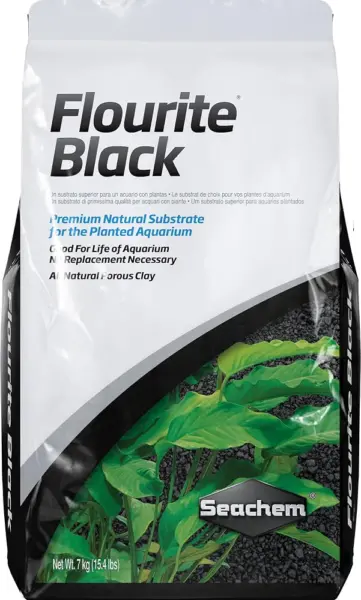
Key Features
- Color: Black
- Material: Porous clay gravel
- pH effect: Does not alter pH
- Bag weight: 15.4 lb
- Price: Premium
There’s a reason the instructions tell you to set a bowl in the tank and pour into it: this is a heavy, dark, dense gravel, and water hitting the bed directly throws up a cloud you’ll spend the evening clearing. We rate it for the tank that gets built once and left alone — a planted betta setup where the substrate goes in and stays for years.
What it’s made of is the appeal. It’s a fracted, porous clay gravel that isn’t chemically coated or treated, doesn’t alter pH, and doesn’t need a laterite layer underneath. In a betta tank the pH neutrality is the useful part: one less variable in five gallons of water. Roots take to the porous surface, and the grain is fine enough for a carpeting plant to close over.
The trade is the grain shape. Flourite is fracted rather than rounded, and that’s the one thing we weigh for a heavy-finned betta that likes to lie on the bottom; a sand is gentler there.
Pros
- Doesn’t alter pH or need additives
- Won’t soften or decompose in the tank
- Fine grain suits carpeting plants
- Heavy enough to hold stems down
Cons
- Needs several rinses before it goes in
For a planted tank you’ll keep for years, this heavy, pH-neutral clay gravel is worth the rinsing: it stays put, holds roots, and won’t soften.
Aqua Natural Bio-Substrate Galaxy Sand – Best for New Tank Cycles
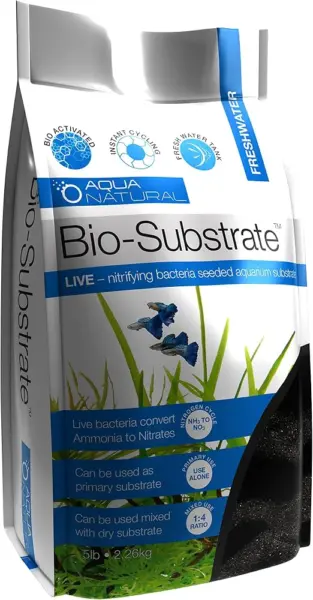
Key Features
- Form: Wet live sand
- Bacteria: Live nitrifying
- Bag weight: 5 lb
- Mixing ratio: 1 live to 4 dry
- Price: Midrange
The bag says not to rinse it, and that’s the whole product: it arrives wet and seeded with live nitrifying bacteria, so rinsing is the one thing that turns a bio-active substrate into plain black sand. It feels wrong to tip a wet bag straight into a new tank after years of rinsing everything, which is exactly why it’s worth knowing about.
The case for a betta tank is twofold. The texture is fine and soft, the kind a long-finned fish can settle onto, and the live bacteria give a new filter a head start on the cycle. We also treat it as a seed rather than a bed: the directions call for one part of this to four parts dry sand, so a bag goes further mixed than it does poured in alone.
Set expectations on the color. Black here means a dark, faintly sparkly sand, closer to charcoal gray under bright light than the jet black on the bag. Under a planted tank’s lighting that reads as contrast, and against a brightly colored betta it’s about as flattering a floor as this group offers.
Pros
- Live bacteria need no rinsing
- Fine sand is gentle under resting fins
- Works as a seed layer under dry sand
- Holds plants in place
Cons
- One bag seeds a bed rather than filling one
- Can cloud the water despite the no-rinse rule
We like it as a seed layer rather than a whole bed: live bacteria you don’t rinse, and a fine dark sand a betta can rest on.
Fluval Bio Stratum – Best for Fine-Rooted Nano Plants
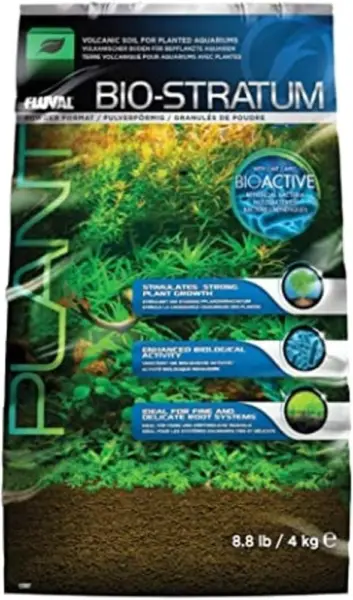
Key Features
- Form: Volcanic soil
- Bag weight: 8.8 lb
- Granule size: 1 mm powder
- Water conditioning: Reduces ammonia
- Price: Premium
Bio Stratum is a volcanic soil ground to roughly 1 mm, and that fineness is both the reason to buy it and the reason to slow down: it clouds the water the moment it’s disturbed, so you fill over a bowl, plant with tweezers, and let filter floss do the first day’s work. None of that is difficult, it’s just slower than tipping in a bag of gravel.
What the fineness buys is a bed that behaves more like powder than gravel. Delicate roots push through without resistance, it doesn’t compact into a brick, and the granules come infused with nitrifying organisms that activate on contact with water. The listing also credits it with pulling ammonia down in a new tank, which we think matters most in exactly the setup this suits: a small, heavily planted tank with one betta in it.
The 8.8-pound bag is the other half of the argument. It’s the smaller of the two Fluval soils here, and for a five- or ten-gallon planted betta tank that’s the right amount of substrate rather than a sack you’d still be working through next year.
So our answer is a conditional yes: it’s the soil for a dedicated nano planted tank where a carpet or a fine-leaved stem is the point and you’ll spend the first week running floss. For a first betta tank with a couple of easy plants, the sand gets you clear water and a fish in the tank the same weekend.
Pros
- 1 mm granules let fine roots through
- Doesn’t compact, so roots keep spreading
- Granules come infused with nitrifying organisms
- 8.8 lb suits a small planted tank
Cons
- Fine granules lift in a strong current
Buy it for a nano planted tank if you’ll accept a hazy first week: the 1 mm granules let fine roots through and the bag suits a small tank.
How We Tested Betta Substrates
We started by pulling together the substrates that show up most often in betta-focused forums, local fish stores, and planted-tank setups, then narrowed the list by grain size, material, and whether the bag was marketed for plant growth or just decoration. That left us with 14 substrates—sand, fine gravel, and a few plant-specific mixes—which we ran through the same three-month routine.
Every bag got rinsed in a five-gallon bucket before it went near a tank. We noted how many rinses it took before the water ran mostly clear, how much grit stayed on the bucket bottom, and whether the substrate packed down like wet sand or stayed loose. In the tanks, we set up small betta setups with a filter, a heater, and a mix of root-feeding plants and ferns, then watched whether plants stayed put or floated up overnight and whether they put out new growth. We also checked the water from the side against a white card—first after filling, then a day later—to judge cloudiness, any tint the substrate gave the water, and how the color read under the tank light.
Over three months, we vacuumed each tank weekly, watched where waste settled, and noted whether the substrate held its color or started looking dull. We also kept an eye on the bettas themselves—whether they rested on the bottom, seemed stressed by a bright substrate, or ignored it entirely. The best substrates were the ones that rinsed without a fight, kept the water clear, held plants through a gentle tug, and still looked good after a month of water changes.
How to Choose Substrate for a Betta Tank
In a betta tank the substrate has to stay out of the water you’re both living in: no clouding, no chemistry surprises, no waste trapped where the siphon can’t reach.
Start with the edges, not the color
A betta’s fins are longer than its body, and it will spend time nosing along the bottom. Rounded 4 to 5 mm gravel or a fine 0.5 to 1 mm sand is forgiving; angular crushed gravel is not, and coarse chips can catch a fin or a barbel.
The trap is the bag that names bettas and turns out to be crushed rock with a bright coat. Run a handful through your fingers before it goes near water — if it could scuff a nail, it can scuff a fin. The Marina gravel is what this looks like when it’s done properly: smooth, coated, no loose grit.
Match the bag to the tank, not the photo
Substrate is sold by weight and needed by depth. Aim for an inch to an inch and a half in a betta tank, which in a five-gallon means roughly one 5 lb bag of clay soil or two of the 10 lb sand; a ten-gallon takes twice that.
This is where most people come up short, and it’s a slow failure: a floor that’s too thin won’t hold a plant, and adding a second bag later means disturbing a settled tank. Buy the whole bed at once and keep the spare dry.
Decide whether you’re planting before you buy
Sand and coated gravel are inert — they do nothing to your water, which in five or ten gallons is a virtue, because small volumes swing fast. Aqua soils go the other way, holding a neutral to slightly acidic pH and feeding roots, and that is exactly what a planted betta tank wants.
We’d frame the choice as a question of appetite: if you want java fern, anubias, and a fish, inert sand plus the odd root tab is the low-risk route. If you want stems and a carpet, the Fluval soils are the ones here that make that realistic.
Plan the fill, because something will cloud
Every soil here clouds to some degree, and so does sand you don’t rinse. Rinse inert sand and gravel until the runoff runs clear; never rinse a bio-active one, which arrives wet and seeded on purpose.
Then set a bowl or a plate on the bed and pour onto that rather than into the tank, and run filter floss for the first day. Hazy on day one and clear by day three is normal. Still hazy on day five means a rinse got skipped.
Think about the two-week job, not the first day
Sand keeps waste on top where a siphon lifts it cleanly; gravel lets debris settle between the grains; aqua soil shouldn’t be deep-vacuumed at all or the bed comes apart. The substrate that stays looking good is the one you can clean quickly without sucking half of it into the bucket.
Frequently Asked Questions
Can I use play sand or potting soil instead of aquarium substrate?
Play sand can work, but it is usually dusty, needs a long rinse, and packs tighter than aquarium sand — which is where a shallow betta tank gets into trouble. Skip potting soil entirely: the fertilizers and organic matter that suit houseplants foul aquarium water and can harm fish. Buy aquarium-specific soil or plain aquarium sand.
Do I have to take my betta out to change the substrate?
Yes, and give yourself an afternoon. Move the fish and the filter media into a bucket of tank water and keep the media wet, because that’s where most of your bacteria live. Swap the substrate, refill with dechlorinated water at the same temperature, then test ammonia daily for the first few days before you relax.
Does a dark substrate make a betta’s colors look better?
Usually, yes. A black or dark brown bed absorbs light and makes reds, blues, and iridescence read stronger, while a pale sand flatters a very dark or metallic fish by contrast. It’s an aesthetic choice rather than a health one, so pick the color that suits the fish you actually have.
Final Verdict
If you’re setting up one betta tank and want the least to go wrong, the Aqua Natural Sugar White sand is the pick: fine enough to be gentle, dense enough to stay put, inert so it can’t move your pH, and quick to settle so the tank clears while you’re still rearranging plants.
Plant the tank and the Fluval Stratum earns its cloudier first week. For a small, fish-first desktop tank, the rounded Marina gravel is the least expensive route here to a floor with no sharp edges at all.