This post contains affiliate links. We may earn a small commission when you buy through our links — at no extra cost to you.
Real plants are lovely until the tank light is wrong, the leaves melt, and you spend a Saturday morning netting brown bits out of the gravel. Fake ones ask nothing of you — no fertilizer, no algae wars — which is why the bad ones sting: washed-out green, leaves that snap off if you look at them wrong, and a base so light the whole stem floats up the moment you fill the tank. What you actually want is a plant that holds its color, stays where you planted it, and passes the three-feet test.
I’ve kept tanks for years, and my team has spent the past four months living with 16 of these in aquariums of very different sizes, from a tall 55-gallon down to a nano. Two things came up again and again: base weight matters more than height, and color is the first thing to go. Measure your water line before ordering anything tall — a plant that’s two inches too long spends its whole life bent against the lid. The picks below are the ones still looking like day one.
Our Top Picks
The Best Fake Aquarium Plants, Reviewed
CousDUoBe 30-Piece Plant Set – Best Overall
Key Features
- Base: Weighted
- Pieces: 30 plants
- Heights: Assorted sizes
- Material: Soft PVC
- Price: Budget
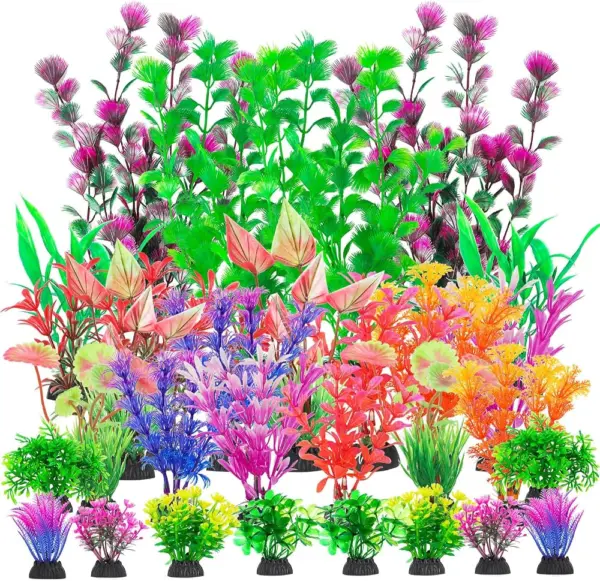
Thirty pieces in one bag is more plant than most single tanks need, and the surplus is exactly why this set is our default. You aren’t getting thirty copies of one stem: the sizes vary enough that the tall pieces go along the back glass, the short ones fill the front corners, and the spares go into the quarantine tank or wait for the next upgrade. The leaves are soft PVC and give under a fingertip instead of poking, which is the detail that decides whether a betta can live alongside them.
Coverage is the other half of the argument. A bare 20-gallon takes most of this bag before it looks planted rather than dotted, and the bright mixed colors lift a tank that’s otherwise gray gravel and a filter. What we noticed in use is how little the leaves announce themselves as plastic — there’s none of the hard, glassy shine that makes cheap stems obvious from across the room.
The catch is the bases. They’re weighted but light, so in sand or a bare-bottom tank they drift until they find a corner; press them into an inch of gravel and they stay where you put them. Nothing in the bag is a centerpiece either — this is greenery and cover, not a focal plant, so plan on one big statement piece alongside it if that’s the tank you want.
Pros
- Thirty plants in mixed heights cover a whole tank
- Soft PVC leaves that bend instead of poking
- Vivid color that lifts a plain tank
Cons
- Light bases drift in sand or bare tanks
Our default for a bare tank: thirty soft-leaved plants in mixed heights that cover a 10-gallon or a 55 in one pass, as long as there’s gravel to press them into.
GloFish 3 ft Bamboo Plant – Best Centerpiece for Tall Tanks
Key Features
- Use: Aquarium or terrarium
- Height: 3 ft
- Pieces: 1 plant
- Material: Plastic
- Price: Midrange
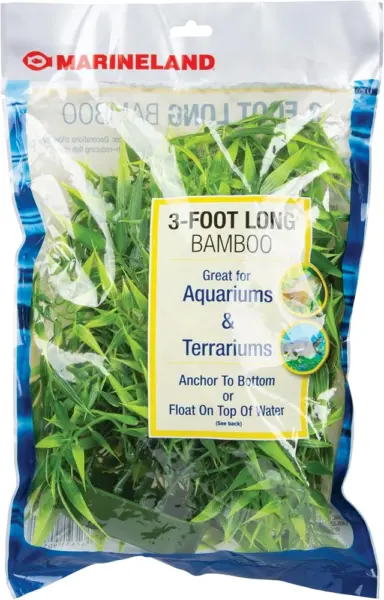
Most tanks are decorated along the bottom and bare through the top half, which is the space this plant was built for. One three-foot stem dropped into a tall tank gives the water column something to move through: the fronds sway with the filter current, fish weave between them, and the tank stops looking like a glass box with gravel in it.
It’s a single plastic plant, packed as one piece, and it’s happiest in a tank that’s tall as well as long — a 55 or a 75 is where those three feet earn their keep. In a shallow tank the stem has to bend over at the waterline, which rather gives the game away.
For vertical space, nothing else here comes close. The fronds are dense enough that guppies, fry and even cichlids use them to get out of sight, and the plant ends up being the thing the rest of the tank is arranged around. We wondered whether one stem could really fill that much water; in a 55 it does.
The base is hollow, and out of the bag the plant will lie on its side until you pack that base with gravel and stand it in the corner. That’s the whole setup, but skip it and you’ll be fishing a three-foot stem out of the filter intake.
Pros
- Three feet of cover for a tall tank’s top half
- Fronds fry and guppies hide in
- Sways with the filter current
- Wipes clean with a soft brush
Cons
- Looks plastic within arm’s length
We reach for this one when the top half of a tall tank is bare: three feet of swaying cover that nothing else here matches.
MyLifeUNIT 10-Pack Seaweed – Best Background for Big Tanks
Key Features
- Base: 1.4 in ceramic
- Height: 12 in
- Pieces: 10 plants
- Water depth: Above 14 in
- Price: Budget
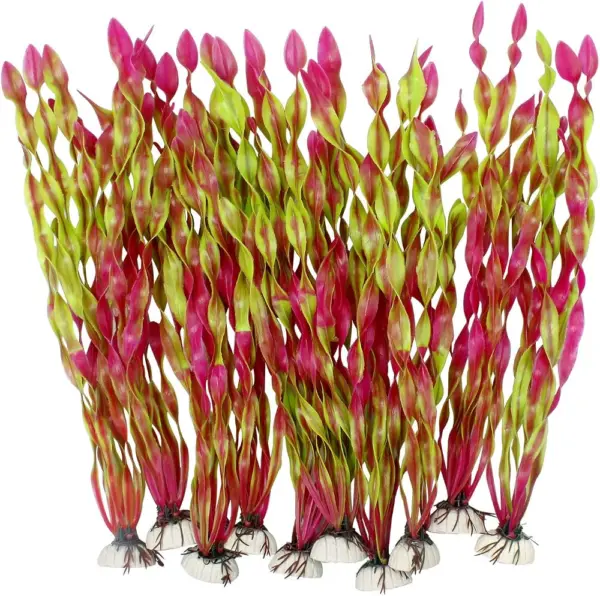
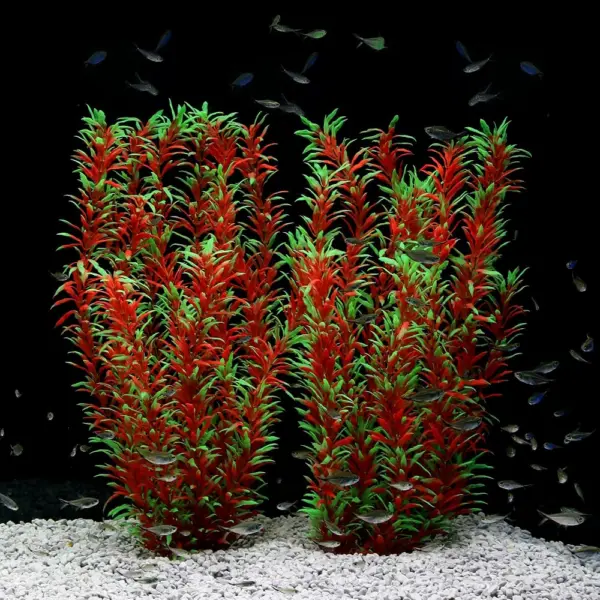
Ten stems of 12-inch seaweed is a lot of plant, and the instructions are honest about where it goes: keep the water line above 14 inches and bury the bases in gravel. That puts it in 29-gallon-and-up territory, where it walls off the back glass in a single pass. In a 10-gallon the stems stand with their heads out of the water.
As a background plant, we think it’s the best value in this group. Ten bases spread across the back of a 40 or a 55 give the tank real depth, and the fronds are soft enough that fish swim through them rather than around them. The wine red is a welcome change from the wall of green most of these sets deliver.
Placement is the whole job here. Bury the base, keep the plant out of the bubble stream from an air stone and away from the filter outflow, and it stands up straight; leave it loose and you’ll be fishing stems out of the filter. A bare-bottom tank is the one setup this doesn’t suit, since those bases are meant to disappear into substrate.
Pros
- Ten 12-inch stems fill a big tank’s back wall
- Soft fronds fish swim through and hide in
- Wine red breaks up all that green
- Ceramic bases sink and stay buried
Cons
- Fronds can work loose from their bases over time
We think this is the best way to wall off the back glass of a 29-gallon or bigger, provided the bases go into gravel.
CNZ 13-Inch Leafy Plant – Most Realistic Single Plant
Key Features
- Pieces: 1 plant
- Material: Plastic with ceramic base
- Base size: 8.7 x 5.4 cm (3.4 x 2.1 in)
- Plant size: 35 x 26.5 cm (13.8 x 10 in)
- Price: Midrange
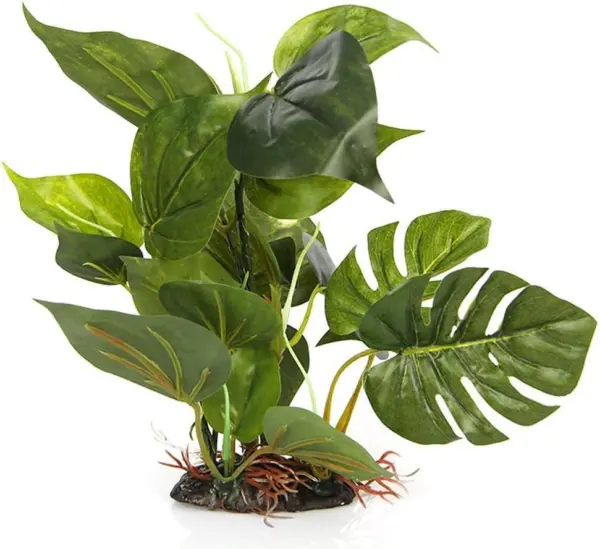
Out of the bag, this plant looks like a green plastic lump with the leaves flattened together. Give it two days in the tank, with the light on it and the water spreading the leaves, and it stops reading as plastic — that turnaround is the most convincing thing about it.
The leaves are broad and soft with a bend in them rather than a cut edge, and there’s a root-like base under the foliage doing a lot of the realism work. In a betta tank it earns its keep twice: the fish can rest on the leaves instead of wedging behind the filter, and fry disappear into the density near the bottom.
Sizing runs to about 13.8 inches across and 10 inches tall on a ceramic base of roughly 3.4 by 2.1 inches, so it sits as a midground bush rather than a background stem. In a 20-gallon long it fills a corner; in a 55 it’s one element among several.
If you want one fake plant that reads as live, this is our pick in this group — the realism here is the strongest of any single plant we cover, and the soft leaves make it the obvious choice for a betta with long fins. It’s a plant to build around rather than a whole scape in a bag.
Pros
- Reads as a live plant once submerged
- Soft broad leaves bettas rest on
- Dense cover for fry near the base
- Flat ceramic base stays put
Cons
- Leaves can snap off the stems
If you want a single plant that reads as live, we point you here; the soft broad leaves suit a betta tank especially well.
JIHAQUA 21-Inch Plant Pair – Best for Hiding Equipment
Key Features
- Base: Quartz ceramic
- Height: 21 in
- Pieces: 2 plants
- Material: PE plastic
- Price: Midrange
The two ugliest things in a big tank are the heater and the filter intake, and two 21-inch bushes cover both. These are full, wide plants — the kind that curtain a corner rather than sit in it — and they do most of their work in the upper half of the water.
They arrive folded and open out in the tank, and the quartz ceramic bases are heavy enough to stand on their own, even on bare glass. The plastic is a soft PE rather than the hard, glassy kind, so the foliage bends when a fish pushes through instead of cracking.
For a bare 55 or 75, this is the quickest way we’ve found here to make a tank look stocked. The foliage is dense enough that fish claim it as territory, one set at each end frames the whole tank, and you don’t have to bury the bases to get them upright — which makes them the easiest tall plant here to shift around when you rescape.
Pros
- Two 21-inch plants fill the ends of a big tank
- Dense enough to curtain a heater or filter
- Heavy bases stand without burying
- Soft PE leaves bend rather than crack
Cons
- Stems can separate over time
Our pick when a big tank looks bare: two dense 21-inch bushes that hide the hardware and fill the corners.
UreverFins Silk Cave – Best for Betta Tanks
Key Features
- Pieces: 1 cave
- Material: Silk leaves, resin cave
- Footprint: 6 x 4 x 3 in
- Tank range: 2.5 to 30 gal
- Price: Budget
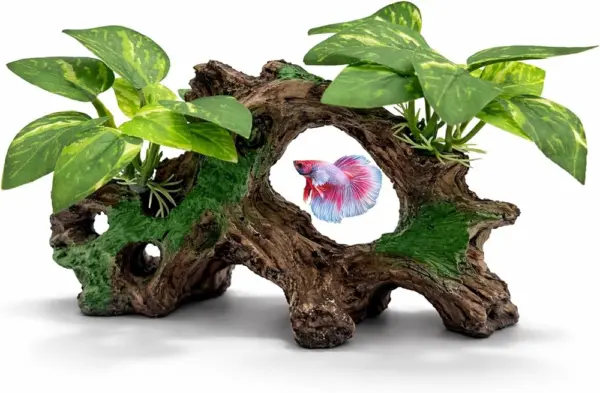
A betta in a bare five-gallon has nowhere to sit, and that’s the gap this fills: a driftwood-look cave about six inches across with soft leaves growing out of the top, weighted so it stays where you put it. In a nano or hospital tank, this is the piece we reach for first, because it gives one fish a territory instead of just standing there being decorative.
There’s no assembly. It goes in as one piece, sits on the bottom, and lifts out at water-change time without disturbing anything else. The leaves are the soft, rounded kind, which is the point for a fish with long fins, and the cave underneath gives it somewhere to get out of the current. The maker lists it for tanks from 2.5 to 30 gallons, and that’s about right.
In a 29-gallon it will disappear, which is worth knowing before you order: this is a piece for a five or a ten, where one betta can claim the entire cave. In a bigger tank, treat it as one detail among many rather than the hiding place.
Pros
- A soft-leaved cave one betta can claim
- Weighted base stays on the bottom
- No assembly, lifts out for cleaning
- Fits nano and hospital tanks
Cons
- Leaves feel more like plastic than silk
- Plants can come unglued from the cave
For a single betta in a small tank, this is the first thing we recommend adding.
Ameliade 26-Piece Plant Set – Planning a Scape
Key Features
- Pieces: 26 plants
- Material: Plastic
- Breakdown: 12 short, 9 medium, 5 tall
- Height range: 2 to 12 in
- Price: Budget
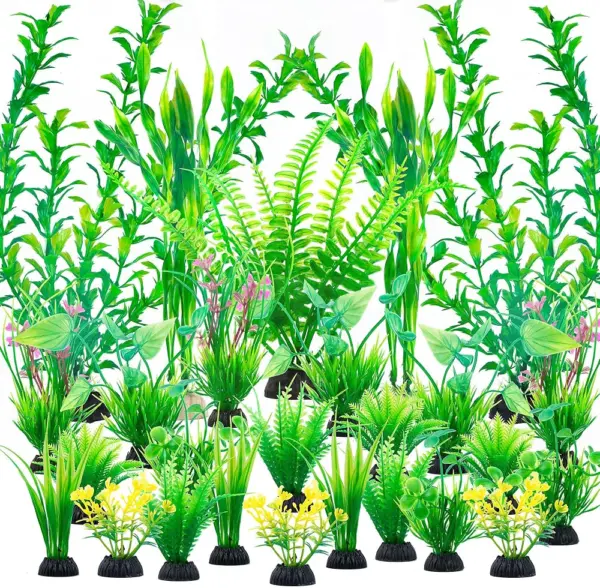
Twelve short, nine medium and five tall, spanning two to twelve inches — the box tells you exactly what’s inside, which is rarer in this category than it should be. That spread is what makes the set easy to plan with: tall pieces at the back, medium through the middle, short ones up front, and no orphan stems stranded at mid-water because there was nowhere else to put them.
We rate it a close second to our top pick. The greens vary from piece to piece instead of repeating one shade, which reads better than a bag of identical stems, and the weighted bases hold with only a thin layer of gravel under them. It’s the set we point at when someone wants to know exactly what’s arriving before they order.
Pros
- 26 plants across a listed 2 to 12 inch spread
- Weighted bases hold in thin gravel
- Varied greens rather than one flat shade
- Enough pieces to scape a tank and keep spares
Cons
- Skews short, so a deep tank still needs a tall plant
A close second to our top pick, and the easier set to plan with because the height spread is printed on the box.
MyLifeUNIT 7-Pack Assorted – Best for Quarantine Tanks
Key Features
- Leaves: Removable
- Pieces: 7 plants
- Material: PVC with ceramic base
- Height range: 3.9 to 12.6 in
- Price: Midrange
The leaves on these seven plants pull off their ceramic bases. That sounds like a small thing until you’re standing at the sink trying to scrub algae out of a stem, and then it’s the reason the plants get cleaned instead of avoided.
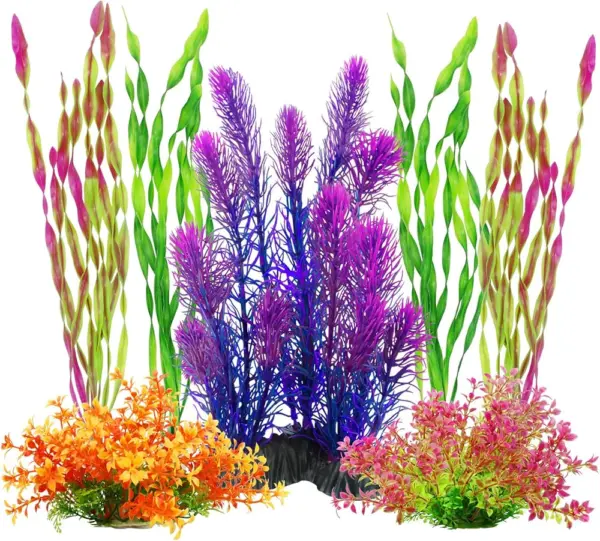
This is the loud set: orange, pink, purple, blue and green in the same box. Under a blue LED the effect is genuinely fun, and in a natural riverbed scape it looks like a bag of candy fell in the tank. The color is the whole point, so buy it on purpose.
Heights run from 3.9 to 12.6 inches across the seven, tall pieces for the back corners and short ones for the foreground, and the leaves are soft enough that a betta pushes through them rather than around.
Where the set earns its place is a quarantine, hospital or fry tank, where bright color and easy cleaning matter more than a natural look and a plant that comes apart for scrubbing is exactly what you want. We keep coming back to it for that job.
Pros
- Leaves detach for a proper scrub
- Seven plants in five bright colors
- Soft foliage bettas can push through
- Heights from 3.9 to 12.6 inches for layering
Cons
- Bases need a gravel layer to sit firmly
Our pick for a quarantine or hospital tank, where bright color and leaves that come apart for cleaning beat realism.
How We Tested Fake Aquarium Plants (and What We Kept Checking)
We started with roughly 60 plants from big retailers and aquarium specialists, comparing listed heights, materials, and — most usefully — how the base was built. Silk, polyester, and molded plastic all behave differently in water, and the base turned out to be the deciding spec: weighted resin, a ceramic disc, a suction cup, or nothing at all. We narrowed to 16 and bought them ourselves.
For four months those 16 lived in working tanks — a 55-gallon community setup, a 20-gallon, and a bare 10-gallon we kept for close inspection — through weekly water changes, gravel vacuuming, and the occasional algae scrub. Every time we lifted a plant out to vacuum, we re-planted it, which is where durability shows up: silk leaves fray at the glue line, molded seams catch the light, and painted stems start flaking. We also ran a thumb along every leaf edge to check for the stiff, sharp plastic you don’t want next to fish.
We photographed each plant on a white card under the same lamp in week one and again at the end, then compared them side by side — a green that shifts toward yellow is invisible until you see the two images together. Stability got the crude test: fill the tank, nudge the plant with a net the way a curious fish would, and watch whether it stays upright in the filter current. Finally we counted cost per plant against how many it takes to fill a tank, because a single stem in a 55-gallon looks far lonelier than the listing photo suggests.
How to Choose Fake Aquarium Plants
Start with height and anchoring rather than looks: a plant that floats or breaks the waterline is one you’ll pull straight back out, however good it looked in the photo.
Match plant height to your water depth
The number that matters is the distance from the top of your substrate to the waterline, not the tank’s volume. A standard 10-gallon is about 12 inches tall, and after an inch or two of gravel you have roughly 10 inches of water — which is why a 12-inch stem that looks modest in a product photo ends up standing with its head out of the tank.
Anything that asks for 14 inches of water, like the MyLifeUNIT seaweed, is a 29-gallon-and-up plant, and a three-foot bamboo wants a tall 55 or 75. Measure first, then shop by height. Sets that state their spread, like the 2-to-12-inch Ameliade box, are the easiest to plan with because you can see whether the tall pieces will reach.
Look at what holds it down
Fake plants fail in the same boring way: they float. A ceramic disc base sits on gravel and stays there, which is what you want in a bare-bottom or sand tank where there’s nothing to bury into. A hollow base you pack with gravel, like the one on the tall bamboo, works just as well once it’s loaded — but it will lie on its side until you do it.
Lighter bases need an inch of gravel to grip. Decide based on your substrate: gravel forgives a light base, sand and bare glass don’t.
Soft leaves matter more with bettas
Cut plastic leaves have edges; soft PVC and silk have curves. If you keep bettas, gouramis or any long-finned fish, that difference is the whole purchase, because a fin catches on a hard edge and tears.
Feel the plant before it goes into the water. If a leaf edge drags across your skin, it will drag across a fin. Broad, soft leaves are better furniture too — a betta will rest on one instead of wedging itself behind the filter.
Plan coverage, then pick your color
Fake plants don’t grow in, so buy the coverage you want on day one: tall stems along the back glass, short pieces in front and in the corners, and something dense where the heater and filter sit. A set with a range of heights does that in one purchase; a bag of one size does not.
On color, two tones of green read as a plant at arm’s length, while neon pink and blue read as decoration. That’s fine if it’s the tank you’re building and wrong if you wanted a riverbed — decide which before you order, because the color is the one thing you can’t fix later.
Frequently Asked Questions
Do I need to rinse fake plants before they go in the tank?
Yes — rinse every piece under warm running water and check for loose bits of plastic or glue. Skip soap, which leaves a residue that ends up in the water.
Warm water does a second job: a plant that arrived squashed flat in its bag straightens out when you hold it in water between 104 and 140 F for a minute, then let it cool in the shape you want.
How do you clean algae off plastic aquarium plants?
Take them out at a water change and let them dry overnight; dried algae brushes off far more easily than wet. A soft-bristled brush gets between the stems without scratching the plastic.
On sets with removable leaves, pull the leaves off their bases first so both parts can be scrubbed properly and the grit doesn’t stay trapped where the leaf meets the ceramic.
Can these go in saltwater or a terrarium?
Several are sold for both fresh and salt water, and the tall bamboo is listed for terrariums as well. What decides the rest is the base: a ceramic disc sits flat on soil or sand, while a light base meant to be buried in gravel will tip over in a dry setup.
Match the base to whatever you’re standing it on, not the plant to the tank.
Final Verdict
Plant a bare tank with the CousDUoBe thirty-piece set and you get coverage, soft leaves and spares for the next tank, provided there’s gravel to press the bases into. If your tank is tall, the three-foot bamboo does something none of the other picks here can. If there’s a betta alone in a small tank, buy the silk cave first.
Whatever you choose, measure from the substrate to the waterline before you order. That one number decides which plants will look planted and which will look like they’re drowning.