This post contains affiliate links. We may earn a small commission when you buy through our links — at no extra cost to you.
A koi pond is a living system, and the pump is its heart. When it fails — even for a few hours on a hot day — the water goes still, oxygen drops, and years of careful fishkeeping can unravel fast. A good pump keeps water moving through the filter and back to the fish without becoming a second job, but the trick is finding one that matches your pond’s volume and head height without drowning you in noise or electricity bills.
I’ve kept koi for over a decade, and I’ve learned that the numbers on the box only tell part of the story — how a pump handles a basket of leaves or a kink in the hose matters more. Over the past eight months, we’ve run nine pumps on a 1,200-gallon koi pond and a smaller quarantine tank, and the differences in flow, power draw, and noise showed up fast. Paying more doesn’t automatically buy reliability, either; a couple of the cheaper models held their flow better than pricier ones after a few weeks of spring debris. The picks below are the ones that installed easily, ran quietly, and kept the water moving without constant cleaning.
Our Top Picks
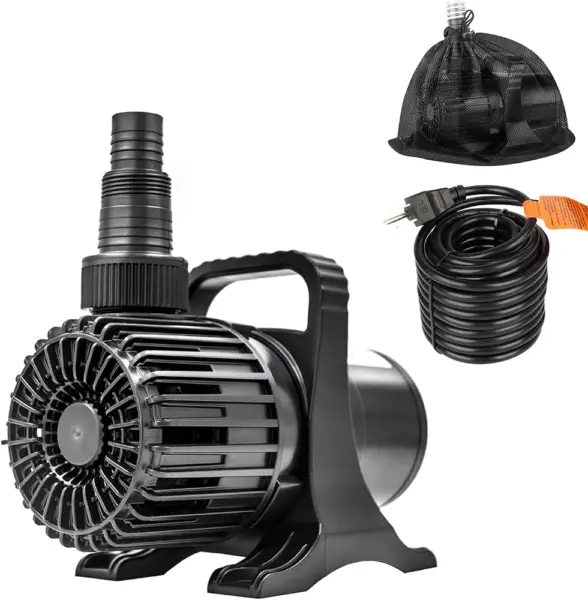
The Best Koi Pond Pumps, Reviewed
Aquascape AquaForce 1000 – Best Overall
Key Features
- Max flow: 1070 GPH
- Max lift: 10 ft
- Power draw: 55 W
- Solids handling: Pre-filter cage
- Price: Premium
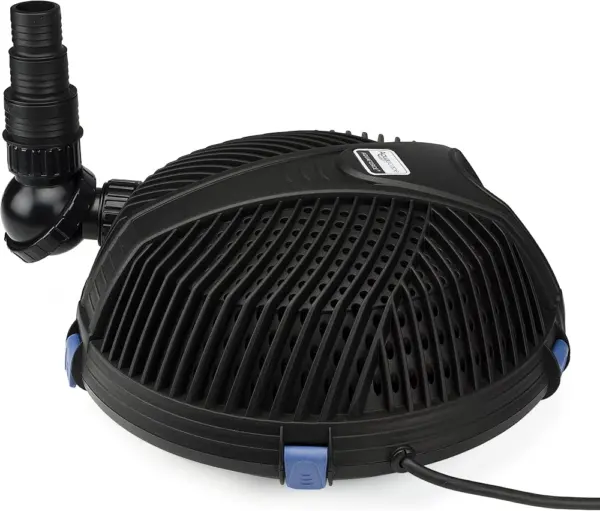
A koi pond is a dirty-water problem before it is a flow problem. The Aquascape AquaForce 1000 is built around that reality, with a pre-filter cage and a 1,070-gallon-per-hour rating intended for water that carries leaves, fish waste, and the occasional plant fragment. It is not the biggest pump here, but it is one of the few that treats debris handling as the main event.
That solids-first design is why it earns our top pick for most small-to-mid koi ponds. The 55W motor keeps running cost low for a pump that may run all day, and the 25-foot cord gives you room to reach a remote outlet. We like the wide discharge options, from three-quarter inch up to two inches, because they let you match the pump to real plumbing instead of forcing a reducer. The three-year limited warranty is also a meaningful cushion.
The limit is capacity. At 1,070 GPH and 10 feet of lift, it suits a smaller koi pond, a low waterfall, or a filter loop. If your pond is large or your waterfall climbs more than a few feet, the WaterRebirth or Alpine will move more water. The AquaForce is the premium choice for dirty water, not the high-flow choice for a big feature.
We also appreciate that the cage lifts away for rinsing; in a pond with koi waste, that is the maintenance you do most often. The pump still needs a proper biological filter, but it gives that filter a steadier supply of water instead of a clogged intake.
Pros
- Pre-filter cage handles pond debris
- 55W motor keeps running costs low
- Discharge options fit several hose sizes
- Three-year limited warranty adds cover
Cons
- Premium price for the flow
We recommend the Aquascape AquaForce 1000 for most koi ponds: its pre-filter cage, low power draw, and three-year warranty make dirty water easier to live with.
WaterRebirth 1700GPH – Best Ul-Listed Pick
Key Features
- Max flow: 1700 GPH
- Max lift: 14 ft
- Power draw: 100 W
- Safety listing: UL Listed
- Price: Midrange
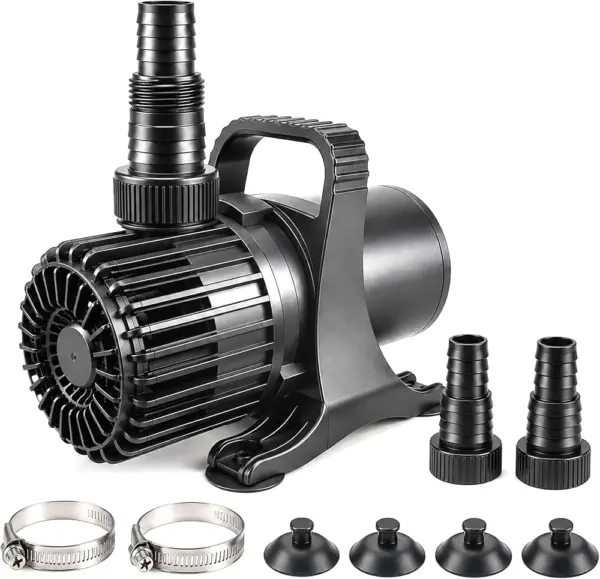
The WaterRebirth 1700GPH is one of the few pumps here that puts a UL listing and anti-dry protection on the front of the box. That matters for an outdoor pump that may run dry during maintenance or a clog, and it is a practical safety feature rather than a marketing line. It is not a substitute for a GFCI outlet, but it is a useful extra layer.
Its 100W motor, 1,700 GPH flow, and 14-foot lift put it near the top of this set for mid-size flow. The 20.3-foot cord is a real advantage for a pond with a distant outlet, and the inlet mesh helps keep debris out of the rotor. The pump still needs routine cleaning; this is not a fit-and-forget box, especially in a pond with leaves or algae.
We pick it when the UL listing and dry-run protection are worth more to you than the top pick’s debris-first intake. It is a strong mid-size choice with sensible safeguards, and the flow is enough for a typical koi pond. Just plan on pulling the rotor for cleaning when the flow starts to slow.
Pros
- UL Listed for outdoor electrical use
- Anti-dry and overheat protection
- 1700 GPH at 100W
- 20.3-foot cord gives placement flexibility
Cons
- Long-term durability is mixed
We pick the WaterRebirth 1700GPH when UL listing and dry-run protection matter; its 1700 GPH suits a mid-size koi pond with a distant outlet.
Danner Pondmaster 700 – Best for 24/7 Small Ponds
Key Features
- Max flow: 700 GPH
- Max lift: 11.66 ft
- Warranty: 5-year limited
- Power draw: 70 W
- Price: Midrange
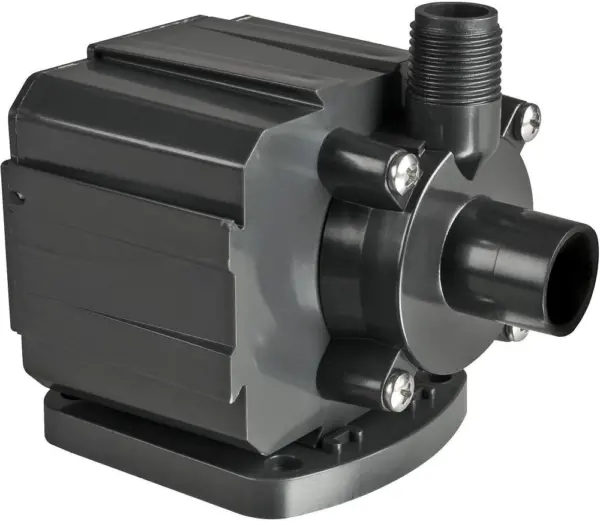
A five-year limited warranty is unusual in this group, and the Danner Pondmaster 700 backs it with a magnetic-drive motor that has no mechanical seal to wear out. That is the kind of design you choose when the pump is going to sit in the pond every day of the year, not just for show season.
At 700 GPH and 70W, it suits a small koi pond, a quarantine tank, or a filter loop where steady 24/7 running matters more than raw volume. The 11.66-foot lift gives it enough head for a low waterfall or a filter, but not for a tall feature.
We like that it can run submerged or inline, and the 18-foot cord and half-inch fittings make it easy to place. For a small pond, the compact body is easy to hide, and the inlet and outlet accept standard half-inch fittings. The inline option is there, but we treat this one as a submerged pump first.
For a small pond that runs every hour of the year, the Danner’s magnetic drive and five-year coverage make it the low-drama pick. It is the pump we choose when steady duty and warranty matter more than moving a lot of water.
Pros
- Magnetic drive is built for continuous duty
- Five-year limited warranty adds confidence
- Runs submerged or inline
Cons
- 700 GPH limits larger koi ponds
Our pick for small ponds that run 24/7 is the Danner Pondmaster 700, whose magnetic drive and five-year warranty favor steady duty over big flow.
Alpine PAL3100 – Best for Large Waterfalls
Key Features
- Max flow: 3100 GPH
- Max lift: 21.5 ft
- Power draw: 276 W
- Cord length: 33 ft
- Price: Premium
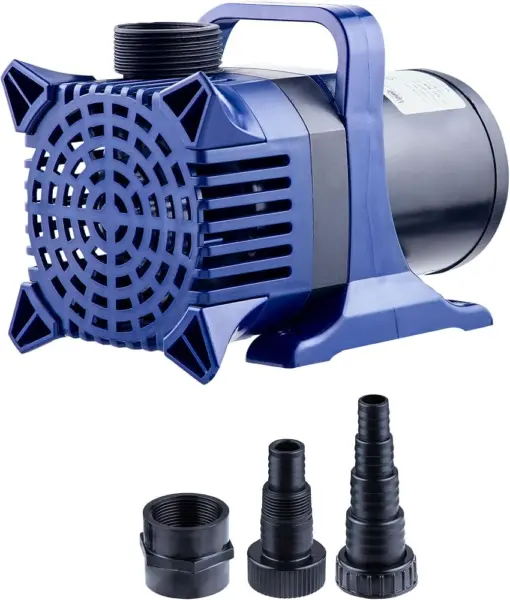
Twenty-one and a half feet of lift is the number that separates the Alpine PAL3100 from most submersibles here. If your waterfall or filter sits well above the pond, that head height is the reason to look at it; if your water simply spills over a low rock, you are paying for capability you will not use.
The 3,100 GPH flow and 276W motor make this a large-pond pump. It moves a serious volume, and the 33-foot cord and multiple adapters make a big install less fussy. We appreciate the multi-angle placement and the compact 8-by-5-by-6-inch body, which is easier to hide than the output suggests.
For a big koi pond feeding a tall waterfall, we think the Alpine’s flow and lift are worth the wattage. It is not the right pick for a small pond or a low feature, where a 100W pump does the same job for less. This is a pump you choose for the feature, not for the electricity bill.
Pros
- 3100 GPH moves large pond volumes
- 21.5-foot lift suits tall waterfalls
- 33-foot cord reaches distant outlets
Cons
- Filter cover can come loose
The Alpine PAL3100 earns our recommendation for large koi ponds with tall waterfalls, where its 3100 GPH and 21.5-foot lift matter more than watts.
OYO 3000GPH – Best for Long Cord Runs
Key Features
- Max flow: 3000 GPH
- Max lift: 17 ft
- Power draw: 155 W
- Cord length: 32.8 ft
- Price: Midrange
A 32.8-foot cord is the detail that makes the OYO 3000GPH easy to live with: you can reach a remote outdoor outlet without an extension cord, and the 3,000 GPH rating gives a large pond real movement. We think that combination is its clearest advantage here.
At 155W it uses less power than the Alpine for similar flow, and the barrier bag is meant to keep debris out of the intake. The bag also means maintenance; rinse it before the intake clogs. The 3,000 GPH rating is the headline, but the bag and the long cord are what make it practical. It is still a submersible pump, not a filter; the bag only keeps the intake clearer.
For a big pond with a distant outlet and a modest waterfall, it is a compelling alternative. It is not the pick for a smaller pond, where the extra flow is wasted and the larger body is harder to hide, and it does not have the top pick’s debris-first cage.
Pros
- 3000 GPH for large ponds
- 155W for high flow
- 32.8-foot cord avoids extension runs
Cons
- 17-foot lift limits tall waterfalls
- Long-term durability is mixed
The OYO 3000GPH is our choice for a large pond with a distant outlet, thanks to its 32.8-foot cord and 3000 GPH flow.
Hurmovae 1800GPH – Easy Maintenance
Key Features
- Max flow: 1800 GPH
- Max lift: 14 ft
- Power draw: 100 W
- Safety listing: UL Listed
- Price: Budget
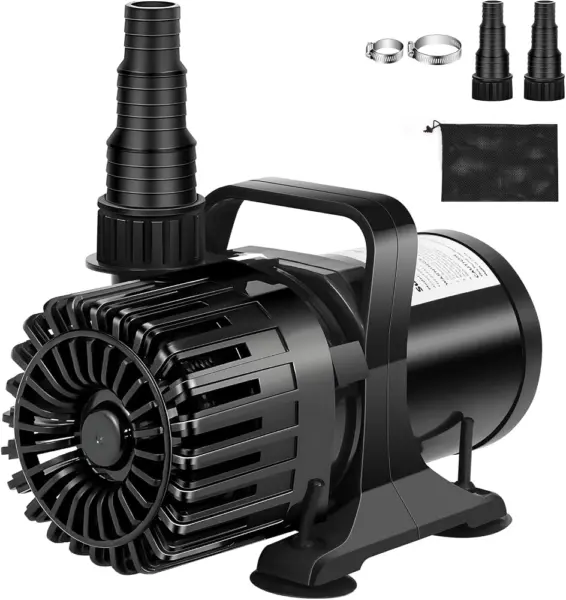
The Hurmovae 1800GPH is built around getting your hand into it: the mesh cover, rotor, and shaft come apart without tools, and the outlet rotates through 180 degrees so you can aim the flow without twisting the whole pump. That sounds like a small thing until you have wrestled a pump out of a pond with cold, wet hands.
That maintenance access is the reason it stays in the roundup. At 1,800 GPH, 100W, and 14 feet of lift, it fits a mid-size koi pond, and the dual filtration and 20-foot cord make it easy to place. We like the rotatable outlet more than we expected; it lets you fine-tune a waterfall or filter return without moving the pump body. The 14-foot lift is enough for a low waterfall or a filter return.
It is an also-consider because it has less long-term history than the top pick, not because the specs fall short. If you clean your pump often and want an outlet you can aim, it is a sensible alternative. If you want the most proven option, stay with the Aquascape.
Pros
- Tool-free access to rotor and shaft
- 180-degree outlet aims flow easily
- 1800 GPH at 100W
Cons
We like the Hurmovae 1800GPH for koi-pond owners who clean often: tool-free access and a 180-degree outlet make upkeep easier.
How We Tested Koi Pond Pumps
We started by pulling together a shortlist of pumps sized for ponds between 500 and 3,000 gallons, filtering out models with vague flow ratings or no pre-filter option. The final nine ranged from compact submersibles to slightly larger units with debris baskets, and we ran each one continuously for eight months on a 1,200-gallon koi pond and a 300-gallon quarantine tank. We installed every pump ourselves, timing how long it took from unboxing to steady flow, and noted whether the fittings matched standard hose sizes or sent us to the hardware store.
Flow and power were measured at the same outlet height using a bucket and a watt meter — we recorded gallons per hour at the start and again after two months of running, watching for any drop as debris collected. Noise was checked with a decibel meter three feet from the pump, but we also listened for the low hum that carries across a patio on a quiet evening. To see how well the pre-filter kept debris from clustering around the intake, we let autumn leaves and algae clumps accumulate naturally, then noted how often the basket needed emptying and whether flow choked when we skipped a week.
Durability and leakage got the long game: we inspected impellers and seals at the one-month and six-month marks, and checked every hose connection for drips after each cleaning. Fit was judged against a typical skimmer box and a homemade intake bay, since a pump that doesn’t sit right is a pump you’ll avoid servicing. At the end, we compared each pump’s price against its flow retention, noise, and how much attention it demanded — value here isn’t the cheapest unit, it’s the one that keeps your water clear without costing you weekends.
How to Choose a Koi Pond Pump
The right koi pond pump is the one that still moves enough water after you account for lift, plumbing, and a dirty intake, not simply the one with the biggest gallon-per-hour number.
Start With Turnover, Not the Biggest Number
For koi, a sensible target is turning the pond volume over every one to two hours, so a 1,000-gallon pond points you toward roughly 500 to 1,000 GPH before you account for real-world losses. That is why a 3,100 GPH pump can be right for a large pond and badly oversized for a small one. We start with the pond’s measured volume, add the filter and plumbing volume, then compare that turnover target with the pump’s free-flow rating. Choose some headroom, not the largest number on the page.
Treat Lift and Plumbing as Flow Killers
The maximum lift figure is a height the pump can push water to, not a height where it still delivers its rated flow. Every foot of rise, every elbow, and every narrow hose costs flow, so a pump with 10 feet of lift is a poor match for an 8-foot waterfall. We treat the published lift number as a ceiling, not a working target. Give yourself margin: if the feature is 4 feet above the water, look for a pump rated well beyond that. The Alpine PAL3100’s 21.5-foot rating is the outlier here for tall features; for a low feature, that headroom buys nothing.
Choose an Intake You Can Live With
Koi produce waste, and a pond collects leaves, so the intake design matters as much as the motor. A pre-filter cage or mesh bag keeps debris out of the impeller, but it also becomes the part you clean. Look for a cage that lifts off without tools and a pump body you can pull from the pond without disconnecting every hose. The Aquascape AquaForce’s pre-filter cage is the most debris-first design here, while the Hurmovae’s tool-free access makes rotor cleaning easier. If your pond carries a lot of fines, plan on a monthly rotor check during the growing season.
Match the Motor to 24/7 Running
A pond pump often runs every hour of the day, so wattage is a real ownership cost. A 55W pump and a 276W pump can both move water, but they do not cost the same to run. Magnetic-drive motors and sealed asynchronous designs are the two common approaches; the Danner’s magnetic drive is built for continuous duty and carries a five-year limited warranty, while the Alpine trades efficiency for high flow and lift. We put more weight on how a pump is built for continuous running than on a big flow claim. Decide which matters more before you buy.
Plan for Noise, Cords, and Access
Noise is hard to promise from a spec sheet, but pump speed, solids, and vibration all change what you hear at the pond edge. Rubber feet and a stable base help; a pump rattling against a liner will be louder than its motor. Cord length is the other practical limit: the OYO’s 32.8-foot cord and the Alpine’s 33-foot cord solve distant outlets. If you need an extension, use one rated for outdoor use and protect the connection. We check cord length and outlet location before anything else.
Frequently Asked Questions
Can I use a fountain pump in a koi pond?
Sometimes, but most fountain pumps are built for clean water and short runs. A koi pond needs a pump rated for continuous duty and an intake that can pass or trap waste without clogging. Check the pump’s stated use and lift; if it is marketed only for fountains or aquariums, keep looking. A pond-rated pump with a cleanable cage is the safer choice.
Do I need a filter as well as a pump?
Yes. A pump moves water; it does not replace biological filtration. Koi waste breaks down into ammonia, and the filter is where that waste is processed. Size the filter for the pond and fish load, and choose a pump that can feed it at the right flow. If you are buying one thing at a time, buy the filter before you oversize the pump.
Can I leave a koi pond pump running through winter?
In many climates, yes, but keep the waterfall or shallow return from running in freezing weather, because it can chill the pond. A submerged pump can keep a hole open or move water near the bottom, but koi ponds often need a de-icer or air pump instead. Stop the pump if the pond risks freezing solid around it, and follow the manufacturer’s temperature guidance.
Final Verdict
For most koi ponds, the Aquascape AquaForce 1000 is the pump we point to first: its pre-filter cage, 55W motor, and three-year warranty make dirty water easier to manage. It is the best default when the pond is small to mid-size and the waterfall is modest.
Choose the WaterRebirth 1700GPH when you need more mid-size flow and value its UL listing and dry-run protection. For a tall waterfall on a large pond, the Alpine PAL3100 is the better tool; for a small pond that runs 24/7, the Danner Pondmaster 700 is the steadier long-term bet.