This post contains affiliate links. We may earn a small commission when you buy through our links — at no extra cost to you.
The fear with stem plants is that you’re paying for a bag of wet leaves. A bunch arrives yellow, half-melted, shedding leaves in the bag, and carrying a few nearly invisible snails that will own the whole tank by the weekend. Yet stem plants are some of the fastest, most forgiving things you can put in an aquarium: they fill the back glass in weeks, outcompete algae for nutrients, and give shy fish somewhere to disappear. What separates a lush thicket from a slow decline is mostly what the supplier ships you and how the stems are handled in that first week.
Over four months, we grew out 14 varieties, from cheap bunches of unrooted cuttings to potted plants, and the quality gap between them was wider than I expected. Size is the sneaky one — 6-inch and 12-inch cuttings look identical in a thumbnail and very different against a 20-gallon back panel. Count stems, not bunches: value comes down to how many usable pieces actually arrive. The picks below are the ones that colored up, rooted in, and stayed clean.
Top Picks
Best for Beginner Background Plant
Anacharis Elodea Densa, 3 Bundles
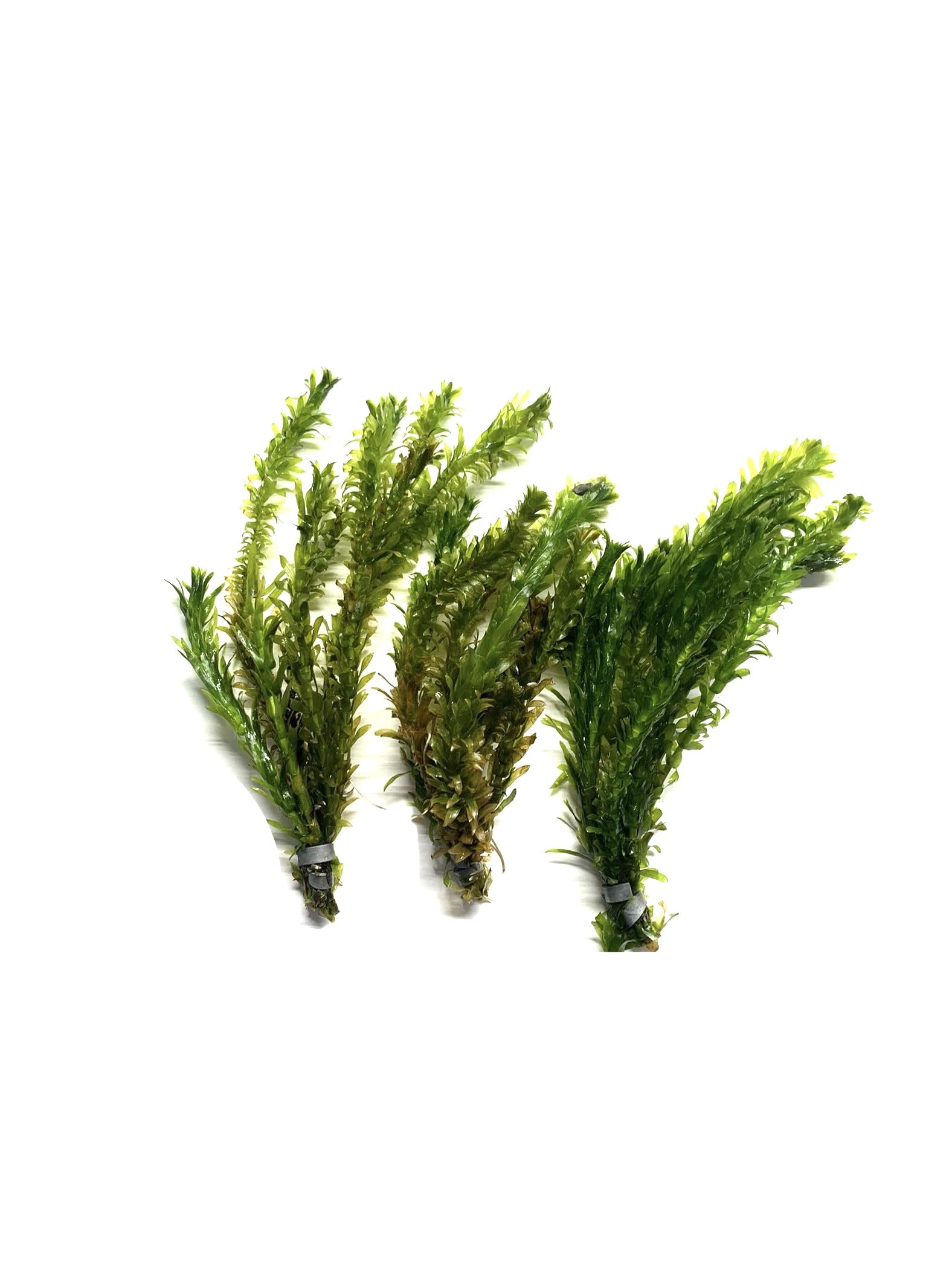
Rating: 4.0 ★ | Price: Midrange | Light: Aquarium light | Typical height: 6-10 inches | Stems per order: 3 bundles, 4-8 stems each | Live-arrival cover: Above 32F
Three bundles, each holding four to eight stems of six to ten inches, is the number that earns this the top spot. Spread along the back of a modest tank, that is more plant than most first orders deliver, and it arrives as loose stems rather than one rooted clump, so you decide where each piece goes. We picked it as the default because it stacks the three things a new planting needs: volume, speed, and a plant that does not care whether you have buried it.
That last part is the detail worth knowing. Anacharis feeds through its leaves and stems as well as its roots, so a new bundle can float near the surface while it recovers from shipping and starts pushing growth, and you can plant it whenever you get around to it. We like starting new stems floating, where it is easy to watch them and just as easy to pull out anything that turns soft. Roots form anyway, and a rooted stem pushed into gravel stays put.
Arrival is where this plant can disappoint. Bunches sometimes come in with browned or mushy sections, and the live-arrival cover has a condition attached: orders placed when the temperature is expected to dip below freezing at the lowest point of the day are not guaranteed. Watch the forecast, open the box the day it lands, and strip anything soft before it fouls the water. Then be ready to trim, because a plant this fast reaches the surface and shades what is behind it, and every cutting you take is another stem for the back corner.
Pros
- Three bundles give real volume from one order
- Grows with or without substrate
- Cheap for the amount of plant you get
- Fast grower that can be trimmed and replanted
Cons
- Bunches can arrive browned or melting
Our default pick: three bundles of fast-growing stems fill the back of a tank for about the price of one potted plant, and they grow even when you never bury them.
Best for Easy Potted Planting
Moneywort (Bacopa Monnieri) Potted

Rating: 4.3 ★ | Price: Premium | Care: Plant in substrate; prune frequently | Form: Potted plant | Light: Partial sun
The pot is the whole argument. Moneywort arrives already growing in substrate, so there is no bunch to untangle, no weight to pull off and no bare stems to bury — you make a hole in the gravel, drop the plant in, and it stays there. For a first stem plant, that removes the step where most people lose patience with the hobby.
It also has the best record in this group for arriving healthy: green, rooted, and quick to put on height. Fast enough that the listing tells you to prune often, and you should, because an untrimmed Moneywort runs along the surface and shades everything under it. Push the tops you cut back into the substrate and they root on their own.
Not every pot travels well. Some arrive limp, with yellowed lower leaves and stems that need a week or two to pick up; the roots are usually intact, so trim the worst of it and give it light and time rather than replacing it. It is also the priciest plant here, and what you are paying for is the pot rather than a lot of stems. If the goal is covering ground, the bunched options stretch further for the same money.
Pros
- Arrives potted and rooted, ready to plant
- Grows tall quickly in a settled tank
- Strong green color on arrival
Cons
- Needs frequent pruning to stay in bounds
This is the one we hand to anyone who has never planted a stem: it arrives in a pot, sinks into the substrate as-is, and starts growing almost immediately.
Best for Pink-Red Midground Accent
Alternanthera Rosanervig
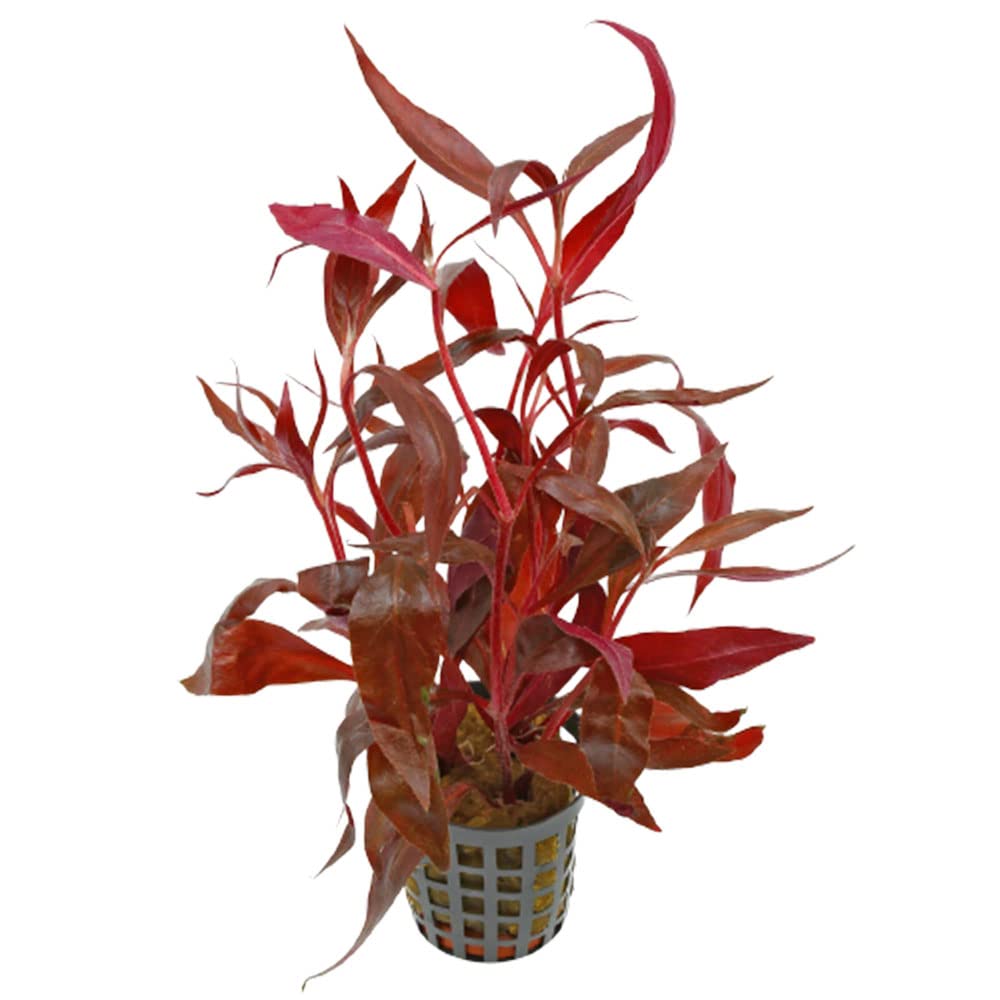
Rating: 4.3 ★ | Price: Midrange | Color: Pink-veined red | Light: Medium to high | Grown in: Texas greenhouse | Placement: Midground
Every other plant in this guide is some shade of green. The Rosanervig is the one that puts pink veins and a wash of red in the middle of the tank, and it earns its place on that alone — but the color is conditional, and the condition is light. Under medium to high light the leaves deepen; under a stock hood strip they come out mostly green with a hint of pink and stay that way.
The habit is the other thing we like. It stays compact, growing four to twelve inches and bushing out instead of shooting for the surface, so it holds the middle of the tank without hiding what is behind it. It ships from a Texas greenhouse in insulated packaging with heat or cold packs when the weather calls for them, and a domestic nursery grow is worth something when you are worried about what else might be riding along on the leaves.
Give it a tank you can actually light — a fixture you can run at moderate intensity through the photoperiod, not the single tube that came with the lid. It is slower than the Anacharis, so treat it as an accent rather than as ground cover, and expect to wait a few weeks for the pink to develop on new leaves. In a dim tank it reads as another green plant, which is a lot to pay for the wrong color.
Pros
- Pink-veined red color the others here cannot match
- Compact four-to-twelve-inch midground habit
- Ships insulated, with heat or cold packs
Cons
- Color fades to green under low light
- Slower to fill space than the fast stems
Buy it for the color, not for a dim tank: give it medium to high light and it is the most striking plant in this group, with pink veins that hold.
Best for Budget Rooted Stems
Bacopa Monnieri Rooted Stems

Rating: 4.1 ★ | Price: Budget | Roots: Included on arrival | Arrival cover: Photo-based guarantee | Stems per order: 7+ stems
This is the cheapest way to put stem plants in a tank, and it does not read like a compromise: seven or more stems per order, each with roots already started, plus a live-arrival promise. Where one pot buys you a single plant, one order of these buys you a planting.
For a big planting we reach for this one. Two orders cover a background for less than a single potted plant costs, and the roots matter more than the stem count, because rooted cuttings hold in gravel from the first day instead of floating up whenever a fish swims past. The guarantee is worth understanding before you open the box: it runs on a photograph, so if the plant lands dead, take the picture first and sort the rest out after.
It is the same species as the potted Moneywort here, sold as rooted cuttings instead of a pot, so the growth habit is the same: upright stems, small paired leaves, and a strong lean toward the light. Give it a spot where you can trim the tops, and one order keeps producing new plants for as long as you keep cutting.
Pros
- Seven or more stems, already rooted
- Cheapest stems in this group by a wide margin
- Photo-based live-arrival guarantee
Cons
- Lower leaves can arrive yellowed or soft
The cheapest stems here still arrive rooted and in generous bunches, with a live-arrival promise — the smart first order if you are planting a big tank on a small budget.
Best for Dwarf Foreground Detail
Lobelia Cardinalis Dwarf

Rating: 4.0 ★ | Price: Midrange | Use: Shelter for fry and invertebrates | Color: Green and purple | Shipping: Combined flat rate | Arrival cover: Live-arrival guarantee
Lobelia cardinalis is the one plant here that arrives as a project. The stems usually come unrooted, so the first stretch is about getting them to root rather than about landscaping, and results split: some push new growth and new roots quickly, others lose their original leaves and sit there before they settle.
The reason to bother is the look. Green leaves with purple undersides, a compact habit that suits the front of the tank, and growth dense enough that fry and shrimp use it as cover. Nothing else in this guide does that job — the Anacharis and the Moneywort are background plants, and the Alternanthera wants the middle.
The catch is the color. Purple holds while the plant is grown emerged at the nursery; once it is submerged in an ordinary tank it tends to green out over time, even when the plant is otherwise healthy and growing. It was raised under high-output light and injected CO2 as well, so a low-tech tank gets a smaller, greener version. We kept coming back to it for the leaf shape and the front-of-tank scale; the purple is a bonus that lasts a while, not a promise.
Pros
- Green and purple foliage unlike the others here
- Compact enough for the front of the tank
- Dense growth shelters fry and invertebrates
Cons
- Color fades to green once submerged
- Often arrives as unrooted stems
A dwarf, purple-tinged accent that looks best in its first months; expect it to green out and to root from scratch, which suits a foreground project rather than an instant effect.
How We Tested: Four Months in Planted Tanks
We started with a list of roughly 40 varieties sold by the suppliers hobbyists actually order from, sticking to common, easy stems rather than rare collector plants. From there we filtered by what was reliably in stock, sold as bunches of at least five stems, and reasonable for a low-tech tank with no CO2 injection. That left 14, spanning budget cuttings up to potted specimens, and every one arrived by mail and went into a quarantine tank before it met anything else.
Unpacking happened on the kitchen counter on arrival day: each bunch photographed next to a ruler, stems counted, brown bottom leaves stripped, then floated for two days before planting. We planted into 10- and 20-gallon tanks on a Sunday, looked for melt every evening through the first week, and checked with a flashlight after lights-out on nights two through ten, tallying every snail we saw rather than trusting a snail-free label.
Growth got measured against the back glass with a ruler each Friday, and we noted whether new roots reached the substrate within two weeks or the stems simply sat there. Color was judged under the same light on the same schedule, since a stem that arrives red and turns green in seven days is a different plant than one that holds. Value was calculated per usable stem rather than per bunch, because a cheap bunch of four short cuttings costs more than a pricier one of ten. The ones worth buying were the ones that recovered fastest, and a handful never did — which is why we kept notes.
How to Choose Aquarium Stem Plants
The format you buy — a bunch of loose cuttings, a pot, or rooted stems — shapes your first month more than the species name on the label does.
Bunches, Pots, and Rooted Cuttings
Bunched cuttings are the cheapest way to buy volume: cut stems, sometimes held by a lead weight, with no roots. They need planting or floating, and they spend a week or two settling in. A pot costs more and delivers one plant already rooted in substrate. Rooted cuttings sit in between — more stems than a pot, less work than a bare bunch. If you have never planted a stem, we point people at the pot every time; if you are filling a bare tank, buy bunches.
Read the Light Before the Color
Green stems — Anacharis, Moneywort, Bacopa — grow under an ordinary aquarium light. Red and pink plants do not hold their color without more, and the Alternanthera is the clearest case here: medium to high light keeps the veining, while a basic hood strip turns it green. The trap is the product photo, which was shot under the best light the seller had. Before buying anything red, look at your own fixture and decide whether you can run it at moderate intensity for most of the day.
Height Decides Placement
Stem plants are placed by the height they reach. Tall, fast growers go along the back wall; compact ones hold the middle; a dwarf like the Lobelia belongs at the front. Two things go wrong. A background plant that reaches the surface shades everything behind it, and a compact plant put at the back simply disappears. Check the mature height, then plant the tallest behind the shortest.
How Much to Order
Stem plants are sold by the bunch for a reason: their job is to fill space quickly. For a bare tank, order volume — three bundles of Anacharis or a couple of orders of rooted Bacopa cover more ground than one pot ever will. For a small tank with a single focal point, one potted plant is plenty. Start with the fast growers, get them established, and add the slower, fussier plants once the tank has settled.
Arrival Day and the First Two Weeks
Order when the forecast is mild. Several sellers void their live-arrival cover below freezing, and heat is just as hard on a plant sealed in a box, so a heat wave is the worst week to have one delivered. If your area is in the middle of either extreme, wait. Plants that sit on a doorstep for an afternoon are the ones that arrive mushy.
Frequently Asked Questions
Can I plant stem plants in gravel?
Yes, and most do fine in it. The limit is grain size: fine gravel and sand hold a stem well, while large, loose gravel lets a freshly cut stem work free before roots form. If your substrate is coarse, plant deeper than looks right, or float the bundle until white roots appear and plant it then.
Do stem plants need CO2 or fertilizer?
Not the easy green ones. Anacharis, Moneywort, and Bacopa grow in a plain tank on fish waste and an ordinary light. CO2 and liquid fertilizer make them denser and faster, but neither is required to keep them alive. If new growth looks pale, start with fertilizer, and fix your lighting before you spend on a CO2 kit.
Can live plants bring snails into my tank?
Yes. Eggs and small snails travel on leaves and stems, and no seller can promise a completely clean plant. Rinse them in a bucket of tank water, pick off anything that looks like a jelly blob, and tip the rinse water outside rather than down the drain. If snails show up anyway, most are harmless grazers — bait them with a blanched vegetable overnight and lift it out in the morning.
What do I do with stem plant trimmings?
Replant them. Cut the top few inches off a stem that has reached the surface, strip the bottom leaves, and push the cut end into the substrate; most stems root without any help. Whatever you do not replant goes in the household trash or a sealed bag, never into a pond, stream, or drain, where a fast grower can take over.
Final Verdict
Start with the Anacharis. Three bundles cover the back of a tank, the stems grow whether or not you bury them, and a plant that fast forgives the mistakes a new tank makes. If loose cuttings sound like a hassle, the potted Moneywort is the calmer version of the same idea — rooted, ready, and easier to place. And if you have a light worth the name, the Alternanthera is the one that makes the tank look planned rather than planted.