This post contains affiliate links. We may earn a small commission when you buy through our links — at no extra cost to you.
Many canister filters claim to handle tanks twice the size they actually manage. A filter rated for 100 gallons often struggles with a moderately stocked 75-gallon tank, leaving you with green water and unhappy fish. The mismatch between marketing and real-world bioload is the most common reason hobbyists replace their filter within the first year.
This guide focuses on filters that deliver on their gallon rating — and a few that exceed it. The real trade-off is not between brands but between flow rate and maintenance ease: a high-flow model demands more frequent cleaning, while a quiet, low-maintenance unit may need to be overspeced. We’ve sorted through the options to identify which filters truly fit your tank size, stocking level, and tolerance for upkeep.
Top Picks
Best for 40–75 Gal Tanks
Fluval 407 Canister

Rating: 4.5 ★ | Price: Premium | Flow Rate: 383 GPH | Media Capacity: 3 EZ-Lift baskets | Noise Level: Near-silent | Maintenance: Pre-filter access, tool-free | Durability: O-ring needs care
The Fluval 407 operates near-silently even in a living room setting, and its pre-filter access lets you clean the mechanical stage without opening the canister – a real time-saver for planted tank enthusiasts who want to reduce disturbance to the tank routine.
For a moderately stocked 75-gallon tank, the 407’s 383 GPH flow provides adequate turnover, though heavily stocked tanks may benefit from a step up in flow. O-ring lubrication every few months is essential to maintain a watertight seal – a quick task that prevents most leak issues.
This filter suits aquarists with 40-75 gallon planted tanks who prioritize quiet operation and are comfortable with periodic O-ring maintenance. It is less ideal for budget-conscious buyers or those placing the filter on finished wood floors, where any leak could cause damage.
Pros
- Exceptionally quiet operation in any room
- Pre-filter cleans quickly without canister disassembly
- Solid build quality with good fit and finish
Cons
- Higher upfront cost than competitors with similar flow rates – the added spend is for quieter operation and easier maintenance, not greater filtration capacity
- Some units may develop motor noise or require replacement within months
For planted tank keepers with 40-75 gallon tanks who value near-silent operation and easy maintenance, the Fluval 407 is the most practical canister filter in its size class.
Best for 30–55 Gal Tanks
Penn-Plax Cascade 700

Rating: 4.3 ★ | Price: Mid-Range | Flow Rate: 185 GPH | Media Capacity: 2 stackable baskets | Noise Level: Quiet | Maintenance: Push-button prime | Durability: Crack risk in housing
The Cascade 700 offers push-button priming and clears tank water within hours at a mid-range price, undercutting the top pick by about $50. It comes with two stackable media baskets, foam pads, carbon, and bio-sponge. The tradeoffs are a plastic housing that may crack over time and pump noise that varies between units – these are acceptable compromises for budget-focused hobbyists.
This filter is best for first-time canister owners with 30–55 gallon tanks who prioritize value and ease of setup over silent operation and premium materials. The occasional noise and housing concerns mean it’s not for finished-floor living rooms, but for dedicated fish rooms or basements it holds its own. With a rated 185 GPH flow, it handles moderately stocked tanks up to 55 gallons, though heavily stocked setups may require stepping up.
Pros
- Push-button priming makes setup simple for first-time canister owners.
- Delivers clear water within hours with effective multi-stage filtration.
- Strong value at a mid-range price for the filtration performance.
Cons
- In setups where the filter is moved or serviced regularly, the plastic housing may develop cracks – more a concern for those seeking heavy-duty build.
- In a quiet living room, the pump hum may be noticeable – less of an issue in a basement or dedicated fish room.
For budget-focused hobbyists with 30–55 gallon tanks who value easy setup and clear water, the Cascade 700 delivers – as long as you’re comfortable with plastic housing and occasional noise.
Best for 125–250 Gal Tanks
Fluval FX4
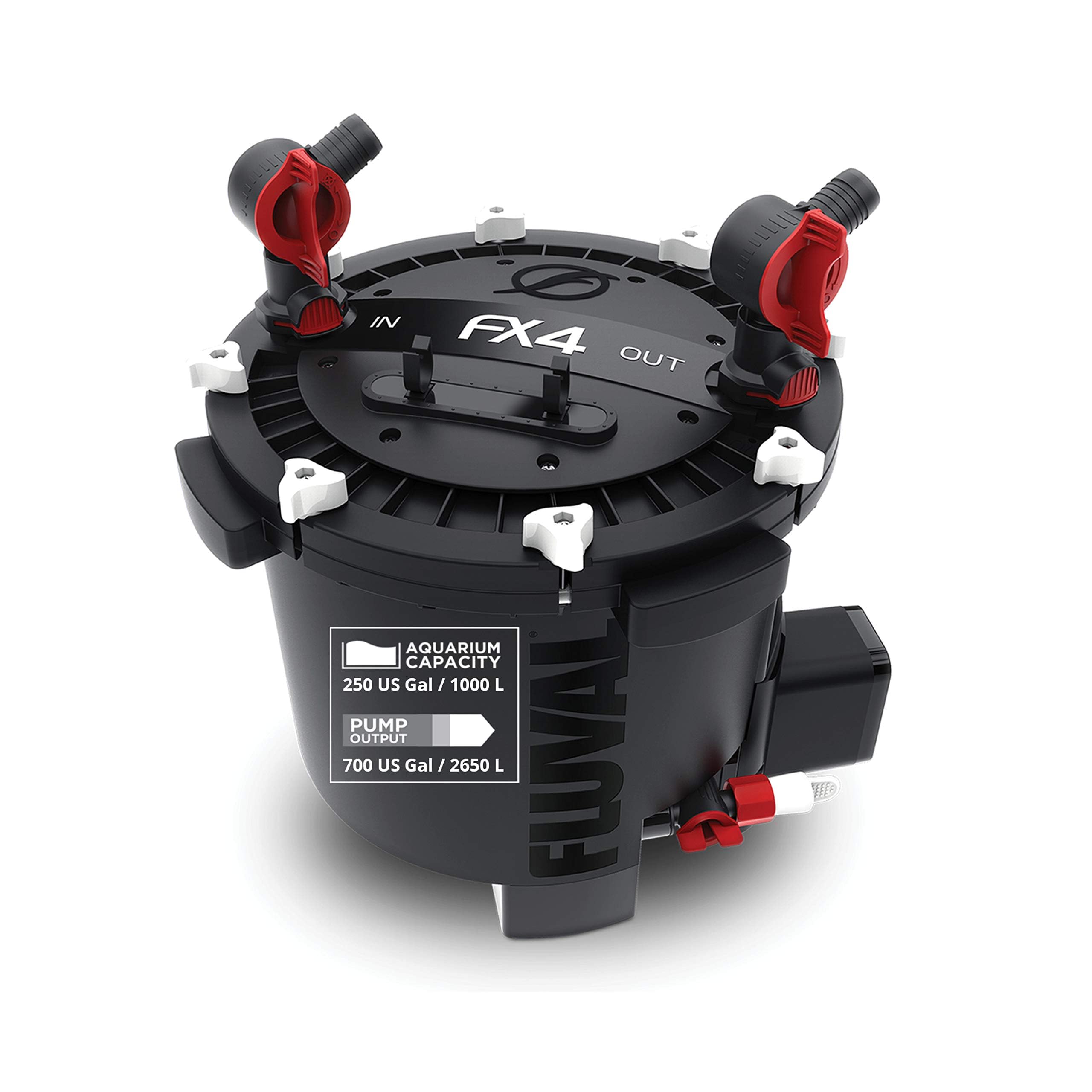
Rating: 4.5 ★ | Price: Premium | Flow Rate: 700 GPH | Media Capacity: 2 baskets, 1 gal volume | Noise Level: Very quiet | Maintenance: Tool-required hose decoupling | Durability: Motor failure risk
A 700 GPH self‑priming pump and 1‑gallon media capacity push massive water volume through two stackable baskets, handling heavy bioloads without strain. The Smart Pump auto-purges trapped air every 12 hours, so restarts after power interruptions are hands‑off. A built-in drain valve simplifies water changes — a practical touch when managing large tanks where hauling buckets is exhausting.
This filter suits owners of 125–250 gallon aquariums who prioritize turnover over convenience. Decoupling the stiff hoses requires a wrench, making routine cleaning noticeably harder than the tool‑free pre-filter access found on smaller models. Hobbyists with the patience for occasional heavy maintenance will find the flow rate and filtration capacity well matched to heavily stocked setups.
Pros
- Powerful flow handles heavy bioloads in tanks up to 250 gallons with ease.
- Quiet operation despite high output — often described as silent.
- Built-in drain valve simplifies water changes, a practical feature for large tanks.
Cons
- Motor may stop running within the first year — worth considering for a filter in this price tier.
The FX4 delivers unmatched water turnover for large aquariums, but the maintenance routine demands more effort and motor longevity can vary — the top pick offers a more practical daily experience for medium tanks.
Best for Planted Tanks
OASE BioMaster 250

Rating: 4.3 ★ | Price: Luxury | Flow Rate: 250 GPH | Media Capacity: 4-stage sealed | Noise Level: Quiet, some air purging | Maintenance: Pre-filter removal without media | Durability: German build, 4yr warranty
OASE integrates a 150W heater directly into the canister, removing in-tank equipment and creating a clean aquascape. The German build quality feels premium, and the four-stage sealed media baskets allow pre-filter cleaning without disturbing biological media — a real time-saver for planted tank enthusiasts.
The filter emits an air-purging sound every 5–10 minutes as it clears trapped air. In a quiet living room or near a seating area this will be a regular, audible event. This makes the BioMaster 250 best suited for aquascapers who value a heater-free tank interior and can accommodate the filter in a cabinet or away from quiet spaces. Beginners expecting silent operation should look at the top pick Fluval 407 instead.
Pros
- Built-in 150W heater keeps the tank free of visible equipment.
- Pre-filter can be cleaned without opening the main media baskets.
- Solid build quality with a 4-year warranty backing German engineering.
Cons
- Premium cost may not make sense for those satisfied with a separate heater and filter.
- Periodic air-purging sound every 5–10 minutes can be distracting in quiet rooms.
For aquascapers who prioritize a heater-free tank and don’t mind occasional mechanical noise, the OASE delivers easy maintenance and robust build. If near-silence is non-negotiable, the Fluval 407 remains the better option.
Best for 10–40 Gal Tanks
EHEIM Classic 2213

Rating: 4.1 ★ | Price: Mid-Range | Flow Rate: 62 GPH | Media Capacity: 2 baskets, Substrat Pro | Noise Level: Dead silent | Maintenance: Manual prime, clamp clips | Durability: 10+ year lifespan
The Eheim Classic 2213 is among the quietest filters available, making it ideal for bedrooms or offices, while its stainless-steel impeller and ceramic shaft contribute to a service life that often exceeds a decade. Compared to shorter-lived quiet filters like the slimmer alternative, the Eheim offers longevity but requires more hands-on setup—expect to follow online guides for priming and clamp adjustments. The two media baskets come with high-quality Substrat Pro, providing strong biological filtration right out of the box. With a flow rate around 62 GPH, it handles lightly stocked 40-gallon tanks without creating a current.
This filter is best suited for experienced hobbyists who know how to prime a canister and don’t mind occasional maintenance of the metal clamp clips. It excels in small tanks (10–40 gallons) where silence matters most, but first-time canister owners may find the sparse instructions frustrating.
Pros
- Near-silent operation – barely audible in quiet rooms.
- Long service life – can last over a decade with basic care.
- Effective biological filtration with included Substrat Pro media.
Cons
- Setup instructions are minimal – expect to use online guides to get it primed.
- Metal clamp clips can lose tension over time, requiring adjustment.
A classic that rewards patient owners with unmatched longevity and silence for small tanks.
Best for Budget Uv
SunSun HW303B
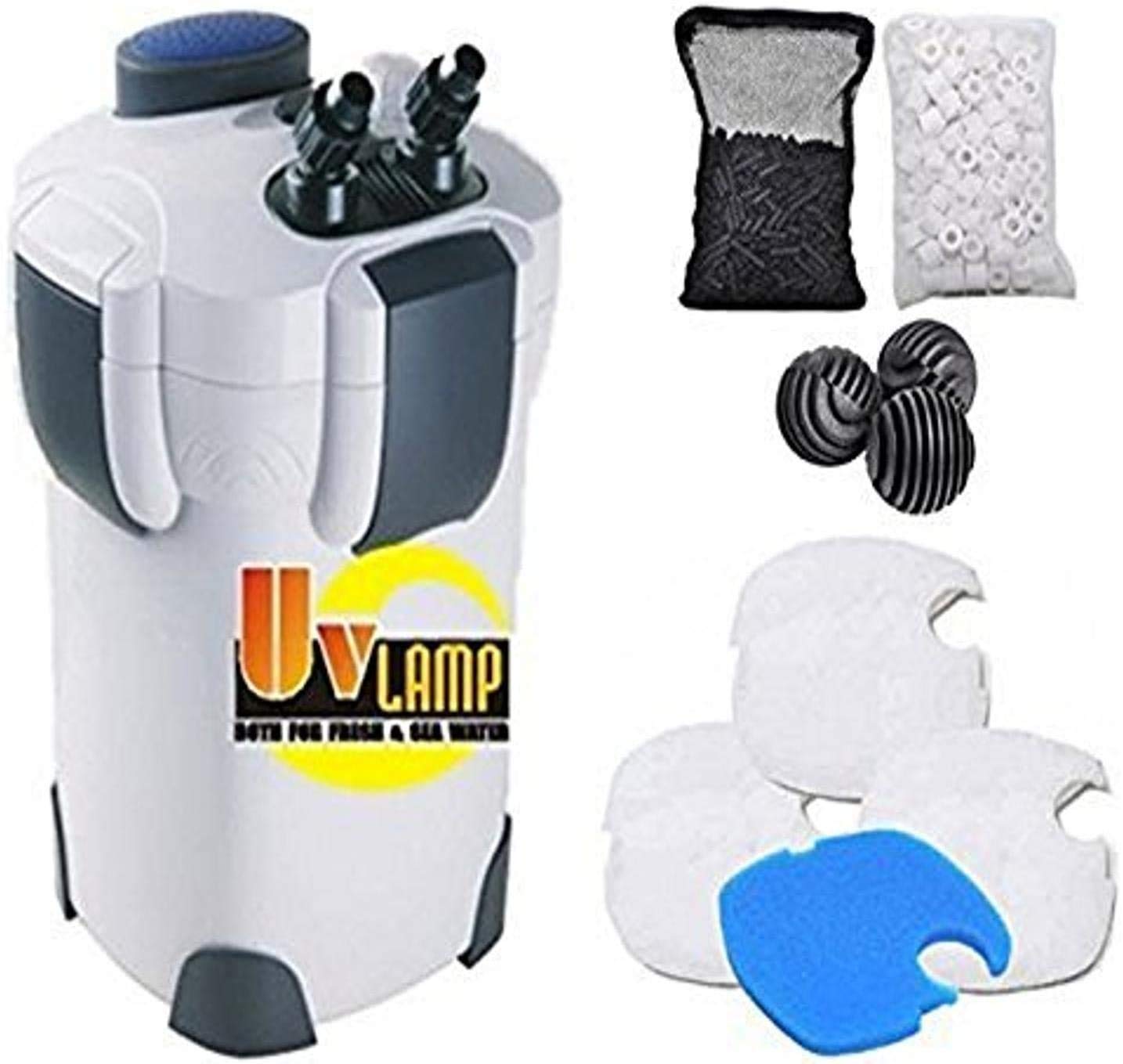
Rating: 4.3 ★ | Price: Mid-Range | Flow Rate: 370 GPH | Media Capacity: 3 stackable baskets | Noise Level: Ultra quiet | Maintenance: Easy tray access | Durability: Cheap plastic fittings
The SunSun HW303B packs a factory-installed 9W UV sterilizer into a canister filter priced well below separate UV units. That integration alone makes it a standout for budget aquarists. Compared to pricier models like the Fluval 407, you give up refined plastics and tool-free maintenance — the trays and fittings have a lighter, more brittle feel, and the UV bulb can arrive cracked or fail early in some cases. Flow at 370 GPH suits moderately stocked 75-gallon tanks, though heavily stocked setups will outpace it.
This filter fits best when you’re willing to trade premium build for cost-effective UV filtration. If your tank is under 75 gallons and you keep the bioload moderate, the HW303B delivers clear water and quiet operation without straining your budget. Skip it if you want heavy-duty plastic or if a broken bulb out of the box would be a dealbreaker — those scenarios point toward the Fluval or OASE lines instead.
Pros
- Built-in 9W UV sterilizer saves you from buying separate equipment
- Very quiet operation during the day and night
- Effective multi-stage filtration leaves water crystal clear
Cons
- Plastic fittings and media trays can feel brittle; some units arrive with cracked parts
- UV bulb may arrive non-functional or fail sooner than expected
If you want UV filtration on a budget and can accept a plastic build that may need an early replacement, the HW303B offers the best value in this price range.
Best for Small to Medium
Aqueon QuietFlow

Rating: 4.3 ★ | Price: Mid-Range | Flow Rate: ~200 GPH | Media Capacity: 3 baskets | Noise Level: Whisper quiet | Maintenance: Quick disconnect | Durability: Motor failure risk
This filter is genuinely quiet — the kind of hum that disappears into a room’s ambient noise, making it a solid fit for a bedroom or office tank. The washable media and simple disassembly cut down on maintenance time. However, the motor can stop functioning within the first year of use, and the flow is fixed, which may be too strong for smaller tanks or delicate fish. That shorter average lifespan keeps it from competing with more durable options at the same price point, so it’s best treated as a good value for a few seasons rather than a long-term investment.
Pros
- Very quiet operation suits noise-sensitive spaces.
- Easy maintenance with removable, washable media.
Cons
- Flow is non-adjustable and may be too strong for smaller or lightly stocked tanks.
- Motor may fail within 6–12 months of continuous operation.
Worth considering if quiet operation is your top priority and you’re comfortable replacing the unit after a year or two, but for longer-term use a more durable option is a better investment.
Best for Backup Use
PONDFORSE Canister
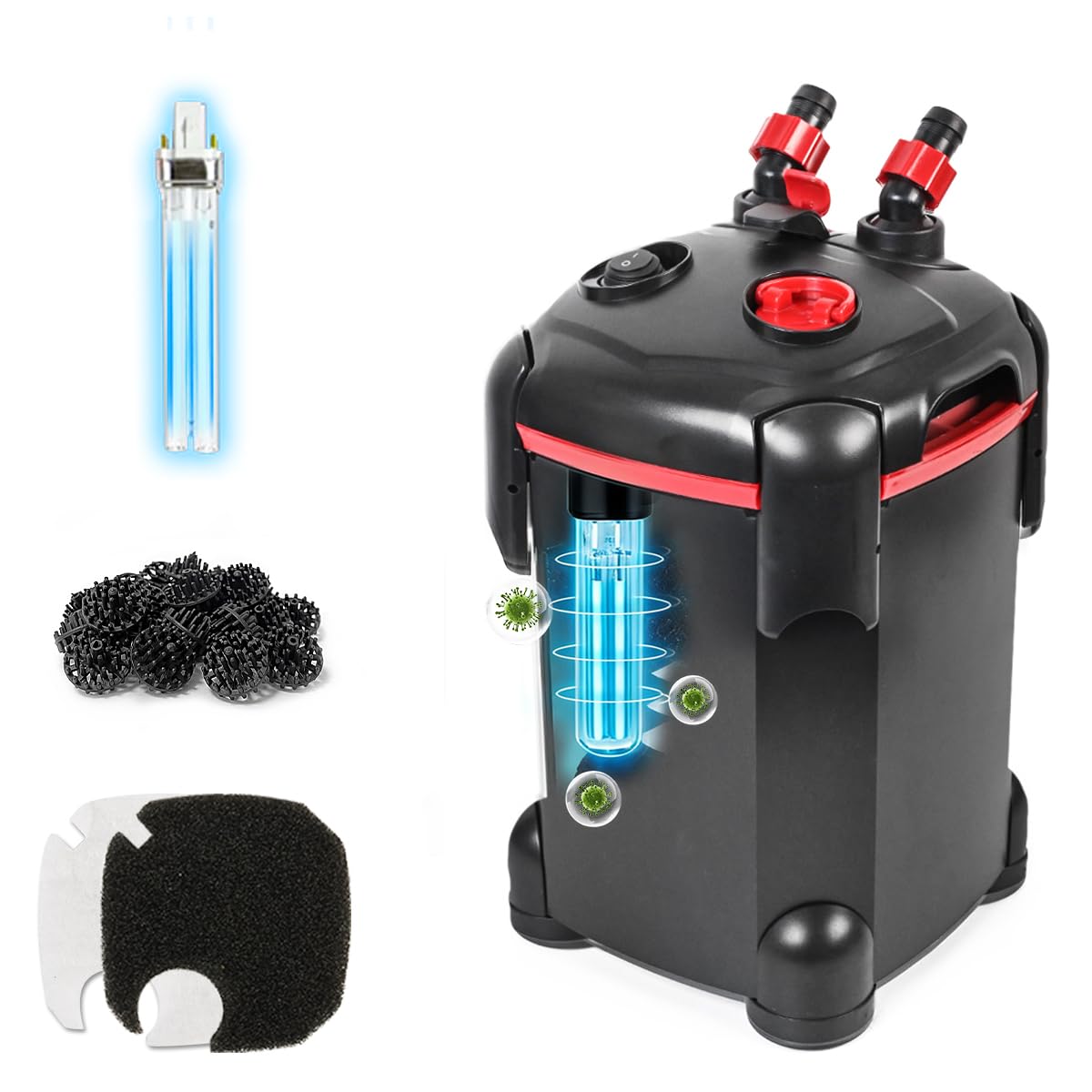
Rating: 4.1 ★ | Price: Budget | Flow Rate: 225 GPH | Media Capacity: Multi-layer | Noise Level: Very quiet | Maintenance: Simple design | Durability: Frequent failures
The PONDFORSE Canister Filter delivers very quiet operation and a simple setup that makes it easy to get started with external filtration at a low cost. However, motor and seal issues can develop within months, and the UV bulb may burn out quickly with possible water leaks into the housing. These limitations make it appropriate as a secondary or emergency filter for tanks up to 40 gallons, rather than a primary setup for heavily stocked aquariums.
Pros
- Very quiet for its price class
- Easy to set up and clean
Cons
- UV bulb can burn out quickly; water may leak into housing
- Motor and seal issues may cause the filter to stop working within months in some cases
Best for emergency backup or very small tanks where budget is the only concern — not a primary filter for daily use.
Best for Large Budget
SunSun HW304B

Rating: 4.1 ★ | Price: Mid-Range | Flow Rate: 525 GPH | Media Capacity: 4 baskets | Noise Level: Quiet | Maintenance: Easy access | Durability: Plastic shatter risk
The SunSun HW-304B delivers 525 GPH flow and a 9W UV sterilizer at a price that undercuts premium rivals by a wide margin, making it a tempting choice for high-volume tanks. On the other side of that value, plastic trays and the UV housing can crack with handling, and seals may weep after power outages or filter moves. That fragility pushes it out of the top tier—this is a filter for hobbyists who are comfortable inspecting and replacing components, not for those who need unconditional reliability.
Pros
- Delivers 525 GPH filtration for tanks up to 150 gallons at a budget-friendly price.
- Integrated 9W UV sterilizer clears green water algae effectively.
Cons
- Plastic media baskets and UV housing can crack under handling or routine maintenance.
- Seals may allow seepage after power outages or when the canister is moved.
If you need high flow and UV for a large aquarium on a limited budget and don’t mind keeping an eye on plastic components, the HW-304B offers unmatched value.
Best for Algae Emergency
COOSPIDER UV Filter

Rating: 4.2 ★ | Price: Budget | Flow Rate: 300 GPH | Media Capacity: Submersible with UV | Noise Level: Not applicable | Durability: Safety hazard
Clears green water within days — effective for severe algae blooms. But water can leak into the UV bulb housing, posing an electrical risk that makes it unsuitable for permanent installation. This submersible internal unit is not an external canister; it’s best reserved as a temporary algae fix while your main filter is offline.
Pros
- Rapidly clears green water and algae blooms within days.
- Very affordable compared to buying a separate UV sterilizer and pump.
Cons
- Pump and UV bulb can stop working within months – best suited as an emergency backup, not a daily driver.
Best used as a temporary green-water killer for severe blooms, not a substitute for a proper external canister filter.
Best for Algae Fix
TARARIUM UV Filter

Rating: 4.2 ★ | Price: Budget | Flow Rate: 400 GPH | Media Capacity: Submersible with UV | Durability: Frequent failure
As a submersible UV unit, it offers the lowest entry price for tackling green water quickly—most tanks see clarity within a week. However, the pump and UV bulb can stop functioning within a few months, and the plastic clips may crack during maintenance. This is a temporary algae fix for tight budgets, not a permanent canister filter replacement.
Pros
- Clears green water within days for under $50.
- Budget-friendly alternative to separate UV sterilizers.
Cons
- Plastic clips and seals may crack when disassembling for cleaning.
Best reserved for temporary algae outbreaks on a tight budget—not for permanent filtration duty.
Best for Large Tank Algae
coospider UV Filter

Rating: 4.0 ★ | Price: Budget | Flow Rate: 600 GPH | Media Capacity: Submersible with UV | Maintenance: Frequent intake cleaning | Durability: Pump/UV fail
This submersible UV unit delivers rapid green-water clearance in large tanks — the 600 GPH flow and separate UV switch make short work of algae blooms. However, it’s not designed for primary long-term filtration: the pump and UV lamp have been noted to stop working within a few months, and the intake can require cleaning every few days to maintain flow. For buyers seeking a permanent external canister with multi-stage mechanical, biological, and chemical filtration, this falls short; it’s best suited as a temporary algae-fixing tool during cycling or emergencies.
Pros
- Clears green water effectively within days
- Adjustable air valve adds oxygenation to the tank
Cons
- Intake can clog and needs cleaning every few days in some setups
- Pump or UV may stop working within a few months of use
Use this only as a temporary algae fix for large tanks with persistent green water, not as a permanent canister filter replacement.
Best for Small Tanks
VEVOR Submersible
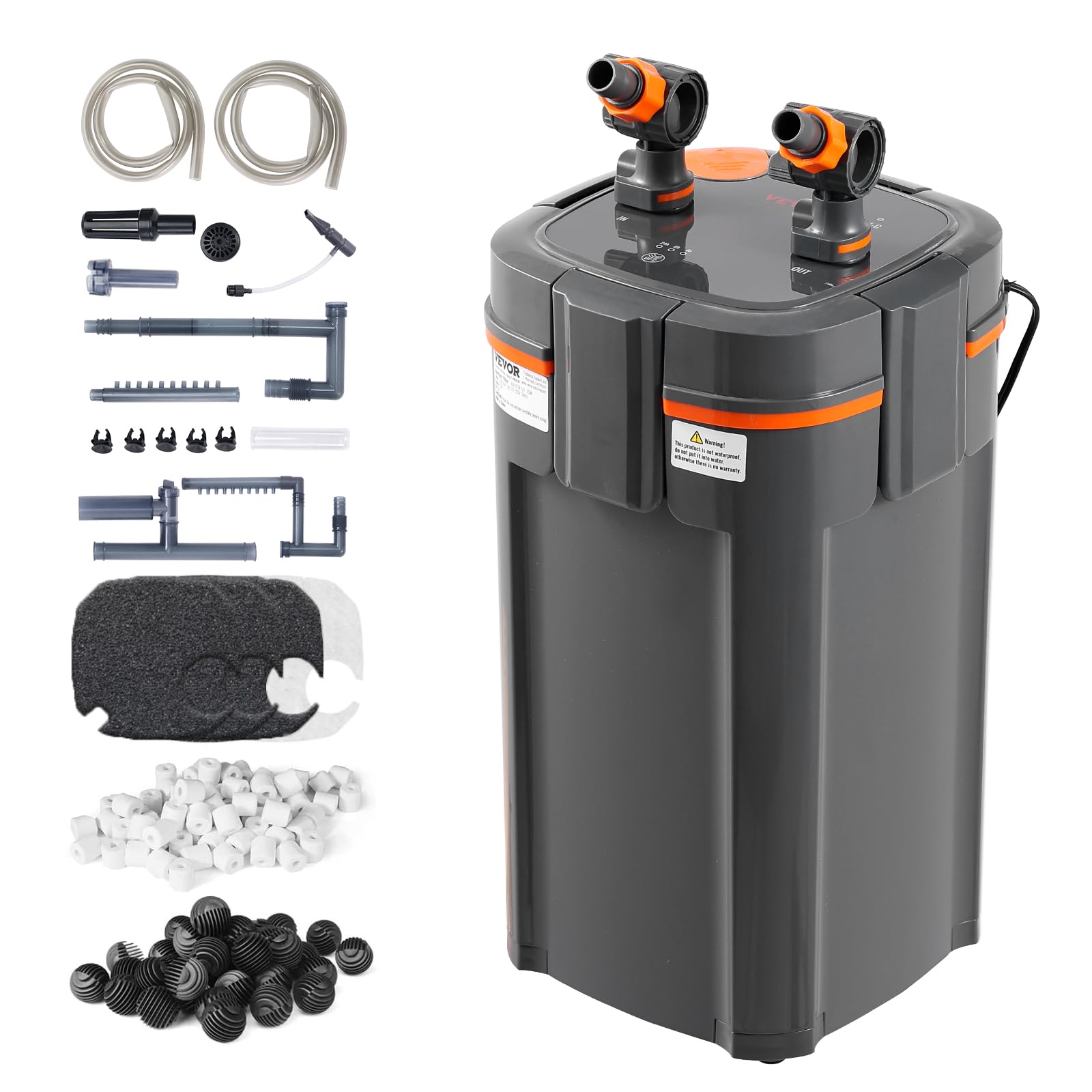
Rating: 4.1 ★ | Price: Budget | Flow Rate: 317 GPH | Media Capacity: 4-stage with UV timer | Noise Level: Extremely quiet | Durability: UV fails often
This VEVOR filter is a submersible internal unit with a handy UV timer (4/8/24h) and near-silent operation – qualities that appeal to nano tank keepers. However, flow output is noticeably lower than the 317 GPH rating suggests, making it best suited for tanks under 30 gallons rather than the advertised 75–100. UV bulb reliability varies between units, and what some receive may not function. More critically for this buyer’s search: it is not an external canister filter with multi-stage mechanical, biological, and chemical filtration. For those set on a canister system, this does not meet that requirement – it belongs in a different category entirely.
Pros
- Nearly silent operation makes it suitable for bedrooms or offices where pump hum is undesirable.
- Four-, eight-, or twenty-four-hour UV timer allows automated algae and pathogen control without separate timers.
Cons
- Flow is significantly weaker than the 317 GPH rating – adequate only for small tanks under 30 gallons.
- UV bulb may arrive non-functional or stop working after some use, so early testing is advisable.
Only consider this if you need a quiet submersible UV filter for a very small tank and are willing to accept a flow rate well below its rating; for external canister filtration, look elsewhere.
Best for Lowest Budget
SunSun HW302

Rating: 4.2 ★ | Price: Budget | Flow Rate: 265 GPH | Media Capacity: 3 baskets | Noise Level: Quiet | Maintenance: Easy | Durability: Leaks and cracks
The SunSun HW302 delivers quiet operation and 265 GPH flow at a price well below any competitor. The plastic clips and media trays may crack during assembly, and water can spill from the lid after a power interruption. For a lightly stocked 20-gallon quarantine tank where cost is the only priority and you can monitor for drips, this filter works. For a main display tank on finished floors, the tradeoffs outweigh the savings.
Pros
- Costs significantly less than comparable canister filters from other brands.
- Runs quietly enough to place in a bedroom without disturbance.
Cons
- Water may spill from the lid when the filter is unplugged or after a power outage.
- Plastic clips and media trays may crack under normal handling.
Ideal for a secondary tank or emergency setup where cost is the only factor and you’re willing to check for leaks.
Best for Backup Only
Marineland Magniflow

Rating: 4.1 ★ | Price: Mid-Range | Flow Rate: 220 GPH | Media Capacity: 3-stage | Noise Level: Quiet | Maintenance: Quick-release valve | Durability: High leak rate
The Marineland Magniflow’s quick-release valve block makes routine maintenance noticeably easier than many mid-range canisters, and it delivers solid water clarity for tanks up to 75 gallons. However, leaks can develop at the lid and valve block, and motor failure within the first year is a possibility some owners encounter. These issues make it a better fit as a backup or temporary filter rather than a primary unit for tanks on finished floors.
Pros
- Quick-disconnect valves simplify filter maintenance.
- Effectively clears cloudy water and improves tank clarity.
Cons
- Lid and valve block seals can develop leaks over time.
- Motor reliability is inconsistent; some units may fail within the first year.
Best suited as a backup or short-term filter where quick maintenance is valued over long-term dependability.
How to Choose
The most common mistake is choosing a filter rated exactly for your tank size; always select one rated for 1.5 to 2 times your water volume to handle real-world bioload.
Flow Rate and Tank Size
Flow rate (GPH) determines how many times per hour your total water volume passes through the filter. A rule of thumb is 4-6 times turnover per hour for freshwater, but heavily stocked or messy fish like goldfish need 8-10 times. A filter rated for a 100-gallon tank at 400 GPH only turns a 75-gallon tank about 5 times per hour – adequate for light stocking but not for cichlids or large communities. Choose a model whose GPH is at least 1.5x your tank’s gallon rating.
Higher flow also means more current, which can stress slow-moving fish and uproot plants. If you keep bettas or nano fish, look for adjustable flow or a filter with a smaller impeller. The trade-off: high-flow models often run louder and require larger media baskets to avoid channeling.
Media Capacity and Configuration
More media baskets allow you to layer mechanical, biological, and chemical media separately. Three to four baskets are ideal; two baskets force you to mix media, reducing each stage’s efficiency. Stackable baskets with handles make swapping media quick, while sealed compartments (like OASE’s) prevent bypass but limit customization.
The volume of biomedia matters more than the number of baskets. A filter with 1 gallon of ceramic rings or bio-balls supports a larger bacterial colony than a filter with three small baskets. If you plan to run carbon or phosphate removers, dedicate a separate basket so media replacement doesn’t disturb the biological layer.
Noise Level
Noise comes from the motor, impeller vibration, and air trapped in the hoses. Quiet filters use oversized motors that run at lower RPMs and rubber feet to dampen vibration. Budget models often use louder motors or thin plastic housing that transmits noise. A filter that’s ‘quiet’ in a basement may be distracting in a bedroom.
Air purging – the periodic gurgle when the filter expels trapped air – is common in models with internal heaters or complex return systems. If you’re sensitive to intermittent sounds, choose a filter with a dedicated air-bleed valve or one known for stable priming, like the Fluval 407.
Ease of Maintenance
Pre-filter access is the most time-saving feature: a sponge on the intake that you rinse weekly without opening the canister. Without it, you must disconnect hoses and lift the lid to clean the mechanical layer. Quick-disconnect valves let you shut off water flow before removing the filter, preventing spills. Some models (EHEIM Classic) require manual priming and clip closure – fine for experienced users but frustrating for beginners.
The frequency of maintenance depends on bioload. Heavily stocked tanks may need pre-filter cleaning every 3 days; lightly stocked planted tanks can go 2 weeks. Models with large, easy-to-reach pre-filters (Fluval 407, OASE BioMaster) cut cleaning time significantly. Avoid filters that require tools for hose removal – you’ll dread maintenance and skip it.
Durability and Leak Resistance
Leaks are the most common reason for filter replacement. They typically originate at the lid seal, hose barb connections, or the UV chamber. Rubber O-rings degrade over time; models with spare O-rings or visible seal inspection windows are safer. Plastic housing that feels thin or has sharp edges is more likely to crack when you tighten the clamps.
Budget filters (SunSun HW302, Marineland Magniflow) have higher leak rates due to softer plastic and less precise molding. Premium filters use reinforced ABS or polycarbonate and include leak-proof valving. If your tank is on a wood floor or above a finished room, invest in a filter with a proven low-leak record, such as the Fluval 407 or EHEIM Classic.
FAQ
Why does my canister filter keep losing prime and making gurgling noises?
This usually means air is entering the system – either through a loose hose connection, a worn O-ring on the lid, or a low water level in the tank. Check all hose clamps and tighten them. If the filter is below the water line, air can be trapped in the pump head; tilt the canister to burp the air. Persistent gurgling after 24 hours suggests a micro-leak at the seal. Replacing the O-ring and lightly lubricating it with aquarium-safe silicone grease often fixes it.
Can I use an external canister filter on a saltwater reef tank?
Yes, but with caveats. Canisters excel at mechanical and chemical filtration, but they can trap detritus and become nitrate factories if not cleaned weekly. In a reef tank, where low nutrients are critical, use the canister primarily for carbon and GFO, and rely on a protein skimmer and live rock for biological filtration. Choose a model with easy pre-filter access (like the Fluval 407) to minimize disassembly. Avoid UV built into the canister – standalone UV units are more reliable.
How often should I clean the pre-filter on my canister filter?
For a moderately stocked tank, rinse the pre-filter sponge every 5–7 days. If you keep goldfish, cichlids, or feed heavily, clean it every 2–3 days. A dirty pre-filter reduces flow by up to 50% and forces the motor to strain. Most filters with a dedicated pre-filter (e.g., Fluval 407, OASE BioMaster) allow you to remove and rinse it without opening the main canister – take advantage of that. If your filter lacks a pre-filter, you’ll need to open the canister every 2 weeks to clean the top mechanical layer.
What size canister filter do I need for a 75 gallon planted tank with cichlids?
A 75-gallon planted tank with cichlids (moderate bioload) needs a filter rated for 100–150 gallons. Look for a model with at least 350–400 GPH flow and 3+ media baskets. The Fluval 407 (rated for 100 gallons, 383 GPH) is a popular match. If you plan to add more fish, step up to the FX4 (700 GPH) and adjust flow with a spray bar. Oversizing ensures you maintain turnover even as plants grow and media clogs.