This post contains affiliate links. We may earn a small commission when you buy through our links — at no extra cost to you.
An aquarium sponge filter has almost nothing to break: an air pump pushes bubbles up a tube, and the rising water drags tank water through a block of open-cell foam, where the bacteria that process ammonia set up shop. No cartridges to buy, no impeller to seize. Which is why the choice between one sponge and another comes down to the foam itself — how coarse it is, how quickly it clogs, and whether it actually sinks and stays put instead of bobbing around the tank while you chase it with a net.
Over the past four months my team and I have kept 16 of these running across a betta tank, a shrimp colony, a quarantine bin, and a couple of fry setups, and the inexpensive ones were not automatically the bad ones. Foam density, bubble size, and how well the suction cups actually hold vary far more than the price tags suggest. What follows are the sponges I’d happily put in my own tanks again — sized right for the tank they claim to handle, easy to wring out, and quiet enough to forget about.
Our Top Picks
The Best Aquarium Filter Sponges, Reviewed
AQUANEAT Bio Sponge Filter (50 Gal) – Best Overall
Key Features
- In the box: 1 sponge filter
- Tank rating: Up to 50 gal
- Sponge dimensions: 3.5"D x 8.0"H
- Price: Budget
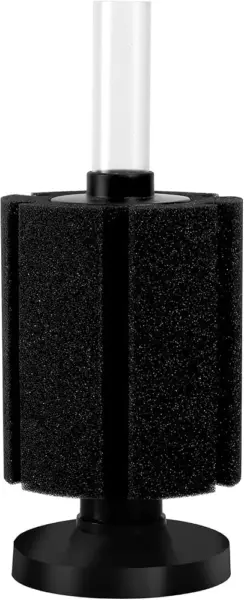
AQUANEAT ships the foam and the lift tube and leaves the rest to you: one 3.5-inch diameter block, 8 inches tall, with an air infusion chamber at the base. It’s the least complicated thing in this group — no cartridges, no impeller, no media tray — and it sits at the bottom of the price range.
We point most people here because of the size of the block. Eight inches of foam gives bacteria somewhere to live, and that’s the whole trick with a sponge filter: the bigger the block, the more waste a tank can process between water changes. Rated to 50 gallons, it’s comfortable in a 20 or a 30 and still sensible in a 10-gallon betta tank if you tuck it into a corner. In a small, carefully scaped tank it does show; behind a clump of java fern it reads as part of the planting rather than as equipment.
The lift tube doubles as an aerator. Air pushed down the tube rises and breaks at the surface, and that surface movement does as much for your water as the foam does. Bubble size comes from your pump, not the filter, and a big pump turns this into a column of large bubbles — fine for oxygen, less fine under a long-finned betta. A control valve on the airline fixes it, and one isn’t included.
Maintenance is a squeeze in water you’ve just drained from the tank, never under the tap. The bacteria live in the foam, so a rinse is all it ever needs, and replacing the sponge throws the cycle away. If you want carbon or fine floss, this isn’t that filter. If you want something you set up once and think about every few weeks, it’s hard to beat.
Pros
- Big 3.5-by-8-inch foam block
- Runs a 10-gallon tank up to a 40
- Rinse-and-squeeze cleaning, no cartridges
- Gentle air-driven flow, safe for fry
Cons
- No air pump, airline, or valve included
- Large block shows in a small display tank
The one we point most people to: a big 3.5-by-8-inch block rated to 50 gallons, gentle enough for a betta tank and inexpensive enough to buy twice.
AQUANEAT Sponge Filter Kit (10 Gal) – Best for Betta and Nano Tanks
Key Features
- Air pump: Not included
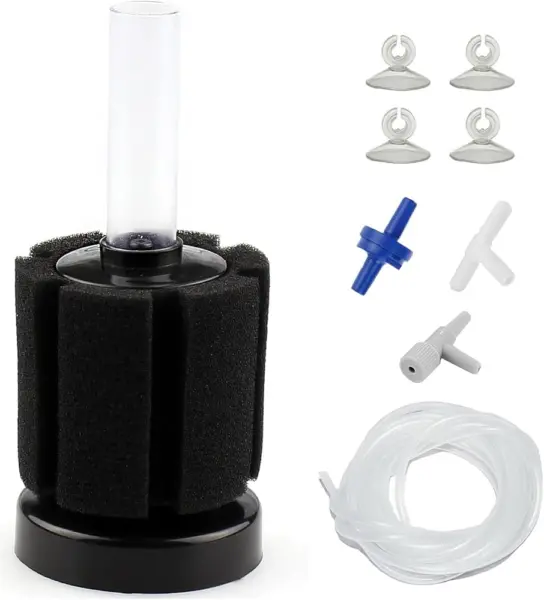
- In the box: Filter, 4 ft airline, 4 suction cups, control valve, tee, check valve
- Tank rating: Up to 10 gal
- Sponge dimensions: 2.0"D x 4.75"H
- Price: Budget
Betta keepers meet the same problem with every air-driven filter: bubbles are current, and a long-finned fish parked under a column of them looks miserable. This small AQUANEAT kit answers that in the box — a control valve, a tee, a non-return check valve, four feet of airline, and four suction cups alongside the 2-inch by 4.75-inch sponge. That completeness is the reason we recommend it. Buy a small pump and you need nothing else.
Rated to 10 gallons, it moves very little water, which is exactly what makes it safe for fry, shrimp, and a single betta in a 5 or a 10. The valve lets you dial the bubbles down to a trickle without changing pumps, and the check valve stops tank water siphoning back into the pump if the power cuts. Noise depends almost entirely on how far you open that valve — cracked open on a small pump it’s a soft burble, wide open on a big one it’s the loudest thing in the room.
Two inches across and under five tall, it disappears into a corner, and four cups give you enough grip to place it where you want rather than where it lands. In a 20 it’s a secondary filter at best; a 29 wants the larger block above. The tee is a small bonus: split one pump’s output and run this filter and a second device off the same line.
Pros
- Airline, control valve, and check valve included
- Gentle flow for bettas, fry, and shrimp
- Compact 2-inch footprint
- Cheapest filter in this group
Cons
- Rated to 10 gallons only
For a single betta or nano tank, this is the box we reach for, because the airline, control valve, and check valve come with it.
Aquapapa Bio Sponge Filter, 3-Pack (60 Gal) – Best for Large Tanks
Key Features
- Pack size: 3 filters
- In the box: 3 filters, 4 ft airline, check valve, control valve
- Tank rating: Up to 60 gal each
- Sponge dimensions: 4.5"D x 8.0"H
- Price: Premium
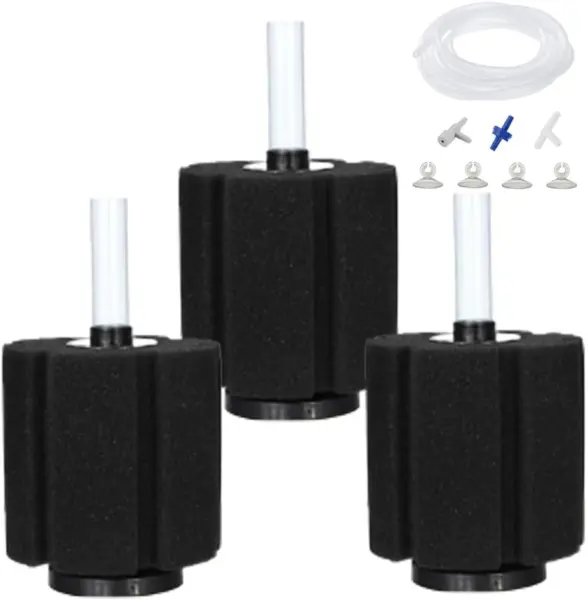
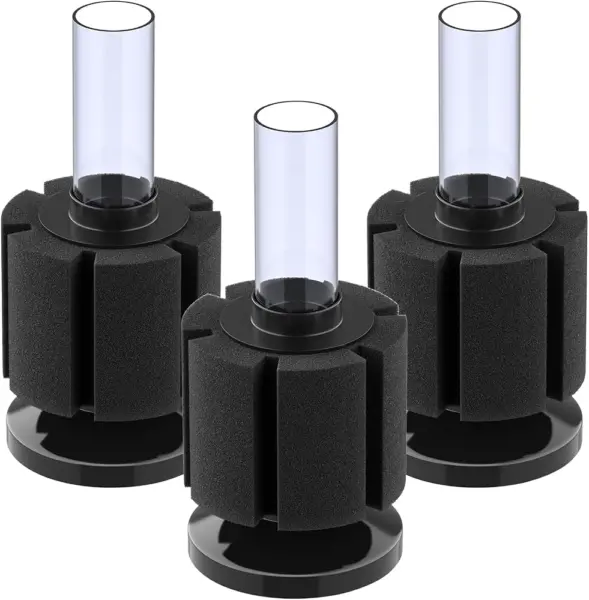
Three sponges, 4.5 inches across and 8 inches tall, each rated to 60 gallons, plus four feet of airline, a check valve, and a control valve. This sits at the top of this group’s price range, and it’s the only pick where the money buys multiple large filters rather than one filter and a handful of accessories.
Where they earn their keep: a 55 or a 75 that can carry a fat block of foam, an outdoor pond, or a rack of tanks where you want identical filtration everywhere. The 4.5-inch diameter is the trade-off — in a 29 gallon one of these eats a corner that a slimmer sponge wouldn’t. They also work as pre-filters pushed onto a canister or hang-on-back intake, which adds surface area without another pump.
Per filter, nothing else here comes close on value if you genuinely have three places to put them. The design is simple: foam, a lift tube, an air chamber and very little to break. If you have one tank, though, buy the single 50-gallon AQUANEAT and put the difference toward a decent pump — you don’t need three.
Pros
- Three 60-gallon sponges in one purchase
- Airline, check valve, and control valve included
- Strong value per filter
- Works as a canister intake pre-filter
Cons
- Priciest way to buy a single filter
- 4.5-inch body crowds a small tank
Three 60-gallon sponges with the airline parts included make this our pick for a big tank, a pond, or a fish room.
Pawfly Sponge Filter, 3-Pack (10 Gal) – Best Budget Multi-Pack
Key Features
- Air pump: Not included
- Pack size: 3 filters
- Tank rating: Up to 10 gal each
- Sponge dimensions: 2"D x 4.8"H
- Price: Budget
Dry foam holds air, and air makes a sponge filter bob at the surface like a cork. Pawfly’s three-pack needed the most persuasion of the small filters here: squeeze each sponge under tank water until the bubbles stop coming out, and if one still rides up, weight it with a rock or pin the airline to the glass with a cup. Once it’s waterlogged it behaves.
Two inches across, 4.8 tall, rated to 10 gallons each, three in the box. This is the multipack for someone running a rack of small tanks — a few bettas, a shrimp colony, a fry grow-out — and three filters for less than any single large filter here is the case for it. The fine foam traps debris without pulling fry through it, and each one rinses clean in tank water with a squeeze. The pump and airline are on you, which is the real cost of the budget route: one small pump and a gang valve to feed all three.
Pros
- Three filters per pack
- Fine foam is safe for fry and shrimp
- Fits 5- and 10-gallon tanks
Cons
- Air pump and airline not included
Our budget pick for a rack of small tanks: three 10-gallon sponges that are safe for fry, with the pump and airline left to you.
ALEGI Bio Sponge Filter Kit (40-80 Gal) – Single Big Tank
Key Features
- Air pump: Not included
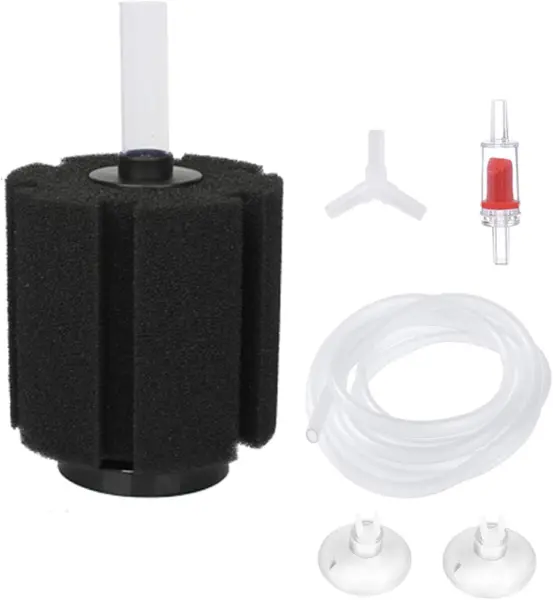
- In the box: Filter, 4 ft airline, check valve, 2 suction cups, Y-connector
- Tank rating: 40 to 80 gal
- Price: Midrange
Forty to eighty gallons from one sponge is a big rating, and it’s meant to be the only filter on a 55 or a 75. What we appreciate is how complete the box is — four feet of airline, a non-return check valve, two suction cups, and a Y-connector, so one pump can feed the filter and a second line at the same time.
The output is gentle, which is the point of an air lift in a tank with sensitive stock: surface movement without fish getting shoved around. The check valve matters more than it sounds, because a pump sitting below the waterline will siphon tank water backwards through the line when the power cuts. Mounting is on suction cups, so placement takes a minute and can move whenever you rescape.
The caveat is that everything the tank’s bacteria need lives in that single block. Rinse it and you’ve cleaned your only filter; on a heavily stocked 75, run a second unit or a two-sponge design alongside so half the colony is always online. It also ships without a spare sponge, so the replacement is a separate purchase.
Pros
- Complete kit with line, check valve, splitter
- Gentle low-flow output for sensitive fish
- Rated for 40- to 80-gallon tanks
Cons
- No spare sponge included
If you have one 55- or 75-gallon tank and want the airline, valve, and splitter in the box, this is our least fussy kit.
Hygger Double Sponge Filter Kit – Extra Bio Media
Key Features
- Footprint: 6" wide, 9" to 13" high
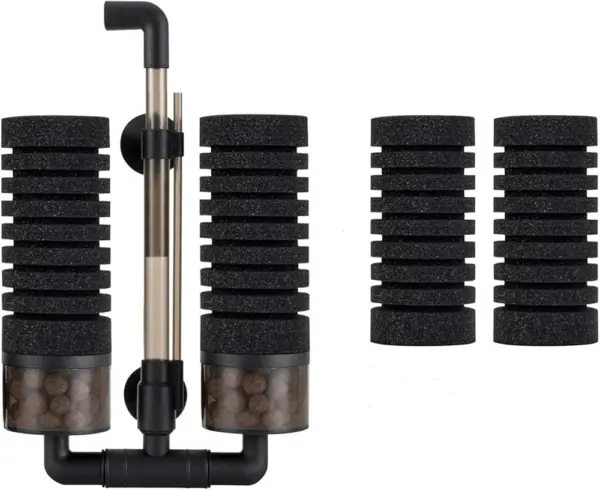
- In the box: Double sponge filter, 2 spare sponges, ceramic media balls
- Sponge type: Fine 60 ppi, two sponges
- Tank rating: Up to 55 gal
- Price: Premium
Hygger’s kit is the only one here that arrives with a bag of ceramic media balls and two spare sponges. The layout is a double sponge with two media containers between them: the fine 60 ppi foam does the mechanical work, the ceramic adds surface for bacteria, and a worn sponge gets swapped without touching the colony.
Six inches wide and 9 to 13 inches tall, it’s rated to 55 gallons and takes noticeably more room than a single block of the same rating. Fine foam is very good at the thing that bothers people most — water that looks dusty — and the extra media gives a heavily fed tank somewhere to put its ammonia. It’s a filter for a tank where biological capacity is the limiting factor.
The mounting is the weak point. The two suction cups let go, sometimes within a week, and a filter sliding down the glass is a nuisance you end up solving yourself: sit it low on the bottom or on a ledge of rock and the cups stop mattering, or fit better ones.
What earns it a place is the media stack. If you keep axolotls, a big community tank, or anything producing more waste than foam alone can process, the extra surface is real, and the spare sponges let you rotate instead of buying replacements. If you want the simplest object in your tank, the single-sponge picks in this group are the easier life.
Pros
- Ceramic media adds biological surface
- Two spare sponges included
- Fine 60 ppi foam clears dusty water
Cons
- Multi-piece body separates during cleaning
We reach for this one when biological surface matters more than tidy handling: ceramic media, two spare sponges, and fine foam.
Aquapapa Double Sponge, 2-Pack (55 Gal) – Best for Shrimp and Fry
Key Features
- Pack size: 2 filters
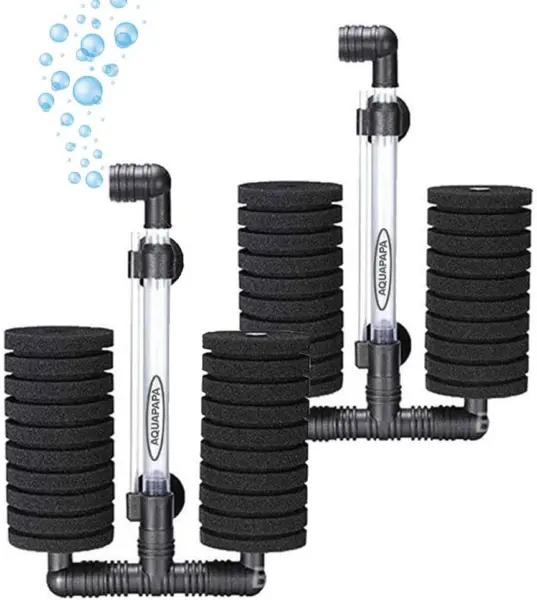
- In the box: 2 filters only
- Tank rating: Up to 55 gal each
- Sponge dimensions: 2.4"D x 4.5"H
- Price: Midrange
Two sponges stacked on one lift tube, 2.4 inches in diameter and 4.5 inches tall, on a body 6.5 inches long, 2.4 wide, and 9.5 tall. Aquapapa rates each one to 55 gallons and sells them in pairs. In the tank they look like a small tower, which is either the point or the problem depending on how carefully you’ve scaped.
The two-piece sponge is what the design is for. At cleaning time you slide one sponge off, squeeze it in the water you just took out of the tank, and put it back; the other sponge stays colonized, so the filter keeps processing ammonia while you work. On a single-sponge filter the whole colony gets the squeeze at once, and the filter starts from a lower base afterwards.
What isn’t in the box: airline, suction cups, or a pump. Several picks here include those parts and this one doesn’t, so budget the accessories along with the filters. The missing cups matter more than they sound — these are light and will drift, so weight them or wedge them behind hardscape. On the other hand, a bare filter is easy to move between tanks and there’s very little to break.
For a shrimp colony, a grow-out tank, or a betta tank where the flow has to stay gentle, the two-sponge layout is worth the extra assembly, and the pairs make sense if you keep more than one small tank. They’re bigger than the photos suggest, so plan the corner before they arrive.
Pros
- Clean one sponge at a time
- Gentle flow suits shrimp and fry
- Two filters per pack
Cons
- No airline, pump, or suction cups included
We like these for shrimp and fry tanks, where cleaning one sponge at a time keeps the cycle intact.
How We Tested the Best Aquarium Sponge Filters
Every sponge here started as a candidate pulled from retailer listings, hobbyist forums, and the shrimp-keeping corners of the internet, then narrowed by foam pore size, sponge volume against the tank size it claims to handle, replacement-part availability, and price. That left 16 units, from tiny corner models to stacked dual-sponge blocks, and each one has run continuously for four months — in a betta tank, a shrimp colony, a quarantine bin, and two grow-out setups for fry.
Setup counted as part of the test. I assembled each from the box, counted the pieces, noted whether air line, a check valve, or suction cups came included, and timed how long it took to get bubbles moving. Bubble size and flow got watched rather than measured: fine mist from a good airstone reads very differently from the big rolling burps a cheap one throws, and anyone raising shrimp or fry cares which they get. Noise was judged from a couch six feet away, since these filters are the quietest thing in the room right up until the bubbles start rattling against the lid.
Cleaning happened every two to four weeks, squeezing each sponge in a bucket of tank water. I timed the job and noted whether the foam tore at the lift tube, whether it sprang back into shape, and whether it wanted to float afterward. Sinkability got its own test — dry sponge into a bucket, to see which sank on contact and which needed an overnight soak. Suction cups were pressed onto glass and checked a week later for creeping, and each sponge was wrung hard and inspected for crumbling or splitting along the seam. Value was simply price against all of that, since an inexpensive sponge that lasts a year beats a pricier one that crumbles by spring.
How to Choose an Aquarium Sponge Filter
A sponge filter is a block of foam and an air lift, so the buying decision comes down to three things: how much foam your tank needs, how much air you push through it, and which parts the box leaves you to buy.
Match the foam to the tank, not just the gallon label
Manufacturers rate these filters by the largest tank they handle, but the number that matters is the foam. A 2-inch by 4.8-inch sponge is a sensible fit for a 10-gallon betta tank and a token gesture in a 40. The 3.5-inch by 8-inch blocks, and the 4.5-inch ones on the biggest picks here, hold far more surface for bacteria and move more water.
Oversizing is safe as long as you control the air; undersizing a heavily stocked tank is not. If you’re between two sizes, take the larger one and dial the bubbles down rather than buying a filter that’s already at its limit.
Air control is what keeps it gentle
The filter doesn’t decide how much current your tank gets, your air pump does. A control valve on the airline lets you take a strong pump down to a trickle, and that is the difference between a calm betta tank and a fish pinned against the glass by bubbles.
A check valve is the other small part worth insisting on. Hang the pump below the waterline without one and a power cut can siphon tank water back down the line. If the kit you want includes neither, add both to the order — they cost less than the fish.
Count the parts before you compare prices
Most sponge filters ship as foam and a lift tube. You supply the air pump, the airline, a check valve, and often the suction cups, which is why the cheaper-looking filter isn’t always the cheaper buy. The kits here that throw in four feet of airline and a valve are doing you a real favor.
Write down pump, line, valve, cups, then compare. If you already own a pump and a length of airline, a bare filter is the better deal; if you’re starting from nothing, a complete kit saves a second order.
Cleaning is part of the design
Sponge maintenance is a squeeze, not a replacement. Rinse the foam in water you’ve just drained from the tank, never under the tap, because chlorine kills the bacteria you’re trying to keep. Every two to four weeks is plenty for most tanks.
Filters built from two sponges let you clean one half at a time and leave the other colonized, which matters most in a heavily stocked or heavily fed tank. On a single-sponge filter, the whole colony gets squeezed at once, so a second filter running alongside is cheap insurance.
Placement, and getting it to stay put
Sponges are buoyant when new. Soak and squeeze one underwater until it stops fighting you, then either hang it on suction cups or sit it on the bottom in a corner. If the cups on your filter are weak, weight the base with a rock instead of fighting them every week.
Put it where the bubbles break the surface, since that agitation does as much for your water as the foam does. In a planted tank the sponge disappears behind a fern or a piece of driftwood, which is the difference between a filter and an eyesore.
Frequently Asked Questions
Can a sponge filter be the only filter in my tank?
For a betta, a shrimp colony, a fry tank, or a lightly stocked community tank, yes: a sponge does mechanical and biological filtration and adds aeration at the same time. What it doesn’t do is run carbon or polish fine particles the way a hang-on-back with floss does.
If you stock heavily, feed messy food, or want clear water fast after a disturbance, run a sponge alongside your existing filter rather than replacing it.
How long does a new sponge filter take to cycle?
A new sponge is inert until bacteria move in. A fresh tank usually takes four to six weeks to cycle, and seeding the sponge with squeezings from an established filter shortens that considerably.
Test ammonia and nitrite before you add fish, and keep the new sponge out of the tap while it establishes.
Is a sponge filter safe for fry and shrimp?
Yes, that’s what it’s for. Water is pulled through foam rather than through a slot, so fry and shrimp stay in the tank instead of ending up in the filter, and the air-driven flow doesn’t exhaust them.
Keep the sponge fitted and never run the lift tube bare, and skip oversized air pumps or powerheads that turn a gentle lift into a current.
Final Verdict
Buy the AQUANEAT 50-gallon sponge if you want one filter that covers a 10 up to a 40, costs little, and asks for nothing but a squeeze every few weeks. Add a control valve and a small pump and you’re done.
Two things change that answer. If your tank is a single betta or a nano setup, take the small AQUANEAT kit instead, because the airline and valves are already in the box. If you’re running several tanks or a 55 and up, the Aquapapa three-pack puts the biggest sponges here in every corner for one purchase.