This post contains affiliate links. We may earn a small commission when you buy through our links — at no extra cost to you.
A sponge filter looks almost too simple to matter: a block of open-cell foam, a lift tube, and an air pump doing the heavy lifting. That simplicity is why so many fishkeepers rely on one, especially in quarantine tanks, shrimp setups, and grow-out tanks where a powered filter intake can do real damage. What separates a good one from an annoying one is foam quality, whether it fits the tank you have in mind, and whether the suction cups hold the thing where you put it. The right one keeps water moving, stays put, and makes routine cleaning a five-minute job rather than a tank teardown.
I’ve kept sponge filters in my own tanks for years, and in four months my team and I tested 14 of them in a 20-gallon community tank, a 10-gallon quarantine tank, and a planted shrimp tank. We looked at filter quality, size, value, and ease of cleaning and use, plus details that surface after a few weeks: bubble size, noise, whether the filter floats or sinks, and which accessories come in the box.
Our Top Picks
The Best Sponge Filters, Reviewed
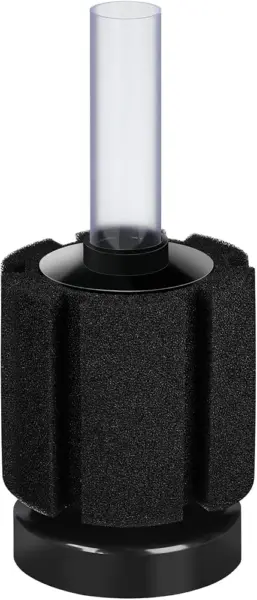
AQUANEAT Bio Sponge Filter, Small – Best Overall
Key Features
- Dimensions: 2.0"D x 4.75"H
- In the box: 1 sponge filter
- Tank rating: Up to 10 gallons
- Price: Budget
Ten gallons, one betta, and a sponge two inches across — that’s the shape of the job this filter was built for, and it’s the one we come back to whenever a new small tank lands on the bench. There’s no cartridge to swap and no impeller to jam. The foam is the filter, and the only moving part is the air you feed it.
Setup is an airline and a pump. Push the tubing onto the stem, drop the unit in a corner, and rising air lifts water through the sponge: debris caught mechanically on the way in, bacteria living in the foam, and a current gentle enough that a long-finned betta can park in front of it without being shoved around. At two inches in diameter it disappears behind a clump of hornwort or a piece of driftwood.
Two things to buy alongside it — an air pump and a control valve for the airline. Neither is in the box, and the valve earns its place the first evening coarse bubbles start popping hard enough to mist the lid. A quarter turn turns that into a ripple, and it’s also how you dial the flow down for fry that don’t want to swim against anything.
The rating stops at 10 gallons. In a 20, run two of these or move up to a larger sponge; in a 10 with a single betta, one is all you need and it won’t stir the tank. That narrowness is the point — this is the filter for the tank most people actually keep.
Pros
- Two-inch footprint hides easily in a planted tank
- Soft foam won’t trap fry or shrimp
- Rinse-and-squeeze cleaning, nothing to replace
- Least expensive pick here with no consumables
Cons
- Air pump, tubing and control valve sold separately
For a 10-gallon betta, fry or shrimp tank, this is the sponge filter we recommend first: tiny, gentle, and inexpensive enough to keep a spare on the shelf.
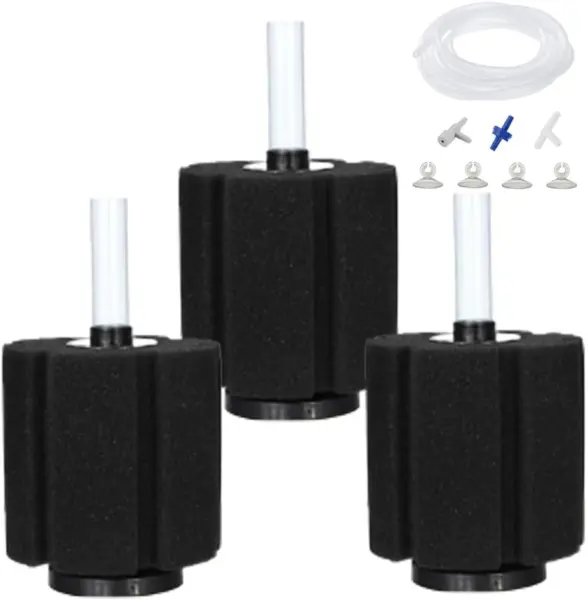
Aquapapa Bio Sponge Filter, 3-Pack (L) – Best for 55-60 Gallon Tanks
Key Features
- Pack size: 3 filters
- Dimensions: 4.5"D x 8.0"H
- In the box: 3 filters, 4 ft airline, check valve, control valve
- Tank rating: Up to 60 gallons each
- Price: Premium
Three filters, each rated to 60 gallons, with four feet of airline, a check valve and a control valve in the box. At four and a half inches across and eight inches tall, each sponge carries real volume — this is not a nano filter scaled up in the photograph.
In a 55 or 60, the point of foam that size is the ratio of surface to flow. There’s enough material for a serious bacterial colony, and the airlift still moves water slowly enough that the tank stays calm, which is why a big sponge filter is the quiet way to run something that also holds fry or shrimp. The spare units are the part we appreciate most: cycle them alongside the working filter and you have seeded sponges ready for a quarantine tank without starting from scratch.
The accessories are sized for one filter, not three. One check valve and one control valve with a three-pack means a manifold or extra valves if you plan to run them all at once, plus a pump that can feed all three. The listing also pitches these as pre-filters slipped over a canister or hang-on intake, which is the cheapest way we know to keep fry out of a big external filter.
Pros
- Rated to 60 gallons per filter
- Calm airlift suits big tanks with delicate fish
- Airline, check valve and control valve included
- Spare units double as seeded quarantine filters
Cons
- One airline set covers one filter, not three
A 55 or 60 gets genuine sponge mass from this three-pack, and the two spare units are the reason we rate it so highly for anyone running more than one tank.
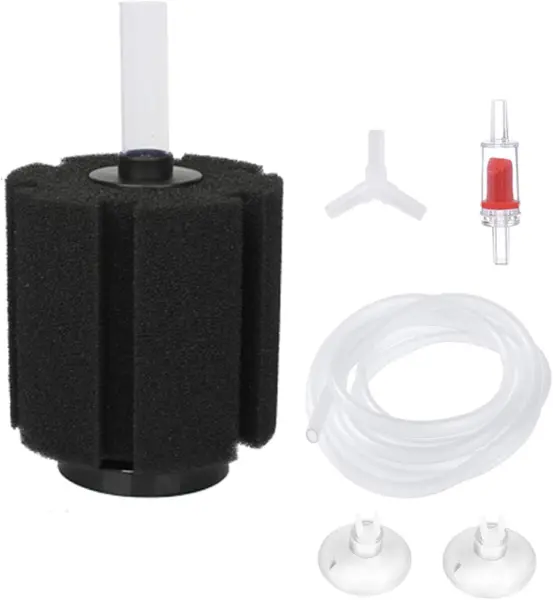
ALEGI Bio Sponge Filter Kit, X-Large – Best Complete Kit for Large Tanks
Key Features
- Pack size: 1 filter
- In the box: 4 ft airline, check valve, 2 suction cups, Y-connector
- Tank rating: 40 to 80 gallons
- Price: Midrange
Four feet of airline, a check valve, two suction cups and a Y-connector arrive with the filter itself, which is more plumbing than most sponges ship with. For someone setting up a 55 who doesn’t want a second order arriving mid-week, that completeness is the whole pitch.
Rated 40 to 80 gallons, it’s a single large sponge rather than a pair, and it does what a big airlift does well: a wide, slow push of water that turns a 60 over without blowing the fish around. The Y-connector is a nice piece of thinking — one pump can feed the filter and an air stone, or a second sponge in a quarantine tank, without a trip to the shop.
What settled it for us is the kit rather than any single specification. A large tank, one purchase, everything in the box and a low-flow output that keeps sensitive fish comfortable. The trade is length and redundancy: four feet of airline is not much when the pump sits on the floor beside a tall stand, and one unit means no second filter running as insurance.
Pros
- Tubing, check valve and Y-connector included
- Rated 40 to 80 gallons on a single unit
- Low-flow output for sensitive fish and shrimp
- Y-connector lets one pump feed two devices
Cons
- Four feet of airline is tight on a tall stand
This is the big-tank kit we hand to someone who wants one filter, one order and nothing left to remember at checkout — 40 to 80 gallons of quiet airlift.
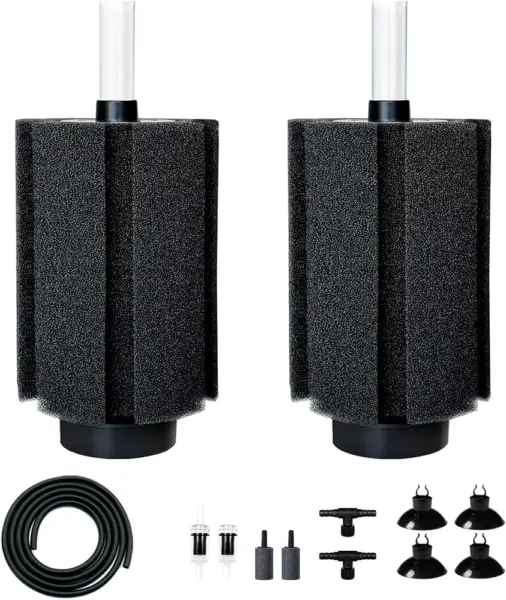
DVHEY Large Sponge Filter with Ceramic Media – Best for 100+ Gallon Tanks
Key Features
- Pack size: 2 filters
- Dimensions: 4.7"L x 4.7"W x 10.4"H
- In the box: 8 ft airline, 4 suction cups, 2 check valves, ceramic media balls
- Tank rating: 80 to 150 gallons
- Price: Premium
Most sponge filters are foam and a tube. This one adds a chamber of ceramic balls above the sponge, and on a tank in the 100-gallon class that extra surface is the difference between adequate and comfortable — which is why it’s our pick at the top end of this guide.
Two units come in the pack, each four and seven-tenths inches across and just over ten inches tall, with eight feet of airline, four suction cups and two check valves. The air stones in the chamber break the air into finer bubbles than a bare airlift, so the rise is quieter and the surface movement is gentler than the size of the thing suggests. In a big tank with big fish, that combination is worth more than raw flow.
Give them time to waterlog. New foam with this much internal volume drifts until it’s saturated, and a sponge that has wandered across the tank isn’t filtering much — press each one under until the bubbles stop, then set it where you want it. It’s the priciest route here to filtering a tank, and past 100 gallons it’s also the least fussy.
Pros
- Ceramic media adds bacterial surface beyond the foam
- Air stones produce finer bubbles and less noise
- Eight feet of airline and two check valves included
- Built for tanks in the 100-gallon class
Cons
Our pick above 100 gallons: two large sponges with a ceramic media chamber, sized and accessorized for the biggest tank in the room.
AQUANEAT Double Bio Sponge Filter, 4-Pack – Best for Multi-Tank Racks
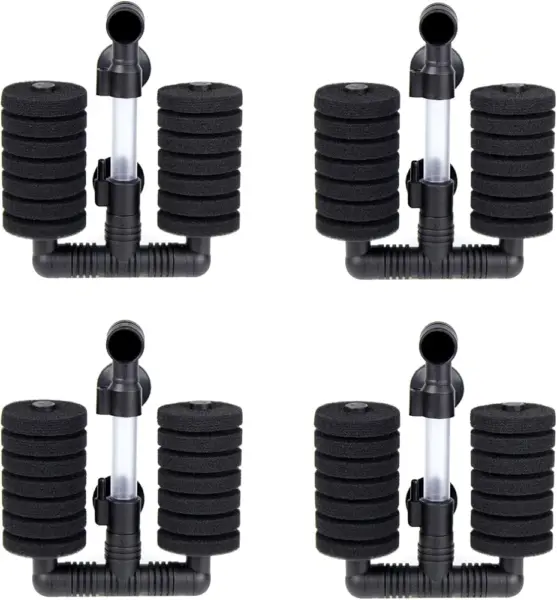
Key Features
- Pack size: 4 filters
- Dimensions: 4"L x 1.8"W x 6.25"H
- Sponge size: 1.8"D x 3.0"H
- Tank rating: Up to 20 gallons
- Price: Midrange
Vacuum packing flattens these sponges, and the listing says so: eight to ten hours in warm water brings them back, and the occasional one stays a little oval. Start the soak the night before a water change and the shape stops mattering — a slightly egg-shaped sponge filters exactly the same as a round one.
Each unit is two foam cylinders stacked on one tube, rated to 20 gallons, so a four-pack covers a rack of small tanks or a couple of 20s with one in reserve. We like the split sponge for maintenance: rinse one cylinder and leave the other alone, and most of the colony keeps working while the tank stays stocked.
Cost per filtered tank is where this wins — four filters, four tanks, one order, and a 20-gallon rating that means two of them will carry a 40 between them. It’s the pick for a breeder’s bench or a fish room, not for the one display tank in the living room.
Pros
- Four filters for multi-tank and breeder setups
- Rated to 20 gallons per unit
- Split double sponge lets you rinse half at a time
- Small footprint in a crowded fry tank
Cons
- Cup supply can fall short of the filter count
Four double sponges for roughly what a single filter costs elsewhere here — the obvious buy if you run a rack of small tanks.
Pawfly Aquarium Sponge Filter, 3-Pack – Best for Fry and Shrimp
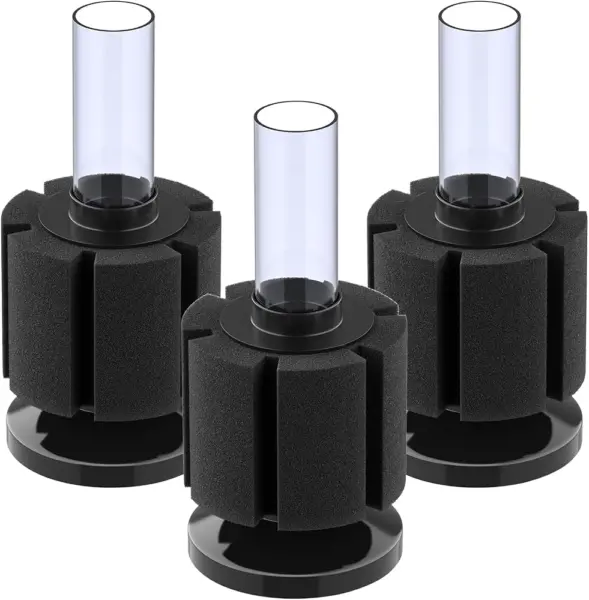
Key Features
- Pack size: 3 filters
- Dimensions: 2"D x 4.8"H
- Tank rating: 5 to 10 gallons
- Price: Budget
Three small filters for less than most single sponges in this guide is the pitch, and at two inches across by four and eight-tenths tall they are genuinely small — the size that vanishes behind a clump of plants or a piece of driftwood in a tank you’re actually looking at.
Rated 5 to 10 gallons, each one is a single sponge that pulls off the tube for rinsing. The listing’s advice of every two to four weeks in tank water is about right for a tank this size, and it’s worth following: a fine sponge cleaned under the tap loses the bacteria you spent a month growing.
Where they earn their place is a rack — three fry tanks, three shrimp tanks, a breeder’s row of fives, all filtered from one purchase. We found the sinking is the fiddly part: press each one under the surface and hold until it stops bubbling, and expect the odd unit to sit on the substrate rather than hang from a cup. Three filters also want three air feeds, whether that’s three pumps or one pump and a manifold.
Pros
- Three filters for the price of one elsewhere
- Compact two-inch footprint for small tanks
- Sponge detaches from the tube for rinsing
- Gentle aeration suits bettas, fry and shrimp
Cons
- Each filter needs its own air feed
The cheapest way here to filter three small tanks at once, as long as you have air to feed all three of them.
How We Tested the Best Sponge Filters
We started with a shortlist of 30-plus sponge filters sold widely, then narrowed it by foam type, lift-tube design, tank-size claims, replacement-part availability, and what came in the box. Price played a role, but it wasn’t the deciding factor; a cheap sponge that needs new suction cups in a month is not a bargain. We ended up with 14 units and ran them for four months.
Each filter went into one of three real setups: a 20-gallon community tank, a 10-gallon quarantine tank, and a planted shrimp tank. We mounted each on clean glass, noted whether the suction cups grabbed on the first try, then checked again after a week of water changes and gravel vacuuming. We dropped each into a bucket before mounting to see if it floated, tipped, or sank upright, and watched bubble size and flow at the surface. Noise got judged from a few feet away during a quiet evening, not by a meter, because that’s how you’ll hear it.
For filter quality, we squeezed the foam, looked for shedding or collapsing pores, and watched whether flow dropped over four weeks. Cleaning was timed: pull the sponge, rinse it in tank water, reassemble, and note if the lift tube or media came apart or was fiddly to reseat. Ease of use covered assembly without instructions, whether the air line, check valve, airstone, and other included accessories actually fit, and how each kit’s contents compared with its cost to run and maintain. We also measured each foam block against the tank footprint, because a filter that crowds the heater or won’t clear the lid is the wrong size no matter how well it works.
How to Choose an Aquarium Sponge Filter
The number on the box is per filter, not per pack, and that single confusion accounts for more wrong sponge-filter purchases than anything else.
Gallons Per Filter, Not Per Pack
A three-pack of filters rated to 10 gallons is three filters for three 10-gallon tanks, not one filter for a 30. Multiply units by rating, or don’t multiply at all. Treat the rating as a ceiling rather than a target, too: how much a sponge really carries depends on how stocked the tank is and how much air you push through it. For a 55, one filter rated to 60 beats three small ones. For a breeder rack, small units are cheaper per tank and easier to swap out.
The Pump, the Airline and the Valve
The sponge is the silent half of the system; the pump is the half you hear, and nothing in this guide includes one. Match the pump to how many filters you’re feeding, and put it somewhere its vibration won’t travel into the stand. A control valve between pump and filter is the most useful extra you can buy: it turns coarse bubbles that pop and mist the lid into a ripple, and it lets you run a betta tank at a fraction of full air.
Weighted Base or Suction Cups
Placement is a design choice, not a detail. A weighted base stands on the substrate, hides behind hardscape, and lifts straight out for a rinse. Suction cups put the sponge mid-glass where you can see it — and where it will eventually let go, especially on a rimmed tank or one with algae film on the panes. Bare-bottom quarantine tanks are the exception, since cups are the only way to keep the foam off the floor. Whichever you pick, soak a new sponge and squeeze it underwater before placing it; dry foam floats.
Foam Density, Added Media and Flow
Coarse foam clogs slowly and rinses out in a few squeezes; fine foam polishes water but wants attention more often. Added media — a second sponge, a chamber of ceramic balls — buys bacterial surface, which matters on a 100-gallon tank and is wasted in a 10. Flow is the other half of the decision. An airlift is gentle by design, which is exactly why sponge filters suit bettas, fry and shrimp, and exactly why they’re a poor choice if you need current moving across a big tank.
Rinsing Without Resetting the Cycle
The sponge is the filter, so cleaning it is the maintenance that matters. Rinse in water siphoned out during a change — never under the tap, where chlorine takes the colony with it — and squeeze rather than scrub. Every two to four weeks covers most tanks. A sponge that clogs within a week is telling you the tank is overstocked or the air is turned up past what the foam can pass. Run two filters and clean them on alternate months.
Frequently Asked Questions
Do I need to replace the sponge?
No — replace it only when the foam tears or crumbles. The sponge is the bacterial bed, so a fresh one starts the cycle over. If you have to swap it, run the new sponge beside the old one for a few weeks so the colony can spread across, then retire the old one.
Do I need a check valve on the airline?
Yes, if the pump sits at or below the waterline. When the pump stops, water can siphon down the tubing and into the pump body. A non-return valve fitted just above the water surface stops that, and it costs far less than the pump it protects.
Can I run a sponge filter from a powerhead instead of an air pump?
On large sponges, yes, and you get much stronger flow through the foam. What you lose is the gentle current that made a sponge worth choosing in the first place, and on a wide sponge the pump body can hold the unit away from the glass so it won’t mount flat. Check the powerhead’s intake diameter against the filter’s tube before you commit.
How long before a new sponge filter clears the water?
The mechanical part is quick: a running sponge traps floating debris, and particle cloudiness usually settles within a day or two. The bacterial side takes weeks. Stock the tank slowly and test for ammonia and nitrite before you assume the filter is cycled.
Final Verdict
For anything 10 gallons or under — a betta tank, a fry box, a shrimp colony — the small AQUANEAT is the filter we recommend, and it’s the least expensive decision on this page. It’s also the kind of purchase people repeat, because once a sponge filter is running quietly in a corner, the next tank gets one too.
Size up only when the gallon count forces it: the Aquapapa three-pack for a 55 or 60 that needs real sponge mass, the ALEGI kit when you want a single large-tank order that arrives complete, and the DVHEY pair once you’re past 100 gallons.