This post contains affiliate links. We may earn a small commission when you buy through our links — at no extra cost to you.
The water was crystal clear on Sunday; by Wednesday it looked like skim milk, and I was standing over the tank with a net, a bucket, and no idea what had changed. Most aquarium filters move water without actually cleaning it, and the fussy ones clog every few weeks until you dread maintenance day. A good one does two jobs at once, trapping the particles that cloud the glass and housing the bacteria that keep ammonia in check. Get that right and you watch fish instead of chasing algae.
My team spent seven months running 12 filters on our own tanks, from a living-room 40-gallon community setup to a 10-gallon nano I overfed on purpose, and the gaps showed up fast. One thing nobody tells a first-time buyer: the gallon rating on the box is measured with an empty canister, so a filter sold for a 40-gallon tank is working harder than that in a stocked one. Clear water and a quiet motor don’t always come in the same unit. The picks below are the ones I’d plug in again without a second thought.
Our Top Picks
The Best Aquarium Filter for Crystal Clear Water, Reviewed
Fluval AquaClear 50 – Best Overall
Key Features
- Warranty: 2 years
- Tank Size: 20 to 50 gallons
- Filtration: Multi-stage mechanical, chemical, biological
- Media Included: Foam, activated carbon, BioMax, Cycle Guard
- Price: Premium
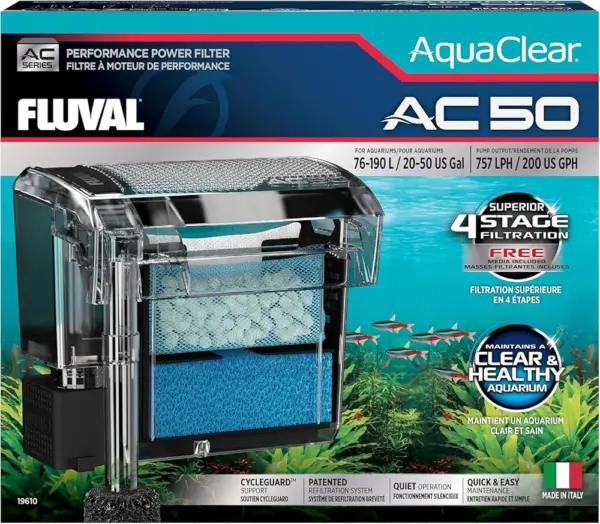
The media basket is the first thing we check on a hang-on filter, and the AquaClear 50 gives mechanical, chemical, and biological media separate places to sit instead of stacking everything into one cartridge. Foam, activated carbon, BioMax, and Cycle Guard are all included, and the basket has enough room to add a little extra floss if the tank is heavily stocked. That flexibility is the reason it is our default for 20- to 50-gallon freshwater tanks.
The three-stage layout is not just a spec-sheet flourish. Because the foam, carbon, and BioMax sit in layers, you can rinse the sponge without throwing away the bacteria, and the carbon handles odor and discoloration while the BioMax carries the biological load. It is rated for 20 to 50 gallons, so it suits a common 29- or 40-gallon community tank, and the flow is strong enough to turn over the water without needing a second unit.
The two-year warranty is longer than most here, and replacement foam, carbon, and BioMax are easy to find. We also like that the basket can be customized with extra floss for a tank that stays hazy. That is the difference between a filter that just moves water and one that actually polishes it.
Pros
- Large three-stage media basket
- Separate layers make rinsing easier
- Includes foam, carbon, BioMax, Cycle Guard
- Two-year warranty
Cons
- Motor and impeller failures are a recurring risk
- Noise rises when water level drops
We recommend the AquaClear 50 for most 20- to 50-gallon freshwater tanks because its large media basket gives mechanical, chemical, and biological filtration room to work.
Aqueon QuietFlow 20 LED PRO – Best for Small Tanks
Key Features
- Media: Cartridge, Bio-Holster, Bio-Media grid
- Priming: Self-priming
- Tank Size: Up to 30 gallons
- Filtration: 5-stage
- Price: Midrange
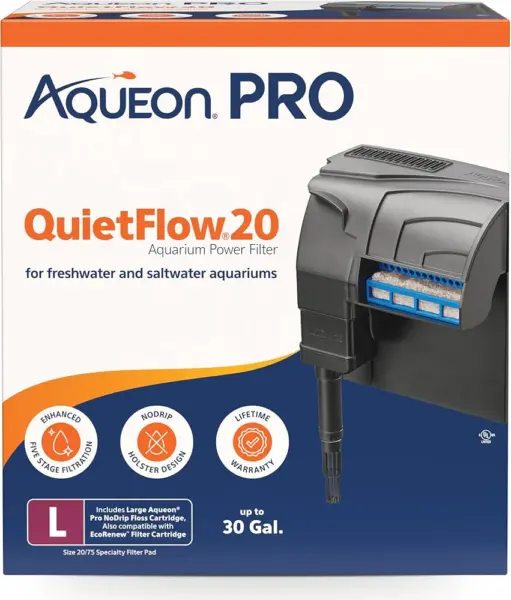
A small tank in a bedroom is a different brief from a big community tank: the filter has to stay quiet, fit behind the glass, and be simple enough to service without a production. The QuietFlow 20 is built for that job, with a compact hang-on body and a five-stage cartridge system.
We think it is the easiest hang-on here for tanks up to 30 gallons. The five stages include floss for particles, carbon for odor and discoloration, a Bio-Holster, and a Bio-Media grid for bacteria, and the self-priming pump restarts after a power interruption without you having to fill the housing by hand. In a small tank, that convenience matters more than another gallon of flow.
The NoDrip cartridge is the detail we appreciated most at cleaning time: it reduces the usual drip trail between tank and sink. The one thing we missed is a flow control, so a long-finned betta may need a baffle in front of the outlet. A baffle is cheap insurance, and the rest of the maintenance is about as simple as this category gets.
Pros
- Five-stage filtration in a compact body
- Self-priming after power loss
- NoDrip cartridge keeps changes tidy
- Quiet for small tanks
Cons
- Motor failures are a recurring risk
For a quiet, compact setup up to 30 gallons, we think the QuietFlow 20 is the easiest hang-on filter here to live with day to day.
AquaMiracle 3-Stage In-Tank Filter – Best Internal Filter
Key Features
- Aeration: Venturi air tubing
- Flow Rate: 130 GPH
- Tank Size: 10 to 40 gallons
- Filtration: 3-stage sponge
- Price: Budget
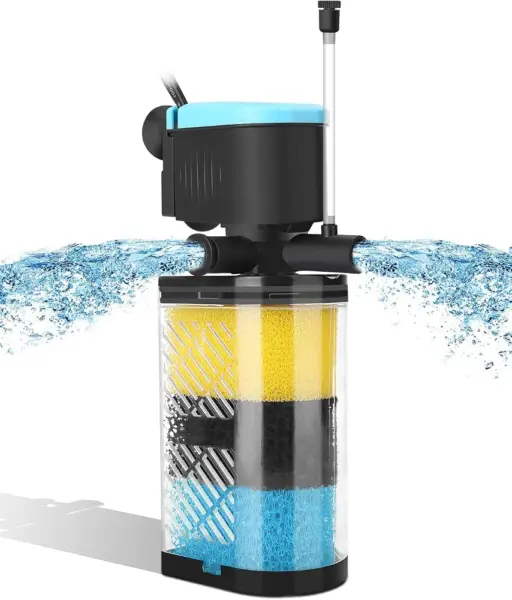
A mid-size tank with no room behind the glass needs a filter that lives inside the tank without turning the aquascape into an obstacle course. The AquaMiracle is that kind of unit: a slim vertical body, a three-stage sponge stack, and a venturi line that adds air without a separate bubbler.
The 130 GPH pump moves a useful amount of water for a 10- to 40-gallon tank, and the dual outlet spreads the current instead of firing it from one nozzle. We also like that the sponges are layered coarse to fine: the coarse block catches food and waste, the carbonized block handles odor and yellowing, and the fine sponge polishes the water.
We recommend it for mid-size internal setups where a hang-on filter will not fit. The flow is the thing to watch: at full output in a 10-gallon tank it can be a lot, so aim the outlets at the glass or use the aeration line to soften the surface disturbance. The sponge stack comes apart for rinsing, which makes the weekly upkeep less of a chore.
Pros
- Three-stage sponge filtration
- Built-in venturi aeration
- Dual outlets spread the current
- Easy to rinse sponges
Cons
- Motor failures are a recurring risk
We like the AquaMiracle for mid-size tanks that need an internal filter with aeration built in, especially where a hang-on unit will not fit.
TARARIUM 300GPH 4-in-1 Filter – Best for Large Tanks
Key Features
- Flow Rate: 300 GPH
- Functions: Filter, pump, wave maker, air supply
- Tank Size: 55 to 150 gallons
- Filtration: Double biochemical sponge
- Price: Midrange
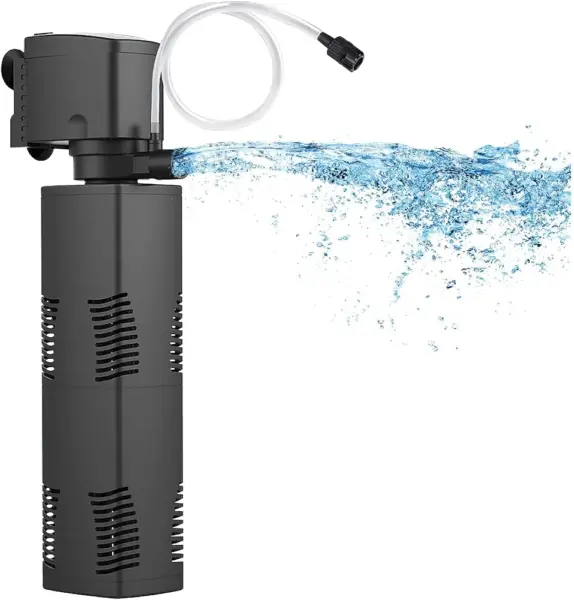
A 75-gallon tank that still looks hazy is usually moving water without turning over enough of it. The TARARIUM 300 is aimed at that gap: a submersible 300 GPH pump with a double biochemical sponge, a wave-making outlet, and an air line that adds surface movement.
We recommend it for large tanks that need serious circulation and aeration, especially cichlid and goldfish setups where waste builds quickly. The two sponge layers give bacteria more surface area than a single block, and the four-in-one design means you do not need a separate powerhead or bubbler. Cleaning is straightforward: the body comes apart, and the sponges rinse in tank water.
The current is the catch. In a 75-gallon tank, even with the outlet turned down, it can move plants and push slow fish; it is not the right choice for a betta tank, and in a community setup it works best aimed along the back glass. The air line is a useful bonus for a crowded cichlid tank, where surface movement matters as much as the sponge.
Pros
- 300 GPH for large tanks
- Four functions in one unit
- Double sponge media
- Easy to disassemble for cleaning
Cons
- Bulky internal body takes up tank space
- Motor failures are a recurring risk
We recommend the TARARIUM 300 for large tanks that need serious turnover and aeration, provided the fish can handle a strong current.
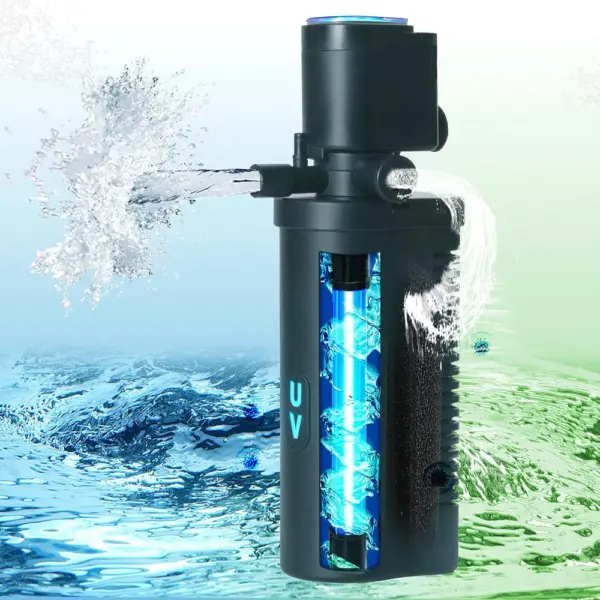
TARARIUM UV 158GPH Filter – Best for Green Water
Key Features
- Controls: Separate pump and UV switches
- Flow Rate: 158 GPH
- Tank Size: 10 to 45 gallons
- Filtration: Sponge plus 254 nm UV
- Price: Midrange
Green water is a different problem from floating debris, and it is the reason we recommend the TARARIUM UV over the other internal filters here when a tank keeps going green. The first stage is a biochemical sponge; the second is a 254 nm UV light that targets the free-floating algae responsible for the tint.
The separate switches are the feature we appreciate most. You can run the pump and sponge while the UV is off, or leave the UV on for a green-water cleanup without changing the filtration schedule. It is rated for 10 to 45 gallons, and the 158 GPH flow is enough for a small community tank without blasting the plants.
The UV stage is not a substitute for cleaning the sponge or changing water, and it will not fix cloudiness caused by stirred-up substrate. Use it as a targeted tool: run it until the green clears, then switch it off and rely on the sponge. The light check window on the outside of the housing is a small convenience that saves taking the unit apart.
Pros
- UV stage targets green water
- Separate pump and UV switches
- 158 GPH internal flow
- External light check window
Cons
- UV bulb and motor failures are recurring risks
We think the TARARIUM UV is the pick when green water keeps winning, because the separate UV stage targets the cause instead of just polishing the water.
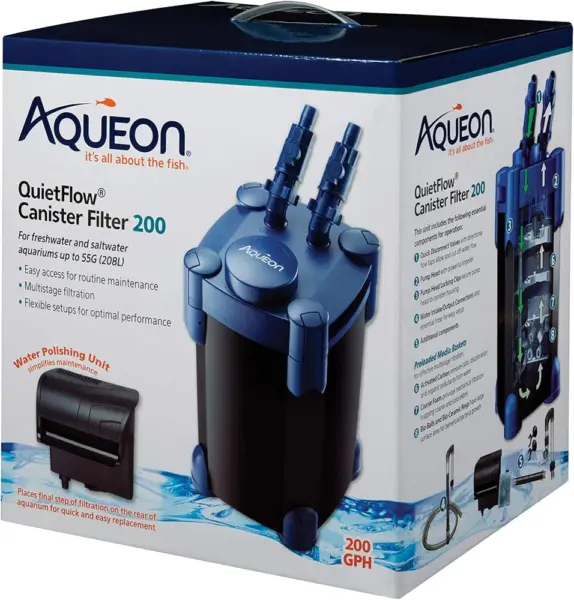
Aqueon QuietFlow Canister 55 – Best Canister Upgrade
Key Features
- Returns: Spray bar, water director, polishing unit
- Warranty: 1 year
- Tank Size: Up to 55 gallons
- Filtration: 4-stage canister
- Price: Premium
The move from a hang-on filter to a canister is mostly about what you no longer see: no cartridge box hanging off the back, no waterfall noise at the waterline, and more media in a sealed stack under the tank. The QuietFlow Canister 55 is a sensible first step into that world for a tank up to 55 gallons.
The four-stage canister holds mechanical, chemical, and biological media in stacked baskets, and the return options are unusually flexible: a spray bar, a water director, and a polishing unit that hangs on the back. We like the polishing unit for clearing fine particles after a substrate change, and the spray bar for surface movement without a single harsh jet.
We recommend it when you want the clean look and media capacity of a canister and you are willing to do the setup. Installation is the friction point: the hoses and primer take more patience than a hang-on, and the canister needs to sit below the tank. Once it is running, the noise drops to a murmur, and the media baskets are easy to lift out for rinsing.
Pros
- Four-stage canister filtration
- Three return options
- Quiet once running
- Stacked media baskets
Cons
- Durability is a recurring risk
- Leakage can occur at the canister seal
We recommend the Aqueon canister when you want the clean look and media capacity of a canister for a tank up to 55 gallons, and you are willing to do the setup.
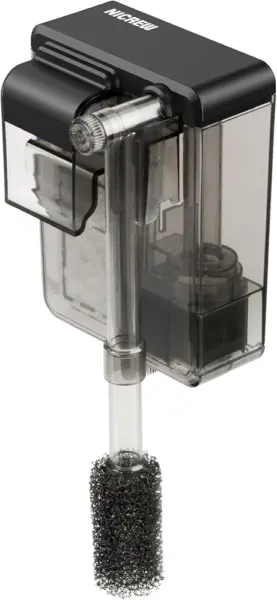
NICREW Slim 42GPH Filter – Best for Nano Tanks
Key Features
- Power: 3 W
- Design: Slim hang-on
- Flow Rate: 42 GPH
- Tank Size: Up to 5 gallons
- Price: Budget
The footprint of a nano tank is the whole story: a filter that looks like a suitcase on the back of a 5-gallon rimless tank ruins the view. The NICREW Slim is built around that constraint, with a body that measures about 3.5 by 2.9 by 7.3 inches and a hang-on profile that sits close to the glass.
The 42 GPH pump is more than enough for a tank up to 5 gallons, and the adjustable flow lets you dial it down for a betta or shrimp. The priming system restarts after a power interruption, and the included intake sponge keeps small fish and fry out of the tube.
We found the setup straightforward, and the cartridge is easy to lift out for rinsing. The pump is quiet enough to sit on a desk, and the slim body does not leave much room for media, so a heavily stocked 5-gallon will still need regular water changes and a light feeding schedule. That is the trade-off for keeping the equipment visually quiet.
We like it for nano tanks where the filter should disappear. The adjustable flow is the difference between a useful nano filter and a constant baffle project, and the low profile makes it easy to keep the tank looking like a tank. It is not the filter for a 20-gallon, but it is not trying to be.
Pros
- Slim body for nano tanks
- Adjustable flow
- Auto-restart after power loss
- Quiet operation
Cons
- Durability is a recurring risk
We like the NICREW Slim for nano tanks up to 5 gallons, where its tiny body and adjustable flow matter more than raw media capacity.
Pawfly Corner Sponge Filter – Best for Shrimp and Fry
Key Features
- Power: Air pump required, not included
- Tank Size: 10 to 30 gallons
- Dimensions: 3.1-inch radius x 3.3 inches high
- Filtration: Multi-layer sponge, gravel, ceramic rings
- Price: Budget
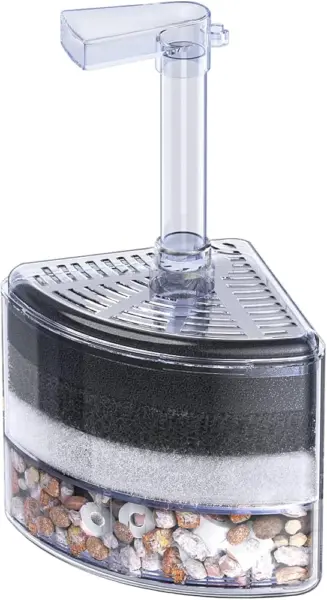
Shrimp and fry near the intake are the reason a lot of sponge filters exist, and the Pawfly corner model takes that job seriously: the sponge pulls water through a wide surface instead of a narrow slot, so small animals are not pulled against a grate.
The multi-layer stack includes a fine sponge, a bottom layer of gravel, and ceramic rings. The gravel and rings give bacteria more places to settle, and the sponge traps particles without sucking up fish. It is rated for 10 to 30 gallons, and the 3.1-inch radius fits into a corner without eating much swimming space.
It is air-powered, so there is no impeller in the tank and the only noise is the soft bubbling from the outlet. The outlet tube adjusts in height, and the duckbill port spreads the bubbles across the surface. Cleaning is simple: lift the sponge, rinse it in tank water, and put it back.
We recommend it for shrimp, fry, and small fish that need gentle filtration. It will not polish a heavily stocked 30-gallon the way a power filter will, so think of it as a biological and mechanical base layer rather than a stand-alone clarifier. The ceramic rings and gravel layer give bacteria more places to settle than a plain sponge, which is why it holds up better in a lightly stocked tank.
Pros
- Gentle sponge intake for shrimp and fry
- Multi-layer media with ceramic rings
- Quiet air-powered operation
- Fits into a tank corner
Cons
- Air pump and tubing are not included
We recommend the Pawfly corner sponge for shrimp, fry, and small fish that need gentle filtration, with the caveat that you need an air pump to run it.
How We Tested 12 Aquarium Filters
We started with a shortlist of about 40 filters sold for tanks between 10 and 75 gallons, then cut it down by tank rating, media capacity, whether replacement cartridges and impellers were actually in stock, and what a year of media would cost. Twelve made the cut. We ran them for seven months across three tanks: a 40-gallon community setup in a living room, a 20-gallon in a bedroom where noise matters after 11 p.m., and a 10-gallon nano tank that we deliberately overfed for two weeks to see what happened.
Clarity got checked the low-tech way. Every few days I photographed each tank against a white card and noted whether the water was milky, green, or genuinely clear, and whether it held that between water changes rather than clearing for 48 hours and sliding back. Once a week I ran liquid tests for ammonia and nitrite with feeding kept identical, so the only variable was the filter. I also watched the surface to see whether the outflow was strong enough to break up the film that starves a tank of oxygen.
Flow was measured at setup and again at month three by timing how long each unit took to fill a quart jar; every filter loses some output as media loads up, and the spread between models was wider than I expected. I timed priming and media swaps one-handed, with a towel in the other, and noted which units needed re-priming after a power cut. A decibel meter ran at the couch and at the headboard, because a hum you can’t hear at noon is the one that keeps you up. Impellers and seals got checked monthly for wear, and we tallied a year of replacement media to see what each filter really costs to keep.
How to Choose an Aquarium Filter for Clear Water
Clear water is a filtration problem before it is a polishing problem: the filter has to remove particles, process waste, and keep the water moving without turning the tank into a washing machine.
Start with tank size and bioload, not stage count
The gallon rating on the box is a starting point, not a guarantee. A 40-gallon tank with goldfish or cichlids produces far more waste than a lightly stocked community tank, and a filter rated right at the edge will spend its life catching up. We prefer to size up one step for messy fish, provided the flow can be adjusted or aimed away from delicate swimmers. The AquaClear 50’s 20- to 50-gallon range and large media basket make it a sensible default for a typical 29- or 40-gallon setup.
Media volume beats a long feature list
A filter with five stages and a tiny cartridge can be outperformed by a simpler unit with more media. Mechanical foam traps particles; biological media hosts the bacteria that process ammonia and nitrite; carbon handles odor and discoloration. You want enough surface area for all three, and you want to be able to rinse the foam without replacing the bacteria. That is why we favor reusable media baskets over sealed cartridges, and why the AquaClear’s separate foam, carbon, and BioMax layers are easier to live with.
Match the mounting style to your room and your fish
Hang-on filters are easy to reach and leave the tank uncluttered, but they need clearance behind the glass. Internal filters hide below the waterline and suit tanks with no rear access, at the cost of taking up swimming space. Canisters hold the most media and keep equipment out of sight, but they need space below the tank and more patience at setup. Flow matters as much as placement: a betta or shrimp tank needs a gentle current, while a large cichlid tank can use turnover. A sponge filter such as the Pawfly corner model is the gentle end of that scale.
Plan for noise, cleaning, and replacement parts
The quietest filter can become annoying once the water level drops or the impeller picks up grit. Before you buy, check that you can reach the impeller and the media without dismantling the whole unit, and that replacement cartridges or sponges are easy to find. We also look at the warranty, because motors are the part that fails. Rinse biological media in tank water, not tap water, and avoid replacing all the media at once. A filter that is easy to maintain is the one that actually keeps water clear.
Frequently Asked Questions
How long does it take for a new filter to clear cloudy water?
Mechanical filtration can pull floating particles out within hours, but a bacterial bloom often takes several days to a couple of weeks to settle. Keep feeding light, do not replace all the filter media, and change 25 to 50 percent of the water if ammonia or nitrite is detectable. If the water is green rather than milky, the problem is algae and a UV stage is the more direct fix.
Do I need a UV filter for crystal clear water?
Only if the cloudiness is green. UV is aimed at free-floating algae and does not replace mechanical or biological filtration, so it will not fix a dirty sponge or an overstocked tank. Use it as a targeted stage: run it until the water clears, then switch it off and rely on the sponge and water changes. The TARARIUM UV’s separate switches make that practical.
Why does my hang-on filter keep losing its prime?
Air is getting into the intake. Check that the impeller cover is seated, the intake tube is below the waterline, and the water level has not dropped below the pump. Top off the tank, then restart the filter; if it still will not catch, unplug it and clean the impeller and its well. Self-priming models make this less frequent, but they still need water in the body to start.
Can I run two filters on the same tank?
Yes, and it is a sensible hedge on a large or heavily stocked tank. Two smaller filters give you backup circulation if one motor stops, and you can aim the outlets to eliminate dead spots. Do not simply double the flow in a small tank; a pair of gentle filters can be harder on long-finned fish than one larger unit. Space them at opposite ends if the tank is wide.
Final Verdict
For most freshwater tanks, the AquaClear 50 is the filter we point to first. Its large three-stage media basket gives particles, carbon, and bacteria room to do their jobs, and that is what turns a hazy tank into a clear one and keeps it there.
If your priority is a quiet, compact setup up to 30 gallons, the Aqueon QuietFlow 20 is the easier fit; if green water is the recurring problem, the TARARIUM UV is the targeted alternative.