This post contains affiliate links. We may earn a small commission when you buy through our links — at no extra cost to you.
A reliable timer is the backbone of a healthy aquarium – it keeps lights on a consistent photoperiod, runs pumps and CO2 systems on cue. But the cheap mechanical timers that dominate the shelf often drift minutes per week or develop a loud tick that echoes in a quiet living room.
Digital timers solve the noise and accuracy problems, yet many lack a ground prong, making them incompatible with three-prong pumps and heaters. You end up juggling adapters or risking safety.
The real choice comes down to your equipment: grounded outlets for pumps, silent operation for bedrooms, and whether you can tolerate a periodic reset. This guide matches each timer to a specific use case – so you don’t pay for features you don’t need or miss the one you do.
Top Picks
Best for Lights & Pumps
G-Homa Outdoor Mechanical

Rating: 4.5 ★ | Price: $ | Timer Type: Mechanical 24h | Outlets & Grounding: 2 grounded | Min Interval: 30 min | Weatherproof: Yes
The G-Homa Outdoor Mechanical timer stands apart from budget alternatives with its notably solid construction – fewer owners report early issues, and the weatherproof flip cover reliably shields both outlets from rain and cold. Large day/night pins make setting a single on/off schedule a matter of minutes, no manual required.
This timer is best for aquarium owners who want a simple, no-fuss device for lights and pumps on a daily cycle. Like all mechanical timers, the dial may drift a few minutes over time, so occasional resetting is part of the routine – a minor inconvenience for the weatherproof durability and low price. If you need multiple daily schedules or digital accuracy, look elsewhere.
Pros
- Sturdy build holds up in outdoor enclosures and wet environments.
- Weatherproof flip cover protects outlets from rain and snow, suitable for year-round outdoor use.
- Clear day/night dial with 30-minute intervals makes programming quick and intuitive.
Cons
- The timer mechanism can occasionally skip a cycle, so pairing with a backup schedule or buying from a store with easy returns is wise.
- Only supports one on/off cycle per 24 hours – not suited for aquariums with multiple time-controlled devices on different schedules.
The G-Homa Outdoor Mechanical is a straightforward, weather-resistant timer that handles basic aquarium light and pump schedules without fuss at a low cost – just accept the occasional drift and single-cycle limit.
Best for Complex Schedules
BN-LINK Digital 7-Day

Rating: 4.4 ★ | Price: $$ | Timer Type: Digital 7-day | Outlets & Grounding: 2 grounded | Min Interval: 1 min | Weatherproof: No
Eight programmable on/off times per day allow separate schedules for lights, CO2 injection, and pumps from a single unit. Dual grounded outlets handle two devices simultaneously, and the battery backup retains settings through power outages. The tradeoff is upfront: programming takes patience — the manual is dense and the interface isn’t intuitive. This timer suits aquarists who need complex cycles and don’t mind a learning curve; for simpler on/off needs, a mechanical timer is easier to set and forget.
Pros
- Up to 8 on/off times per day with independent 7-day scheduling.
- Dual grounded outlets let you control lights and pumps simultaneously.
- Battery backup holds settings during power outages.
Cons
- Programming involves a steep learning curve — expect to study the manual or watch a video.
- Time accuracy may drift slightly over weeks, requiring occasional correction.
A strong choice when you need multiple timed zones per day and can invest time in setup. For basic on/off cycles, a simpler mechanical timer is less hassle.
Best for Outdoor Equipment
BN-LINK Outdoor Mechanical
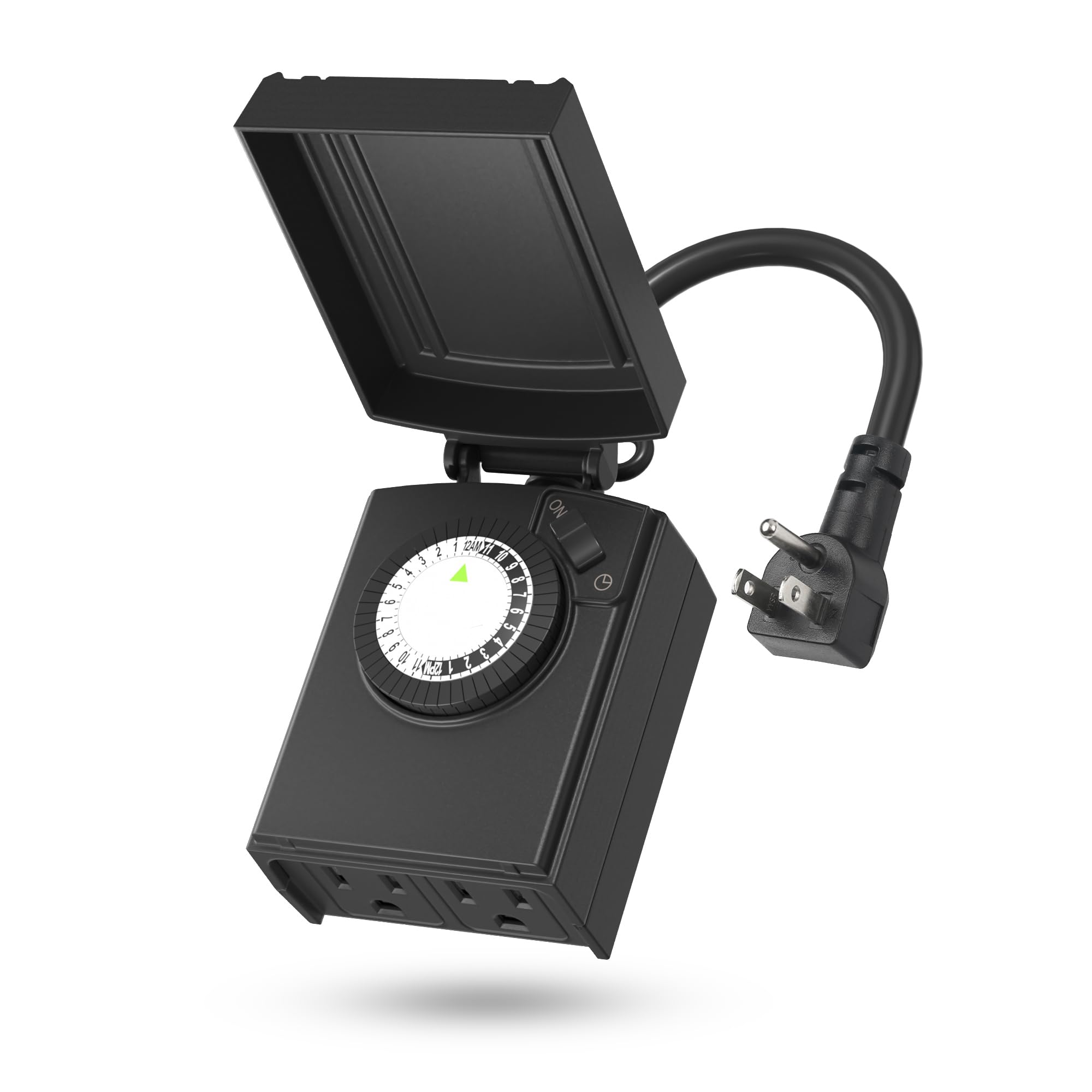
Rating: 4.5 ★ | Price: $ | Timer Type: Mechanical 24h | Outlets & Grounding: 2 grounded | Min Interval: 30 min | Weatherproof: Yes
The BN-LINK Outdoor Mechanical timer combines a weatherproof cover and two grounded outlets with a simple 24-hour pin dial — a no-fuss way to control aquarium lights or pumps in exposed locations. Its 30-minute intervals and mechanical timekeeping handle routine daily cycles, though time will drift slightly over weeks (typical of this type). Where this unit differs from the top pick is build consistency: some units may stop working after a few months, making a flexible return policy worth considering. This timer suits budget-conscious aquarists who want a basic outdoor schedule and can accept the possibility of an early replacement.
Pros
- Weatherproof cover protects timer from rain and snow in outdoor spots.
- Simple pin-and-dial scheduling with 30-minute increments — no programming required.
- Two grounded outlets let you control two devices simultaneously.
Cons
For outdoor aquarium setups that don’t require pinpoint accuracy and where budget is a priority, this timer’s weatherproof design and dual outlets deliver good value — just be prepared for the possibility of early replacement.
Best for Indoor Lights
GE 24h Indoor Mechanical
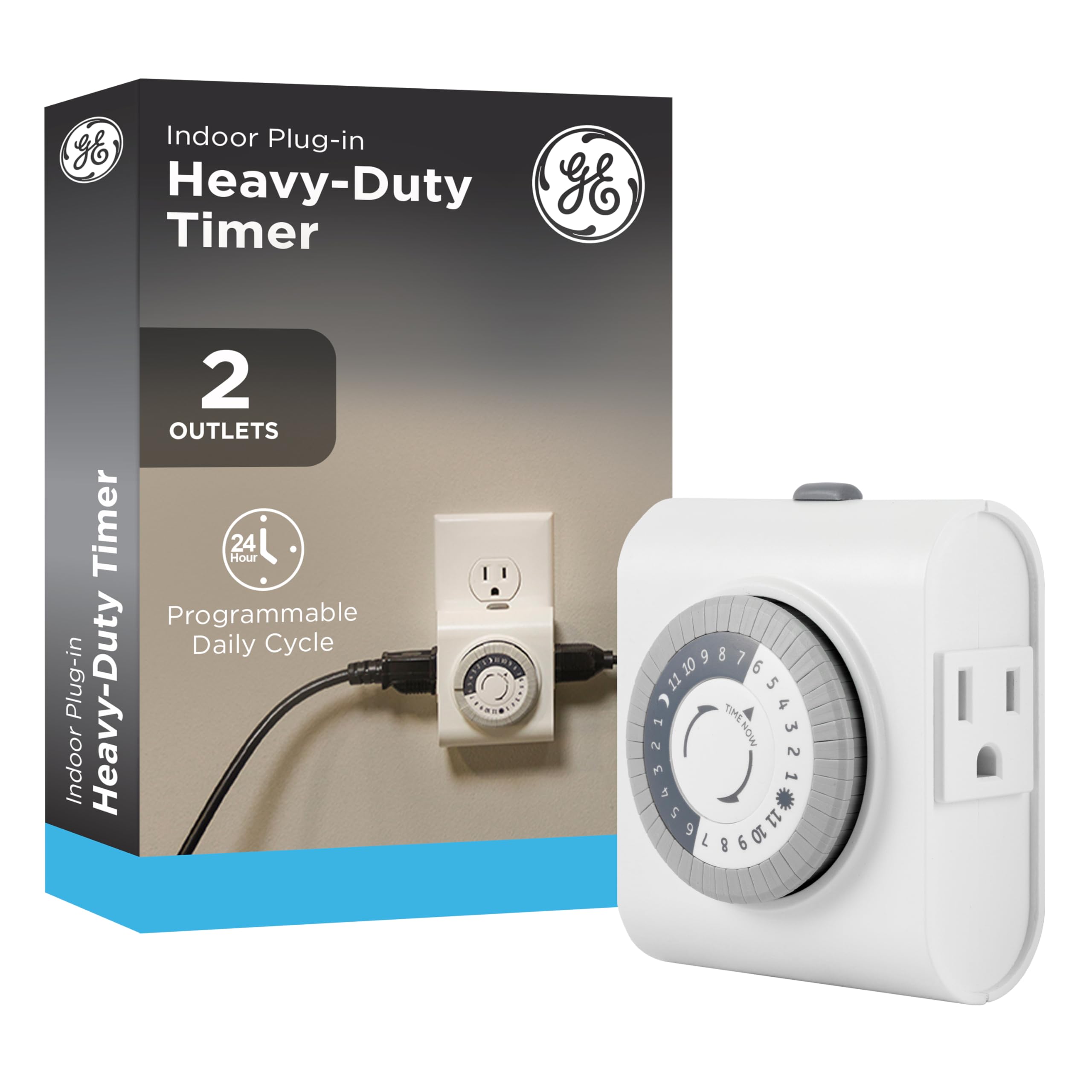
Rating: 4.6 ★ | Price: $ | Timer Type: Mechanical 24h | Outlets & Grounding: 2 grounded | Min Interval: 30 min | Weatherproof: No
GE’s consistent performance record makes this indoor mechanical timer a solid choice for basic 24-hour cycles on aquarium lights. The pushpin setup takes a minute to learn, with no programming needed – dual grounded outlets handle lights and pumps at 30-minute intervals. Unlike the top pick’s outdoor focus, this unit stays indoors and lacks weatherproofing. Best for setups in living areas or fish rooms where the mechanical ticking won’t be distracting – the hum is noticeable in quiet spaces. An entry-level price adds to its appeal for simple schedules.
Pros
- Simple pushpin setup with no programming required
- Dual grounded outlets for lights and pumps at 30-minute intervals
- Budget-friendly price for a dependable indoor timer
Cons
- Mechanical ticking or humming may be noticeable in quiet rooms
A cost-effective indoor timer for simple aquarium lighting schedules.
Best for 2-Prong Lights
Fosmon Digital 2-Pack

Rating: 4.4 ★ | Price: $$ | Timer Type: Digital 24h | Outlets & Grounding: 1 polarized | Min Interval: 1 min | Weatherproof: No
Unlike mechanical timers that tick or hum, these digital units operate silently and program via a large, intuitive LCD display. The two-pack delivers strong value for setups needing multiple timed outlets. The polarized 2-prong socket means they won’t accept grounded plugs — best suited for LED aquarium lights rather than pumps or heaters. Occasional units may arrive non-functional or stop working within a few months, so verifying function immediately is wise.
Pros
- Large LCD display with intuitive programming — set on/off times in seconds.
- Completely silent operation — no ticking or humming in quiet rooms.
- Two timers in one package for the price of a single unit elsewhere.
Cons
- Polarized 2-prong outlet cannot accept grounded plugs — incompatible with pumps, heaters, or other 3-prong equipment.
- Some units may arrive defective or develop issues within a short period — worth testing on arrival.
A straightforward option for non-grounded aquarium lights where quiet operation and easy programming take priority over grounded compatibility.
Best for Simple One-Cycle
DEWENWILS Digital 2-Pack

Rating: 4.4 ★ | Price: $$ | Timer Type: Digital 24h | Outlets & Grounding: 1 polarized | Min Interval: 1 min | Weatherproof: No
The DEWENWILS digital timer differentiates itself from mechanical options with silent operation and a battery backup that holds settings for months. Programming is straightforward via five buttons and a large display. However, it only supports one on/off cycle per day – inadequate for multiple periods – and its polarized outlet cannot accept grounded plugs without an adapter.
This timer suits aquarium setups that need a single daily light cycle for 2-prong LED lights, where quiet operation and easy setup are valued. For more complex schedules or grounded equipment, an alternative timer is a better fit.
Pros
- Programming is quick thanks to five buttons and an easy-to-read display.
- Operates silently – no mechanical ticking to disturb a quiet room.
- Backup battery preserves the schedule for months, even after a power outage.
Cons
- Durability may vary between units; some have been noted to have shorter lifespans than expected.
A simple, quiet digital timer for basic 2-prong light schedules – not for multi-cycle or grounded equipment.
Best for Compact Temporary
GE Single Mechanical
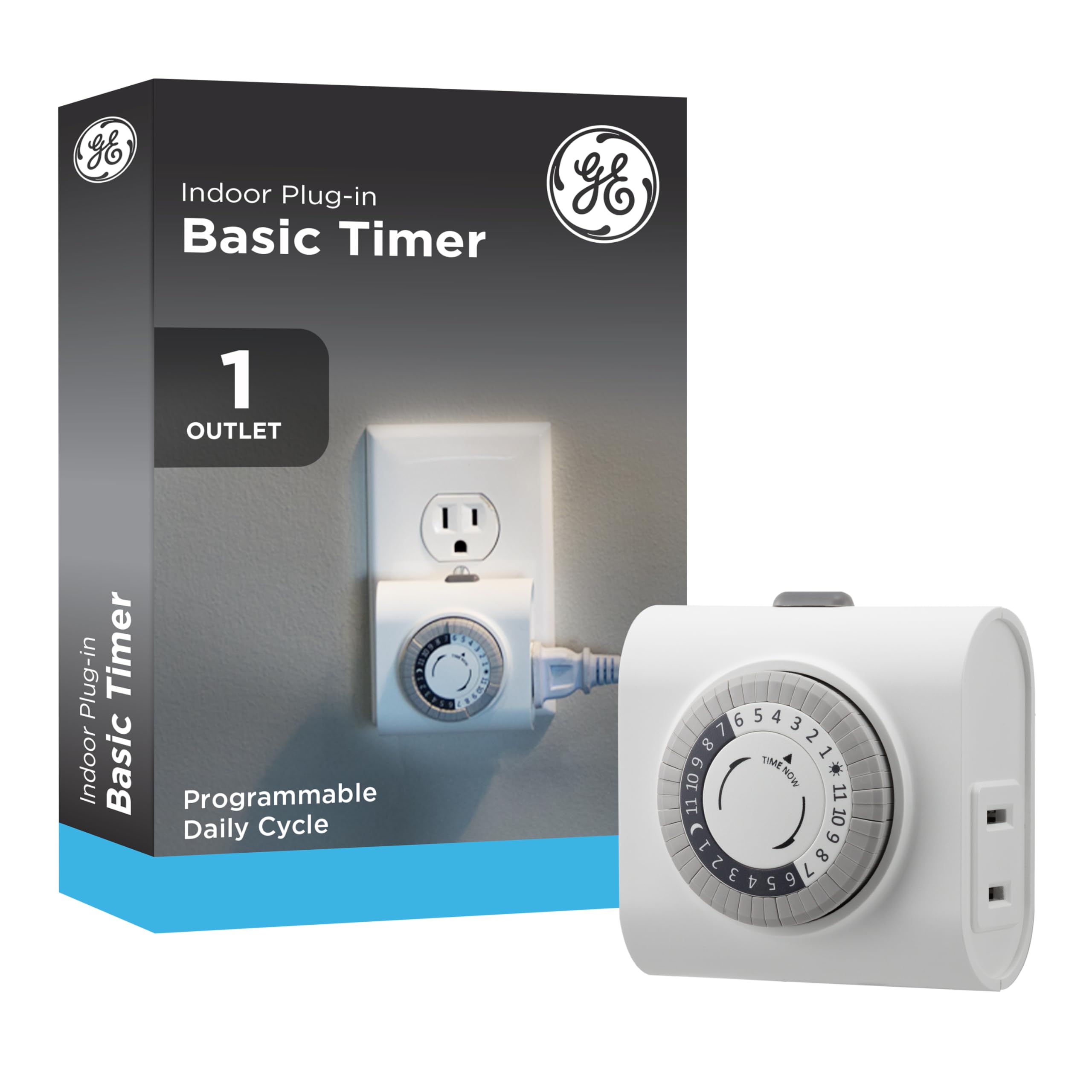
Rating: 4.4 ★ | Price: $ | Timer Type: Mechanical 24h | Outlets & Grounding: 1 polarized | Min Interval: 30 min | Weatherproof: No
At roughly half the width of typical mechanical timers, this GE model slips into crowded outlets without blocking adjacent plugs — a genuine advantage for cramped power strips. However, the push-pins require firm pressure to set, and the overall build does not hold up well to consistent daily use. It is best reserved for temporary seasonal lighting where schedule precision is non-essential.
Pros
- Tiny footprint fits in tight outlets without blocking neighboring plugs.
- Dependable for basic on/off scheduling in non-critical applications.
Cons
- Mechanical timekeeping can drift over time, requiring periodic schedule adjustments.
Only consider this if your outlet space is extremely limited and you’re willing to reset the timer weekly for non-critical tasks like holiday lights.
How to Choose
The first decision is whether you need the simplicity of a mechanical timer or the precision of a digital one – it determines noise, accuracy, and scheduling flexibility.
Mechanical vs Digital Timer
Mechanical timers use a rotating dial with pushpins to mark on/off periods. They’re cheap, easy to set, and work with any load up to 15 amps. But the internal clock motor gradually drifts – expect to lose or gain a few minutes per week, and you’ll need to reset after power outages.
Digital timers rely on a quartz crystal, holding time within seconds per month. They run silently and often include a battery backup that retains settings through blackouts. The trade-off: many digital models are harder to program, and some lack grounded outlets.
Outlets and Grounding
A grounded (three-prong) outlet provides a safety path for electrical faults. If your pump or heater has a three-prong plug, the timer must have a grounded receptacle – otherwise you’re running equipment without protection. Polarized (two-prong) timers work only for equipment with two-prong plugs, typically LED lights.
Check your gear before buying: most submersible pumps and heaters use three-prong plugs. Using a two-prong timer with a three-prong device via an adapter defeats the ground and is unsafe.
Minimum Interval Precision
Mechanical timers have fixed intervals – typically 15 or 30 minutes – because the pushpins snap into pre‑molded slots. That’s fine for overnight lighting or a pump that runs once an hour. For CO2 injection or dosing pumps that need to turn on for just 5 minutes every 90 minutes, you need a digital timer with one‑minute precision.
If your only need is a simple day/night light schedule, 30‑minute intervals are plenty. If you automate multiple circuits, look for 1‑minute resolution.
Weatherproofing
An outdoor timer has a gasketed cover that protects the plugs and controls from rain, splashes, and humidity. For an aquarium inside a stand, a basic indoor timer works unless you routinely splash water during water changes. Outdoor-rated timers often use a clear flap that must be closed – leaving the cover open defeats the weatherproofing.
In a humidity-prone fish room or next to a pond, the extra seal makes a real difference in lifespan. Indoor timers exposed to moisture fail faster due to corrosion of the contacts and motor.
Battery Backup
Digital timers with a rechargeable battery or a coin cell keep the clock running during a power outage. Without backup, you’ll find your lights stuck on or off after a brief flicker, and you’ll have to reprogram the schedule. Mechanical timers have no backup – after an outage they just stop, and the dial will show the wrong time until you manually turn it back to the correct position.
If you live in an area with frequent power interruptions, a digital timer with battery backup saves you the frustration of resetting schedules. For stable power, a mechanical timer’s simplicity may be enough.
FAQ
Why does my mechanical aquarium timer make a loud ticking noise at night?
Mechanical timers contain a small synchronous motor that drives the dial. Over time, the gears can wear or become dry, producing a distinct ticking or humming sound. This is normal for most mechanical models, especially in quiet rooms. Digital timers run silently – if noise bothers you, switch to a digital timer or isolate the mechanical unit inside a cabinet.
Can I use a digital timer with a grounded aquarium pump?
Only if the digital timer has a three-prong grounded outlet. Many digital timers, especially budget two-packs, use polarized two-prong receptacles to keep costs down. They cannot accept a grounded plug safely. Check the product specs: if it says ‘polarized’ or ‘2-prong’, you need a different timer or a grounded model.
How often do I need to reset a mechanical light timer for my fish tank?
Mechanical timers typically drift 2–5 minutes per week. After a month, your lights could come on 15 minutes early or late. You’ll want to check and reset the dial every two to four weeks to maintain a consistent photoperiod. After a power outage, you must reset it immediately because the dial stops.
Is it safe to plug a heater and light into the same timer outlet?
It depends on the total wattage. Most timers are rated for 15 amps (about 1800 watts). A typical aquarium heater uses 50–300 watts, and LED lights use 10–50 watts. As long as the combined load stays under 80% of the rating (1440 watts), it’s safe. However, don’t share a single timer outlet with a heater and a pump that cycles on and off frequently – the power drawn when they both start simultaneously might trip a breaker.