This post contains affiliate links. We may earn a small commission when you buy through our links — at no extra cost to you.
Many aquarists discover that test strips for GH and KH give readings that jump around from week to week. That variance isn’t user error — it’s a limitation of strip chemistry. Colorimetric pads struggle to resolve the small differences that matter for sensitive species.
Liquid drop tests sidestep this problem with a titration-based method that measures hardness drop by drop. The trade-off is a few extra minutes per test and a slightly higher initial learning curve.
For setups like shrimp tanks, discus aquariums, or planted systems, that trade-off buys you confidence. This guide covers the best options in both formats so you can match the tool to your tank’s needs.
Top Picks
Best for Precise Gh/kh
API GH & KH Test Kit

Rating: 4.7 ★ | Price: Budget | Test Type: Liquid drop | Number of Tests: ~200 tests | Parameters Measured: GH, KH | Accuracy Reputation: Drop-by-drop titration | Ease of Use: Count drops, match color
The API GH & KH Test Kit delivers the most precise general and carbonate hardness readings available in a budget-priced liquid test. Once familiar with the drop-count process, hobbyists complete tests quickly and get results that consistently match lab references. Test strips offer speed, but this kit provides the accuracy needed for sensitive species like shrimp and planted tanks.
This kit suits hobbyists who prioritize accuracy over convenience. Beginners may find the multi-language instruction sheet confusing at first — a short video tutorial resolves the confusion. Best for planted tanks and shrimp keepers who need precise GH/KH control. At a budget-friendly price, one bottle lasts for roughly 200 tests.
Pros
- Accurate GH and KH readings — consistently outperforms test strips in side-by-side comparisons
- Simple drop-by-drop process after a short learning period
- Long-lasting bottles provide great value for regular testing
Cons
- Multi-language instruction sheet can be confusing for first-time users — a tutorial video is recommended
For precise GH/KH testing without the premium price, this liquid kit is the clear choice for serious freshwater hobbyists.
Best for Quick Weekly Checks
API 5-in-1 Test Strips

Rating: 4.6 ★ | Price: Mid-Range | Test Type: Test strips | Number of Tests: 25 strips | Parameters Measured: GH, KH, pH, NO2, NO3 | Accuracy Reputation: Color chart match | Ease of Use: Dip and compare
The API 5-in-1 Test Strips deliver a five-parameter snapshot in about 30 seconds — dip, read, and move on. For weekly check-ins or beginners learning the basics, that level of convenience is hard to beat. The tradeoff comes with general hardness (GH) and carbonate hardness (KH): readings can vary compared to liquid drop tests, so these strips suit casual monitoring rather than sensitive species like shrimp or cichlids that need exact hardness values.
Pros
- Dip-and-read in seconds — no mixing or counting drops required.
- Measures five common parameters in one strip for regular water quality checks.
- Budget-friendly option for multi-parameter monitoring across multiple tanks.
Cons
- GH and KH accuracy can be inconsistent — readings may not match liquid test results.
- Not suitable for sensitive species that require precise hardness management.
Fine for quick weekly snapshots, but keep a liquid GH/KH test on hand if you need exact readings for sensitive tanks.
Best for Precise Kh Control
Salifert KH/Alk Test

Rating: 4.6 ★ | Price: Premium | Test Type: Liquid drop | Number of Tests: 100-200 tests | Parameters Measured: KH only | Accuracy Reputation: Drop-by-drop titration | Ease of Use: Count drops, clear endpoint
The Salifert KH test delivers laboratory-grade alkalinity precision, with a sharp blue-to-pink color change and calibration fluid to verify accuracy. Unlike the top pick API kit that covers both GH and KH at a lower price, this kit focuses exclusively on carbonate hardness — ideal for reef keepers who monitor alkalinity daily. One trade-off: syringe markings may become faint after repeated use, though the calibration fluid helps confirm ongoing readings.
Pros
- Highly accurate KH readings with a clear blue-to-pink color change.
- Includes calibration fluid to verify kit accuracy at any time.
- Each kit yields 100–200 tests, offering good value for regular monitoring.
Cons
- Measures only carbonate hardness (KH) — not suitable if you need general hardness (GH) readings.
- Syringe markings can wear off over time, making volume measurement less clear.
For reef keepers who require exact KH control, this is the reference standard — just order a spare syringe for longevity.
Best for General Monitoring
Tetra EasyStrips 6-in-1

Rating: 4.6 ★ | Price: Mid-Range | Test Type: Test strips | Number of Tests: 25 strips | Parameters Measured: GH, KH, pH, NO3, NO2 | Accuracy Reputation: Color chart match | Ease of Use: Dip and compare
The color pads on these strips are notably easier to read than many alternatives, making the dip-and-compare process almost effortless. Results appear within a minute, covering nitrate, nitrite, pH, chlorine, general hardness (GH), and carbonate hardness (KH). Like any strip, accuracy falls short of liquid drop tests — the KH scale in particular can be tricky to interpret correctly.
This kit suits freshwater hobbyists who want a fast, convenient multi-parameter check between water changes. Skip it if you need exact GH or KH values for sensitive species or a reef tank — for those, a liquid test kit is the better fit.
Pros
- Simple dip-and-compare process with well-defined color pads
- Results in under a minute for six key parameters
- Good value for frequent monitoring in community tanks
Cons
- Accuracy lags behind liquid tests; best for trend tracking, not precise measurements
- KH color scale can be difficult to read, especially in low light
A sensible choice for hobbyists who prioritize speed and readability over lab-grade precision — just verify critical hardness levels with a liquid kit.
Best for Budget Monitoring
HOVIRAN 7-Way Strips

Rating: 4.5 ★ | Price: Budget | Test Type: Test strips | Number of Tests: 125 strips | Parameters Measured: GH, KH, pH, NO3, NO2 | Accuracy Reputation: Color chart match | Ease of Use: Dip and compare
With 125 strips at a budget-friendly price, these HOVIRAN strips are designed for casual monitoring across multiple tanks. The dip-and-read design simplifies routine checks, delivering results in under a minute. They measure GH and KH alongside other parameters, making them a practical choice for beginners managing low-stakes setups like betta tanks where quick frequency matters more than lab-grade precision.
Pros
- Dip-and-read design works in under a minute – no mixing or counting drops.
- 125 strips per pack for a low price, ideal for frequent testing across multiple tanks.
- Included color chart and simple instructions help beginners get started immediately.
Cons
- GH and KH readings can vary compared to liquid test kits – best for general awareness, not sensitive species.
For budget beginners who want to monitor basic water parameters without investing in liquid kits, these strips offer an affordable way to stay informed.
Best for General Snapshots
SJ WAVE 11-in-1 Strips
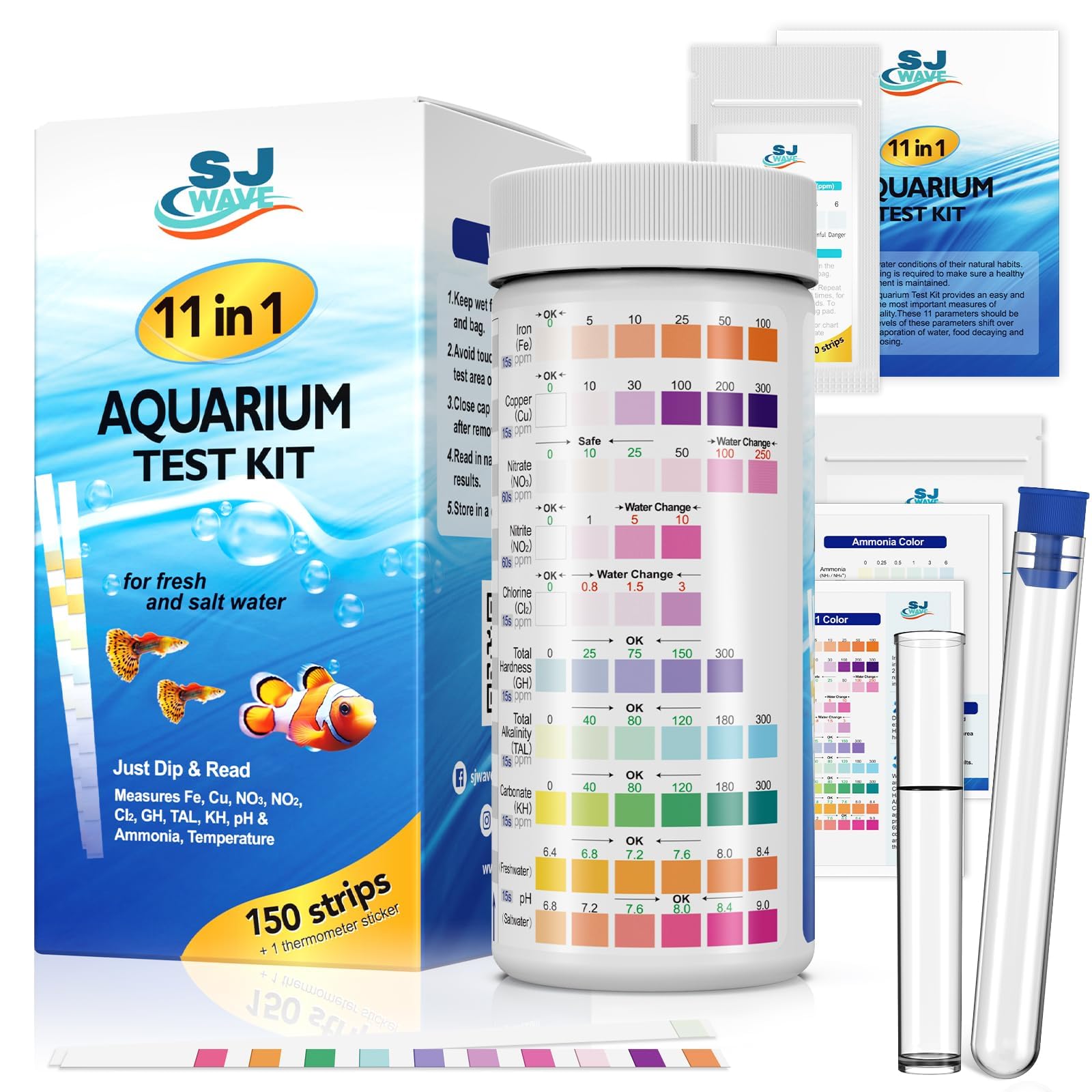
Rating: 4.5 ★ | Price: Mid-Range | Test Type: Test strips | Number of Tests: 150 strips | Parameters Measured: GH, KH, pH, NO3, NH3 | Accuracy Reputation: Color chart match | Ease of Use: Dip and compare
This kit delivers a high volume of strips covering 11 parameters including separate ammonia tests, making it a cost-effective option for frequent checks across multiple tanks. However, its GH and KH readings can vary from liquid test results, so it is best suited for general water awareness rather than precise hardness control for sensitive species.
Pros
- Easy to use – quick dip and read results without mixing chemicals.
- High test count per dollar, covering 11 parameters plus ammonia strips.
Cons
- GH and KH readings can differ from liquid test results, making precise hardness monitoring unreliable.
Best for budget-conscious beginners who want many strips for general health snapshots across multiple tanks, not for precise hardness control.
Best for Budget Checks
FUNSWTM 7-in-1 Strips

Rating: 4.5 ★ | Price: Budget | Test Type: Test strips | Number of Tests: 100 strips | Parameters Measured: GH, KH, pH, NO3, NO2 | Accuracy Reputation: Color chart match | Ease of Use: Dip and compare
These strips deliver good value for routine monitoring, with clear color pads that are easy to read. However, hardness and pH readings can differ from liquid test results, so this kit suits basic awareness rather than precise control of GH or KH.
Pros
- Color-coded pads are straightforward to match against the included chart.
- Packs 100 strips at a per-test cost that makes frequent checking affordable across multiple tanks.
Cons
- pH and general hardness readings may not match results from liquid test kits.
For stable community tanks where occasional cross-checks are acceptable, this is a cost-effective way to stay on top of water quality.
Best for Casual Monitoring
AAwipes 8-in-1 Kit

Rating: 4.4 ★ | Price: Mid-Range | Test Type: Test strips | Number of Tests: 150 strips | Parameters Measured: GH, KH, pH, NO3, Cl2 | Accuracy Reputation: Color chart match | Ease of Use: Dip and compare
This 150-strip kit includes an ammonia nitrogen test alongside GH, KH, and chlorine — useful for general awareness. The strips are easy to read and cover multiple parameters, but hardness readings can vary between strips, and the ammonia pad may not change color in some cases. For casual hobbyists who want a large quantity for routine checks, the value is solid — but those needing precise hardness control or reliable ammonia readings are better served by a dedicated liquid test.
Pros
- Easy-to-read color chart with large collection of strips for frequent monitoring.
- High strip count at a mid-range price — enough for multiple tanks or weekly checks.
Cons
- Hardness results may differ from liquid test kits; cross-check if precision is needed.
Best for casual hobbyists who prioritize strip count and ease of use over precision, and who can accept occasional accuracy tradeoffs.
Best for Quick Checks
DIPSTIK 7-Way Strips

Rating: 4.5 ★ | Price: Budget | Test Type: Test strips | Number of Tests: 100 strips | Parameters Measured: GH, KH, pH, NO3, NO2 | Accuracy Reputation: Color chart match | Ease of Use: Dip and compare
These strips handle well and give a fast snapshot of seven parameters including GH and KH, making them a practical tool for routine awareness. The main tradeoff is that pH and hardness readings may not match liquid test results, which limits their use for precise adjustments or sensitive species. This is a solid budget option but lacks a unique advantage over other value-priced strip kits — for the same price tier, you get similar accuracy limitations without any standout feature.
Pros
- Quick and simple dip-and-read operation for routine checks
- Cost-effective for regular monitoring across multiple tanks
Cons
- pH and hardness readings may not match liquid test results
A practical option for budget-conscious owners who want a quick water quality overview without precision requirements — fine for general awareness, not for critical dosing decisions.
Best for Budget Snapshots
Umlecoa 7-in-1 Kit

Rating: 4.4 ★ | Price: Budget | Test Type: Test strips | Number of Tests: 125 strips | Parameters Measured: GH, KH, pH, NO3, NO2 | Accuracy Reputation: Color chart match | Ease of Use: Dip and compare
This 7-in-1 strip kit bundles 125 strips with a test tube and thermometer at a low price, making it a convenient option for quick water parameter checks. However, the color pads can be difficult to read — colors may not align with the chart and can bleed, which reduces confidence in hardness (GH/KH) readings. This is adequate for beginners seeking a general snapshot, but not for those who need reliable hardness testing.
Pros
- Dip-and-read strips give water parameter readings in under a minute.
- Includes a test tube and thermometer, adding value beyond the strips alone.
Cons
- Color pads can bleed or not match the chart, making hardness readings uncertain.
Fits best for budget-conscious beginners who want a quick water-quality snapshot and aren’t relying on precise GH/KH numbers. Pair with a liquid test for hardness if accuracy matters.
Best for Beginner Guide
JNW Direct 9-in-1 Strips

Rating: 4.3 ★ | Price: Mid-Range | Test Type: Test strips | Number of Tests: 100 strips | Parameters Measured: GH, KH, pH, NO3, NO2 | Accuracy Reputation: Color chart match | Ease of Use: Dip and compare
JNW Direct’s 9-in-1 strips come with a helpful eBook that guides beginners through water chemistry basics, making them a convenient entry point for quick multi-parameter checks. However, the strip quality is among the weakest in the category—colors can bleed and readings may not match the chart, especially for hardness. Fine for learning, but not for reliable monitoring.
Pros
- Easy to use and quick results in under a minute.
- Included eBook provides a helpful guide to aquarium water parameters.
Cons
- Colors may bleed together and readings can be inconsistent, particularly for hardness.
Best for absolute beginners who want a learning tool alongside quick parameter awareness, but hardness readings should be cross-checked with a liquid test.
How to Choose
The core choice in hardness testing is liquid drop vs. strip — accuracy versus convenience.
Test Type
Liquid drop tests use a titration method where you add reagent drop by drop until the water changes color. The number of drops directly equals the hardness in degrees. This gives precise, repeatable results down to a single degree.
Test strips rely on a chemical pad that changes color in proportion to hardness. The result is read by comparing the pad to a printed chart. This is faster but introduces variation from lighting, moisture, and interpretation.
Number of Tests
Liquid kits typically provide 100 to 200 tests per bottle, which can last months for a single tank. Strip packs range from 25 to 150 strips, with larger packs offering a lower cost per test.
The trade-off: a 150-strip pack may seem economical, but if you test weekly, it still runs out faster than a liquid kit that gives 200 tests from two bottles. Consider your testing frequency and number of tanks.
Parameters Measured
Some kits measure only GH and KH, while multi-parameter strips include pH, nitrate, nitrite, and sometimes ammonia or chlorine. A dedicated hardness kit gives more reliable GH/KH numbers than a multi-strip where the pad must share space with other tests.
For sensitive species, a separate GH/KH liquid test is better. For routine community tank checks, a multi-strip that includes both hardness and nitrogen parameters saves time and money.
Accuracy Reputation
Accuracy in test kits is tied to the test method, not the brand. Liquid titration yields resolution of 1 dGH or 1 dKH. Test strips typically offer 3–5 degree increments and are more prone to reading errors from color interpretation.
Independent user reports consistently show liquid kits matching reference solutions, while strip results vary by as much as 4 degrees when compared side by side. This gap matters when you need to maintain specific hardness for breeding or plant growth.
Ease of Use
Liquid kits require filling a vial, adding reagent drops, swirling, and counting until a color change. It takes about 5 minutes per parameter and demands careful attention to the endpoint. First-time users often need to watch a short tutorial.
Strips are simpler: dip for one second, shake off excess, wait the specified time, and compare to the chart. This takes under a minute. The readability of the color chart is critical — some strips have pads that bleed or show colors that don’t match well.
FAQ
Are aquarium test strips accurate enough for shrimp tanks?
Most test strips lack the precision needed for shrimp tanks, where GH and KH must stay within a narrow range (e.g., 4–6 dGH and 1–2 dKH for Caridina species). Strips often read in 3–5 degree increments, which is too coarse. A liquid drop kit like the API GH & KH test provides the 1-degree resolution shrimp keepers need.
Why does my KH test strip show different results than my liquid test?
Strip pads for KH are calibrated to a broader range and can shift due to humidity or aging. Liquid titration methods measure alkalinity directly through a chemical reaction, giving a more consistent result. If your strip reading differs by more than 1 degree, trust the liquid test for critical decisions like buffer additions.
How many drops does the API GH test require for a precise reading?
The API GH test uses a drop-count method: add one drop at a time, swirl, and stop when the sample changes from orange to green. The number of drops equals the GH in degrees. A typical soft water sample may need 4–6 drops, while hard water can exceed 15. Shake the bottle well before each drop for consistent results.
Can I use GH/KH test strips for saltwater aquariums?
Yes, many test strips are labeled for both fresh and saltwater. However, saltwater systems often have KH values above 8 dKH, and some strip scales top out at 10 dKH or have coarse increments. For reef tanks requiring precise KH control, a liquid test like Salifert’s KH/Alk kit is more reliable. If using strips, confirm the range covers your target.