This post contains affiliate links. We may earn a small commission when you buy through our links — at no extra cost to you.
Many wavemakers claim sky-high GPH but deliver far less in a real tank. Others run quietly for a few weeks, then develop a clicking or rattling sound that drives you crazy. The challenge isn’t finding a pump that moves water—it’s finding one that keeps doing it without waking up the house or dying early.
The real trade-off in this category is raw flow power versus long-term silence and reliability. You can get 1600 GPH for under $25, but you might replace it within months. Or you can spend a bit more for a pump that stays silent for years and fits your tank’s actual size. This guide picks pumps that match your setup and your patience for tinkering.
Top Picks
Best for Mid-Size Tanks
Hydor Koralia Evolution 850

Rating: 4.4 ★ | Price: Mid-Range | Flow Rate: 850 GPH | Mount Type: Magnet + suction
The Hydor Koralia Evolution 850 delivers dead-silent 850 GPH circulation with a broad, gentle flow that moves water without stirring up sand beds. After a brief break-in period, the pump becomes virtually silent – a trait that sets it apart from budget alternatives that often develop noise over time. Many owners report years of trouble-free service, making it one of the more dependable mid-range options available.
Best suited for freshwater tanks between 50 and 90 gallons or reef tanks needing steady flow across the entire water column. The pump’s size is noticeable inside the tank – worth checking clearance if you have a tight aquascape. In saltwater setups, voltage leaks have been noted after several years, so using a ground fault interrupter is a sensible precaution. For those who prioritize silence and durability over speed control, this pump is a strong fit. It is not designed for tanks under 40 gallons or for hobbyists who need adjustable flow rates.
Pros
- Very quiet operation – one of the quietest mid-range pumps.
- Reliable performance – many users report years of trouble-free service.
- Strong, broad water flow that covers the tank without creating sand storms.
Cons
- Bulky design takes up significant space inside the tank.
- Fixed-speed operation – no variable control for those wanting adjustable flow.
The Koralia Evolution 850 is the right call if you want reliable, quiet circulation without adjustable features – ideal for medium tanks where steady flow is more important than control.
Best for Nano Tanks
Hydor Koralia Nano 240

Rating: 4.4 ★ | Price: Mid-Range | Flow Rate: 240 GPH | Mount Type: Magnet + suction
Whisper-quiet 240 GPH with a strong magnet mount – purpose-built for nano tanks from 5 to 15 gallons. The top pick, Koralia Evolution 850, moves more water for larger tanks, but this version fits where space and silence matter most. Best for nano reef or planted freshwater tanks where gentle flow is enough. Flow is too weak for tanks over 20 gallons, and the mounting joint limits aiming range – not an issue for compact setups where the pump stays hidden and can be positioned within its allowed arc.
Pros
- Exceptionally quiet after a short break-in – suitable for a bedroom or living room nano tank.
- Compact size with strong magnet mount – easy to hide and position in small aquariums.
Cons
- Mounting joint limits aiming – cannot direct flow parallel to the glass.
For nano tanks under 15 gallons that need silent, gentle circulation, this pump delivers without fuss – just keep it in its size lane.
Best for Budget Mid-Size
FREESEA 1600 GPH Wave Maker

Rating: 4.3 ★ | Price: Budget | Flow Rate: 1600 GPH | Mount Type: Magnet + suction
The FREESEA delivers 1600 GPH of strong, consistent circulation and a magnetic base that holds securely even on thick glass—at a budget-friendly price. Compared to the dead-silent Hydor Koralia Evolution 850, you trade years of quiet reliability for raw water-moving power and a lower upfront cost, but this pump fits medium to large tanks (40–75 gal) where flow volume matters most.
Best for budget hobbyists who want maximum flow per dollar and are comfortable with possible noise in a living area or using it as a secondary or backup pump in a larger tank. The 5-foot power cord may require an extension cord, and while many units run for years, some may need replacement within a few months—worth buying with a flexible return window in mind.
Pros
- Strong 1600 GPH flow moves debris effectively in 55–75 gal tanks.
- Magnetic mount holds firmly on thick glass without slipping.
- Budget-friendly alternative to premium wavemakers.
Cons
- In quiet rooms, a clicking or rattling sound may develop after a few weeks.
- Durability can vary—some pumps may need replacement within a few months of use.
A strong flow and solid mount at a low price—best suited for budget builders who can accept occasional noise and variable longevity.
Best for Large Tanks
Uniclife 2100 GPH Adjustable

Rating: 4.3 ★ | Price: Mid-Range | Flow Rate: 2100 GPH | Mount Type: Magnetic
The Uniclife delivers adjustable 2100 GPH flow with four wave modes and a feeding mode, giving large-tank reef keepers the control that the single-speed Hydor lacks. This pump suits budget-minded aquarists with 60–120 gallon tanks who value adjustability over near-silent operation and can accept the possibility of early unit variation. For those needing dead-silent, reliable performance, the Hydor remains the better choice.
Pros
- Adjustable flow with four wave modes and feeding mode for precise water movement control.
- Strong 2100 GPH output moves plenty of water for 75–120 gallon tanks.
Cons
- High-pitch whine or grinding noise can occur in quiet environments.
- Some units may cease operation shortly after installation.
A capable adjustable pump for large tanks at a mid-range price, but the noise and reliability lottery make the Hydor a safer long-term bet for silent operation.
Best for Mid Reef
Jebao SOW‑8

Rating: 4.4 ★ | Price: Premium | Mount Type: Magnetic
Quiet, adjustable flow with night sensor and feed mode—features usually found on pricier pumps—make the Jebao SOW-8 a strong contender for mid-sized reef tanks. The tradeoff is that the controller interface can feel unintuitive, and some units may need replacement within months. This pump suits hobbyists with 40–75 gallon tanks who want DC adjustability at a mid-range budget and are okay with a learning curve on controls.
Pros
- Creates strong, broad water movement across the entire tank, even at lower speeds.
- Runs quietly enough for living room or bedroom aquarium setups.
- More affordable than most controllable DC wavemakers with similar features.
Cons
- Controller interface can feel cheap and unintuitive—someone accustomed to simpler pumps may need time to learn it.
- Some units may need replacement within months of use—worth buying from a retailer with a good return policy.
For reef hobbyists who want adjustable DC flow without spending on premium brands, the SOW-8 delivers on quiet performance and control—provided you’re comfortable with the controller’s quirks and buying from a retailer with a flexible return policy.
Best for Extreme Budget
SunSun JVP‑110 2‑Pack

Rating: 4.2 ★ | Price: Budget | Flow Rate: 528 GPH | Mount Type: Suction cup
The SunSun JVP‑110 two‑pack delivers 528 GPH per pump at a price that undercuts even single budget units. That makes it the cheapest way to get water moving in a medium tank, but the tradeoff is longevity – the top pick will run years, while these may need replacement within months.
Best suited as a temporary wave maker for freshwater setups where noise isn’t an issue and you’re willing to swap out pumps periodically. The suction cups can lose grip, the propeller may spin backward on restart, and the short power cord limits placement – all manageable if you treat these as disposable backups.
Pros
- Two pumps for the price of one – massive cost savings for temporary builds.
- Adequate 528 GPH flow for 55–75 gallon tanks.
- Compact palm‑sized design fits tight spaces.
Cons
- Suction cups may lose grip within weeks, causing the pump to slide or fall.
- Reverse spinning on restart requires unplugging and plugging back in – an occasional quirk.
Buy this if you need a cheap backup or temporary flow for a freshwater tank and don’t mind occasional tinkering – otherwise, invest in a single reliable pump.
Best for Large Tanks
AQQA 2100 GPH
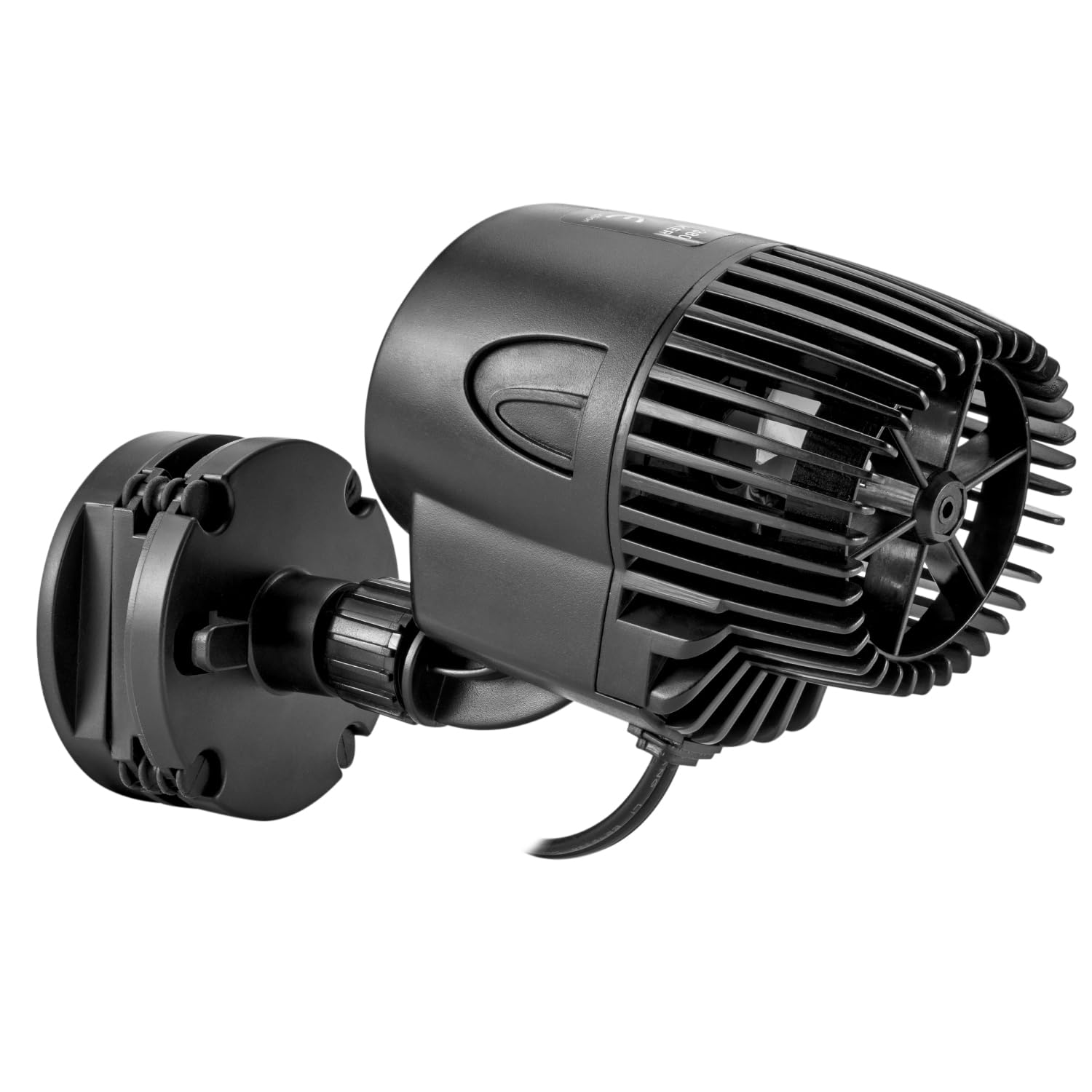
Rating: 4.5 ★ | Price: Budget | Flow Rate: 2100 GPH | Mount Type: Magnetic
This pump moves a lot of water for the price, with a magnet mount that stays put. There’s no speed adjustment – you get one fixed flow – and some units may be louder or less durable than alternatives. It’s a practical choice for big freshwater tanks (>100 gal) where brute force rules, but not for quiet rooms or smaller setups.
Pros
- Strongest flow per dollar in this price range – moves water aggressively in large tanks.
- Magnetic base holds securely on thick aquarium glass.
Cons
- No speed control – the fixed 2100 GPH can overwhelm smaller or planted tanks.
Best for large freshwater setups where raw water movement is the goal and background noise is acceptable.
Best for Small Tanks
hygger Mini 530 GPH

Rating: 4.4 ★ | Price: Budget | Flow Rate: 530 GPH | Mount Type: Magnetic
The hygger Mini Wave Maker delivers near-silent water movement in small tanks, with a compact magnetic mount that rotates 360° for precise placement. Its 530 GPH flow suits 20–40 gallon aquariums, though units may vary in noise and longevity. For hobbyists who prioritize silence and can accept occasional inconsistency, this is a budget-friendly option — but those wanting guaranteed long-term performance should look to more consistent alternatives like the Hydor Nano.
Pros
- Very quiet at lower speeds – nearly silent in most setups.
- Compact size with 360° rotation fits small tanks and is easy to position.
Cons
- Unit-to-unit consistency varies – some remain quiet for years, others may develop noise or stop moving water within weeks.
A solid fit for budget-minded hobbyists who need a quiet, compact circulator for a 20–40 gallon tank and are comfortable with the possibility of an early replacement.
Best for Nano Fluval
Fluval Sea CP1

Rating: 4.4 ★ | Price: Budget | Mount Type: Suction cup
This pump fits neatly into Fluval Evo 13.5 and similar nano tanks, creating enough surface agitation for small volumes. However, the suction cup mount may lose grip over time, and some units produce noise on startup. The listed flow rate of 5200 LPH appears inflated—actual output is moderate, matching the intended tank size better than the spec suggests.
Pros
- Compact size fits Fluval Evo 13.5 and similar nano tanks without crowding.
- Creates effective surface agitation and water movement for small volumes.
Cons
- Suction cup mount can lose grip over time, requiring repositioning.
Best for Fluval Evo nano tank owners who value a compact fit and can accept an occasional suction cup reset.
Best for Simple Setups
Aqueon 950 GPH

Rating: 4.4 ★ | Price: Mid-Range | Flow Rate: 950 GPH | Mount Type: Suction cup
Delivers solid 950 GPH flow for single-direction setups in 55–90 gallon tanks. The suction cup mount may lose grip on textured glass, and the nozzle adjusts horizontally only — not ideal for aiming flow up or down. Magnetic-mount alternatives at similar prices offer more flexibility.
Pros
- Effective 950 GPH water movement for medium tanks.
- Simple build that has run for years in some setups.
Cons
- Can require replacement within the first month – account for this when choosing.
Best for low-stakes setups where suction cups and fixed direction are acceptable, and where the possibility of early replacement is a manageable risk.
Best for Huge Tanks
hygger 4200 GPH Double

Rating: 4.2 ★ | Price: Mid-Range | Flow Rate: 4200 GPH | Mount Type: Magnet + suction
Moves 4200 GPH of water quietly, making it a powerful option for extra-large tanks between 110 and 240 gallons. The high flow is ideal for those who need raw water movement, but it runs at full speed only — magnetic mount can struggle on glass over 1/2 inch thick, and some units may develop electrical issues over time. This pump fits best when adjustability and long-term reliability are secondary to sheer flow power.
Pros
- 4200 GPH moves huge volumes of water for large tanks.
- Operates quietly despite the high power output.
Cons
- No speed control – runs only at full blast, too strong for tanks under 110 gal.
Best for extra-large tanks where raw flow is the priority and you can work around the fixed speed and potential mounting or electrical tradeoffs.
How to Choose
The single most important factor in choosing a wavemaker is matching flow rate to tank size—too little leaves dead spots, too much stresses fish and blows substrate everywhere.
Flow Rate vs. Tank Size
Flow rate is measured in gallons per hour (GPH). A common rule is 5–10 times tank volume per hour for freshwater, 10–20 times for saltwater. But this is a starting point: a 75-gallon tank with active cichlids can handle 750 GPH, while a planted discus tank needs far less.
Many budget pumps overstate GPH. A unit claiming 1600 GPH may actually move 1000 GPH in real-world conditions due to head pressure and impeller design. Choose a slightly higher rated flow than your calculation, then use adjustable models or point the flow away from delicate areas.
Mounting Type: Magnetic vs. Suction Cup
Magnetic mounts hold securely on glass up to about ½ inch thick and allow easy repositioning without reaching into the tank. Suction cups lose grip over time, especially in saltwater or warm freshwater, causing the pump to fall and potentially disturb the substrate or livestock.
If your tank has thick glass (over 12 mm/½ inch), check the magnet’s rating—some magnets won’t hold and may let water inside, leading to rust. Magnetic mounts are generally worth the extra cost for permanent installations.
Noise Level: What to Expect
Noise typically comes from two sources: air trapped in the impeller (which clears after a few minutes) and worn bearings or debris buildup. Many pumps run quietly at first but develop a clicking or rattling sound after weeks as calcium deposits form on the shaft.
Pumps with a DC motor tend to be quieter than AC pumps, especially at lower speeds. Regular cleaning of the impeller and shaft every month prevents most noise issues. If a pump is loud out of the box, it may have a manufacturing defect.
Cord Length: Planning Placement
Most budget wavemakers come with a cord only 5–6 feet long. If your tank stand is tall or your outlet is far from the tank, you’ll need an extension cord. This adds clutter and can be a trip hazard near the tank.
Measure the distance from the intended pump location to the nearest outlet before buying. Some mid-range pumps offer longer cords or have detachable power supplies that allow easier extension.
Adjustability: Speed and Direction Controls
Adjustable pumps let you reduce flow for smaller tanks or change wave patterns to match coral needs. Non-adjustable pumps run at full speed, which can be too strong for many setups. Directional control (360° rotation) is common, but some mounts limit the aiming range.
DC pumps with controllers offer multiple modes: constant, wave, random, and feeding pause. This is valuable for reef tanks but adds cost and complexity. For a simple freshwater tank, a single-speed pump aimed correctly often works fine.
FAQ
Why does my aquarium wavemaker make a loud clicking noise after a few weeks?
That clicking is usually from calcium or debris buildup on the impeller shaft. Unplug the pump, disassemble the impeller, and clean the shaft and magnet with a soft brush and white vinegar. Soaking in vinegar for 10 minutes dissolves hard deposits. If the noise persists after cleaning, the bearings may be worn—some pumps are simply noisier by design.
Can I use a wavemaker with a magnetic mount on a ½-inch thick glass aquarium?
It depends on the pump’s magnet strength. Many budget magnets are rated for glass up to ½ inch, but the actual holding force decreases with thickness. For ½ inch glass, look for pumps with strong neodymium magnets and user reviews that confirm they hold. If the magnet is weak, the pump may slide or fall, especially with vibration. Thicker glass often requires a separate magnet plate or a different mounting system.
How many GPH do I need for a 75-gallon freshwater tank?
Aim for 375–750 GPH total flow (5–10 times turnover). A single pump rated around 800–1000 GPH works well, especially if it’s adjustable. For gentle flow species like angelfish or discus, stick to the lower end. For active cichlids or goldfish, go closer to 1000 GPH. You can also use two smaller pumps placed on opposite sides to create more natural circulation.
Do aquarium wavemakers harm fish if they get too close?
Yes, fish can be stressed by strong direct current, especially if they are weak swimmers or small. Position the wavemaker so the flow hits the glass or decor first, creating a gentle indirect current. In small tanks, aim the pump at the surface for surface agitation rather than directly at the middle. Most fish learn to avoid strong flow areas, but for species like bettas or fry, use a diffuser or a lower GPH pump.