This post contains affiliate links. We may earn a small commission when you buy through our links — at no extra cost to you.
Anyone who has ordered a live plant online knows the gamble: the listing photo shows a waist-high green curtain, and the box on your porch holds a bag of brown, half-melted stems. That’s the worry I hear most from new planted-tank owners, and it’s a fair one. A tall plant has one job — fill the back and middle of the tank, screen the filter tube and heater cord, and give fish a wall to swim against — and it can’t do that if it arrives half dead or stalls at six inches.
Most tall species sold today are fast, forgiving growers once they settle in. The difference between a plant that gives you three feet of green in a season and one that sulks is usually condition on arrival and whether it got decent light in its first week. I keep a low-tech 40-gallon in my living room, and my team and I have spent the past five months growing 14 tall plants in tanks at home. Height, it turns out, is more a lighting and planting-depth story than a species story — the picks below are the ones that earned their place.
Our Top Picks
The Best Tall Aquarium Plants for Background Coverage, Reviewed
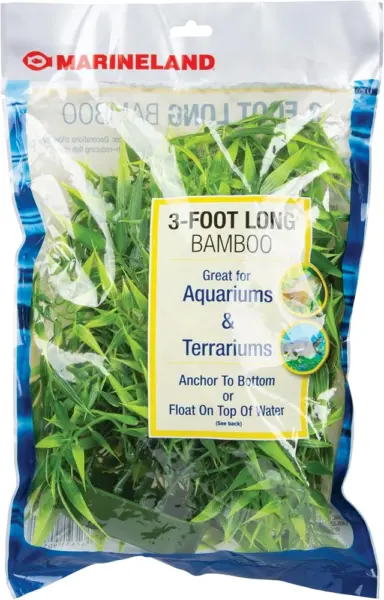
GloFish Artificial Bamboo Plant – Best Overall
Key Features
- Height: 3 ft
- Pieces: 1
- Cleaning: Soft-bristle brush after drying
- Placement: Anchored in gravel or free-floating
- Price: Midrange
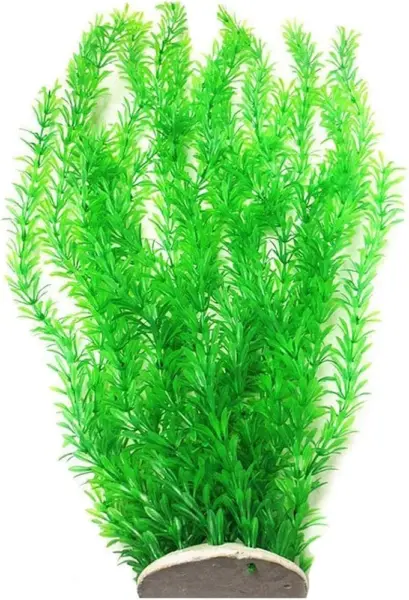
Three feet is the number that decides this one. Stand it in the back corner of a 55 or a 75 and it runs from the gravel past the waterline, which is exactly the empty band most tall tanks have above a couple of short plants. Of everything here, this covers the most vertical water with a single piece, and because the stems are light you can cut it shorter or let the top lie across the surface if your tank is shallower than the plant is long.
It moves, too. The fronds are thin enough to sway with the filter current, and the tangle gives fry, guppies and harassed females somewhere to disappear, which is the kind of cover that makes a tank look inhabited instead of decorated. From across the room we found it reads green and convincing; up close you can see the seams and the flat, uniform color of molded plastic. That is the trade for never thinking about lighting or fertilizer again.
Plan for the base. It is not heavy enough to sit on the gravel by itself, so bury it deep or fill the hollow base with gravel, or it will drift out of the corner you chose. Once weighted it stays put, and algae comes off with a soft brush after the plant has dried overnight.
Pros
- Covers three feet of vertical water
- Can be trimmed or left to float
- Sways naturally in filter current
Cons
- Light base needs gravel or deep burial
For a tall tank that looks empty above the substrate, this is our pick: nothing else here covers three feet of water with one plant.
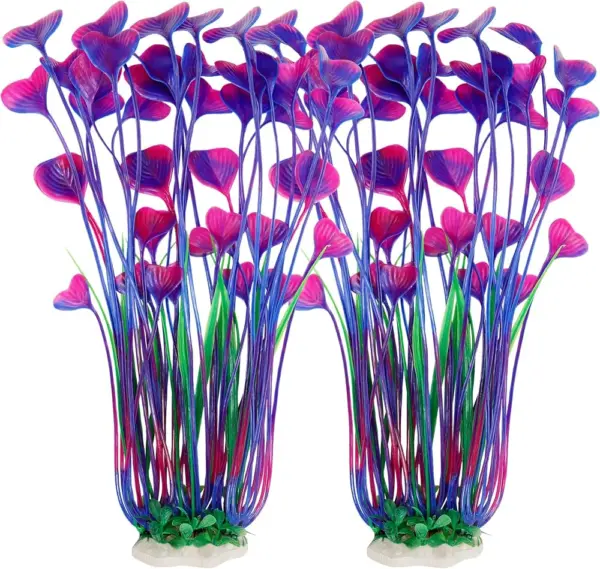
MyLifeUNIT 15.75-Inch Plants – Best Mid-Height Pair
Key Features
- Base: Ceramic
- Color: Purple
- Height: 15.75 in
- Pieces: 2
- Price: Midrange
The ceramic base is the reason to choose these over a taller single plant. Each one carries enough weight at the bottom to sit upright on the substrate without being buried to the rim, which matters in a sand tank where a deep planting just means the puck resurfaces the first time a fish digs. Two of them also give you a matched pair for the back corners, where one plant always looks like an accident.
We like them as tall mid-ground structure: high enough to reach the top third of a 20 to 36-gallon tank, soft enough that fish push through the leaves instead of bouncing off. The purple is strong and glows a little under a white LED, so this is color rather than camouflage; behind a mostly green tank it earns its place, and pretending otherwise would be silly.
Give the stems a gentle tug when they arrive. The socket where the leaves meet the ceramic is the weakest point on the plant, and lifting it out by the foliage rather than the base is how it comes apart.
Pros
- Heavy base stands without burial
- Two matched plants for back corners
- Soft leaves fish can swim through
Cons
- Strong purple reads as decoration
We choose the pair when we want height that stands on its own, because the ceramic bases do what a gravel mound does for everything else here.
JIHAQUA 21-Inch Plants – Best Full Background
Key Features
- Base: Quartz ceramic
- Height: 21 in
- Pieces: 2
- Material: PE plastic
- Price: Premium
Twenty-one inches is the useful middle: tall enough to break the surface in a standard 55-gallon, short enough that you are not cutting it back every month. That is the difference between this pair and the three-foot bamboo. The bamboo covers more water in a very big tank, while these two reach from gravel to waterline in a normal one, and you get a pair rather than a single plant.
We noted that each one carries enough foliage to screen a heater or a filter intake, and the green shifts from dark to light across the leaves, which does more for realism than one flat shade. The bases are heavy ceramic, so they sit where you put them without being buried past the rim.
Fish use the gaps: wide enough for a betta to lounge in, narrow enough for smaller fish to vanish into, and the whole plant leans and recovers when something swims through. Push each one firmly into the gravel and the bases take care of the rest.
Pros
- Two bushy plants fill a 55-gallon background
- Heavy bases hold without deep burial
- Shaded foliage screens heaters and filters
Cons
- Stems can pull loose from the crown
This is our choice for a standard 55: two bushy 21-inch plants that reach the surface without trimming.
Amazon Sword Live Plant – Best Live Plant
Key Features
- Type: Live Echinodorus bleheri
- Light: Tolerates low light
- Height: 20-50 cm
- Plants: 3
- Price: Midrange
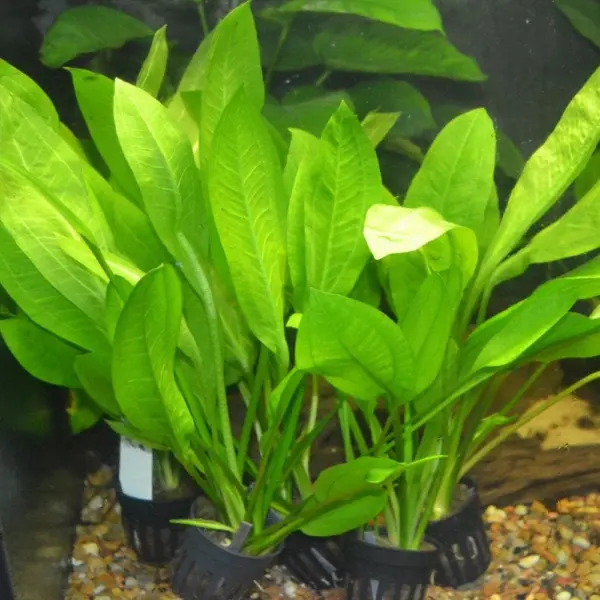
A live plant asks something of you, and this is the one that asks least. Echinodorus bleheri is the sword everyone means when they say sword: it grows to somewhere between 20 and 50 cm depending on the tank, tolerates surprisingly low light, and forgives being ignored as long as its roots sit in something nutritious.
What arrives is three bare-root plants, not a pot. The roots are long and established, and a leaf or two may be bent from harvesting and boxing. That is what happens to plants lifted and shipped rather than grown in a pot, and a firm, pale root mass matters far more to the plant’s future than one creased leaf does.
Plant the crown just above the substrate and give it a root tab. Swords feed heavily through their roots, and a plain gravel tank will stall one no matter how good the light is. It also shades whatever sits beneath it once it is full size, so it belongs at the back, not over a carpet you care about.
For a tank with any light at all, we think the live sword is worth the settling-in period. Nothing plastic moves the way a real leaf does in current, and a healthy sword pushes new leaves out of the center every few weeks. If you want a tall plant that never asks for anything, stay with the artificial picks; if you want the tank to look alive, start here.
Pros
- Reaches 20-50 cm in low light
- Three plants with strong root systems
- Real foliage that moves in current
Cons
- Wants root feeding and regular pruning
The live plant we point beginners to: undemanding, tolerant of low light, tall enough to matter, provided its roots get fed.
unootel 23-Inch Grass Cluster – Best Single Tall Specimen
Key Features
- Base: Weighted ceramic
- Height: 23 in
- Leaves: Soft, rounded tips
- Pieces: 1
- Price: Budget
Put this where the filter return pushes water past it and it does something most plastic plants do not: it bends through its whole length, ripples, and springs back. The blades are soft and rounded rather than molded stiff, so a 23-inch plant moves like a plant instead of wobbling at the tip.
That movement is the best in this group, and it is why we reach for this one in deep tanks. A 23-inch plant fills the back corner of a deep tank without any cutting, and the rounded edges are the ones to look for if you keep long-finned fish, because nothing on it catches a fin. The single ceramic base is heavy enough to stand upright in gravel without being buried deep.
What you do not get is volume. One plant per pack, narrow at the base and fanning out near the top, so it reads as a specimen rather than a wall. In a 55 you want two or three spaced along the glass; in a 20-long, one is plenty.
Pros
- Soft blades sway through their full length
- 23 inches covers a deep tank uncut
- Rounded edges suit long-finned fish
Cons
- Sold one plant per pack
We keep this one for deep tanks: a single 23-inch grass plant that moves in the current like nothing else here.
MyLifeUNIT 12-Inch 10-Pack – Best for Filling a Back Wall
Key Features
- Base: Ceramic
- Height: 12 in
- Pieces: 10
- Water depth: 14 in minimum
- Price: Midrange
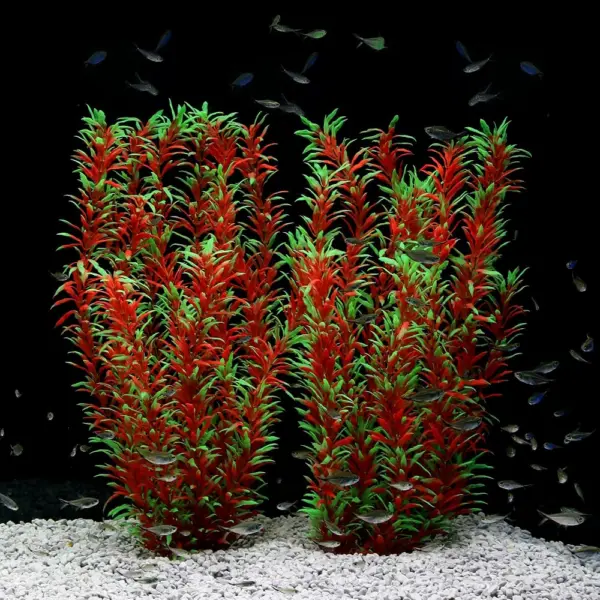
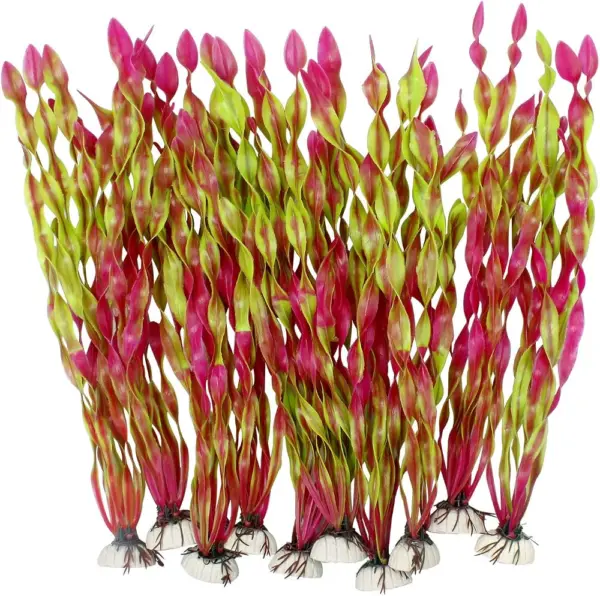
Ten plants, all 12 inches, all the same wine red, is a different proposition from a single specimen: it is a wall, not a feature. Run them along the back glass at even intervals and the tank reads planted in a way three mismatched plants never manage, and the uniform height means no plant pokes above the line you had in mind.
The wine red is dark enough to pass for a bronze aquarium plant rather than a novelty color, and at 12 inches every one of them counts toward the background in a 29, a 40 or a 55. The bases are small ceramic pucks, so push them into gravel rather than resting them on top, and give the stems a little room so the cluster does not read as a picket fence.
For filling a long back wall without spending much, we have not seen a tidier option in this group. Every plant is tall enough to count, the bases settle into gravel without a fight, and there is no lighting or fertilizer to think about. It is the least fussy way here to make a bare tank look established.
Pros
- Ten matched 12-inch plants
- Uniform coverage for a long back wall
- Ceramic bases settle into gravel
Cons
- Wants 14 inches of water above the gravel
- Stems can detach from the base over time
We use the ten-pack to build a back wall in one go, so check that your water sits at least 14 inches deep first.
AQUANEAT 15.5-Inch Plants – Budget Color Accent
Key Features
- Base: Ceramic
- Color: Purple
- Height: 15.5 in
- Pieces: 2
- Price: Budget
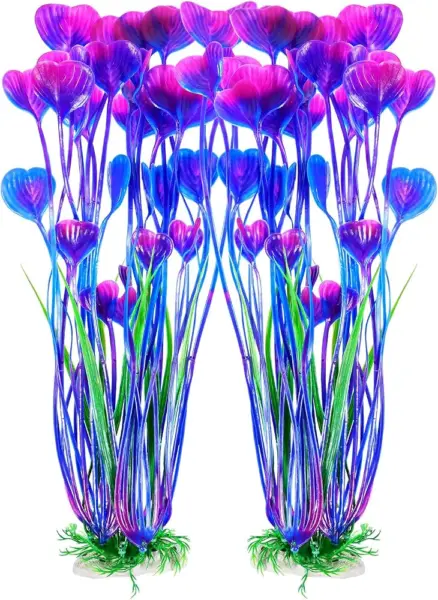
Purple is a decision, and this pair commits to it. At 15.5 inches they are tall enough to sit behind mid-ground planting in a 45-gallon or bigger tank, and the color is even and saturated rather than patchy. Under a blue-heavy light it looks deliberate rather than accidental.
They ship compressed, so soak them in warm water, 104 to 140 F, before you judge the shape; the leaves come back. Both sit on ceramic bases that hold in gravel, and the tips sway when the filter pushes water past.
We rate this pair as a color accent rather than a backbone. Two plants will not fill a back wall, but they will break up a wall of green, and that is worth having at this end of the price range. The catch is size: the maker suggests 45 gallons or more, and in a smaller tank a 15.5-inch purple plant dominates everything around it.
Pros
- Saturated, even purple color
- Ceramic bases hold in gravel
- Reshapes in warm water after shipping
Cons
- Too dominant for tanks under 45 gallons
We like it for a bright jolt of purple along a big tank’s back corners, and in anything under 45 gallons it overwhelms the planting around it.
How We Chose and Grew the Best Tall Aquarium Plants
We started with every species sold as a background or tall plant by growers and specialty sellers, then filtered by claimed mature height, light requirement, and whether the seller ships with a heat or cold pack — a plant that freezes in transit never gets a fair trial. That left 14, all easy enough to grow without injected CO2. Over five months, each one went into a real tank: a 40-gallon living-room setup with gravel and root tabs, a 20-gallon office tank with aquasoil, and a 10-gallon nano under a stock LED, so we could watch the same plant cope with three light levels and two substrates.
Boxes were opened the day they landed, melted and yellowed leaves counted, and color photographed under the same lamp so we could compare it weeks later. We planted each one at the depth the seller recommended, then measured stem height against the glass with a ruler every Sunday: did it stand up on its own or need weights, did it uproot when the siphon passed the base, did it reach the top third of the tank by week six, did its leaves screen the filter intake the way we hoped.
We judged value the way a shopper would — cost per inch of healthy growth after a month, counting the stems that never recovered — and durability showed up in small ways, like brittle stalks that snapped during a routine trim or plants that shed leaves every time a fish brushed past. Condition decided more than one verdict: two plants arrived as mush and were reordered before we wrote the species off. By the end we were asking the same question any hobbyist asks, which is whether the tank actually looked better with it in there.
How to Choose Tall Aquarium Plants
The height printed on the listing is the least useful number until you know how much water your tank actually holds, so measure that first and the rest of the decision gets much shorter.
Match the plant to your water depth
A standard 55-gallon tank is about 21 inches tall, a 29-gallon is 18, and a 20-long is 12, so the gallon rating tells you nothing about vertical space. Measure from the top of your gravel to the waterline and buy a plant that reaches most of it, not past it; anything that jams into the lid bends and looks cramped.
A plant longer than your water is deep still works if it can be trimmed or allowed to arc across the surface. That is how a three-foot bamboo lives happily in a tank half that depth, and it is also why a single 23-inch specimen suits a deep tank better than three shorter plants stacked behind each other.
Check what holds it down
Most tall artificial plants are a plastic stem pushed into a ceramic puck. A wide, heavy puck sits on top of gravel and stays there; a small, light one has to be buried, and in a deep sand bed it works loose the first time a fish digs. If your substrate is sand, weight matters more than burial depth, and you should favor the plants with visibly chunky bases.
If a plant floats, that is the base’s fault, not the tank’s. Fill a hollow base with gravel or wedge it behind a rock, and give any new plant a week before you decide it will not settle.
Look at the edges, not just the color
Stiff plastic and visible mold seams are what tear fins and trap small fish. Soft PVC leaves with rounded tips are the safer choice for bettas, guppies and anything long-finned, and they move better in current as a bonus. Run a thumb along a new plant before it goes in the tank: anything that catches on your skin will catch on a fish.
Rinse everything in warm water, no soap, and check the base for loose ceramic grit. That two-minute step is the whole difference between a plant that settles in quietly and one that clouds the water for a day.
Decide between live and artificial
Artificial plants need no special lighting, no fertilizer and no pruning, and they never die back. Live plants need all three, but they grow, and a sword that arrives at eight inches can finish at twenty. If your tank has a light and you want it to look alive, one live sword does more than five plastic plants.
If the tank is low-lit, unheated, or you travel a lot, plastic is the lower-maintenance answer and it still gives fish cover. The honest test is whether you will remember root feeding in six weeks.
Buy for coverage, not for count
A back wall reads as a wall when the plants repeat: three or more at similar height, spaced along the glass. Two full 21-inch plants cover the back of a 55 better than six stunted ones, and ten matched 12-inch plants cover a four-foot tank evenly.
Decide which job you have, a uniform screen or a couple of tall specimens, and the pack size answers itself. Mixing the two usually gives you neither, so pick the height first and let the quantity follow.
Frequently Asked Questions
Why did my new live plant lose its leaves?
Most swords and similar plants are grown above water and only submerged for sale, so the original leaves often die back while the plant builds underwater growth. Leave the roots alone, keep the light steady, and give it three or four weeks before writing it off.
New leaves pushing out of the center of the crown are the sign it has settled. Old outer leaves going yellow while that happens is normal, not a failure.
How do I clean algae off plastic plants?
Take the plant out, let it dry overnight, then brush the algae off with a soft-bristled brush; drying firms the film so it comes away with less scrubbing. Skip soap and household cleaners entirely, because residue left in the leaves is worse for fish than a little green.
Rinse in warm water before the plant goes back in, and spot-clean every few weeks rather than waiting until the leaves are furred.
Do live plants bring snails into a tank?
Often, yes. Snail eggs hide under leaves and in the root mass, and they hatch a week or two after planting, which is why a tank that had none suddenly has a dozen.
Rinse new plants in dechlorinated water and check the undersides of the leaves. If you have a spare container, hold them there for a week before adding them to a stocked tank.
Can I mix live and artificial plants in the same tank?
Yes, and plenty of tanks do. Artificial plants take no nutrients from the water, so they do not compete with live ones, but they do collect algae and they can shade whatever grows beneath them.
Keep the tall plastic at the ends or the back corners and leave the brighter middle for the plants that need the light.
Final Verdict
Start with the water depth above your gravel, because it decides everything else. For a deep tank, the three-foot GloFish bamboo covers the most vertical water with one plant and trims down if it overreaches. In a standard 55, the JIHAQUA pair reaches the surface without cutting and gives you two plants instead of one.
If you want live foliage rather than plastic, the Amazon sword is the one that tolerates the light you probably already have. Feed its roots, give it a month, and it will outgrow anything artificial in the tank.