This post contains affiliate links. We may earn a small commission when you buy through our links — at no extra cost to you.
A 40-gallon tank in summer can be a heat trap. Many 1/10 HP chillers marketed for this size struggle when the room temperature climbs above 85°F, leaving your axolotls or corals stressed. The result is a chiller that runs constantly without keeping up – or one that fails entirely after a few months.
The real trade-off is between upfront cost and long-term peace of mind. Budget models work well for many owners, but durability and support vary widely. Premium options cost nearly twice as much but deliver consistent performance, quieter operation, and a titanium evaporator that holds up in saltwater.
This guide cuts through the spec claims to match your cooling needs – whether you run a reef tank, a freshwater axolotl setup, or just want to keep your fish comfortable without breaking the bank.
Top Picks
Best for Reef, Axolotl, Freshwater
Active Aqua 1/10HP
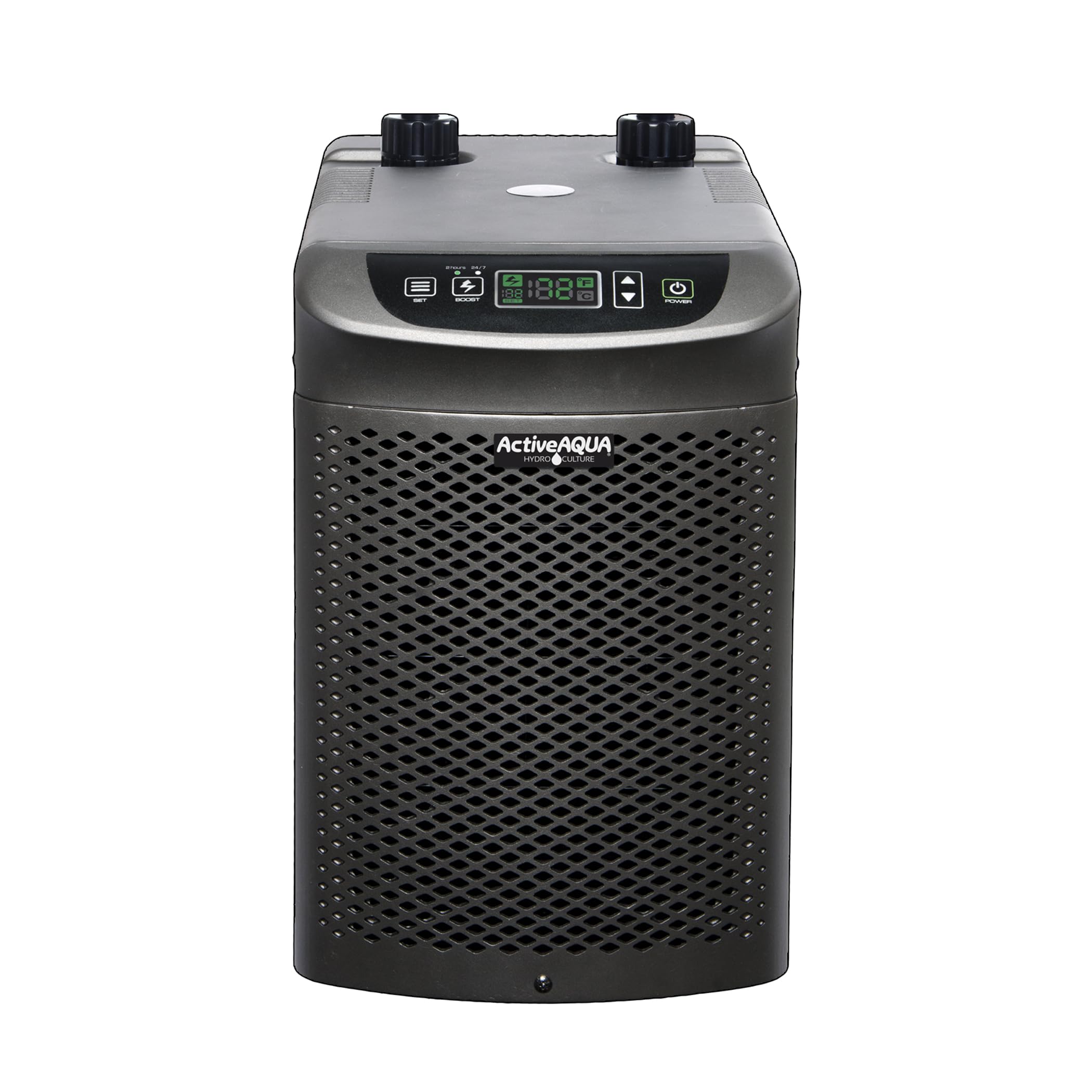
Rating: 4.3 ★ | Price: Premium | Horsepower: 1/10 HP | Refrigerant: R134a | Noise: Noticeable fan hum
Cooling stays within 1°F of the setpoint even during peak summer conditions, thanks to a titanium evaporator that resists saltwater corrosion and a boost function that accelerates initial chill-down. The unit holds temperature consistently over months of operation, which matters for sensitive livestock like axolotls or coral.
This chiller is a strong fit for owners who prioritize temperature precision over silence—reef keepers, axolotl enthusiasts, and cold plunge users. The compressor hum is comparable to a box fan, so it works best in basements, fish rooms, or garages rather than near a living area. Set-up takes minutes with standard hose fittings and a digital interface.
Pros
- Holds water temperature within 1°F of the setpoint for stable conditions.
- Titanium heat exchanger handles both freshwater and saltwater without corrosion.
- Simple hose connections and digital programming out of the box.
Cons
- In quiet rooms the compressor hum will be present—suits dedicated equipment areas.
- Occasional reports of internal water leakage; worth inspecting the unit upon arrival.
Premium-priced but delivers the temperature stability and build quality that reef and axolotl keepers need—worth the investment if you can place it away from quiet living spaces.
Best for Axolotl, Budget
BAOSHISHAN 42gal 1/10HP

Rating: 4.2 ★ | Price: Budget | Horsepower: 1/10 HP | Refrigerant: R290 | Noise: Quiet (mini fridge hum)
The BAOSHISHAN delivers the quiet cooling that axolotl owners need — compressor hum stays at a mini-fridge level, and temperature holds within a couple degrees of the set point. It’s the most affordable way to keep a 40-gallon freshwater tank stable through summer months. The tradeoff is in lifespan: cooling performance can drop off after a year of continuous use, and US-based support is slow when issues arise.
This chiller is best for axolotl keepers who want reliable cooling now and are comfortable planning for a replacement after a couple of years. It is not suited for saltwater reef tanks or anyone who needs absolute temperature stability without monitoring — the evaporator isn’t titanium, and durability variability makes backup worthwhile.
Pros
- Quiet enough for a living room — described as similar to a mini fridge.
- Keeps a 40-gallon axolotl tank within ±2°F of the target temperature.
Cons
- Customer support response times can be slow for US-based buyers.
- Cooling performance may decline after a year of continuous operation.
Best suited for axolotl owners who prioritize upfront savings and quiet operation over long-term certainty.
Best for Silence, Larger Tanks
JBJ Arctica 1/10HP

Rating: 4.1 ★ | Price: Luxury | Horsepower: 1/10 HP | Refrigerant: R134a | Noise: Very quiet
The JBJ Arctica 1/10 HP is the quietest compressor chiller in this class — owners consistently describe the noise as comparable to a small refrigerator hum, making it suitable for living areas where fan noise would be intrusive. The tradeoff: this model demands more space (13x19x20 inches, 41 lb) and its built-in thermostat benefits from calibration or an external controller for precise temperature management.
Best for experienced aquarists with large reef tanks (40–70 gal) who prioritize silence over plug-and-play convenience. The large size and calibration requirement steer casual or space-constrained buyers toward the top pick.
Pros
- Near-silent operation – comparable to a small refrigerator hum, ideal for quiet rooms.
- Effective cooling for 40–70 gallon tanks, quickly reaching and holding target temperature.
- Titanium heat exchanger and solid construction suited for long-term use.
Cons
- Thermostat accuracy can vary by 1–2°F; calibration or an external controller may be needed for precise control.
- Unit is large and heavy (41 lb), requiring a dedicated, sturdy surface – not for cramped spaces.
If silence is non-negotiable and you have the space, this chiller delivers. Otherwise, the top pick offers simpler temperature management in a smaller package.
Best for Silent, under 30 Gal
JBJ Arctica 1/15HP

Rating: 4.1 ★ | Price: Luxury | Horsepower: 1/15 HP | Refrigerant: R134a | Noise: Quiet
The JBJ Arctica 1/15 HP stands out for its ultra-compact footprint and near-silent operation. Unlike the top-pick Active Aqua, which offers more cooling capacity and a titanium evaporator, this unit trades raw power for quietness and size. It’s best suited for 20–30 gallon tanks where a small chiller can be tucked away without fan noise. For 40-gallon tanks in hot climates, the 1/15 HP may struggle to keep temperatures stable – a clear boundary to check before buying.
Pros
- Near-silent operation – one of the quietest chillers available.
- Compact size fits easily under smaller tank stands.
- Effective cooling for 20–30 gallon tanks in moderate climates.
Cons
- The fuse can blow after power surges – worth keeping spares and a surger protector on hand.
- Some units may require early replacement, making a warranty check advisable before purchase.
Ideal for secondary or nano tanks where quiet operation is non-negotiable – just plan for the fuse upkeep.
Best for Budget, Dual-Purpose
Poafamx 42gal 1/10HP

Rating: 4.0 ★ | Price: Mid | Horsepower: 1/10 HP | Refrigerant: R290 (disputed) | Noise: Mixed reports
Effective cooling for many aquarium and cold plunge setups, with a titanium evaporator that resists saltwater corrosion. However, some units may arrive with defects or struggle to maintain stable temperatures below 60°F, making it a gamble for primary use with sensitive livestock.
Pros
- Effective cooling for axolotl tanks and cold plunge setups using 1/10 HP compressor.
- Titanium evaporator eliminates corrosion concerns in saltwater aquariums.
Cons
- Compressor hum may be noticeable in quiet rooms – less of an issue in garages or for cold plunge use.
Best suited as a backup chiller or for budget-conscious builders who can inspect and test thoroughly.
How to Choose
Choosing an aquarium chiller means balancing cooling power, noise, and long-term reliability – not just matching the gallon rating on the box.
Horsepower: 1/10 HP vs 1/15 HP
Horsepower determines how much heat the chiller can remove per hour. A 1/10 HP unit can handle a 40-gallon tank in most climates, but in 90°F+ weather it may run continuously or struggle to drop below 75°F. A 1/15 HP model is only suitable for 20–30 gallon tanks or very mild environments – it lacks the capacity to overcome intense summer heat.
Oversizing is not harmful; a 1/10 HP chiller will cycle on and off more efficiently than a 1/15 HP running flat out. For a 40-gallon tank in a warm room, 1/10 HP is the minimum. If you live in a hot region and keep sensitive livestock, stepping up to a 1/10 HP unit from a reputable brand is the safer choice.
Refrigerant Type
R290 (propane) is a natural refrigerant with good cooling efficiency and lower global warming potential. However, it requires careful handling – if the system leaks, propane is flammable. Most R290 chillers use a sealed circuit with no user serviceable parts, so leaks are rare but not impossible.
R134a is the older standard. It cools slightly less efficiently per volume but is non-flammable and widely supported for repairs. For most hobbyists, the refrigerant type matters less than the overall build quality. What matters more is that the chiller uses a copper-free system for saltwater – look for titanium heat exchangers regardless of refrigerant.
Noise Level
Chiller noise comes from the compressor and the fan. Budget units often use smaller, louder fans; premium models like JBJ Arctica use advanced sound dampening and larger, slower-spinning fans. A chiller that sounds like a box fan in your living room may be fine in a garage but intrusive in a bedroom.
Noise is subjective, but a common reference point: a chiller rated at 40 dB is quieter than a refrigerator hum, while 50 dB is similar to a conversation. If you need absolute silence, target units with confirmed quiet operation – but expect to pay a premium. Many users place the chiller in a cabinet or basement to reduce perceived noise.
Included Pump
Some chillers ship with a matching pump, so you don’t need to buy one separately. The pump must deliver a flow rate within the chiller’s recommended range – too little flow reduces cooling efficiency, too much can cause the compressor to short-cycle.
If the chiller does not include a pump, factor an additional $30–$60 into your budget. Also check the pump’s maximum head height – for chiller placement below the tank, you need a pump that can lift water against gravity. A chiller with an included, correctly sized pump simplifies setup and ensures performance.
Warranty and Support
Warranty length is a strong indicator of manufacturer confidence. Many budget chillers carry no warranty or only 30 days, while premium brands offer 1–2 years. For a chiller that runs 24/7 in a humid environment, a short warranty is a risk – a failed compressor often means replacing the entire unit.
US-based customer support matters when you need replacement parts or troubleshooting. Import brands may offer no phone support and slow email response. If you cannot afford downtime, choose a chiller with a known support network and a return policy that covers shipping.
FAQ
Can a 1/10 HP aquarium chiller keep a 40-gallon tank cool in 90°F weather?
Yes, but it will run continuously and may only maintain a ~15°F drop below room temperature. In a 90°F room, expect the tank to stay around 75–77°F. If you need lower temperatures (e.g., 68°F for axolotls), a 1/10 HP chiller may not suffice on the hottest days without additional cooling like a fan.
Why does my new aquarium chiller not cool below 60°F?
Most compressor-based chillers are not designed to chill below 60°F – the evaporator can freeze, or the thermal safety cut-off kicks in. Check your chiller’s minimum temperature specification. If it’s rated only down to 65°F, you cannot force it lower. Some budget units also have thermostats that drift by 1–2°F, so verify with an external thermometer.
How do I calibrate the thermostat on my JBJ Arctica chiller?
JBJ Arctica models require a separate external controller for precise temperature control because the built-in thermostat can be off by 1–2°F. The manual provides a calibration procedure using a screwdriver on the control board – but most owners find it easier to plug the chiller into a standalone temperature controller (like an Inkbird) for accurate regulation.
Is R290 refrigerant better than R134a for aquarium chillers?
R290 cools slightly more efficiently and has a lower environmental impact, but it is flammable. In a sealed chiller used near water, the risk is minimal, but if you are concerned about leaks or want easier repair options, R134a is the safer choice. For most hobbyists, the build quality and warranty matter far more than the refrigerant type.