This post contains affiliate links. We may earn a small commission when you buy through our links — at no extra cost to you.
Many aquarium chillers promise cooling for 70+ gallons but struggle to keep a 55-gallon tank stable in summer. That gap between marketing claims and real-world performance is a common frustration for aquarists.
The solution isn’t always spending more — it’s matching the chiller’s actual cooling capacity to your tank’s heat load, ambient temperature, and flow rate. This guide separates models that deliver on their specs from those that fall short.
Compressor-based chillers (not fans) are the focus here, organized by tank size and budget to remove the guesswork.
Top Picks
Best for Medium-Large Tanks
Fitnet 79 Gal 1/3 HP Chiller

Rating: 4.3 ★ | Price: Mid-Range | Horsepower: 1/3 HP
The Fitnet 1/3 HP chiller keeps tank temperatures within 1°F of the set point once the swing adjustment is made, cycling far less than many alternatives. In hot weather, owners have reported maintaining 68°F in Florida summers without the compressor running constantly. The unit runs quietly enough for a living room — the fan and compressor hum are present but unobtrusive.
This chiller works best for axolotl, reef, or cold-plunge setups in the 55–79 gallon range. The manual is poorly translated and skips key steps; new owners will need a YouTube walkthrough to adjust the default 5°F temperature swing down to a narrower range. For anyone willing to spend ten minutes learning the setup, this is a dependable cooling solution at a mid-range price.
Pros
- Maintains stable temperatures even during summer heat waves
- Quiet enough for bedrooms or living areas
- Cost-effective for the cooling capacity it provides
Cons
- Poorly translated manual omits essential setup steps; video guides are necessary
- Default temperature swing of 5°F may confuse new owners until the F1 setting is adjusted
For medium-large freshwater and reef tanks, this chiller delivers consistent cooling with minimal noise — just plan a few minutes to learn the setup via video.
Best for Small Tanks
BAOSHISHAN 42gal 1/10 HP Chiller

Rating: 4.2 ★ | Price: Budget | Horsepower: 1/10 HP
Quiet operation and an included pump-and-hose kit make this chiller straightforward to add to a 20–40 gallon freshwater or axolotl tank. It lacks the rugged consistency of the top-pick Fitnet, but for budget-conscious keepers who don’t need absolute durability, the lower upfront cost can offset the risk. Some units may show cooling inconsistencies within the first year, and the supplied pump can be underpowered, prompting an upgrade. Best suited for first-time buyers willing to accept that maintenance or replacement might come sooner than with pricier options.
Pros
- Whisper-quiet compressor keeps noise unobtrusive, comparable to a mini-fridge.
- Maintains temperature within a tight ±2°F band, ideal for axolotls and shrimp.
- All-in-one kit includes pump and hoses, simplifying first-time installation.
Cons
- The included water pump may lack sufficient power for longer hose runs or higher head pressure.
- Cooling output can diminish after extended use, with occasional reports of units losing cooling ability within the first year.
If you need a chilled tank under 40 gallons and can accept the possibility of replacing the unit sooner than a premium model, this chiller delivers solid daily performance at an accessible price.
Best for Reef Tanks
Active Aqua 1/4 HP Chiller

Rating: 4.0 ★ | Price: Premium | Horsepower: 1/4 HP
The Active Aqua chiller uses a pure titanium evaporator that resists saltwater corrosion, a clear advantage for reef keepers over the top pick. The boost function cuts initial cooldown time, and noise is comparable to a mini-fridge — low enough for most rooms. But the chiller ships without a pump or hoses, adding to the upfront investment, and the plastic fittings have been noted to leak in some cases. It’s best for serious hobbyists who want long-term durability and are willing to handle the extra setup and cost.
Pros
- Pure titanium evaporator resists saltwater corrosion — ideal for reef tanks.
- Boost function speeds initial cooldown for cold plunges or tanks.
- Quieter than many compressors — similar to a mini-fridge.
Cons
- Pump and hoses sold separately, adding to total cost.
- Plastic fittings may leak on some units — worth inspecting upon arrival.
Best for reef keepers who need saltwater-safe cooling and don’t mind the added pump cost — just plan for fitting inspection.
Best for Large Tanks
Dreamtrue 79 Gal 1/3 HP Chiller
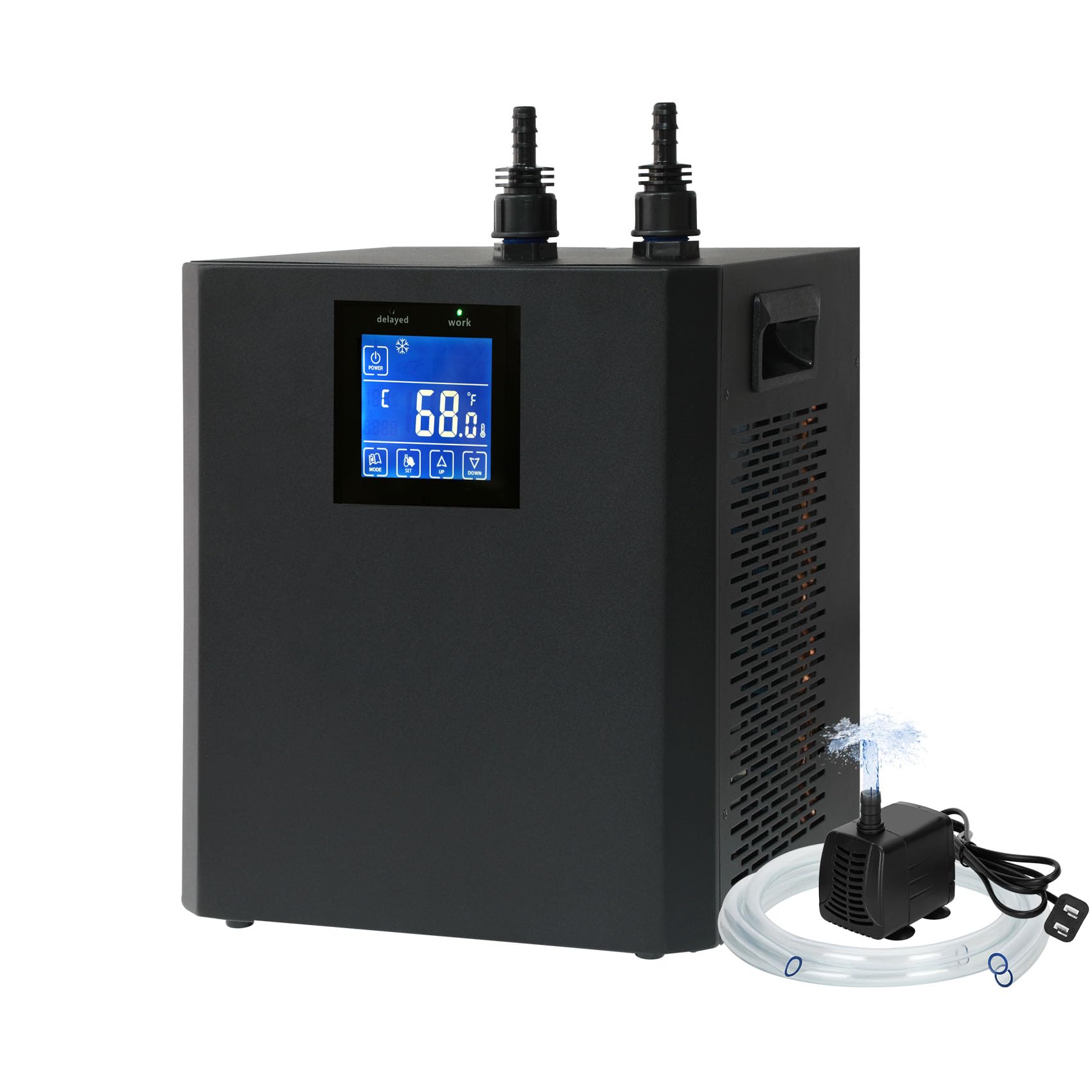
Rating: 4.0 ★ | Price: Budget | Horsepower: 1/3 HP
This chiller matches the top pick’s 1/3 HP capacity at a significantly lower price, making it a tempting option for large tanks up to 79 gallons or cold plunge setups. The trade-off comes in consistency: some units can stop cooling within the first few months, and customer support is minimal.
Best for axolotl keepers and DIY builders who are comfortable troubleshooting on their own. The included manual is barely usable and no online version exists, so setup relies on online guides. If you can accept the possibility of early issues, the cooling performance and quiet operation are solid for the price.
Pros
- Easy to set up and program right out of the box.
- Quiet operation, comparable to a fan, suitable for bedrooms.
- Capable of maintaining cool temperatures in 55-gallon axolotl tanks.
Cons
- Some units may stop cooling within a few months, so buying with a flexible return window is wise.
- The manual is poorly translated and no online version is available—YouTube is needed for setup help.
A budget-friendly choice for large-tank cooling if you’re willing to work around potential reliability and support gaps.
Best for Tight Budget
Poafamx 42gal 1/10 HP Chiller

Rating: 4.0 ★ | Price: Budget | Horsepower: 1/10 HP
The Poafamx 42gal chiller is the cheapest refrigeration option for small tanks, and it does cool axolotl tanks quickly at first. But the plastic fittings may crack, temperature consistency can vary between units, and the refrigerant spec is misleading (R290 claimed, R134a actual). This makes it best for temporary setups or secondary tanks where the budget is extremely tight.
Pros
- Cools axolotl tanks in the 40–44 gallon range effectively
- Rapid initial temperature drop for small tanks
Cons
- Temperature consistency can vary between units, and some may not reach lower temperatures
For a budget secondary tank or temporary setup where any active cooling helps, this chiller can serve — just keep expectations tempered regarding build and performance.
How to Choose
The most overlooked factor in chiller performance is that claimed tank capacity often assumes ideal conditions—your actual cooling needs depend on ambient temperature, heat load, and water flow.
Horsepower and Cooling Capacity
Horsepower directly determines how much heat the chiller can remove per hour. A 1/10 HP unit may suffice for a 20-gallon tank in a cool basement, but in a warm room with high lighting, it will run continuously and struggle to maintain target temperature.
For a 40–55 gallon tank, 1/4 to 1/3 HP provides a safety margin. Oversizing slightly reduces runtime and extends compressor life, but too much power for a small tank can cause short cycling.
Noise Level and Compressor Type
Compressor chillers produce a low hum similar to a mini-fridge. If you place the chiller in a living room or bedroom, look for units explicitly rated under 40 dB. Fan noise from the condenser can be more noticeable than the compressor itself.
Some budget models lack vibration dampening, transmitting noise through the floor. Rubber pads or a separate stand can mitigate this, but not all units are equally quiet out of the box.
Refrigerant Type and Efficiency
R290 (propane) is more efficient and environmentally friendly but uncommon in aquarium chillers. R134a is the standard, offering reliable cooling with moderate efficiency. Some budget chillers claim R290 but ship with R134a—a red flag for spec accuracy.
The refrigerant type matters little for most users; what matters is that the chiller achieves your set point consistently. A unit that short-cycles or fails to cool below 60°F likely has a compressor or control issue, not a refrigerant problem.
Included Accessories
A chiller without a pump and hoses can add $30–$100 to your total cost. If the included pump is underpowered (a common complaint on budget models), flow rate drops, reducing cooling efficiency and risking compressor strain.
Separate pumps with higher flow ratings often improve performance. Match pump flow (GPH) to the chiller’s recommended range—too slow reduces cooling, too fast may not give water enough contact time with the evaporator.
Build Quality and Warranty
Plastic fittings are the most common failure point. Units with metal or reinforced fittings last longer, especially if you frequently disconnect and reconnect hoses. A two-year warranty is a sign of confidence; one-year or none suggests higher risk.
Warranty claims often require shipping the 30+ pound unit back at your expense. Consider this when evaluating a budget chiller—a cheap buy can become expensive if it fails within a year.
FAQ
Why does my aquarium chiller fail to cool below 60 degrees?
This usually means the chiller is undersized for your tank’s heat load or the ambient temperature is too high. Check if the unit is rated for your tank volume under summer conditions. Also ensure water flow is within the recommended range—too low reduces cooling, too high may bypass the evaporator.
How do I set the temperature swing on a Fitnet chiller?
Press and hold the SET button until F1 appears, then use the up/down arrows to adjust the differential (default 5°F). A smaller swing (e.g., 2°F) causes the compressor to cycle more often but keeps temperature tighter. Refer to online video guides since the manual is poorly translated.
Is R290 or R134a refrigerant better for aquarium chillers?
R290 is more efficient and eco-friendly, but R134a is more common and still effective. The specific refrigerant matters less than whether the chiller can maintain your target temperature. R290 requires special handling and is flammable, so R134a is safer for DIY setups.
Why is my chiller leaking water from the fittings?
Loose or overtightened plastic fittings are the usual cause. Hand-tighten only, and apply PTFE tape to hose barbs if needed. Some units ship with cracks in the fittings—inspect upon arrival and return if damaged. Condensation on the hoses can also drip; insulate them with foam tubing.