This post contains affiliate links. We may earn a small commission when you buy through our links — at no extra cost to you.
Keeping a reef tank at a stable 78°F is essential for coral health, but chiller choice often means compromising between fast cooling and saltwater-safe materials. Budget models frequently rely on aluminum evaporators that corrode over time, while titanium-equipped options cost more. The real challenge is finding a chiller that delivers consistent performance without sacrificing longevity in a marine environment.
Many reef keepers also face a trade-off between cooling speed and long-term reliability. A powerful compressor may cool quickly but can short-cycle if oversized, wearing out faster. This guide focuses on chillers that balance cooling capacity with construction that withstands the reef tank’s demands.
We’ve selected models that hit the essential specs: proper horsepower for your tank size, titanium evaporator where possible, and quiet operation. Whether you’re cooling a nano reef or a 79-gallon system, the right match depends on your priorities for noise, corrosion resistance, and budget.
Top Picks
Best for 40-79 Gal
BAOSHISHAN 79gal 1/3 HP
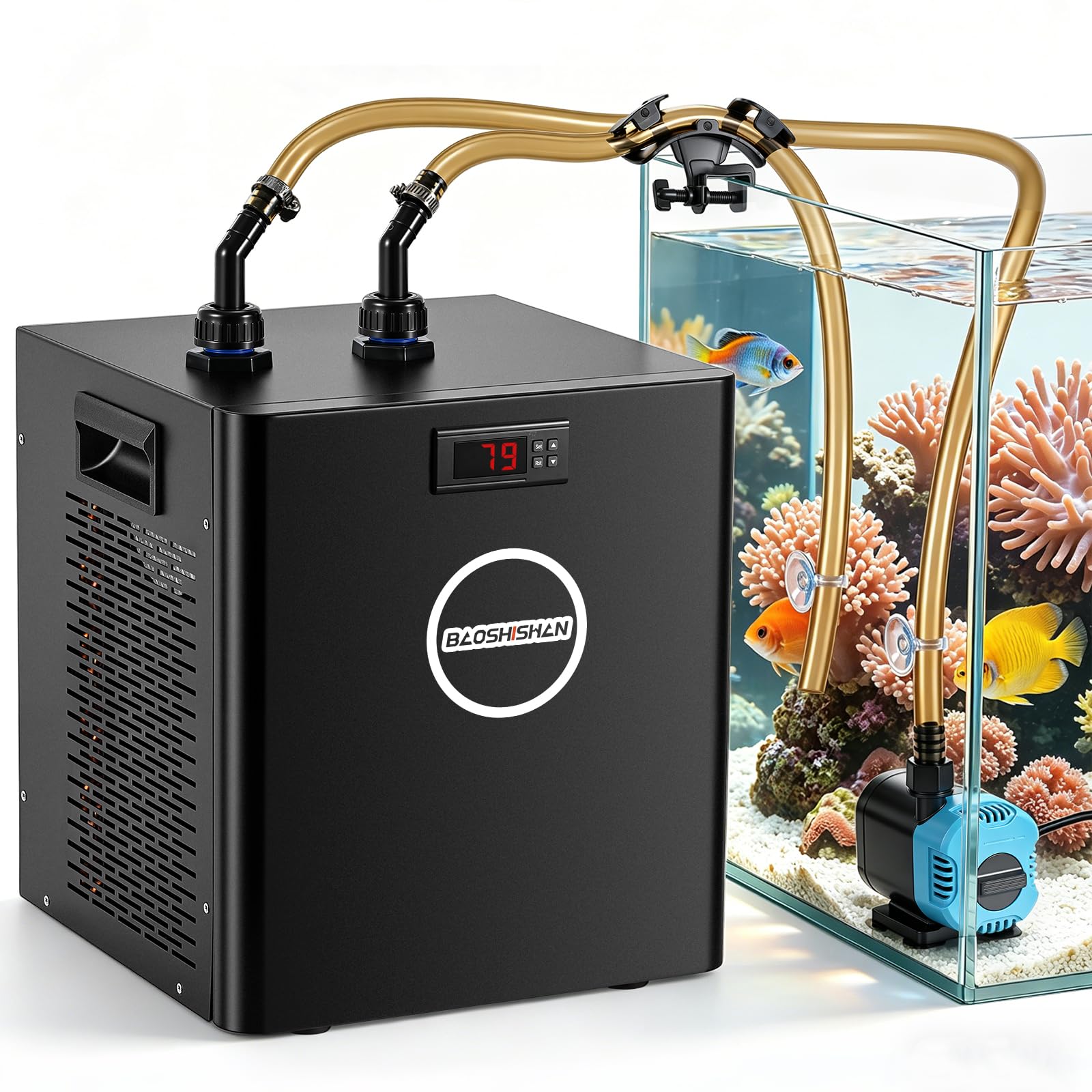
Rating: 4.2 ★ | Price: Mid-Range | HP: 1/3 HP | Capacity: 79 gal | Evaporator: Titanium | Refrigerant: R290
Temperature control holds within ±2°F, keeping water stable for sensitive reef life. Dual silent fans keep compressor hum comparable to a mini-fridge, making it a practical choice for a living room or home office. Setup is straightforward with the included pump.
Best suited for reef keepers with 40–79 gallon tanks who want a balance of cost and cooling performance. The 1-year warranty covers initial defects, but buyers comfortable with potential post-warranty maintenance will find this a fair trade-off for the price. Ultra-sensitive systems needing ±0.5°F precision may need a more accurate unit.
Pros
- Temperature control holds within ±2°F for stable reef conditions
- Quiet operation with dual fans humming at mini-fridge levels
- Easy setup with included pump out of the box
Cons
- Temperature accuracy is within ±2°F – fine for most reefs but not for systems requiring absolute ±0.5°F precision
- Some units may require service within the first year; the warranty covers that, but post-warranty reliability is a consideration
Strong performer for the price, but longevity is a gamble – the 1-year warranty offers limited protection.
Best for 79-Gal
Fitnet 79gal 1/3 HP

Rating: 4.3 ★ | Price: Mid-Range | HP: 1/3 HP | Capacity: 79 gal | Evaporator: Aluminum | Refrigerant: R134a
User reports highlight rapid cooling and stable temperature retention even in warm rooms. Compared to the top pick, this Fitnet chiller cools faster and holds its setpoint with minimal drift, but uses an aluminum evaporator instead of titanium. Best for reef keepers who plan to use a separate thermostat and are comfortable sourcing setup guidance online—the included manual provides little help. Long-term saltwater use may require monitoring for corrosion over time.
Pros
- Cools 79-gallon tanks quickly and consistently, even in warm rooms.
- Holds target temperature with little fluctuation after initial setup.
Cons
- The manual is vague and unhelpful, making first-time setup frustrating.
- Aluminum evaporator may not resist saltwater corrosion as well as titanium over extended use.
If cooling speed and mid-range pricing are your priorities and you can work around a sparse manual, this chiller delivers. For long-term reef tanks, the top pick’s titanium evaporator offers more peace of mind.
Best for Up to 60 Gal
JBJ Arctica 1/10 HP

Rating: 4.1 ★ | Price: Premium | HP: 1/10 HP | Evaporator: Titanium | Refrigerant: R134a
JBJ’s Arctica runs quietly enough for a living-room setup, a clear advantage over the top pick’s more audible compressor. That quiet operation, combined with a longer warranty, suits reef keepers who prioritize noise levels and support over raw cooling speed. Temperature calibration can be off by 1–2°F, requiring a manual offset, so reef keepers should plan to fine-tune the setpoint.
Pros
- Near-silent compressor suits open-plan living spaces
- Consistent cooling for reef tanks up to 60 gallons
- Two-year warranty provides added security against early issues
Cons
- Some units may stop cooling within months – worth testing promptly and using the warranty if needed.
The JBJ Arctica is the right call for reef keepers who want a quiet chiller in their living space and value the peace of mind of a longer warranty.
Best for under 40 Gal
Poafamx 42gal 1/10 HP

Rating: 4.0 ★ | Price: Budget | HP: 1/10 HP | Capacity: 42 gal | Evaporator: Titanium | Refrigerant: R290
The Poafamx 42gal chiller pairs a titanium evaporator – essential for saltwater corrosion resistance – with a budget-friendly price that undercuts most alternatives. It handles nano reefs and axolotl tanks effectively, keeping temperatures moderate without breaking the bank. The caveat: temperature consistency can drift near its 60°F lower limit, and the plastic pump and fittings may need attention within the first year. This makes it a fit for keepers who prioritize entry cost over long-term precision and are comfortable swapping the pump if needed.
Pros
- Titanium evaporator resists saltwater corrosion for reef use.
- Cools nano tanks and axolotl habitats reliably at moderate setpoints.
- Lowest price among chillers with a titanium coil.
Cons
- Temperature control can be inconsistent when set below 60°F.
- Plastic fittings and included pump may require replacement within a year.
A cost-effective entry for nano reef keepers who accept the occasional pump swap and don’t need sub-60°F precision.
Best for under 20 Gal
JBJ Arctica 1/15 HP

Rating: 4.1 ★ | Price: Premium | HP: 1/15 HP | Evaporator: Titanium | Refrigerant: R134a
The JBJ Arctica 1/15 HP delivers near-silent cooling ideal for a bedroom or office nano reef under 20 gallons. It maintains stable temperatures in small setups, but its limited cooling capacity cannot handle larger tanks, making it a niche choice for micro systems where silence is paramount.
Pros
- Extremely quiet operation
- Stable cooling for nano reefs under 20 gallons
Cons
- Fuse may blow, and proprietary replacements are hard to source
Best for nano reef keepers who prioritize silence and have a tank under 20 gallons.
How to Choose
The most important buying insight: a titanium evaporator is non-negotiable for saltwater reef tanks to prevent corrosion and premature failure.
Cooling Capacity
HP rating and tank volume must match your system’s heat load. A 1/3 HP chiller typically handles 40–79 gallons, while 1/10 HP suits tanks under 40 gallons. Oversizing causes short cycling—frequent on/off cycles that wear the compressor and waste energy.
Consider your ambient room temperature and lighting. A chiller rated exactly for your tank will run longer in a hot room; bumping up one size (e.g., 1/3 HP for a 60-gallon tank) gives a buffer without oversizing.
Compressor and Refrigerant
R290 (propane) is an eco-friendly refrigerant with good cooling efficiency, but it’s flammable. R134a is the older standard, non-flammable, and still common in premium chillers. Both work well for reef tanks; the choice rarely limits performance.
The compressor type matters more for longevity. Reciprocating compressors are standard; some budget units use rotary compressors that are quieter but less durable. Check warranty length as a proxy for expected lifespan.
Evaporator Material
Titanium is the only material that resists saltwater corrosion indefinitely. Copper or aluminum will eventually pit and leak, introducing metals into your reef tank that can harm invertebrates. If a chiller has an aluminum evaporator, plan on replacing it within 2–3 years in a marine environment.
Titanium adds cost but eliminates a common failure point. For reef keepers, this is not a luxury—it’s a necessity for long-term reliability.
Noise Level
Chiller noise comes from the compressor and fans. Compressor hum is constant; fans produce air noise. Units with dual silent fans (typically larger diameter) can reduce fan noise to a whisper, but compressor vibration may still transmit through flooring.
In a living room, look for models described as ‘near-silent’ or with low dB ratings. For a garage or fish room, noise is less of a concern. Vibration pads can help isolate compressor noise.
Included Pump and Fittings
The pump flow rate directly impacts cooling efficiency. A higher flow rate moves water through the chiller faster, reducing temperature drop per pass and preventing the compressor from short cycling. Many stock pumps are undersized—upgrading to a pump with 300+ GPH for 1/3 HP chillers improves performance.
Check if the pump is included and whether the inlet/outlet fittings match your setup. Some chillers use standard hose barb fittings; others require adapters. Plan for potential pump replacement within the first year.
FAQ
Why does my aquarium chiller keep turning on and off rapidly?
Short cycling is usually caused by an undersized pump or an oversized chiller. If the pump flow is too low, water passes through too slowly, cooling too much and triggering the thermostat to turn off—only to turn back on moments later. Increasing pump flow or adjusting the chiller’s temperature differential can help.
Can I use a freshwater chiller in a saltwater reef tank?
Only if the evaporator is titanium. Many freshwater chillers use copper or aluminum heat exchangers that will corrode quickly in saltwater and release toxic metal ions. Always check the evaporator material before using any chiller in a reef system.
How long should a reef aquarium chiller last before needing repair?
With proper maintenance and a titanium evaporator, a quality chiller should last 3–5 years. Budget units with aluminum evaporators often fail within 1–2 years due to corrosion. The most common failures are pump motors and compressors—both are replaceable, but repair costs can approach half the price of a new unit.
What’s the difference between R290 and R134a refrigerant in chillers?
R290 (propane) is more energy-efficient and has a lower global warming potential, but it’s flammable. R134a is non-flammable and still widely used. Both cool effectively for aquarium chillers. The choice between them is not a major performance factor for reef tanks—focus on evaporator material and compressor quality instead.