This post contains affiliate links. We may earn a small commission when you buy through our links — at no extra cost to you.
The biggest challenge with small aquarium heaters is consistency. A heater that works perfectly for a 10-gallon community tank can overshoot in a 3-gallon nano, and many budget models drift by several degrees or fail within months. That leaves fish keepers guessing whether the water is actually at 78°F.
At the same time, the choice between a preset 78°F heater and an adjustable model forces a trade-off: simplicity versus flexibility. A preset heater is foolproof if 78°F suits your fish, but useless if you need a different temperature for treatment or a specific species. Adjustable heaters offer control but introduce calibration issues and often lower long-term reliability.
This guide focuses on how the heating element type, thermostat accuracy, and build quality affect real-world performance in tanks from 1 to 20 gallons. The right pick depends on your tank size, fish type, and how much fine-tuning you’re willing to do — and every buyer should plan to verify temperature with a separate thermometer.
Top Picks
Best for Budget Community Tanks
Tetra HT 50W

Rating: 4.4 ★ | Price: Budget | Wattage & Tank Size: 50W, 2-10 gal | Thermostat: Preset 78°F | Safety: Auto shut-off | Material: Glass
The preset electronic thermostat eliminates temperature swings caused by bimetallic strip heaters, holding 78°F steadily in tanks from 2 to 10 gallons. This design sidesteps the mechanical drift that plagues cheaper alternatives, giving beginners one less variable to worry about.
Its compact 4-inch glass body fits behind most aquarium decor without being obtrusive, making it easy to hide in small setups. The submersible design and auto shut-off on exposure provide basic safety for standard glass tanks.
This heater is the right fit for budget-conscious beginners keeping bettas or tropical community fish in standard 2–10 gallon tanks where 78°F is the target temperature. If your fish require a warmer or cooler environment, or if your tank exceeds 10 gallons, the preset temperature becomes a hard limitation that no workaround can fix.
Pros
- Holds temperature steadily in 10-gallon tanks and smaller
- Compact design tucks easily behind tank decor
- Exceptionally low price for a submersible heater with electronic thermostat
Cons
- Preset 78°F cannot be adjusted; only suitable for fish that thrive at that temperature
- Some units may need replacement after about a year of use
For a standard 2–10 gallon tropical tank where 78°F is the target, the Tetra HT offers dependable heating without the mechanical issues of cheaper alternatives, all at a budget price.
Best for Nano Tank Adjustability
hygger 10W

Rating: 4.6 ★ | Price: Mid-Range | Wattage & Tank Size: 10W, 1-5 gal | Thermostat: Adjustable 59-93°F | Safety: Dry-run, overheat, error codes | Material: 2mm thickened quartz glass
For tanks under 5 gallons where the preset 78°F of many heaters won’t work, this hygger delivers full adjustability and a digital display that reads out current—and target—temperatures. The compact quartz glass body leaves more room for plants and hardscape in nano aquascapes, and overheat plus dry-run protection with error codes adds a layer of safety rarely seen at this size.
Betta and shrimp keepers who need temperatures outside the typical tropical range will appreciate the fine-grained control. The built-in temperature sensor can read about 2°F higher than actual water temperature, so setting it a couple of degrees below your target corrects this offset. That quirk is a usability note, not a hazard, but it does mean a separate thermometer is helpful for confirmation.
Pros
- Precise temperature adjustment with an easy-to-read digital display and external controller
- Ultra-compact 4.1-inch body fits into the smallest nano tanks without crowding
- Quartz glass build and error-code safety features feel sturdy for the size
Cons
- Button can feel sticky or require firm presses to change settings
- Temperature sensor may read about 2°F higher than actual water, requiring manual offset
For nano tanks needing adjustable warmth and a tiny footprint, the hygger 10W offers digital control that the top pick lacks; just plan on verifying with a separate thermometer.
Best for Durable Premium Heater
Fluval M 50W

Rating: 4.4 ★ | Price: Premium | Wattage & Tank Size: 50W, up to 15 gal | Thermostat: Adjustable (dial) | Material: Borosilicate glass, ceramic heat sink
Borosilicate glass and a ceramic heat sink give the Fluval M 50W an edge in heat distribution and longevity over simpler electronic heaters. The 3-year warranty backs a design that owners often keep running for years. The trade-off is a manual dial that requires patience to set an exact temperature – a separate thermometer is needed for verification.
This heater is a good fit for hobbyists with established tanks up to 15 gallons who value durable hardware and are willing to pay a premium for it. Skip it if you’re on a tight budget or working with a nano tank under 5 gallons – the size is too large, and the dial adds setup steps that quick-fix buyers may find frustrating.
Pros
- Borosilicate glass and ceramic heat sink distribute heat evenly, reducing hot spots in the tank.
- Mirror finish blends into the aquarium background, making it nearly invisible.
- Durable construction supports years of continuous use.
Cons
- Too large for tanks under 5 gallons; may take up significant space in nano setups.
- In some cases, units can break or shatter, requiring a backup heater.
A premium heater built for longevity – pair it with a separate thermometer for dial precision, and make sure your tank is at least 5 gallons.
Best for Safety-Focused 5-10 Gal
hygger 50W
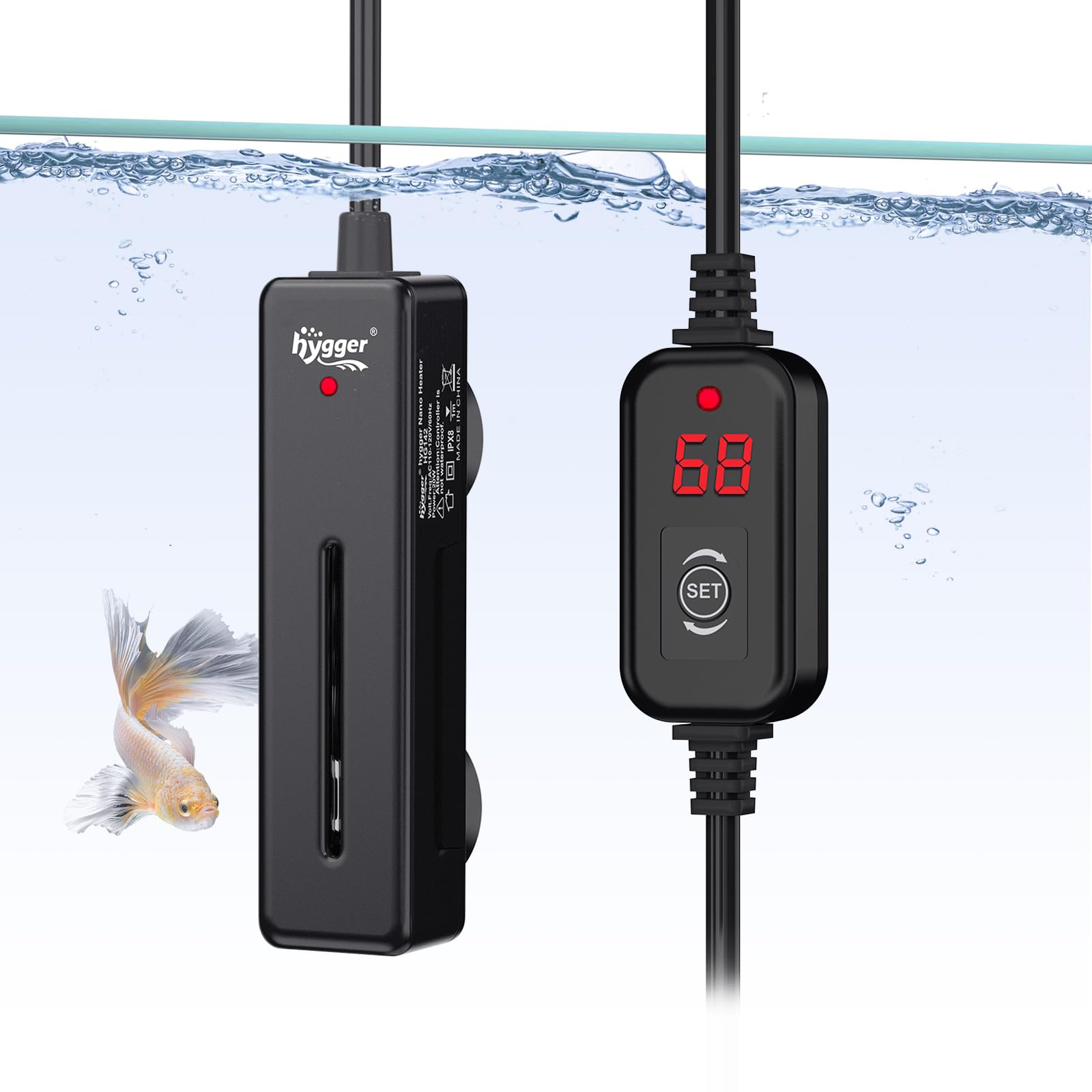
Rating: 4.5 ★ | Price: Mid-Range | Wattage & Tank Size: 50W, 5-10 gal | Thermostat: Adjustable 59-93°F | Safety: Low-water shutoff, overheat alarm, memory | Material: Quartz glass with plastic guard
Unlike the top pick’s fixed 78°F preset, this heater gives you full control from 59 to 93°F via an external digital controller. The low-water shutoff, overheat alarm, and error-code system make it one of the most safety-oriented options in this size range. You get a clear temperature readout without needing to guess where the dial is set.
Best suited for tanks between 5 and 10 gallons where you need a specific temperature for bettas, community fish, or shrimp. The sensor can read about 2°F higher than actual water temperature, so plan to set the target a couple degrees below your desired temp. Not intended for very small nano tanks under 5 gallons, where 50W can overshoot.
Pros
- Digital display on external controller shows current temperature – easy to read at a glance.
- Holds set temperature within about 1°F in most setups, giving consistent warmth.
- Low-water shutoff and overheat protection provide a real safety buffer for unattended use.
Cons
- Some units may stop working within a few months – worth testing performance early and keeping the return window in mind.
For adjustable heating in 5-10 gallon tanks with safety features, this is a strong option – just account for the temperature offset and check unit function early.
Best for Budget Digital Controller
FREESEA 50W

Rating: 4.3 ★ | Price: Mid-Range | Wattage & Tank Size: 50W, 1-10 gal | Thermostat: Adjustable 63-94°F (external controller) | Safety: Dry-run, overheat protection | Material: Glass
The FREESEA 50W brings an external digital controller and large LED display to the budget-friendly segment — a feature set usually reserved for pricier models. This allows precise temperature adjustment (63-94°F) and real-time readout without reaching into the tank. In small aquariums from 5 to 10 gallons, most owners find it holds temperature within a degree or two of the set point, making it a functional choice for basic tropical setups.
Where the FREESEA falls short vs. top picks like the Tetra HT is in refinement. Some units produce a high-pitched whine or clicking sound during heating cycles — noticeable in a quiet living room or bedroom, though less bothersome in a home office or basement setup. Temperature readout can also drift over time or be off out of the box, so pairing this heater with a separate aquarium thermometer is wise rather than relying solely on the display.
This heater suits budget-conscious aquarists who want an external digital controller and don’t mind a little background noise or occasional calibration. It’s a better fit for tanks placed in non-sleeping areas and for owners willing to verify temperature with a secondary thermometer. If quiet operation or spot-on accuracy out of the box is a dealbreaker, the Tetra HT preset heater is the more consistent alternative within the same price tier.
Pros
- External digital controller with large LED display for easy adjustment and live readings.
- Holds steady temperatures within 1-2°F in small tanks, good for 5-10 gallon setups.
- Adjustable thermostat from 63-94°F covers most tropical and temperate species.
Cons
- High-pitched whine or clicking noise during operation can be annoying in quiet rooms.
- Temperature accuracy may drift over time or be off out of the box; worth checking with a separate thermometer.
A cost-effective way to get external digital control and adjustability in small tanks, but the noise and potential accuracy drift make it a budget compromise rather than a set-it-and-forget-it solution.
Best for Budget Digital Heater
DaToo 50W Digital

Rating: 4.4 ★ | Price: Budget | Wattage & Tank Size: 50W, 2-10 gal | Thermostat: Adjustable (external controller) | Safety: Three-point temp sensing | Material: ABS plastic housing, quartz glass
The DaToo 50W offers an external digital controller with LED display at a budget-friendly price. It heats small tanks (2–10 gallons) effectively and allows easy temperature adjustment. That convenience comes with trade-offs: temperature may not consistently reach the set point, and some units can develop issues after a year or two. Consider it for temporary use or as a backup heater.
Pros
- External digital controller simplifies temperature adjustment and monitoring.
- Heats small tanks from 2 to 10 gallons effectively.
Cons
- Temperature may not consistently reach the set level.
- Some units may stop heating or have display issues after extended use.
Best suited as a temporary or backup heater for small tanks where budget is the primary concern.
Best for Temporary Tiny Tanks
AquaMiracle 15W
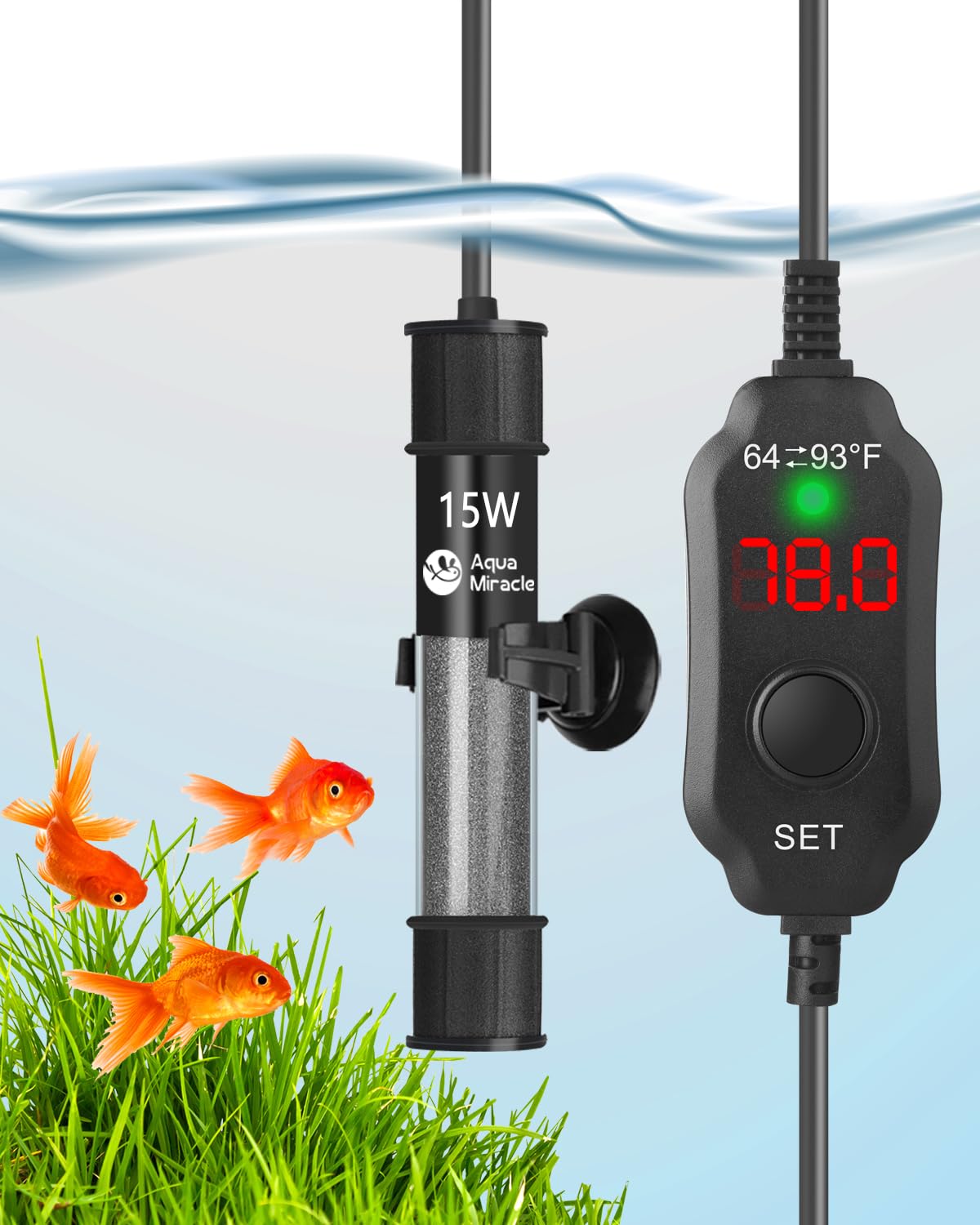
Rating: 4.3 ★ | Price: Mid-Range | Wattage & Tank Size: 15W, 1-3 gal | Thermostat: Adjustable 64-93°F | Safety: Dry-run, overheat, memory | Material: Glass, rubber, plastic
The AquaMiracle 15W fits into spaces where most heaters can’t – at just 4 inches, it’s ideal for 1–3 gallon quarantine or treatment tanks. The dry-run and overheat protection work as intended, and the LED display makes temperature easy to read. However, reports of units breaking within months and occasional temperature swings mean this heater is best reserved for tanks that get regular attention, not for long-term unattended setups.
Pros
- Ultra-compact 4-inch body fits the smallest tanks and tight spaces.
- Safety shutoffs (out-of-water and overheat) engage reliably.
Cons
- Durability can be short – some units stop working within months, which may go unnoticed in unattended tanks.
- Temperature control can vary between units; occasional overheating or underheating has been noted.
Worth considering for a temporary quarantine tank where you can monitor conditions, but not for a permanent setup with valuable fish.
Best for Usb Nano Heater
AquaMiracle USB 10W

Rating: 4.2 ★ | Price: Mid-Range | Wattage & Tank Size: 10W, up to 1 gal | Thermostat: Adjustable 64-93°F | Safety: Overheat protection, memory | Material: Plastic/glass
The AquaMiracle’s USB power and palm-sized build are genuinely useful for desk bowls or travel setups where a wall outlet isn’t available. It’s best considered for temporary or backup use: the heater’s construction and power output suit only the smallest tanks under 1 gallon, particularly when room temperature is stable and the heater can be left undisturbed.
Pros
- Ultra-compact design fits bowls under 1 gallon
- USB power allows operation from power banks for travel or backup
Cons
- In a cold room, the 10W heater may not maintain consistent temperature in a full 1-gallon tank
- Glass housing can crack if the heater is moved or handled while still warm
Best for temporary setups or backup use in small bowls, where its compact size and USB power are genuine advantages.
Best for Extreme Budget
AQUANEAT 25W

Rating: 4.4 ★ | Price: Budget | Wattage & Tank Size: 25W, 3-5.5 gal | Thermostat: Preset 78°F | Material: Glass
The AQUANEAT 25W heater is one of the most compact options available at a budget-friendly price, making it easy to fit into nano tanks and temporary setups. Performance is generally acceptable for betta tanks, but some units may run warmer than the preset 78°F, and the suction cup can lose its grip after a few weeks. These inconsistencies make it a poor choice for permanent tanks or setups with valuable fish — better reserved for quarantine or extreme budget builds where precision and durability are secondary concerns.
Pros
- Compact 4.5-inch design fits small nano tanks easily.
- Includes a thermometer strip for basic temperature monitoring.
Cons
- Preset to 78°F only – not suitable for fish requiring a different temperature.
Works as a short-term solution or bargain stopgap, but the potential for temperature drift and a weak suction cup rule it out for permanent use.
How to Choose
The wattage-to-tank volume ratio is the single most critical factor: a heater too powerful can rapidly overheat a small tank, while one too weak will struggle to maintain temperature.
Wattage & Tank Volume
The standard rule is 5 watts per gallon of water. A 50W heater is ideal for 10 gallons, but in a 5-gallon tank it can overshoot quickly if the thermostat isn’t precise. Oversizing increases the risk of cooking fish during power recovery or if the heater fails in the ‘on’ position.
For tanks under 5 gallons, 25W or even 10W heaters provide a safer margin. Always choose a slightly lower wattage if you’re between sizes — it’s easier to add a second small heater than to manage an overheated tank.
Adjustable vs. Preset Thermostat
Preset heaters are set to 78°F, which suits most tropical community fish. They eliminate calibration guesswork but lock you out of other temperatures. If you need to treat ich at 82°F or keep cool-water fish at 72°F, a preset heater won’t work.
Adjustable heaters give flexibility, but many use a simple bimetallic strip that drifts over time. Digital controllers with external sensors are more accurate but can develop an offset of 2°F or more. Always cross-check with a separate thermometer.
Safety Features
Automatic shut-off when the heater is out of water (dry-run protection) and overheat protection are basic expectations. Without them, a heater left on during a water change can shatter or start a fire. Some models add low-water error codes that alert you before damage occurs.
Memory function is a bonus: it remembers your temperature setting after a power outage, so you don’t have to reset manually. These features add cost but are worth it for unattended tanks or keepers who travel.
Build Material & Durability
Glass heaters are the most common and cheapest, but they can crack from thermal shock during water changes or if knocked. Quartz glass and borosilicate glass resist cracking better. Plastic-encased heaters are less prone to shatter but may degrade over time under heat.
Look for thick quartz glass (2mm or more) and a ceramic heat sink for even heat distribution. The suction cup mounts also matter — some harden and lose grip within weeks, causing the heater to slide and rest against the substrate, which can lead to glass breakage.
FAQ
Why does my aquarium heater keep overheating my betta tank?
The most common cause is using a heater with too high a wattage for the tank volume. A 50W heater in a 3-gallon tank can overshoot quickly, especially if the thermostat is a simple bimetallic strip. Always follow the 5W-per-gallon rule and ensure the heater is near the filter output for even water circulation. If the issue persists, replace the heater with a lower-wattage model.
Is a 50W heater too big for a 10 gallon tank?
No, 50W is the standard recommendation for a 10-gallon tank (5W per gallon). However, if the heater is a basic preset model with a bimetallic thermostat, it may overshoot in warmer rooms. An adjustable digital heater with a separate thermometer gives you more control. In a 10-gallon tank, 50W is the sweet spot for reliable heating.
Should I get an adjustable or preset heater for my 5 gallon fish tank?
If your fish are tropical and thrive at 78°F, a preset heater like the Tetra HT is simple and reliable with fewer calibration issues. If you need to treat disease at higher temperatures or keep species like discus that require 82°F, an adjustable model is necessary. Preset heaters are cheaper and less prone to drift, but they lock you into one temperature.
How long should an aquarium heater last before it needs replacing?
Budget heaters often fail within 1-2 years, especially if they use a bimetallic strip. Higher-quality models like the Fluval M can last 3-5 years or more thanks to ceramic heat sinks and borosilicate glass. Replace any heater that shows corrosion, inconsistent temperature, or stays on continuously. Most failures happen during water changes due to thermal shock.