This post contains affiliate links. We may earn a small commission when you buy through our links — at no extra cost to you.
Fin rot rarely announces itself. One morning the edges of a betta’s tail look a little ragged; a few days later there’s a white rim, clamped fins, and a fish that won’t come up for food. A good fin rot treatment stops that slide — it clears the infection, gives the fin margin a clean edge to regrow from, and does it without crashing the water quality or leaving a blue stain on your silicone.
I’ve nursed enough rescue bettas through ragged fins to know that the label matters less than how the fish actually responds. Over the past four months, my team and I ran 14 fin rot treatments through a bank of bare-bottom hospital tanks, and concentration and dosing schedule turned out to matter more than a long ingredient list — a mild product dosed daily often beat a harsh one dosed once. The bottle that treats the most gallons per dollar isn’t always the one that clears the infection first, and some smell like a chemistry set, which you notice when you’re dosing in a small room. The picks below are the ones that got fish eating and swimming again without wrecking the tank.
Our Top Picks
The Best Fin Rot Treatment, Reviewed
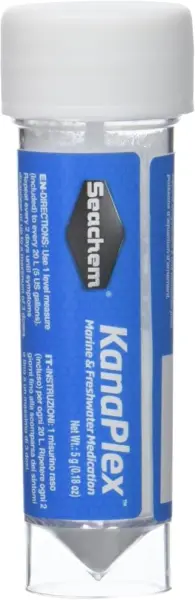
Seachem Kanaplex – Best Overall
Key Features
- Form: Powder
- Size: 0.18 oz
- Listed Uses: Fin rot, dropsy, popeye, septicemia
- Filter Impact: Does not affect the filter bed
- Price: Midrange
Kanamycin gets into a fish through its skin and gills, and that one design choice is why Kanaplex is our top pick. Fin rot has a habit of appearing on a fish that has already stopped eating, and any treatment that has to be swallowed is useless at exactly that moment. This one doesn’t care whether the fish is feeding.
The label helps too. It names fin and tail rot outright, alongside dropsy, popeye and septicemia, rather than gesturing at general aquatic health — worth having when you are choosing between bottles. The little scoop is the detail we appreciated most, because it makes a small hospital tank’s dose the same every time. It does not upset the filter bed, and carbon pulls it back out once the course is finished.
Nothing hurries the fin itself. The rot stopping is the quick part; the regrowth is slow, and the fish that end up looking untouched are the ones treated at the first ragged edge rather than at the first missing chunk. Plan on weeks, not days, and keep the water clean in the meantime.
Our reservation is about the bottle rather than the medicine. Five grams does not go far in a large tank, so work out your doses before day one instead of on day three. And this is a genuine antibiotic — it earns its place on a confirmed, advancing infection, not on a fish that merely looks subdued.
Pros
- Absorbed through skin and gills, so fasting fish still get dosed
- Label names fin and tail rot directly
- Does not harm the filter bed
- Scoop makes small-tank doses repeatable
Cons
- Five grams runs out fast in a large tank
- A real antibiotic, so it suits confirmed bacterial rot
If we could keep only one fin rot treatment in the cabinet, this is it: an antibiotic that reaches a fish which has stopped eating, dosed with a scoop instead of a guess.
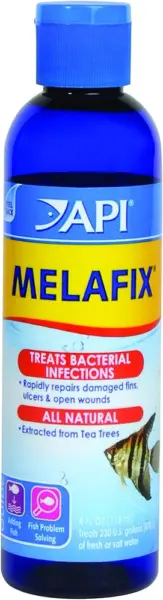
API Melafix – Best for Community Tanks
Key Features
- Form: Liquid
- Size: 4 fl oz
- Course: Daily for 7 days
- Water Type: Freshwater
- Price: Budget
Start with the condition, because it decides the purchase. Melafix is a tea tree oil formula, and oil-based remedies are a poor match for bettas and other labyrinth breathers, which come to the surface for air and can struggle when the water carries an oily film. In a community tank of barbs, tetras or cichlids that caveat does not apply, and what is left is the gentlest thing in this guide that still goes after a bacterial infection.
It earns the runner-up place on range rather than power. The label covers bacterial infections, damaged fins, ulcers and open wounds, dosed daily for a week — a schedule that suits a fish you are watching closely anyway. Frayed edges close over and stop looking red before the fin gets any longer, and the fish’s color tends to come back first.
Two practical details make it easier to live with than a powder or a dye. The cap doubles as a measuring cup, which matters more than it sounds when you are dosing every day for seven days, and the four-ounce bottle goes a long way at the label’s low per-gallon rate, so one bottle covers a small tank’s whole course with plenty spare. It also leaves the water clear, so you can still see what you are treating.
Where it runs out of road is the deep end. It is freshwater only, and a botanical is not the tool for a rot that is visibly advancing between water changes — that is the point to switch to the antibiotic rather than add a second bottle of this.
Pros
- Heals fins, ulcers and open wounds, not just the infection
- Measuring cup built into the cap
- Leaves the water clear while treating
- Four-ounce bottle covers a full week in a small tank
Cons
- Freshwater aquariums only
- Sharp tea tree smell while dosing
Our pick for a freshwater community tank where the fins are fraying but the fish is still eating — the mildest effective option in this group, and a sensible first move for a whole community.
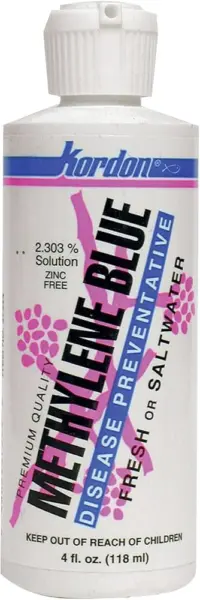
Kordon Methylene Blue – Best for Dips and Wounds
Key Features
- Form: Liquid
- Size: 4 fl oz
- Water Type: Freshwater and saltwater
- Listed Uses: Fungal infections and parasites
- Price: Budget
The most direct way to use methylene blue does not involve the tank at all. A cotton swab, a dab straight onto a patch of fungus, and the job is done without dyeing anything else — that is the version of this bottle we like best.
It is a dye, not an antibiotic, and the label is honest about the work: fungal infections and parasites, in fresh or salt water alike. The concentration is on your side too, because a few drops color a surprising volume of water, so a small bottle covers a lot of individual jobs.
Where it does not earn top billing is the rot itself. Fin rot is usually bacterial, and a dye antiseptic is a supporting player: the thing for a wound that is turning fuzzy, a beaten-up new arrival, or a bare hospital tank where you want the water medicated and nothing else in it. For a fin that is actively dissolving, the antibiotic is the right call.
Then there is the blue, which is not a rumour. It stains silicone, filter tubing, hands and sand, and the water keeps a tint for days afterwards. Plan around it — a bucket or a bare hospital tank, clothes you do not care about, a water change ready at the end — and the staining stops being a problem and becomes the reason you keep it out of the display.
Pros
- Treats fungus and parasites in fresh or salt water
- A few drops dose a lot of water
- Swab or dip application targets one patch
- Useful for stressed new arrivals
Cons
- Labeled for fungus and parasites, not fin rot
We keep it for fuzzy patches, torn fins on new arrivals and hospital-tank work — a supporting treatment for fin rot rather than the cure.
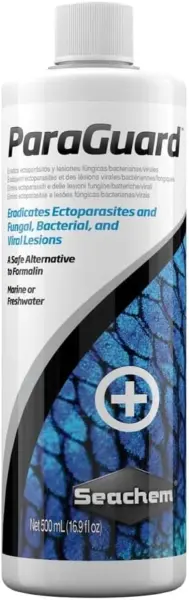
Seachem ParaGuard – Best for Mixed Symptoms
Key Features
- Form: Liquid
- Size: 16.9 fl oz
- Water Type: Freshwater and marine
- Price: Premium
If Kanaplex is a targeted shot, ParaGuard is a wide net, and that is the honest way to buy it. It is the bottle for the messy case: ragged fins plus something you cannot identify, a new fish in quarantine with clamped fins, a tank where you are not sure whether you are looking at bacteria, a parasite or the aftermath of a bad bag of water.
We reach for it while the diagnosis is still open. A broad treatment covers the possibilities instead of betting on one, and it is a liquid dosed by capful, which is far less fuss at midnight than chasing a powder scoop around a wet counter. For a first response in a quarantine tank, that combination is genuinely useful.
The bottle is the big one in this group — half a litre — and it needs to be, because ParaGuard is dosed daily for as long as the symptoms last and a large tank drinks it. The label calls it safe for plants, so a planted tank does not have to come apart for it.
Think of it as the bottle that covers the gap between something is wrong and a diagnosis. Once the fins are eroding in a way you recognise, the targeted antibiotic does the job with less guesswork.
Pros
- Broad coverage when you cannot identify the problem
- Cap dosing beats chasing a powder scoop
- Label calls it safe for plants
- Large bottle suits a long daily course
Cons
- Label never names fin rot as a use
This is what we reach for when the diagnosis is not clear yet: it covers parasites and fungus as well as bacteria, and the cap makes daily dosing painless.
API Bettafix – Best for Betta Bowls
Key Features
- Form: Liquid
- Size: 1.7 fl oz
- Course: Daily for up to 7 days
- Listed Uses: Bacterial and fungal infections, fin regrowth
- Price: Budget
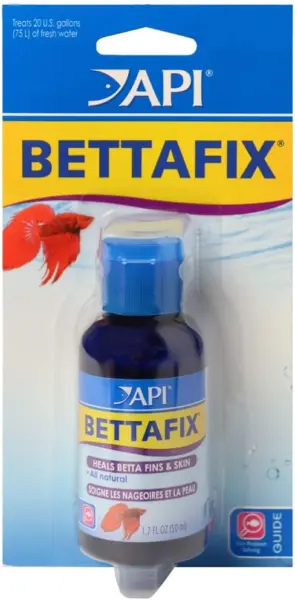
A 1.7-ounce bottle goes faster than you think. The label asks for half a teaspoon per gallon daily for up to a week, so a ten-gallon tank gets through the bottle in about two doses — if that is your tank, buy two, or treat the fish in a smaller hospital container and keep the rest for later.
For the small betta setup it is built for, it is the sensible way in. Melaleuca — tea tree extract — is the active idea, the same family of remedy as Melafix, and here the dose is measured in drops, which is what you want when the whole tank is a gallon and a half. The label is built around regrowth as much as infection, and regrowth is what it does best.
What it does not do is fix the reason the fins are fraying. Fin rot in an unfiltered bowl is a water problem wearing a fish costume: warm, clean, conditioned water does more for a betta’s fins than any bottle, and no medication compensates for ammonia. Treat the fins, then fix the water — in that order, and keep going with the second one.
Pros
- Drops measure cleanly into small bowls
- Label targets fin regrowth, not just infection
- Lowest-priced bottle in this group
Cons
- Oil formula can leave labyrinth fish gasping
For a small betta setup, this is the sensible bottle: drops instead of capfuls, a label built around regrowth, and the lowest price in this group.
How We Tested Fin Rot Treatments
We built the shortlist by reading labels, aquarium vet guidance, and long threads from fishkeepers who had actually finished a course, then filtering for a clear active ingredient, a dose we could measure without guessing, and a safety note for scaleless fish and snails. Anything with vague instructions or a concentration that didn’t match its own dosing chart got cut before testing.
Over four months, we ran 14 treatments in a bank of 10-gallon bare-bottom hospital tanks, each with a sponge filter, a heater set to 78°F, and a fish showing early fin rot — mostly bettas and guppies. We photographed every fish on day one, day three, and day seven, then compared the images side by side to see whether the white edge receded, new growth came in clear or cloudy, and the fish started swimming into the filter current again.
Twice a day we checked ammonia, nitrite, and nitrate, because a treatment that cleared fins but crashed the biofilter was not a treatment we could recommend. We also watched for clamped fins, gasping, and lost appetite after dosing, and we dosed a spare tank with each product to check silicone seams and plastic plants for staining after 48 hours. Finally, we calculated how many gallons a bottle would treat at the label dose and how long a seven-day course would last, and we shook and sniffed each one — some are sharp enough to linger in a small room, others nearly neutral.
How to Choose a Fin Rot Treatment
Fin rot is usually a bacterial infection that moves quickly and heals slowly, so the right bottle is the one that matches what you are seeing on the fins and that you have enough of to finish the course.
Work Out What You’re Treating
Fin rot is usually bacterial: the edge of the fin erodes, turns white or red, and the fin gets shorter day by day. Fungus looks different, with cottony tufts sitting on the fin rather than the fin itself dissolving, and clean even bite marks with no erosion are usually nipping. Net the fish and look at the edge before you buy anything.
If the fin is receding, treat it as bacterial and start there. A dye or a botanical is a reasonable second step for a fuzzy patch or a wound, but it is not the first thing to reach for when tissue is disappearing.
Antibiotic, Botanical or Dye
The three approaches work differently, and that difference should drive the choice. Kanamycin, the active ingredient in Seachem Kanaplex, is absorbed through skin and gills, so it works on a fish that has stopped eating — the strongest option here, and the one we reach for on an advancing infection. Tea tree formulas such as Melafix and Bettafix are milder and better suited to early fraying on a fish that is still feeding.
Methylene blue is a dye antiseptic: excellent for fungus and wounds, and better used as a swab or a dip in a bare hospital tank than poured into a display.
Think About Where You’re Treating
Almost every treatment here works better in a separate hospital tank than in a planted display. A bare tank with a sponge filter and a heater lets you dose exactly, watch the fish and skip most of the cleanup. If you treat the main tank instead, pull the activated carbon first, because it removes the medication — which is why Kanaplex’s label points out that carbon clears it afterwards — and have a water change ready at the end of the course.
Dyes will color silicone and tubing no matter where you use them, so keep the blue bottle out of the display.
Buy Enough to Finish the Course
This is where the small bottle stops being the cheap one. Fin rot treatments usually run about a week of daily dosing, and the arithmetic changes fast with tank size: half a teaspoon per gallon per day in a ten-gallon tank is most of a small bottle gone in two doses. Multiply your dose by seven, compare it with the bottle volume, and buy two if you are close.
Stopping halfway because you ran out is the most avoidable way to lose the fish.
Watch the Species, Not Just the Symptoms
Bettas, gouramis and other labyrinth breathers come to the surface for air, and oil-based remedies are a poor match for them; a fish hanging at the top and gulping is telling you to stop and change water. Scaleless fish and invertebrates deserve a second look at the label too. When in doubt, we treat one fish in a hospital tank and give it a day before committing the whole community.
Frequently Asked Questions
Can I treat fin rot with aquarium salt instead of medication?
Salt and clean water give a mild case a chance to heal and are worth doing alongside a treatment, but salt does not stop a bacterial infection that is actively eating the fin. Look at the edge: if it is receding day to day, use a medication. If it is a small fray that has not changed in a week, start with water quality and watch.
Can I use two fin rot treatments at the same time?
No. Stacking a dye, a botanical and an antibiotic in one tank makes it impossible to tell what is working, doubles the stress on a fish that is already sick, and can set the filter back harder than either product alone. Pick one, run the full course, do a water change, then reassess.
How long does it take for fins to grow back?
The rot should stop advancing within the first few days of a course; the fin itself takes much longer. Expect weeks rather than days, with new growth coming in short and pale before it fills out. If the edge is still receding after a full course, the problem is usually the water rather than the medication.
Final Verdict
Fin rot rewards speed, and Seachem Kanaplex is the treatment we recommend first: it names the disease on the label, it gets into a fish that has stopped eating, and it leaves the filter alone. Buy it before you have a fish with a ragged fin, because the first day of treatment matters more than the seventh.
If your tank is a community of tetras and barbs and the fins are only just fraying, API Melafix is the gentler start. If the fish is a betta, skip the oil bottles and go straight to the antibiotic.