This post contains affiliate links. We may earn a small commission when you buy through our links — at no extra cost to you.
A heater that holds temperature within 1°F sounds ideal — but that accuracy often comes from digital sensors that can drift over time. Meanwhile, the most durable heaters use simpler dials that require manual calibration and patience to set right. The real trick isn’t picking between digital or analog; it’s knowing which failure mode you’re willing to manage.
For a 75-gallon tank, a single 300W heater is working at its limit. That makes redundancy a smarter strategy than chasing higher wattages. And while budget heaters now offer digital displays and safety features, their internal components often mirror those in pricier models — the difference shows in build quality and support, not specs.
This guide matches heaters to the way you actually keep fish: how much monitoring you can do, how many backups you run, and whether a cracked glass or a fried controller is the bigger risk in your setup.
Top Picks
Best for 40-75 Gal Tanks
HiTauing Upgraded 300W

Rating: 4.7 ★ | Price: Mid-Range | Wattage: 300W | Temp Control: Digital dual display | Safety Features: Dry-run, overheat protection | Material: Quartz glass + guard
Temperature stays within a narrow range of the set point, thanks to the dual‑display digital controller that shows both target and actual readings. The quartz glass body feels well‑made, and the removable shell simplifies cleaning without exposing the heating element. Safety auto‑shutoff when out of water provides extra protection against dry‑firing.
This 300W heater is best matched to tanks from 40 to 75 gallons. For a 75‑gallon setup it sits at the upper limit, which means stable heating is achievable but you’ll want a backup unit if your room runs cool. It’s not suited for tanks over 100 gallons. A small number of units have shown glass cracking or melting in isolated cases, so checking the heater during the first week is sensible.
Pros
- Holds water temperature within a tight tolerance of the set point.
- Quartz glass body with removable shell simplifies periodic cleaning.
- Auto shut‑off when out of water and over‑temperature protection built in.
Cons
- 300W output may struggle to maintain temperature in tanks larger than 75 gallons in colder rooms.
- Rare instances of glass shell cracking or melting – worth monitoring during initial break‑in.
For a 75‑gallon tank where precision matters, this is the most accurate mid‑range heater available. Pair it with a second smaller unit if your room temperature drops below 68°F.
Best for 40-75 Gal Tanks
HiTauing 300W Digital

Rating: 4.5 ★ | Price: Budget | Wattage: 300W | Temp Control: Digital external controller | Safety Features: Auto shut-off, out-of-water | Material: Quartz glass, ABS guard
For 40–75 gallon tanks, the HiTauing 300W Digital maintains temperature as consistently as the top pick, with a simple external controller that makes setting a temperature quick. It comes at a noticeably lower price, making it an economical choice for those who prioritize digital convenience over premium build. Some units may develop heating inconsistencies after extended use — this heater works best for budget-minded aquarists who are comfortable with the possibility of an occasional swap within the first year.
Pros
- Digital control panel lets you set the exact temperature without guesswork.
- Holds a steady temperature across a range of tank sizes up to 75 gallons.
- Easy to install with reliable suction cups and a protective guard.
Cons
- In a 75-gallon tank, the heater runs near its capacity; colder rooms may challenge heat retention.
- Durability can vary between units — some may stop heating properly after months of use.
If you need a digital heater for a 40–75 gallon tank on a tight budget, the HiTauing 300W delivers the core function — just keep a flexible return window in mind for the occasional unit variance.
Best for 159-264 Gal
Eheim Jager 300W

Rating: 4.4 ★ | Price: Premium | Wattage: 300W | Temp Control: Dial thermostat | Safety Features: Auto shut-off when dry | Material: Shatterproof glass
Rated for 159–264 gallons, this 20‑inch heater delivers consistent heat for deep aquariums and sumps where shorter heaters fall short. The manual dial requires calibration against a separate thermometer, and the 20‑inch length won’t fit standard 75‑gallon tanks with limited vertical clearance. For serious aquarists running tall tanks or using sumps, the robust shatterproof glass and German build justify the premium.
Pros
- Delivers consistent heat across 75–150 gallon tanks.
- Built with thick shatterproof glass for durability against accidental impacts.
- Heats large water volumes quickly and evenly.
Cons
- Some units may stop producing heat after several months of continuous use — worth checking periodically.
For those with the vertical space and patience for manual calibration, the Eheim Jager offers the longest reach and most robust build among sub‑$50 heaters.
Best for Up to 100 Gal
Aqueon Pro 300

Rating: 4.4 ★ | Price: Premium | Wattage: 300W | Temp Control: Adjustable dial | Safety Features: Auto shut-off, overheat | Material: Metal alloy + plastic
The Aqueon Pro 300 replaces glass fragility with a metal core that won’t shatter — a real advantage for tanks with large, active fish or accidental bumps. Compared to the top pick’s digital accuracy, this heater relies on a manual dial that can be stiff to turn and may need recalibration.
This suits owners who prioritize physical durability over precise temperature control and are comfortable using the lifetime warranty if needed, as some units have been noted to stop heating or split open over time.
Pros
- Shatterproof metal core prevents cracking from bumps
- Lifetime warranty reduces long-term replacement cost
- Good value for a heater built to withstand rough handling
Cons
- Manual temperature dial can be stiff and may not hold calibration
- Occasional early failure means the lifetime warranty is worth keeping in mind
The right call for tanks where glass breakage is a real concern — plan on using the warranty for peace of mind.
Best for 120-160 Gal
AquaMiracle 800W
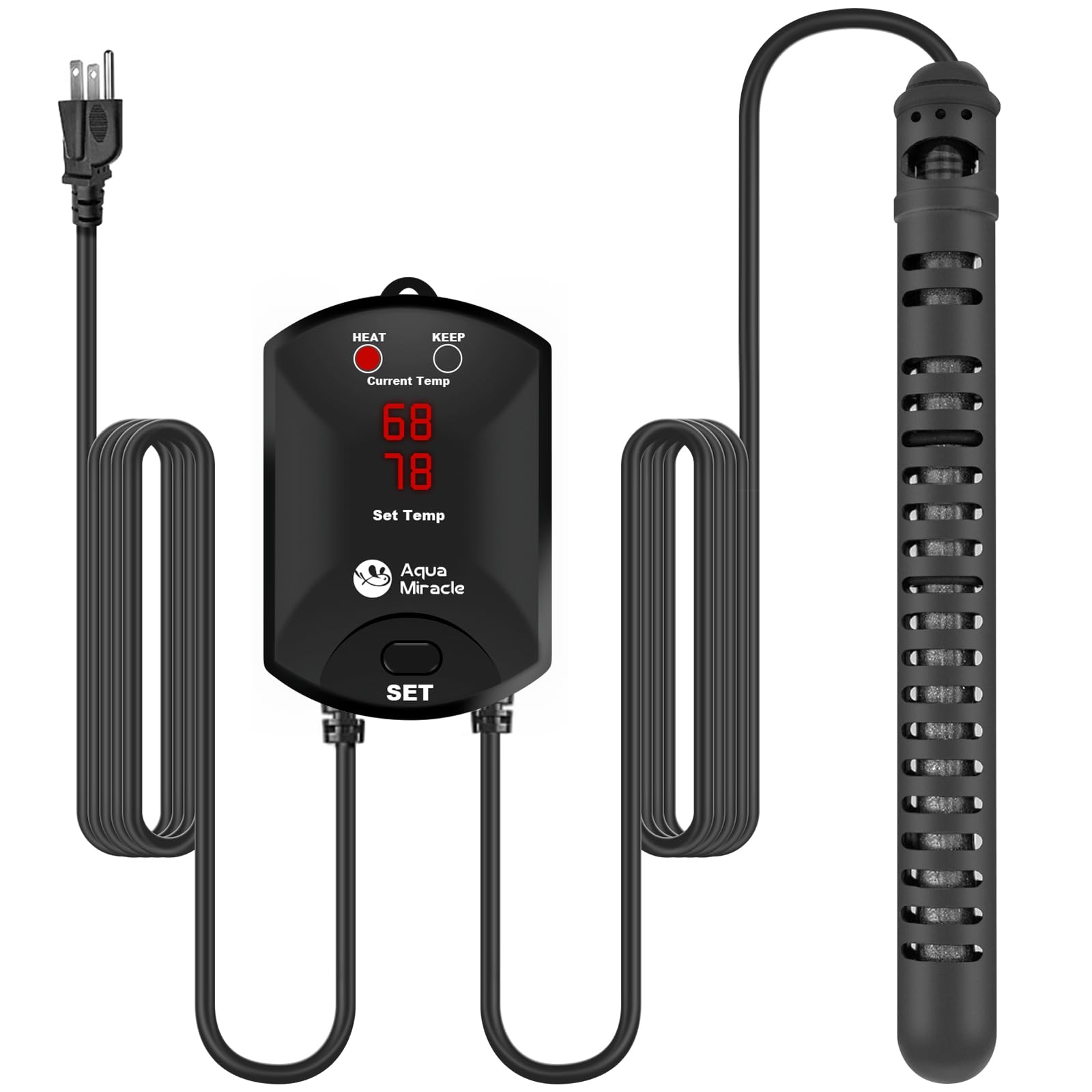
Rating: 4.6 ★ | Price: Budget | Wattage: 800W | Temp Control: Digital external thermostat | Safety Features: Dry-run, overheat, memory | Material: Quartz glass, ABS guard
This 800W heater brings impressive heating speed to large tanks at a budget price, with a digital external thermostat and memory function that retains settings after power outages. However, some units have experienced overheating despite built-in protections, meaning careful monitoring and an external thermostat are recommended for safety. Best suited for very large tanks (120-160 gallons) where budget is the priority and you’re willing to add a backup controller and keep an eye on temperatures.
Pros
- Heats large tanks quickly and effectively.
- Good build quality and features for the price.
- Memory function retains temperature settings after power loss.
Cons
- Potential overheating in some units means an external thermostat is necessary for safe operation — adds cost and monitoring to the setup.
For very large tanks on a budget, this heater offers strong performance, but only if you’re prepared to add external thermostat monitoring and accept the risk.
Best for 55-75 Gal
Orlushy 300W

Rating: 4.4 ★ | Price: Budget | Wattage: 300W | Temp Control: Adjustable dial | Safety Features: Auto shut-off when over-temp | Material: Quartz glass, ABS shell
The Orlushy 300W heats quickly and performs well in 55–75 gallon tanks, making it a functional pick for larger setups on a tight budget. Where it differs from the top-pick HiTauing Upgraded model is in long-term expectations: some units may develop temperature inconsistencies or stop working within months. This heater suits first-time owners or anyone heating a secondary tank who would rather spend under $25 now and replace it later than invest in a pricier unit. Accepting the durability gamble is part of the value proposition here.
Pros
- Heats up quickly in 55–75 gallon tanks
- Comes with a free thermometer, adding to the low entry cost
- Build quality is reasonable for the price point
Cons
- Temperature control can vary between units, affecting stability
- Some units may develop cracking or stop working within a few months
For a spare tank or a tight budget, the Orlushy delivers heat without breaking the bank — just keep a backup handy.
Best for 40-75 Gal Tanks
HiTauing 300W LED

Rating: 4.5 ★ | Price: Mid-Range | Wattage: 300W | Temp Control: Digital display external | Safety Features: Overheat, dry-run protection | Material: Quartz glass, ABS guard
The HiTauing 300W digital heater delivers accurate temperature control and a clear display, with overheat protection suited for 40-75 gallon tanks. Occasional unit inconsistencies — such as component wear causing display errors or shutdown — make the slightly pricier upgraded version a more dependable choice for primary heating.
Pros
- Works well for medium to large tanks (55-75 gallons)
- Maintains stable temperature with easy-to-read digital display
Cons
- Heat-related component wear may cause the heater to stop functioning or display errors
A functional backup or budget option for medium tanks, but the upgraded version is worth the extra investment for primary use.
Best for 40-75 Gal Tanks
ZazaFi 300W
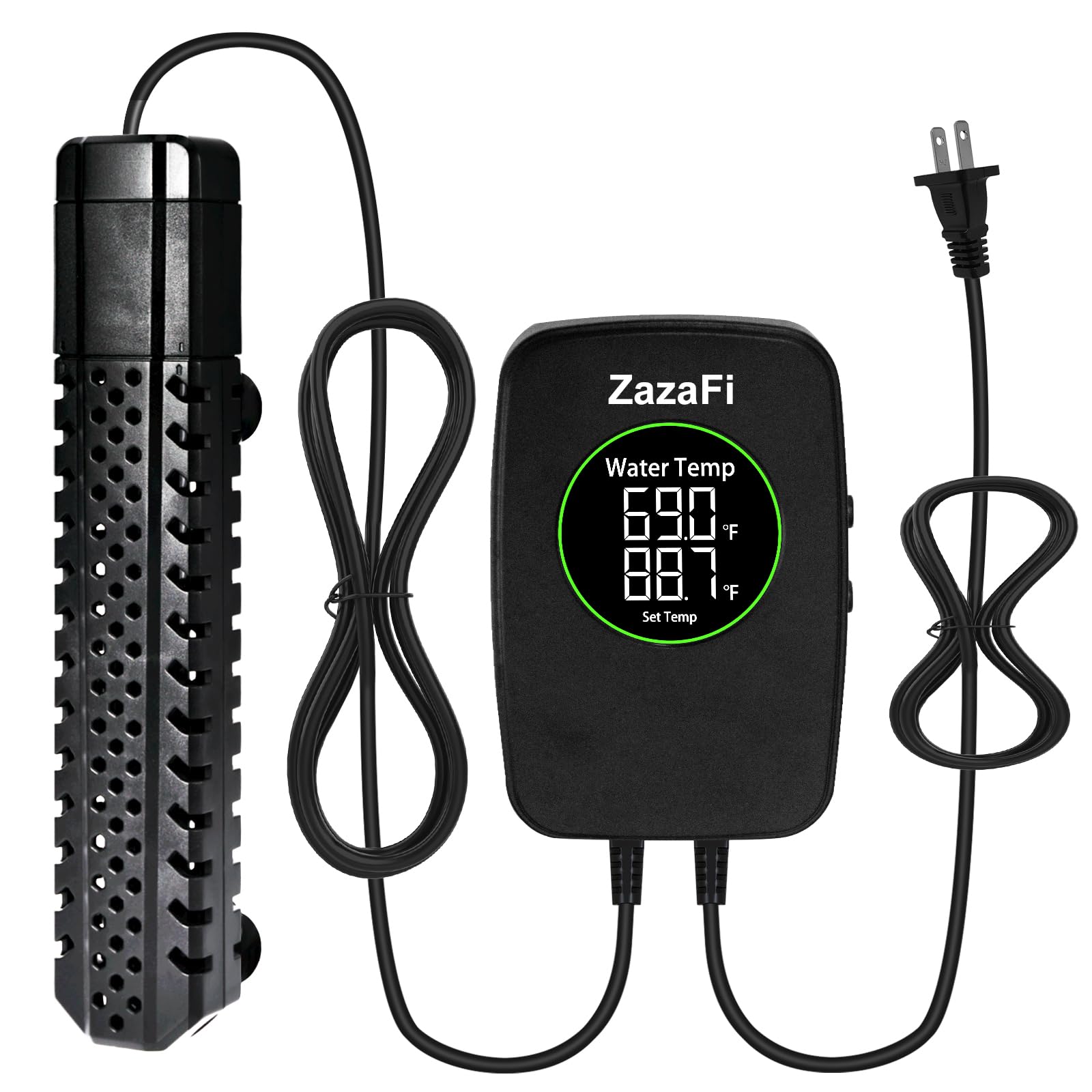
Rating: 4.6 ★ | Price: Mid-Range | Wattage: 300W | Temp Control: Digital controller +/- | Safety Features: Auto shut-off, over-temp | Material: Quartz glass, ABS guard
Dependable temperature accuracy within 1°F for turtle tanks and 40-75 gallon aquariums. Digital controller lets you set the temperature easily, but the display is dim in bright light. Button durability is the weak link — the plus key can fail within days. Worth considering if precise control matters more than long-term build.
Pros
- Consistent temperature within 1°F across the tank
- Works well for both turtle tanks and standard freshwater/saltwater setups
Cons
- Plus button on the controller can stop responding after a few days of use
Best suited for buyers who prioritize temperature precision over button longevity.
Best for 40-75 Gal Tanks
AHJ 300W Digital

Rating: 4.4 ★ | Price: Budget | Wattage: 300W | Temp Control: Digital controller LCD | Safety Features: Over-temp, dry-run | Material: Thick quartz + guard
Delivers accurate digital temperature control and heats quickly for 40–75 gallon tanks, with a solid build for the price. However, reports of plastic housing melting and electrical exposure mean this is best suited as a backup or for temporary tanks where close monitoring is routine.
Pros
- Precise digital temperature control with LCD display
- Solid build quality for a budget-friendly heater
Cons
- Some units have shown plastic melting and possible electrical exposure — use only with external monitoring
Best suited as a backup heater or for quarantine tanks where you can keep an eye on it — not for unattended primary use in a valuable fish setup.
Best for 40-80 Gal
hygger 300W Digital

Rating: 4.1 ★ | Price: Premium | Wattage: 300W | Temp Control: Digital LED controller | Safety Features: Overheat, dry-run alarms | Material: Quartz glass, PC guard
The hygger 300W Digital’s digital display and alarm alerts offer real-time visibility into heater performance. However, durability is uneven; some units may experience plastic degradation or alarm quirks, making it a better fit when used with a backup heater for large tanks.
Pros
- Holds water temperature within 1°F of the set point for stable conditions.
- Digital LED controller shows both target and current temperature at a glance.
Cons
- Random beeping alarms can be disruptive in quiet environments, especially at night.
This heater suits keepers who want real-time power monitoring and are willing to pair it with a secondary heater for safety.
Best for 20-80 Gal
MantaMaze 300W

Rating: 4.5 ★ | Price: Mid-Range | Wattage: 300W | Temp Control: Digital external controller | Safety Features: Auto shut-off, overheat | Material: Quartz + V0 plastic
The MantaMaze 300W holds temperature steadily, heats up quickly, and offers precise digital control at a mid-range price. For larger tanks, its long-term durability over extended use is still being established, making it suitable only for those willing to monitor closely and accept some uncertainty.
Pros
- Maintains steady water temperature without significant fluctuations.
- Digital display enables precise temperature setting with external controller.
Cons
- Long-term durability in tanks above 75 gallons is not yet established given limited market feedback.
Best for hobbyists with medium tanks (40–80 gallons) who value digital precision and are open to a newer brand with a shorter track record.
How to Choose
For tanks 75 gallons and above, a single 300W heater is at its limit; using two 300W heaters provides redundancy and more even heating.
Wattage – Right-Sizing for Your Tank
A 300W heater is the standard starting point for a 75-gallon tank, but it will run continuously if the room is cool or the tank is heavily stocked. Stepping up to 500W or 800W in a single unit cuts heating time but concentrates all failure risk into one device. A more durable setup uses two 300W heaters positioned at opposite ends of the tank. That way, if one fails, the other can hold a safe temperature until you replace it.
For tanks over 100 gallons, two 300W heaters (or one 300W plus one 500W) also improve heat distribution and reduce the temperature gradient between the glass and the center of the tank.
Temperature Control – Digital vs. Dial
Digital controllers display set and current temperatures, making them convenient and precise — but the built-in sensor can drift by several degrees over months. A separate aquarium thermometer (a $5 investment) lets you catch drift before fish notice it. Dial thermostats are simpler and less prone to sensor drift, but they require manual calibration: set the dial, wait 24 hours, check with a thermometer, then adjust.
The trade-off: digital gives you immediate readout and easier adjustment, but demands occasional verification. Dial is more reliable long-term but takes two days of fiddling to dial in.
Safety Features – What Actually Matters
Auto shut-off when dry and over-temperature protection are standard on most heaters above $20, but their reliability varies. In cheaper models, the sensor that triggers shut-off can itself fail, leaving the heater running. Out-of-water shut-off is especially important for sump systems or tanks where water level drops during maintenance.
Memory function (retaining settings after a power outage) is a useful convenience but not a safety feature. For critical setups, an external thermostat controller adds a second layer of protection regardless of the heater’s built-in features.
Material – Glass vs. Metal vs. Plastic
Quartz glass heaters are the most common and heat efficiently, but they can shatter if bumped or if the glass has a manufacturing flaw. Shatterproof metal-core heaters (like the Aqueon Pro) eliminate that risk but are heavier and more expensive. Plastic guards on glass heaters reduce the chance of direct contact but can melt if the heater malfunctions.
For tanks with large, active fish (cichlids, Oscars) or frequent maintenance, a metal-core or shatterproof glass heater is worth the extra cost. For peaceful community tanks, a guarded quartz heater with auto shut-off is sufficient.
Reliability and Failure Patterns
Budget heaters under $30 share remarkably similar internal components — a bimetallic strip or basic thermistor driving a relay. Failure patterns repeat: cracked glass, melted housings, or relays that weld shut and cook the tank. Reviews show that 10-20% of units from budget brands fail within the first year, regardless of rating. Higher-priced brands like Eheim and Aqueon aren’t immune, but their failure rates are lower and they typically honor warranties.
The safest approach is to treat any single heater as a component that can and will fail eventually. Redundancy (two heaters sized for half the tank volume) turns a catastrophic loss into a minor temperature dip.
FAQ
Can I use a 300W heater in a 125-gallon tank?
Yes, but it will struggle. A 300W heater is the minimum for 75 gallons; for 125 gallons you need at least 500W total. Running two 300W heaters gives you 600W and redundancy — if one fails the other can still keep the tank above 70°F in most homes.
Why is my aquarium heater flashing E1 or HH error code?
E1 and HH typically indicate the internal sensor has detected a temperature outside its safe range — usually above 95°F. This can happen if the heater is left out of water, if the sensor is covered by debris, or if the heater is actually overheating. Immediately unplug the heater, let it cool, and check for dry-run or scale buildup. If the error persists, replace the unit.
How do I calibrate the temperature on a digital aquarium heater?
Most digital heaters do not have user calibration; they rely on a fixed sensor. To work around drift, set the heater 2-3°F higher than your target and verify with a separate thermometer after 24 hours. Some controllers (like the HiTauing Upgraded) let you adjust an offset in the settings — check the manual for a ‘CAL’ mode.
Is it safe to leave an aquarium heater on all the time?
Yes, heaters are designed to cycle on and off continuously to maintain temperature. The risk is not from continuous operation but from component failure that keeps the heater stuck on. Using a heater with an independent thermostat or an external controller adds a failsafe. Also, always unplug the heater during water changes if the water level drops below the heater.