This post contains affiliate links. We may earn a small commission when you buy through our links — at no extra cost to you.
Planted aquariums need a careful balance: enough flow to filter waste, but not so much that plants get uprooted or CO₂ escapes. Many standard hang-on-back filters come with fixed flow rates designed for bare tanks, not lush aquascapes. This guide picks filters that let you dial in the current — without breaking the budget or your eardrums.
Beyond flow control, planted tank owners often face noise issues from cheap pumps or leaky canisters. We’ve focused on models that stay quiet and reliable, so you can enjoy your tank rather than listen to it hum. The best choice depends on tank size and whether you prioritize easy cleaning or maximum biological filtration.
Whether you keep a 10-gallon nano or a 70-gallon jungle, the right filter makes the difference between thriving plants and constant algae battles.
Top Picks
Best for Small-Medium Planted
Seachem Tidal 35

Rating: 4.5 ★ | Price: Mid-Range | Flow Adjustability: Dial | Media Capacity & Custom: Customizable basket | Noise Level: Quiet | Ease of Maintenance: Easy, basket | Bio Filtration Effectiveness: Customizable media basket
The Seachem Tidal 35 brings self-priming convenience, a fully adjustable flow dial, and an integrated surface skimmer to a compact HOB design. Flow can be dialed down to 90 GPH for gentle circulation in planted tanks, while the in-tank motor eliminates priming hassle and keeps operation quiet.
This filter suits small to medium planted aquariums up to 35 gallons, especially shrimp and betta setups where adjustable low flow and surface skimming matter. The main boundary is tank size — it cannot handle larger volumes. Individual units may occasionally show flow inconsistency or motor noise over time, so a flexible return window is sensible.
Pros
- Very quiet operation
- High build quality in media basket and pump
- Fully adjustable flow with integrated surface skimmer
Cons
- Limited to tanks 35 gallons and under
- Some units may develop flow inconsistencies or motor noise
For planted tanks under 35 gallons, this is the most feature-complete HOB at a mid-range price — no other option combines self-priming, adjustable flow, and surface skimming as cleanly.
Best for Medium Planted Tanks
Fluval 207 Canister

Rating: 4.5 ★ | Price: Premium | Flow Adjustability: Spray bar/lever | Media Capacity & Custom: Foam, carbon, bio rings | Noise Level: Quiet | Ease of Maintenance: Easy, basket | Bio Filtration Effectiveness: Bio rings & foam
The Fluval 207 is a canister that excels in quiet operation and layered biofiltration, an advantage over the top pick’s HOB design for those who want minimal noise and more media capacity. Three removable baskets provide mechanical, chemical, and biological filtration with adjustable flow via the spray bar. The catch is manual priming and the need to keep gaskets and hose connections properly sealed — a routine check every few months prevents drips. This filter suits experienced aquarists running tanks up to 45 gallons who don’t mind occasional maintenance under the cabinet.
Pros
- Ultra-quiet operation — suitable for living spaces where filter hum is a concern.
- Multi-stage filtration delivers clear water with minimal surface agitation, benefiting planted tanks.
- Media baskets lift out without draining the canister, simplifying regular cleaning.
Cons
- Some units may experience motor or impeller issues within the first year; a warranty or extended protection plan is worth considering.
A strong choice for experienced planted tank owners seeking silent canister filtration with good media capacity.
Best for Large Planted Tanks
AquaClear 70 HOB
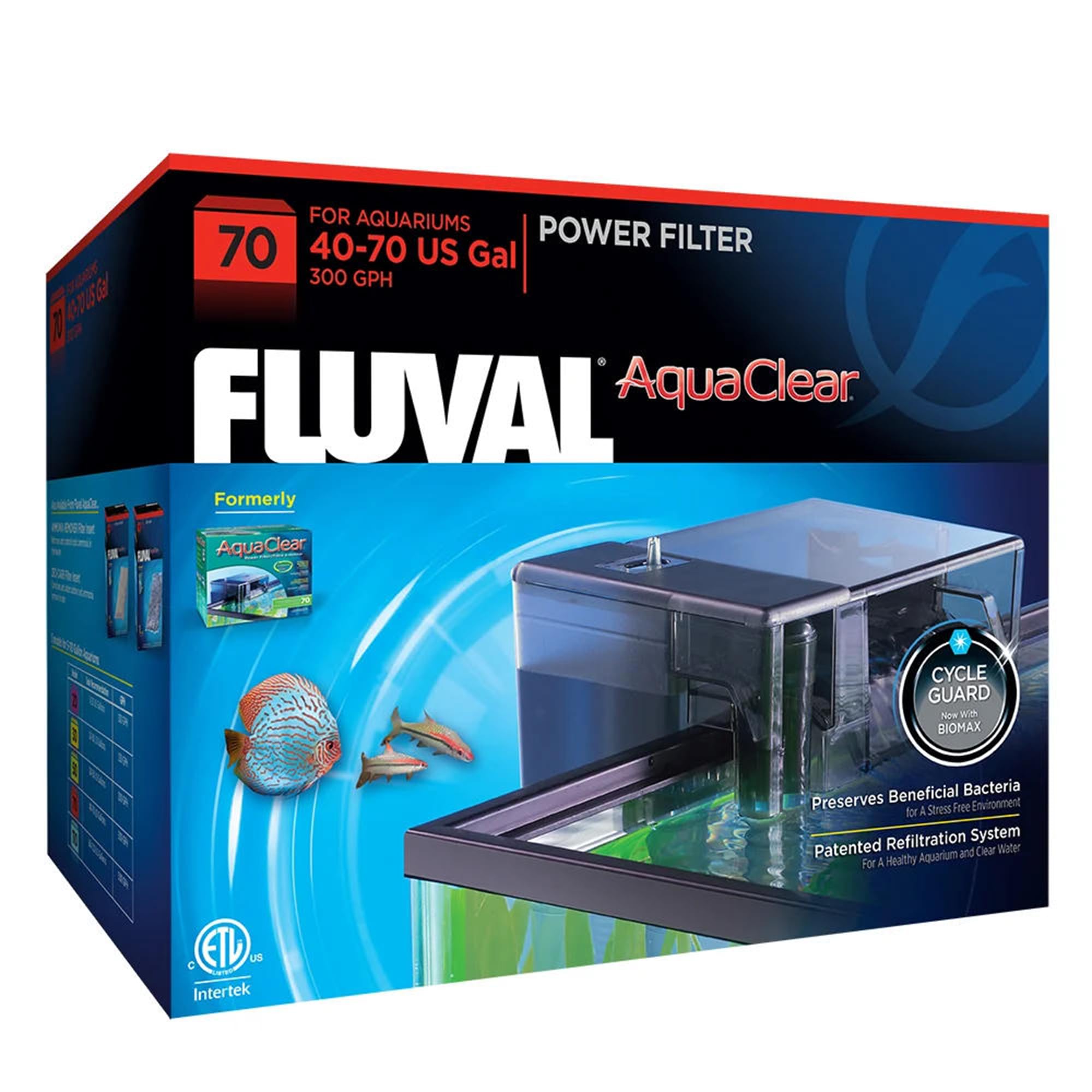
Rating: 4.4 ★ | Price: Mid-Range | Flow Adjustability: Knob | Media Capacity & Custom: Large customizable basket | Noise Level: Variable | Ease of Maintenance: Easy, basket | Bio Filtration Effectiveness: Customizable bio media
The AquaClear 70 holds a large media basket that lets you stack sponges, ceramic rings, and carbon in any order — combined with an adjustable flow knob, you can dial in gentle current for plants without excessive surface agitation. Noise level can vary between units: some produce a hum or rattle depending on water level and surface contact, so this filter suits hobbyists who prioritize media flexibility and filtration capacity over absolute silence. Priming requires filling the chamber before plugging in, but becomes routine after a few uses.
Pros
- Massive media basket lets you customize biological, mechanical, and chemical layers
- Flow control knob for precise water current adjustment
- Crystal clear water results with proper media setup
Cons
- Noise level can vary between units — some produce a hum or rattle in quiet rooms
If you run a 40–70 gallon planted tank and want the freedom to tweak media and flow, the AquaClear 70 delivers — just expect a bit of background hum.
Best for Nano Planted Tanks
Marina S10

Rating: 4.4 ★ | Price: Budget | Flow Adjustability: Dial | Media Capacity & Custom: Small cartridge | Noise Level: Quiet | Ease of Maintenance: Easy, cartridge | Bio Filtration Effectiveness: Cartridge limited
The Marina S10 stands out with its slim design and quiet operation, making it a strong fit for nano planted tanks up to 10 gallons. The adjustable flow prevents excessive surface agitation, preserving CO2 and nutrients for plants. However, its small media capacity limits the bioload it can handle – best for light stocking like bettas or shrimp. An occasional vibration noise can occur, but proper alignment usually resolves it. This filter is ideal for aquarists seeking an affordable, space-saving option for small planted setups.
Pros
- Very quiet operation suitable for bedrooms or living spaces.
- Adjustable flow prevents excessive surface agitation in planted tanks.
- Effective multi-stage filtration keeps nano tanks clear.
Cons
- In quiet rooms, the motor may produce a vibration that can be reduced by adjusting alignment.
- Small media capacity restricts bioload – suitable only for lightly stocked nano tanks.
For small planted tanks under 10 gallons, the Marina S10 offers adjustable flow and quiet operation at a budget-friendly price.
Best for Shrimp/fry Planted
hygger Sponge Filter M

Rating: 4.4 ★ | Price: Budget | Flow Adjustability: Air pump | Media Capacity & Custom: Sponge + ceramic balls | Noise Level: Quiet | Ease of Maintenance: Easy, sponge | Bio Filtration Effectiveness: Sponge & ceramic
The hygger Sponge Filter M pairs two coarse sponges with a bag of ceramic balls, giving you biological filtration without the surface agitation that disturbs planted tanks. Unlike adjustable HOBs (like the slim Seachem Tidal 35), this air-driven unit creates a calm current that suits low-flow setups – shrimp, fry, and delicate plants. The tradeoff is that it needs a separate air pump (not included), and the included suction cups may lose grip over time on textured glass. Best for aquarists who prioritize gentle circulation and aren’t running heavily stocked communities.
Pros
- Dual sponges plus ceramic media provide solid biofiltration for low-bioload tanks.
- Ultra-quiet operation – only the hum of an air pump, no motor noise.
- Budget-friendly entry point for nano to mid-sized planted tanks.
Cons
- Suction cups can lose hold on textured or slightly uneven glass surfaces.
- Sponges need rinsing every few weeks – clogged sponges reduce flow quickly.
A quiet, gentle filter that matches the needs of shrimp and fry keepers – just plan on a secure mounting solution and regular sponge cleaning.
Best for Nano Budget
NICREW Internal 5-10G

Rating: 4.2 ★ | Price: Budget | Flow Adjustability: Dial | Media Capacity & Custom: Cartridge + foam | Noise Level: Loud | Ease of Maintenance: Easy, cartridge | Bio Filtration Effectiveness: Cartridge & foam
This internal filter provides reliable mechanical and biological filtration for small tanks at a budget price, and is easy to clean. However, its design makes it less suitable for nano planted tanks where gentle current and quiet operation are needed. For a more refined option, consider the Marina S10.
Pros
- Reliable for small tanks
- Good filtration for nano tanks
Cons
- Waterfall noise may be noticeable in quiet rooms
- Flow can be too strong for delicate fish even at lowest setting
Best suited as a budget temporary filter for nano tanks with hardy fish, but not recommended for planted setups or delicate species.
Best for Nano Shrimp
AQUANEAT Sponge Filter

Rating: 4.5 ★ | Price: Budget | Flow Adjustability: Air pump | Media Capacity & Custom: Multiple media types | Ease of Maintenance: Easy, sponge | Bio Filtration Effectiveness: Multiple bio media
Multiple media types (foam, ceramic rings, bio balls) in a compact corner sponge filter deliver biological and mechanical filtration with gentle flow — ideal for nano planted and shrimp tanks. However, the unit is smaller than expected, and the Hygger alternative offers more media capacity for a similar price, making this best for the smallest setups.
Pros
- Three-stage filtration with foam, ceramic rings, and bio balls
- Exceptionally low cost for the media diversity
Cons
- May be smaller than expected — verify corner dimensions before purchase
A budget-friendly sponge filter for nano tanks under 10 gallons where space is tight — the Hygger offers more media if you have room for a slightly larger unit.
Best for High Bioload
Marineland Penguin 350

Rating: 4.4 ★ | Price: Budget | Media Capacity & Custom: Proprietary cartridges | Noise Level: Moderate | Ease of Maintenance: Easy, cartridge | Bio Filtration Effectiveness: Bio-wheel
The Penguin 350 is easy to set up and cleans water effectively, a budget-friendly choice for high-bioload community tanks. But its fixed 350 GPH flow creates strong surface agitation, and the motor hum may be noticeable in quiet rooms – both problems for planted aquariums needing gentle, adjustable circulation.
Pros
- Simple to install and operate right out of the box.
- Multi-stage filtration keeps water clear in heavily stocked tanks.
Cons
- Fixed flow rate causes strong surface agitation – unsuitable for planted tanks.
Best for non-planted community tanks that need high flow on a budget; skip this if you have a planted aquarium.
Best for Small Budget
Tetra Whisper IQ 20

Rating: 4.2 ★ | Price: Budget | Flow Adjustability: Dial | Media Capacity & Custom: Cartridge | Noise Level: Quiet | Ease of Maintenance: Easy, cartridge | Bio Filtration Effectiveness: Cartridge only
The Tetra Whisper IQ 20 offers adjustable flow at the lowest price of any HOB filter, making it tempting for budget builds. However, its intended use is short-term or emergency setups—the motor housing can develop leaks over time, and the unit may stop working within months. For a planted tank you plan to maintain long-term, a more consistent filter like the Seachem Tidal 35 is worth the extra investment.
Pros
- Quiet operation (rated <40 dB)
- Affordable price
Cons
- Motor housing leakage can occur over time
For a temporary quarantine tank or emergency backup where budget is the only priority, this filter works—just plan to replace it within months.
How to Choose
The most critical decision for a planted tank filter is flow adjustability — without it, you risk uprooting plants and degassing CO₂.
Flow Adjustability
Adjustable flow lets you fine-tune water movement to match your aquascape. High current pushes substrate around and strips CO₂ from the water column, while too little creates dead spots where waste accumulates.
Look for filters with a dial, spray bar, or lever that reduces output by at least 50%. HOB filters with flow control are rare; canisters and internal filters typically offer more precise adjustment.
Media Capacity & Customization
Media volume determines how much biological filtration your filter can support. Larger baskets allow ceramic rings, bio balls, or custom foam — essential for stable water chemistry in densely planted tanks.
Proprietary cartridges limit your media choices and cost more over time. Filters with open baskets let you mix and match media for specific needs, like polishing carbon or phosphate removers.
Noise Level
Noise in filters comes from water splashing, pump vibration, or air bubbles. Splash noise increases when water level drops below the outflow — keeping the tank full reduces it significantly.
Pump noise is usually a sign of air trapped in the impeller or worn bearings. Self-priming designs (like the Seachem Tidal) eliminate priming rattle, while canister filters tend to hum at a lower frequency than HOBs.
Ease of Maintenance
Filters that disassemble without tools save hours over the years. Removable media baskets let you swap or rinse media without pulling the whole unit apart — especially useful when cleaning sponge pre-filters weekly.
Cartridge-based filters are fast to replace but create recurring costs. Sponge filters need only a squeeze in tank water, making them the lowest-maintenance option for shrimp or fry tanks.
Biological Filtration Effectiveness
Biological filtration relies on surface area for beneficial bacteria. Ceramic rings, bio-balls, and sintered glass provide far more surface area than foam cartridges. The more media volume and porous media you have, the faster your cycle stabilizes.
Sponge filters are excellent for gentle bio-filtration but clog sooner than canister baskets. Canisters with layered media (foam → carbon → bio rings) offer the best balance of mechanical and biological filtering.
FAQ
Can I use a HOB filter on a planted tank without disturbing my plants?
Yes, as long as the filter has adjustable flow and you orient the outflow so it doesn’t blast plants directly. Point the spray bar toward a wall or use a spoiler attachment to diffuse the current. Avoid HOBs with fixed high flow rates — they’ll uproot stems and blow substrate around.
How do I adjust the flow on a canister filter for a planted aquarium?
Most canisters have a flow control valve on the outflow hose, a spray bar orientation, or an inlet control. Turn the valve to reduce flow by 30-50%, then check for dead spots. Spray bars with rotating outlets let you aim the return flow along the glass to create a gentle circular current.
Is a sponge filter enough for a heavily planted tank?
Sponge filters work well for low-bioload planted tanks (shrimp, nano fish) but lack the mechanical polishing needed for heavy waste. For a fully stocked planted tank with large fish, combine a sponge filter with a small HOB or canister to handle solid waste without overwhelming the sponge.
Why does my aquarium filter keep leaking after cleaning?
Leaks usually come from dried-out or misaligned O-rings, especially on canister filters. After every cleaning, lubricate the O-ring with silicone grease and check that the lid clamps are fully seated. For HOBs, ensure the motor housing is pushed all the way down and the intake tube is free of debris that can push the seal loose.