This post contains affiliate links. We may earn a small commission when you buy through our links — at no extra cost to you.
Many 100-gallon tank filters advertise impressive GPH numbers, but once you add media and plumbing, actual flow drops significantly. That’s where the real test begins.
Media volume and basket design matter more than peak flow for keeping water clear. A filter that holds more biological media handles heavier bioloads without frequent cleaning.
This guide cuts through the marketing numbers to focus on what keeps your tank healthy: consistent flow, easy maintenance, and durability. Whether you prefer canisters or HOBs, we’ve matched options to specific tank setups.
Top Picks
Best for All-Around 100 Gal
Fluval 407 Canister

Rating: 4.5 ★ | Price: $$$ | Flow Rate: 383 GPH | Media/Baskets: 3 EZ-Lift baskets | Leak/Valves: Quick-release valves | Maintenance: EZ-Lift, easy prime
The Fluval 407 runs quietly enough to go unnoticed in a living room, and its three stackable EZ-Lift baskets make filter media swaps a five-minute task. At 383 GPH, the flow rate supports a well-stocked 100-gallon community tank without creating a current that disturbs plants or fish. Real-world flow drops with media loading, but remains sufficient for standard stocking levels — a result of the pump’s consistent performance and low energy draw at 15W.
Water clarity is reliably clear across varied bioloads, and the adjustable flow valve allows fine-tuning for planted tanks or sensitive species. For heavier bioloads like goldfish or large cichlids, the FX4 model offers more flow and media volume, but the 407 avoids overpowering a standard setup. The few leak reports that surface typically trace back to the lid O-ring not being fully reseated after cleaning — a condition that is preventable with regular inspection.
This filter suits aquarists who value quiet operation and easy maintenance over raw flow numbers. It is a good fit for planted tanks where media flexibility and adjustable output matter, and for first-time canister users who want a well-documented product with clear instructions. The premium price reflects consistent build quality, though motor seal failures have been noted on some units within the first year — a factor to consider when evaluating extended warranties.
Pros
- Whisper-quiet operation even in open living spaces.
- Tool-free media baskets simplify filter maintenance without tools.
- Adjustable flow rate suits planted tanks and gentle community setups.
- Consistent water clarity across varied stocking levels.
Cons
- Lid and hose connections may leak if O-rings are not reseated correctly after cleaning.
- Motor seal durability varies; some units require replacement within months.
For a quiet, low-maintenance canister that handles standard 100-gallon community tanks without fuss, the Fluval 407 is the right choice. Buy it for peace of mind over budget alternatives if you can accept occasional seal inspection.
Best for Budget Canister Filtration
Penn-Plax Cascade 1200

Rating: 4.3 ★ | Price: $$ | Flow Rate: 315 GPH | Media/Baskets: 4 stackable baskets | Leak/Valves: No quick-release | Maintenance: Push-button prime
The Cascade 1200 matches the media capacity of higher-priced competitors with four stackable baskets and a push-button prime, all at a mid-range price. Where it differs from the top pick is material quality: the plastic housing can develop cracks if the canister is bumped or moved regularly, and the priming mechanism requires a fast, rhythmic pumping that some find awkward rather than the effortless seal of premium models.
This filter suits budget-conscious aquarists managing high-bioload tanks like turtle or cichlid setups, where frequent media cleaning is already part of the routine. The plastic durability and priming quirk are manageable tradeoffs for those comfortable with occasional tinkering. Not the right fit for buyers who want a set-and-forget canister or need to fit a filter under low cabinets — the 20.5-inch height limits placement options.
Pros
- Four stackable media baskets with handles simplify servicing
- Push-button primer helps restart flow after cleaning
- Quiet enough for living rooms and bedrooms
- Effective water clarity for tanks up to 150 gallons
Cons
- Plastic housing can develop cracks if the canister is bumped or moved regularly
- Priming requires a fast, rhythmic pumping that some find awkward
- Gaps between media baskets and canister wall can allow water to bypass filter media
The Cascade 1200 delivers performance rivaling premium canisters at a lower price — a smart choice for those who accept the plastic tradeoff and don’t mind a brief priming routine.
Best for Hob with Skimmer
Seachem Tidal 110 HOB

Rating: 4.4 ★ | Price: $ | Media/Baskets: Large removable basket | Leak/Valves: No quick-release | Maintenance: Self-priming, easy
The Seachem Tidal 110 packs enough media capacity to challenge many canister filters, with a removable basket that leaves room for custom media choices. Self-priming eliminates the hassle of manual siphoning, and the adjustable flow rate suits planted tanks or fish that prefer gentler currents. These features, combined with an integrated surface skimmer, make it one of the most capable HOB filters on the market.
When water level is consistent and the skimmer stays clear of debris, the Tidal 110 operates quietly – a clear step up from the hum of many HOBs. But a drop in water level or a clogged skimmer intake can produce a sucking noise, and the skimmer itself can trap small fish or fry. These limitations are manageable in a well-maintained tank without tiny inhabitants.
This filter fits tanks where cabinet space is limited or nonexistent, and owners who want the convenience of a HOB without sacrificing filtration media. It works well for planted setups with controlled flow, but not for breeders raising fry or those who can’t maintain a steady water level. The ceramic media dust from packaging can scratch the housing if not rinsed first – a one-time precaution worth taking.
Pros
- Large, removable media basket with room for custom configurations.
- Self-priming design eliminates manual siphoning after cleaning.
- Adjustable flow and surface skimming for planted or sensitive fish tanks.
Cons
- Noise can develop when water level drops or skimmer intakes debris.
- Surface skimmer may trap small fish, shrimp, or fry.
A feature-packed HOB that delivers near-canister media capacity at a budget price – ideal for aquarists who can work around its water level sensitivity.
Best for Heavy Bioload Tanks
Fluval FX4 Canister
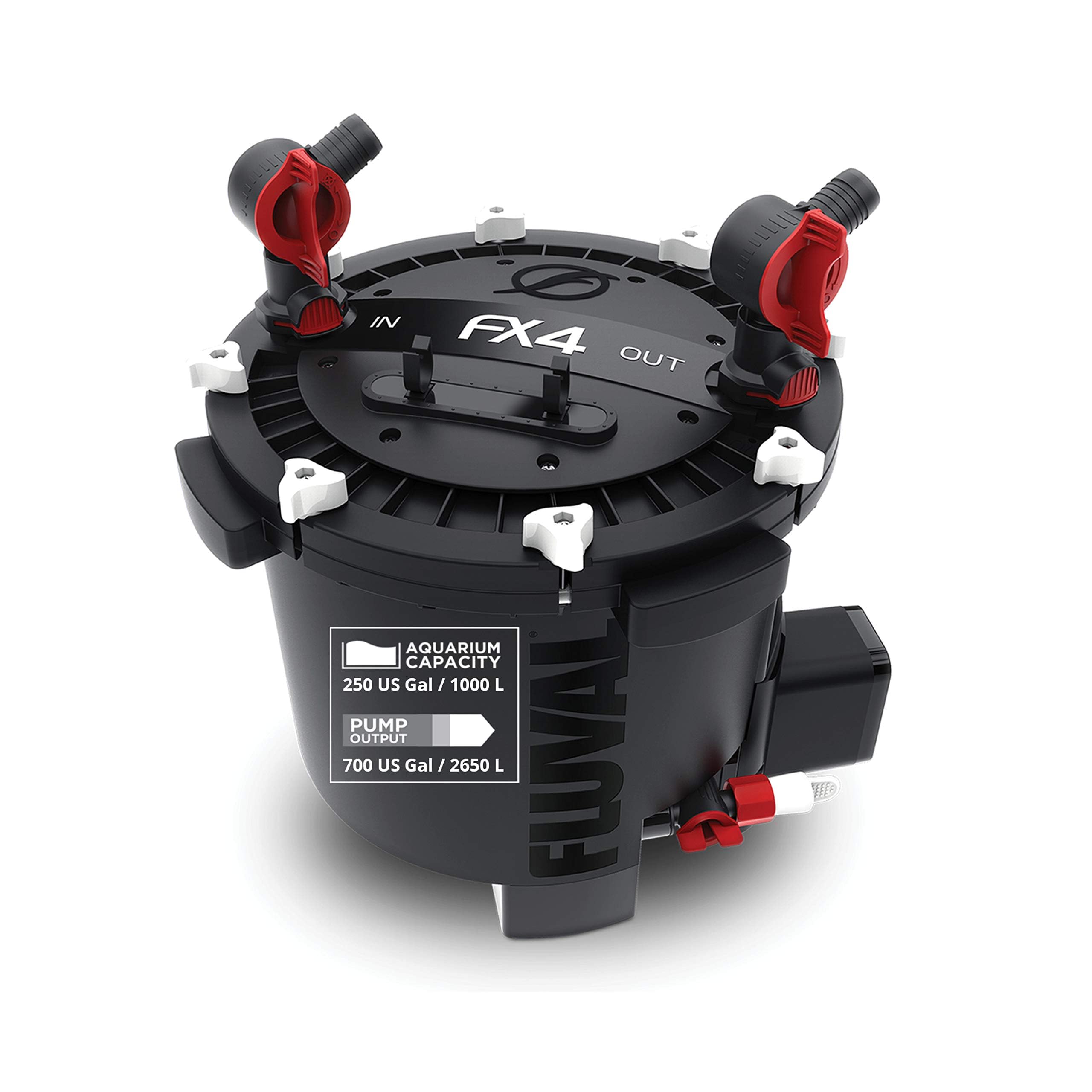
Rating: 4.5 ★ | Price: $$$$ | Flow Rate: 700 GPH | Media/Baskets: 1 gal media volume | Leak/Valves: Drain valve only | Maintenance: Self-priming, drain
The FX4’s 700 GPH flow and 1-gallon media capacity provide robust filtration for messy, densely stocked tanks, with users noting near-silent operation and rapid water clarity improvements. Compared to the top pick in this class, the FX4 adds significant headroom — enough to handle a fully stocked cichlid or goldfish setup without flow drop-off.
This filter is suited for aquarists running heavy bioloads — think large cichlids, goldfish, or planned upgrades to a larger tank. The self-priming Smart Pump technology eliminates the need for manual priming, and the drain valve simplifies water changes. Those with a lightly stocked 100-gallon setup or tight cabinet space will find the FX4 oversized and premium-priced; the standard 70-gallon class of canisters offers a better fit.
Pros
- Runs quietly despite high flow — in-room noise is minimal.
- Clears water quickly in heavily stocked tanks — noticeable improvement within hours.
- Media capacity handles large bioloads without frequent cleaning — supports dense fish populations.
- Convenient drain valve makes water changes and media access straightforward.
Cons
- Requires a larger investment than standard canisters — only worthwhile if you need the extra headroom.
- Hose connections are stiff and may require tools to detach during maintenance.
- Some units may experience loss of priming or motor performance after several months of use.
For aquarists with heavy bioloads or plans to upgrade, the FX4 delivers unmatched flow and media capacity. For lightly stocked tanks, the extra cost and size are hard to justify.
Best for Budget Internal Filter
AquaMiracle Internal Filter

Rating: 4.2 ★ | Price: $ | Flow Rate: 300 GPH | Media/Baskets: 3 sponges | Leak/Valves: No valves | Maintenance: Sponge swappable
Three replaceable sponges (coarse, carbonized, fine) and a 300 GPH pump cost less than a canister’s replacement media alone. Setup takes about two minutes: attach the suction cups, drop it in, and plug in. For someone maintaining a 100-gallon tank on a tight budget, this internal filter delivers clear water with minimal upfront investment.
The tradeoff for that low price is a filter best suited as a supplement rather than the primary workhorse. In a community tank with moderate stock, it handles mechanical and chemical filtration well enough, but the media volume is modest compared to a full canister. Where it really shines is as a backup unit or alongside a main filter – the compact horizontal shape fits shallow tanks where HOBs won’t clear the rim.
Owners who place this in a quiet living space may notice a low hum or occasional rattle from the impeller. The clips that hold the body together can feel stiff the first few times, though they loosen after repeated openings. The more serious boundary is that the motor may stop working within months in some units – worth factoring in a flexible return window if you need long-term reliability.
Pros
- Sponges rinse clean in seconds under tap water – no floss or carbon bags to replace.
- Leaves water noticeably clearer within a day or two after installation.
- Costs less than a set of canister media refills – true budget entry point for 100-gallon tanks.
Cons
- The body clips can be hard to unlatch, especially when new.
- In a quiet bedroom or living room, the pump hum and occasional rattle will be present.
- The motor may stop running within a few months in some units – worth buying with a flexible return window.
A cost-effective stopgap or backup filter for aquarists who need clear water now and can accept that long-term durability isn’t guaranteed. Pair it with a canister if you plan to keep the tank running for years.
Best for High-Flow Turtle Tanks
TARARIUM Internal 400

Rating: 4.3 ★ | Price: $ | Flow Rate: 400 GPH | Media/Baskets: 3-stage sponge | Leak/Valves: No valves | Maintenance: Transparent, easy clean
The TARARIUM Internal Filter delivers 400 GPH of strong current with wave-making capability, making it well-suited for turtle tanks or as a supplemental circulation pump. Its transparent housing allows easy inspection and cleaning. For the price, it provides impressive flow that supports messy turtles and high-oxygen environments. However, design tradeoffs restrict it to temporary or supplementary roles, which keeps it from being a top pick for a permanent primary filter in a 100-gallon setup.
Pros
- Delivers 400 GPH strong current with wave-making for high-flow setups.
- Transparent housing allows easy visual inspection and cleaning.
- Budget-friendly price for the flow rate provided.
Cons
- Flow rate cannot be adjusted – may be too powerful for many fish.
- Some units may experience motor failure within weeks of use.
Best for turtle keepers or as a budget supplemental pump for high-flow needs.
Best for Green Water Cure
AquaMiracle UV Filter
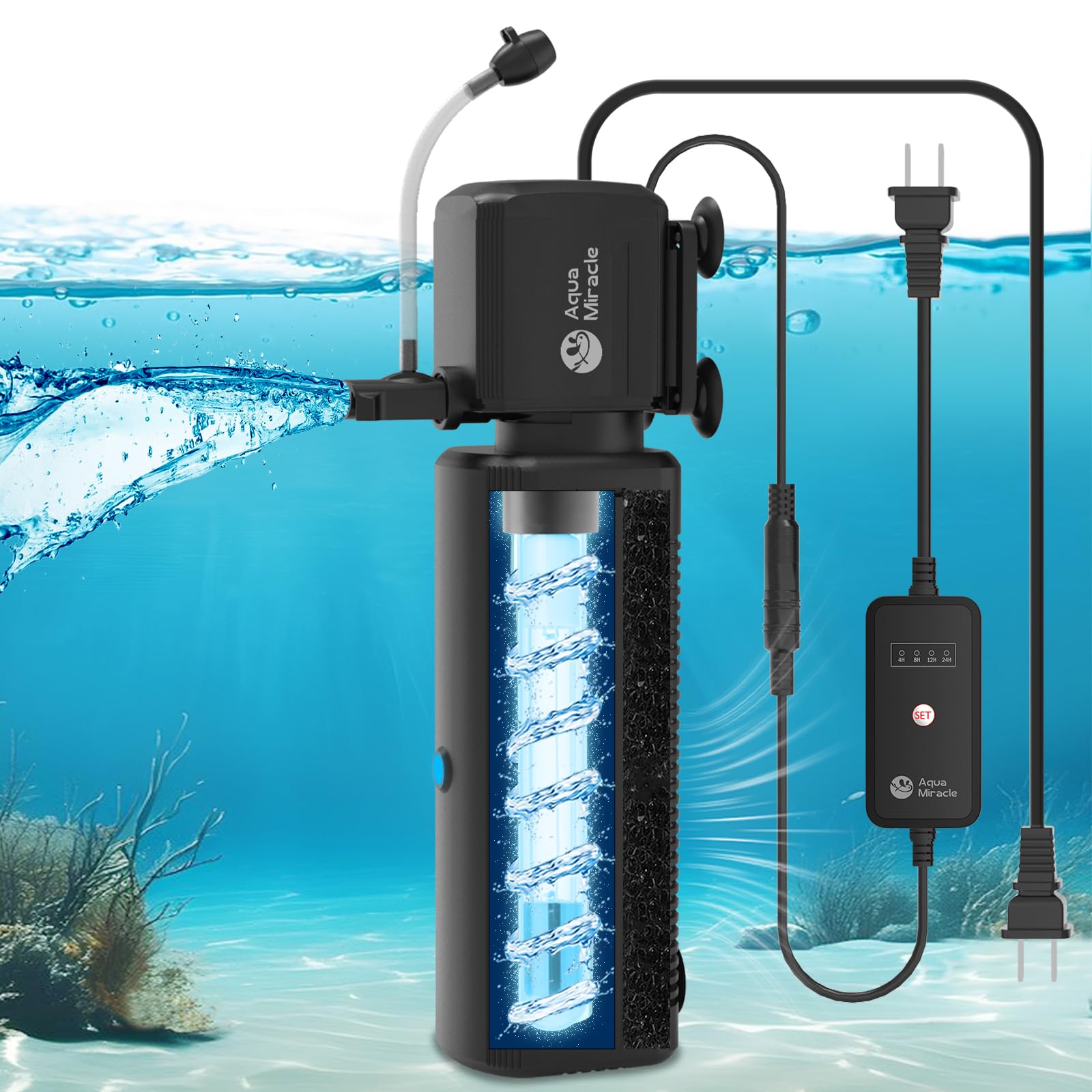
Rating: 4.3 ★ | Price: $ | Flow Rate: 400 GPH | Media/Baskets: 3 sponges + UV | Leak/Valves: No valves | Maintenance: Easy clean modes
The integrated 10W UV light with a timer clears green water fast — a common complaint for larger tanks. Dual aeration and rainfall modes add surface movement and gas exchange. However, the media volume is small and the fixed 400 GPH flow cannot be adjusted, making this a poor choice for tanks with small or delicate fish. Some units may arrive with missing parts or develop mechanical noise after short use. This filter is best reserved as a UV booster alongside a primary canister filter.
Pros
- Built-in UV light with timer eliminates green water and algae blooms quickly.
- Dual aeration and rainfall modes improve oxygen exchange and surface movement.
Cons
- Flow rate is fixed at 400 GPH — too strong for tanks with small or delicate fish.
- Some units may arrive with incomplete parts or develop mechanical noise after short use.
If you already run a canister filter on a 100-gallon tank and need a cheap, effective UV fix for green water, this internal filter does the job — just don’t rely on it for biological filtration or gentle flow.
Best for Temporary Quarantine Use
Coospider Internal 300 GPH

Rating: 4.3 ★ | Price: $ | Flow Rate: 300 GPH | Media/Baskets: Dual sponge | Leak/Valves: No valves | Maintenance: Easy to clean
The Coospider delivers 300 GPH flow with a venturi aeration feature at a price well below most internal filters, making it effective for clearing debris in large turtle tanks or as a temporary quarantine solution. The dual-sponge media is easy to rinse and maintain. However, long-term durability is a limitation — some units may experience motor failure within months, which reduces its value as a permanent primary filter. This tradeoff is acceptable for short-term or high-turnover setups where frequent replacement or backup is practical.
Pros
- Strong flow for an internal filter, clears large tanks quickly
- Easy-to-clean dual-sponge media requires no tools
- Very budget-friendly with added venturi aeration
Cons
- No flow adjustment — current may be too strong for fish that prefer calmer water
- Noise consistency varies; may be noticeable in quieter rooms
Best for budget buyers who need immediate high flow in turtle tanks or quarantine setups and are comfortable with a shorter lifespan.
Best for Bargain Canister
Marineland Magniflow 360

Rating: 4.1 ★ | Price: $$ | Flow Rate: 360 GPH | Media/Baskets: 3 trays | Leak/Valves: Quick-release valve block | Maintenance: Quick-release, easy
The Marineland Magniflow 360 operates quietly and includes a quick-release valve block that simplifies media changes — a genuine convenience. Water clarity improves quickly after installation, and the three-tray media layout offers ample space for 100-gallon setups. However, seal integrity and motor longevity vary between units; some owners encounter leaks or priming difficulties. These durability concerns, combined with a valve block design that can trap air, prevent this filter from competing with more consistent alternatives. It’s a viable pick for aquarists who want premium features at a discount and are prepared to handle occasional maintenance.
Pros
- Clears water noticeably fast after installation
- Runs quietly enough for a living room setup
- Quick-release valve block makes media swaps easy
Cons
- Seal may loosen over time, leading to water leaks that could damage flooring
- Valve block can trap air during restart, requiring occasional manual priming
This filter fits aquarists who want a feature-packed canister at a discount and are comfortable with potential seal and priming quirks; for others, a more consistent option is worth the extra cost.
How to Choose
The flow rate printed on the box drops by a third once you add media.
Flow Rate
A filter’s advertised GPH is measured with an empty chamber. Once you add sponges, ceramic rings, and bio-balls, expect a 30–50% reduction. For a 100-gallon tank, aim for a filter that delivers at least 300–400 GPH in real use. A unit rated at 700 GPH at zero head might still be a good choice if you run heavy media. The key is matching flow to your bioload: community fish need moderate turnover, while messy eaters benefit from higher rates.
Low flow leads to dead spots and poor gas exchange. High flow can stress delicate fish or uproot plants. Look for adjustable flow valves or diffuser spray bars to fine-tune the current.
Media Volume and Basket Design
More media means more surface area for beneficial bacteria and longer intervals between cleanings. Canisters with multiple stackable baskets let you customize the order: coarse mechanical, then fine chemical, then biological. Basket handles and a removable tray system simplify maintenance.
Some filters use a single large basket or cartridge-based media, which limits flexibility and forces replacement costs. For a 100-gallon tank, a minimum of three baskets or equivalent media volume is recommended. Check if the basket design prevents water from bypassing around the edges — gaps reduce filtration efficiency.
Leak-Proof Seals and Quick-Connect Valves
The most common failure point on canister filters is the seal. A good O-ring design with a secure locking mechanism prevents water from creeping out during operation or after a power outage. Quick-connect valves on both intake and output hoses allow you to disconnect the filter without draining the hoses — a huge convenience for maintenance.
Cheaper plastic valves can crack under pressure or become brittle over time. Metal or reinforced plastic versions last longer. If the filter lacks quick-connects, you’ll need to clamp hoses or accept a small flood every cleaning. For HOBs, the seal is less of an issue, but the intake tube must sit tight to avoid air sucking.
Ease of Maintenance and Priming
Canister filters require periodic disassembly to rinse media and clean the impeller. Models with a push-button or self-priming mechanism simplify startup after cleaning — no need to suck on hoses or fill manually. A built-in drain valve or water change port reduces mess.
Look at how the media baskets are accessed: top-loading designs are easier than bottom-loading in tight cabinets. Internal filters are simpler but require more frequent cleaning of the sponges. The easier a filter is to maintain, the more likely you’ll actually do it on schedule.
FAQ
Why does my canister filter make a rattling noise after a few months?
A rattling sound often means the impeller is out of balance or has debris wrapped around it. Remove the impeller assembly, clean the shaft and magnet with a soft brush, and lubricate the rubber mounts if recommended. If the noise persists, the impeller may be warped and need replacement. This is common with budget filters that use lower‑tolerance parts.
Can I use a 400 GPH canister filter on a 100 gallon tank?
Yes, a 400 GPH canister can work for a lightly stocked community tank, but you’ll likely need to supplement with additional biological media or a second filter if you keep messy fish. Real‑world flow after adding media may drop to 250–300 GPH, which is still within the standard 3–5x turnover range. For heavy bioloads, aim for 500 GPH or more.
How often should I clean the media in a canister filter for a 100 gallon tank?
Clean mechanical media (sponges, pads) every 4–6 weeks, or when flow noticeably drops. Rinse them in old tank water to preserve beneficial bacteria. Biological media (ceramic rings, bio‑balls) only needs rinsing every 3–6 months; replace only if crumbling. Over‑cleaning can crash your nitrogen cycle.
Is a hang-on-back filter powerful enough for a 100 gallon freshwater tank?
A high‑performance HOB like the Seachem Tidal 110 or AquaClear 110 can handle a 100‑gallon tank if it’s not heavily stocked. The trade‑off is lower media volume compared to a canister and potential noise if the water level drops. For community fish with moderate bioload, a single HOB works; for goldfish or cichlids, use a canister or pair of HOBs.