This post contains affiliate links. We may earn a small commission when you buy through our links — at no extra cost to you.
Choosing a canister filter for a 20-gallon tank means walking a tightrope between effective filtration and not blasting your fish into the glass. Many filters marketed for this size are actually oversized, turning a peaceful aquarium into a washing machine.
At the same time, budget models often cut corners on seals and motors — leading to leaks or failures within months. The real challenge is finding a filter that’s quiet, reliable, and sized correctly from the start.
This guide focuses on the two models that hit that sweet spot for 20–30 gallon tanks, balancing flow, noise, and maintenance ease. Oversizing isn’t just annoying; it stresses fish and damages plants.
Top Picks
Best for Whisper-Quiet Use
Fluval 107 Canister Filter

Rating: 4.5 ★ | Price: Mid-Range | Flow Rate: 145 GPH | Media Baskets: EZ-Lift, stackable
The Fluval 107 delivers whisper-quiet operation that makes it suitable for a living room or bedroom, and its EZ-Lift baskets simplify maintenance — no need to disconnect hoses to access media. Filtration keeps water crystal clear, ideal for planted tanks up to 30 gallons.
Ideal for first-time canister buyers who want a refined experience without a steep learning curve, the 107 provides consistent flow and easy setup. This filter prioritizes quiet and convenience over raw power, making it a strong match for smaller aquariums where noise matters most.
Pros
- Whisper-quiet running suitable for bedrooms and living rooms
- Crystal-clear water output for planted tanks
- EZ-Lift baskets make media swaps quick and tool-free
Cons
- Lid or hose seals may develop leaks in some units
- Motor can stop working after a few months in a small number of units
The Fluval 107 is the quietest canister filter in its size class, with filtration that meets the needs of a planted 20-gallon tank — worth the mid-range price if you prioritize silence and easy maintenance.
Best for Budget-Conscious Owners
Penn-Plax Cascade 500

Rating: 4.3 ★ | Price: Mid-Range | Flow Rate: 115 GPH | Media Baskets: Two stackable with handles
The Cascade 500 provides the same effective filtration as pricier canisters at a noticeable discount, backed by a large owner base. You trade some noise refinement and potential long-term durability for the lower price.
It’s a good fit for first-time canister users and budget-conscious hobbyists with 20–30 gallon tanks who can accept occasional handling care — some units may develop cracks in the pump housing or base.
Pros
- Strong value for the price
- Easy setup and tool-free access
- Quiet operation in typical living spaces
Cons
- In some units, the pump housing or base may crack during normal use
This filter delivers consistent performance at a lower price, but the occasional cracking issue means it’s best for budget-focused owners willing to handle with care.
Best for Future Upgrades
Fluval FX2 Canister Filter
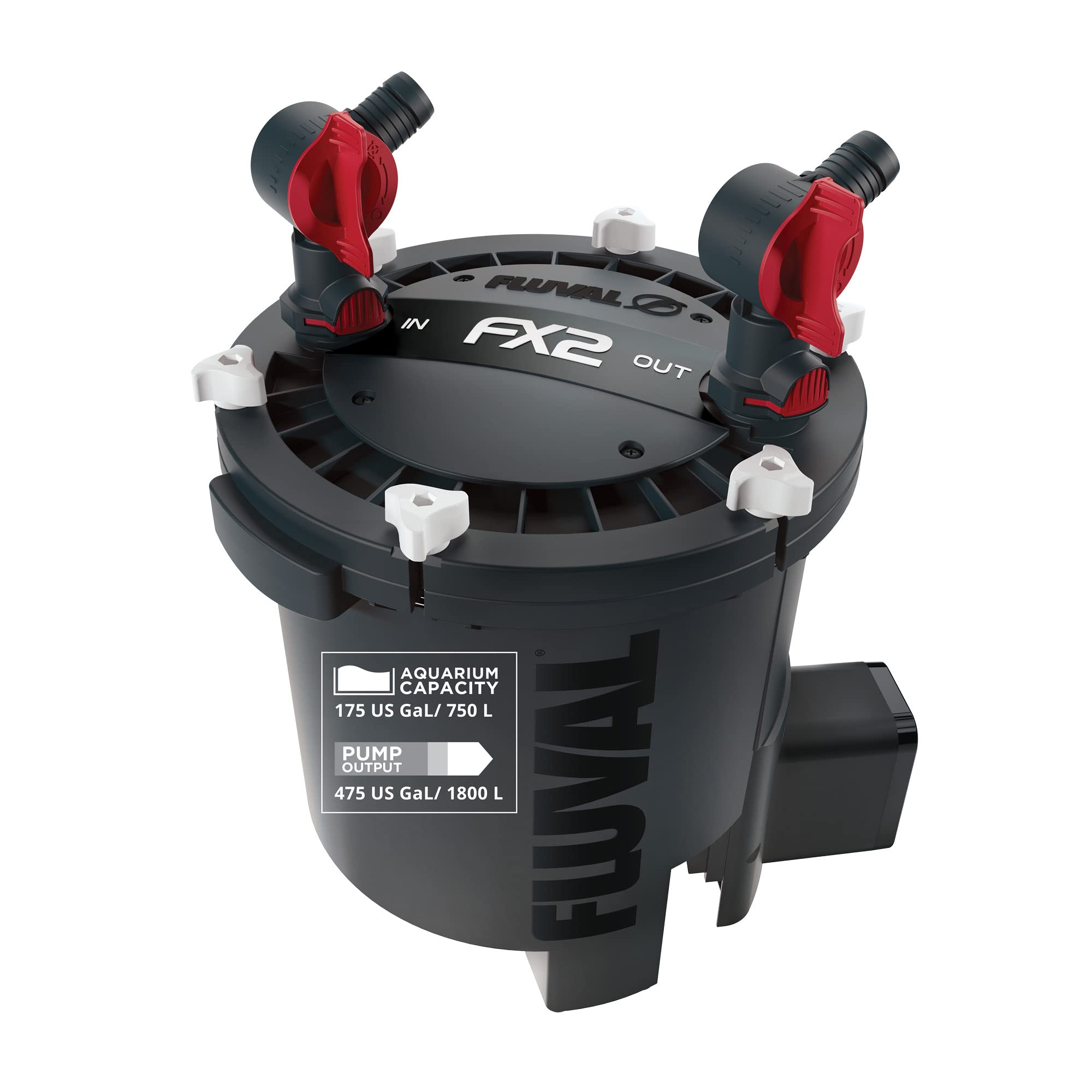
Rating: 4.3 ★ | Price: Premium | Flow Rate: 475 GPH | Media Baskets: 4-stage basket-in-basket
The Fluval FX2 brings a self-priming Smart Pump and an integrated water change system that makes maintenance noticeably easier on larger setups. However, its 475 GPH flow is excessive for a 20-gallon aquarium — this filter is best reserved for tanks of 75+ gallons or for aquarists who plan to upgrade soon.
Pros
- Self-priming pump eliminates manual siphoning during initial setup and routine restarts.
- Built-in water change system simplifies draining and refilling without extra equipment.
Cons
- Pump motor may fail within the first year in some units.
This filter is a practical choice only if you plan to upgrade to a 75+ gallon tank soon — otherwise, its flow and price are mismatched for a 20-gallon setup.
Best for Large Tanks
SunSun Hw303B
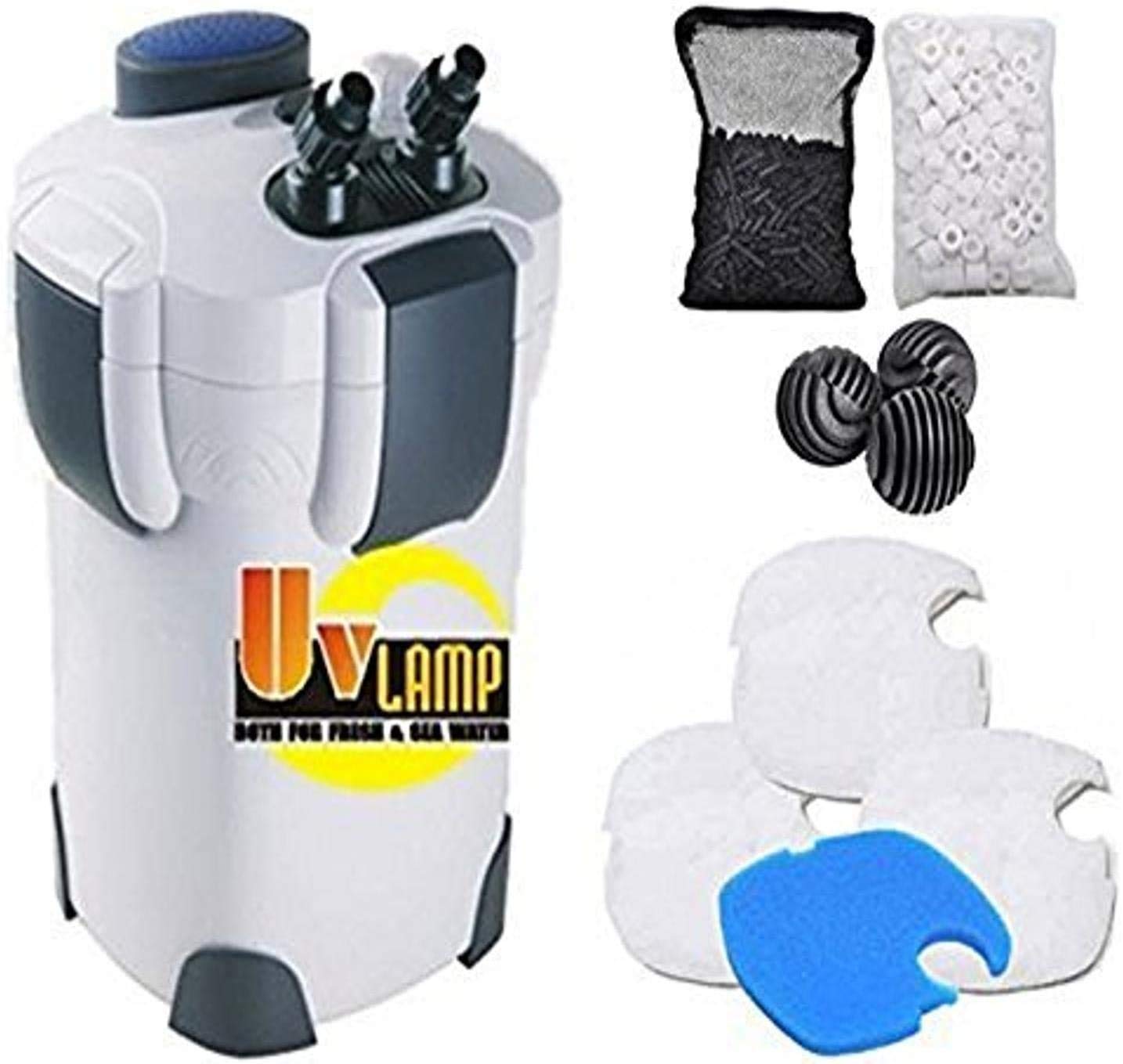
Rating: 4.3 ★ | Price: Mid-Range | Flow Rate: 370 GPH | Media Baskets: 3 baskets, carbon, ceramic
The SunSun Hw303B delivers strong filtration and quiet operation with included UV and media baskets — a solid value for larger setups. However, its 370 GPH flow is too intense for a 20-gallon tank even on the lowest setting, and the plastic fittings may crack over time, making it a better fit for 55–100 gallon tanks where the power and features are a genuine advantage.
Pros
- Powerful water flow and effective filtration for tanks up to 100 gallons
- Quiet pump even at high throughput
Cons
- Flow overwhelms 20-gallon tanks; plastic fittings may crack over time
Choose the SunSun Hw303B only if you have a 55–100 gallon tank and want a budget canister with UV — it’s not suited for a 20-gallon setup.
Best for Temporary Setups
PONDFORSE Canister Filter
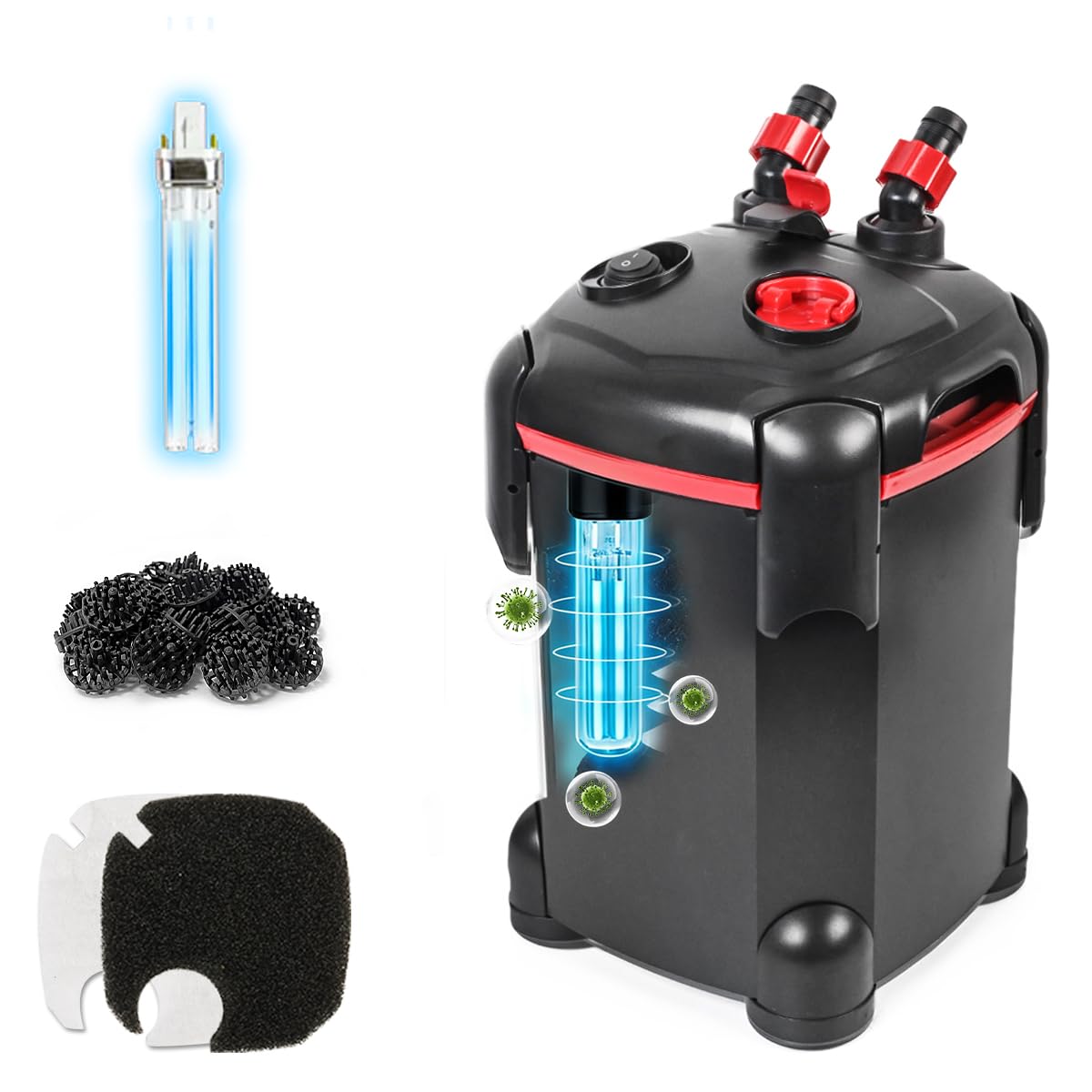
Rating: 4.1 ★ | Price: Budget | Flow Rate: 225 GPH | Media Baskets: Sponges, bio balls, UV
The PONDFORSE runs quietly and assembly is quick out of the box, with sponges, bio balls, and a UV bulb included at a budget-friendly price. For a quarantine tank or a short-term setup where you expect to swap equipment in a few months, these strengths matter. The motor and UV bulb, however, can wear out before the six-month mark, and the plastic seals may develop leaks over time — traits that make this a poor fit for a permanent display tank where reliability is expected.
Pros
- Ultra-quiet operation suitable for noise-sensitive spaces.
- Easy to set up and clean with included media and UV bulb.
Cons
- Motor and UV bulb life can be short, requiring replacement within a few months.
- Seals may develop leaks over time, limiting its use to temporary setups.
Only consider this if you need a low-cost filter for a quarantine or temporary tank and are comfortable replacing it within six months.
How to Choose
The single most important rule for a 20-gallon tank: never choose a filter rated more than 30 gallons, or you’ll create currents that exhaust small fish and uproot plants.
Flow Rate (GPH)
For a 20-gallon tank, aim for 5–10 times turnover per hour, or 100–200 GPH. A filter that pushes 370 GPH (like the SunSun) will blast weak swimmers into the intake and strip CO₂ from planted tanks.
Lower flow rates around 115–145 GPH are safe for bettas, tetras, and shrimp, while still providing enough circulation for biological filtration. Always match the filter’s rated tank size, not just the GPH number.
Noise Level
Canister filters sit below the tank, so vibration transmits through the cabinet. Cheap motors often emit a hum or grinding after a few months, while premium eTEC or DC motors stay near-silent throughout their life.
If the filter lives in a bedroom or living room, prioritize models with a proven track record of quiet operation — user feedback on specific models is more reliable than marketing claims like ‘ultra-quiet.’
Media Capacity and Maintenance
More media baskets mean better mechanical and biological filtration, but also more to clean. Look for filters with tool-free access — lifting baskets or quick-release valves reduce the chance of spills and make monthly cleaning a 10-minute job.
Stackable baskets (Fluval 107, Penn-Plax Cascade 500) allow you to customize media layers. Avoid models where you must disassemble the entire housing to change pads.
Reliability and Leak History
Leaks typically come from two places: the lid gasket and the hose connections. Filters with threaded fittings and double O-rings are less prone to failures than those relying on press-fit seals.
Even well-reviewed models (4.5 stars) have a small percentage of units that leak or develop motor issues. Check the return policy and consider buying from a retailer with easy exchange — this is a risk that no warranty fully eliminates.
FAQ
Can a canister filter be too powerful for a 20 gallon tank?
Yes. A filter rated for 75+ gallons (like the SunSun Hw303B or Fluval FX2) creates currents that exhaust small fish, uproot plants, and can even prevent bettas from surfacing for air. Stick to filters rated for 20–30 gallons, which provide 100–150 GPH — gentle enough for community tanks.
Why does my canister filter keep leaking and how do I fix it?
Leaks usually come from a dry O-ring, misaligned lid, or loose hose clamps. First, disassemble, lubricate the O-ring with aquarium-safe silicone grease, and re-seat the lid evenly. Tighten all hose connections by hand. If the leak persists after a few tries, the gasket may be damaged and requires a replacement — check manufacturer parts availability.
How often should I clean a canister filter on a 20 gallon aquarium?
Every 4–6 weeks is standard for a 20-gallon tank with a low to moderate fish load. Over-cleaning (every week) kills beneficial bacteria; under-cleaning (every 3 months) risks clogging and reduced flow. Rinse media in tank water, never tap water, to preserve the biological filter.