This post contains affiliate links. We may earn a small commission when you buy through our links — at no extra cost to you.
Many aquarium chillers promise more cooling than they can deliver in a real home. An evaporative fan that drops 10°F in a dry 72°F room may only manage 3°F when the ambient hits 85°F with high humidity. Compressor units often have their ideal performance calculated in lab conditions, not your living room.
The decision isn’t simply fan versus compressor. It’s about matching the cooling method to your tank size, room temperature, and the livestock’s sensitivity. A 40-gallon axolotl tank in an air-conditioned room may only need a $40 fan, while the same tank in a warm garage demands a $300 compressor.
This guide focuses on real-world temperature drops, durability across seasons, and the trade-off between upfront cost and long-term reliability. For most small to medium freshwater tanks, a well-chosen fan chiller provides sufficient cooling at a fraction of the cost, while large or sensitive reef tanks need a reliable compressor.
Top Picks
Best for Axolotl & Reef
Active Aqua 1/10 HP
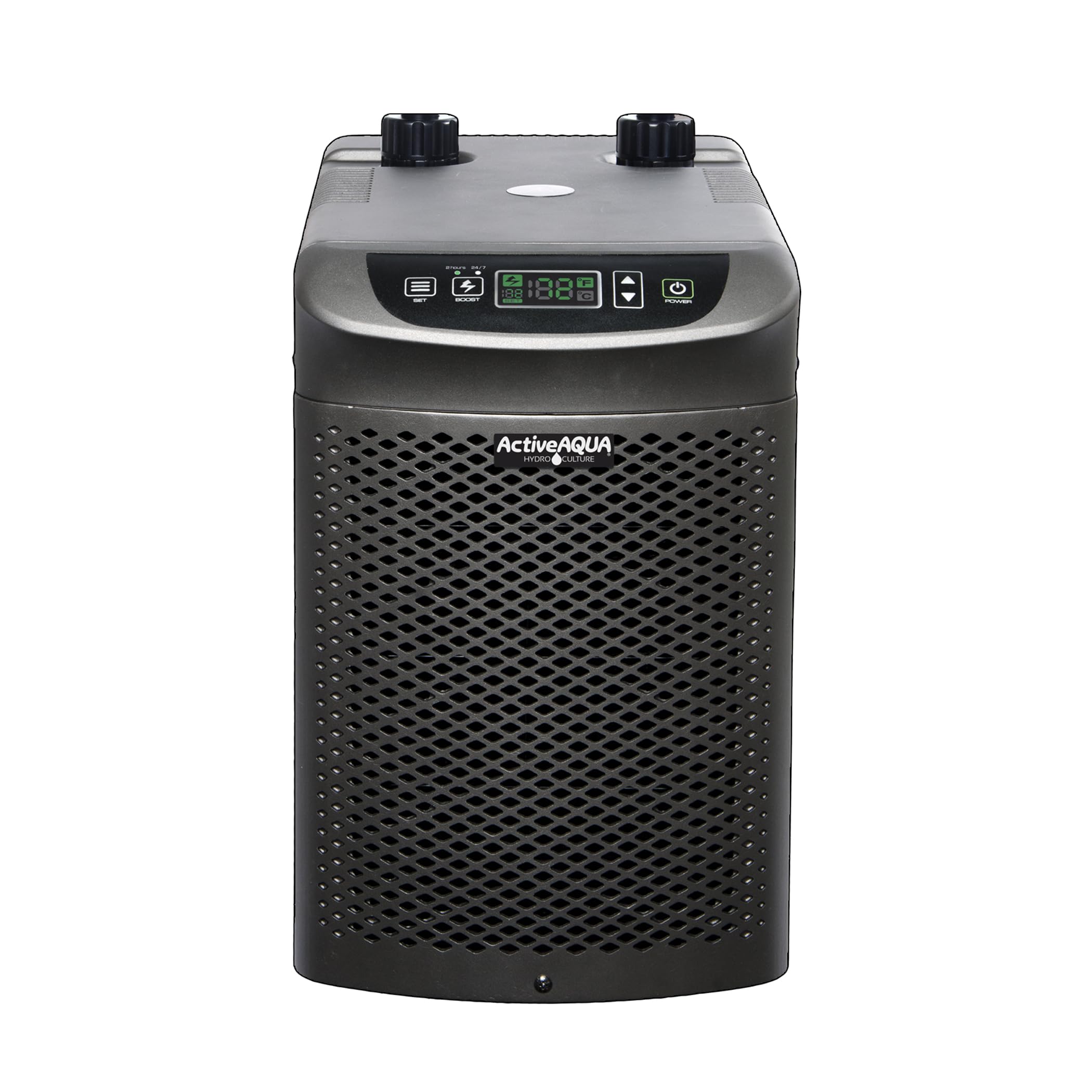
Rating: 4.3 ★ | Price: $$$ | Cooling Method: Compressor | Tank Size: 10–40 gal | Horsepower: 1/10 | Special Feature: Boost function
The Active Aqua 1/10 HP compressor chiller holds water temperature within 1°F of the set point, an important capability for temperature-sensitive species like axolotls and reef corals. The titanium evaporator resists corrosion in saltwater setups, and the digital controller with boost function gives precise adjustment for tanks between 10 and 40 gallons.
Owners have noted years of service from this unit, and the straightforward connections make initial setup quick. The pump and hoses attach without special tools, and once in place, the chiller runs continuously with minimal maintenance beyond periodic cleaning.
The compressor produces a hum comparable to a small window air conditioner, making it a less good fit for bedrooms or quiet living rooms. In a basement, garage, or equipment closet the sound is absorbed without issue. Some units may experience internal leakage from the pump fittings – a simple inspection upon arrival can identify any issues early.
This chiller suits axolotl and reef keepers who prioritize temperature stability over silent operation. The premium price reflects the titanium evaporator and overall build quality, which reduce the likelihood of corrosion or early failure. The noise level and occasional leak reports are trade-offs that buyers should weigh against the peace of mind this unit provides for sensitive aquatic environments.
Pros
- Maintains water temperature within 1°F of the set point – critical for temperature-sensitive species.
- Easy to set up with basic tools; digital controls and boost function simplify adjustments.
- Durable construction and titanium evaporator support long service life for a compressor chiller.
Cons
- In a quiet living space, the compressor hum will be present – less of an issue in a basement or garage.
- Internal leakage from pump fittings can occur in some units – worth checking on arrival.
For aquarium keepers who need accurate temperature control and are prepared for a noticeable compressor hum, this chiller provides the temperature stability and build quality that make it a long-term investment. The occasional leakage possibility is easily mitigated with an early inspection.
Best for Axolotl, Reef 40 Gal
BAOSHISHAN AL-160

Rating: 4.2 ★ | Price: $$ | Cooling Method: Compressor | Tank Size: 42 gal | Horsepower: 1/10 | Special Feature: Digital display
The BAOSHISHAN AL-160 uses a true compressor (R290 refrigerant) to maintain tank temperature within 1.5°F — the same cooling method as chillers costing twice as much. Owners describe it as sounding like a mini-fridge, which suits living rooms or offices without being intrusive. The tradeoff for that upfront savings is durability: some units stop cooling after 12–18 months, and the included water pump is one component that can give out early. For aquarists who treat this as a cost-effective tool rather than a decade-long investment, the performance during that window is solid.
This chiller fits best for axolotl or reef tanks up to 40 gallons where the owner values compressor-grade temperature control but doesn’t want to spend for a long-proven brand. It also suits hydroponic setups with similar volume needs. Because long-term reliability can vary, it’s less suitable for critically stocked systems where a chiller failure would be costly — those buyers should look at the more expensive, consistently durable alternative in this lineup.
Pros
- Holds water temperature within 1.5°F of the set point
- Quiet enough for a living room — sounds like a mini-fridge
- Straightforward setup with strong cooling for its price tier
Cons
- Included water pump may need early replacement to keep the chiller running
- Long-term durability is uncertain — some units stop cooling after a year of use
For budget-conscious aquarists who aren’t relying on absolute long-term reliability, the BAOSHISHAN delivers genuine compressor cooling that performs well for mid-sized tanks at a fraction of the cost.
Best for Small Tanks under 20
hygger 3-Fan

Rating: 4.4 ★ | Price: $ | Cooling Method: Evaporative fan | Special Feature: Timer & speed settings
Three separate fan heads and five speed settings let you direct airflow exactly where it’s needed — across the water surface or toward a heat-producing light. The built-in timer (0.5–12 hours) helps manage runtime without manual monitoring, a step up from simpler single-speed fans. The tradeoff against an auto probe-controlled model is that you’ll adjust speeds yourself as room temperature changes, which suits owners who check their tank daily.
This fan chiller fits best on rimless or narrow-rim tanks (glass up to about 0.6 inch) in dry climates where evaporative cooling can drop water temperature 6–10°F. It’s a practical choice for axolotl keepers on a budget or small planted tanks (10–20 gal) that need a modest temp drop. Worth noting: the clip may not grip thick plastic rims securely, and some units have developed a rattle noise after weeks of use — a reality of budget fan construction.
Pros
- Cools axolotl tanks by 6–10°F in many setups, sufficient for 10–20 gallon enclosures.
- Quiet operation with five speed levels and a programmable timer for hands-off control.
- Budget-friendly alternative to compressor chillers, costing a fraction for similar small-tank cooling.
Cons
- Clip may not fit tanks with thick plastic rims or lids that obstruct mounting.
- Some units can develop a rattling or buzzing noise after several weeks of use.
A cost-effective fan chiller for small tanks where manual adjustment is acceptable — just check your tank rim and be prepared for possible fan noise over time.
Best for Quiet Reef Tanks
JBJ Arctica 1/10

Rating: 4.1 ★ | Price: $$$ | Cooling Method: Compressor | Horsepower: 1/10 | Special Feature: Titanium coils
The JBJ Arctica’s defining characteristic is its silent operation—described by owners as barely noticeable, like a small refrigerator in the background. This makes it a clear step ahead of the top pick Active Aqua, which runs with a noticeable compressor hum that can be intrusive in a living room or bedroom. The titanium coils and compact build also reflect solid construction for a device meant to run continuously.
This chiller fits best in small to medium saltwater or reef tanks (20–40 gal) placed in noise-sensitive areas. The tradeoffs are a steep upfront cost for a 1/10 HP unit and occasional thermostat drift of 1–2°F, which may be an issue for delicate corals. Some units have also needed fuse or compressor repairs within the first year—so a good warranty or return policy is wise. Buyers comfortable with these boundaries will find the quietest cooling available in this capacity range.
Pros
- Near-silent compressor—barely audible in quiet rooms
- Solid build with titanium evaporator coil
- Generally consistent temperature control within 1°F
Cons
- Premium pricing for the modest cooling capacity
- Thermostat can read 1–2°F off, requiring calibration for sensitive setups
- Compressor or fuse repairs have been noted in some units within the first year
If silence is your top priority and you’re willing to accept a higher price and occasional calibration checks, the JBJ Arctica delivers. Otherwise, the more durable (but louder) top pick offers better long-term value.
Best for Large Tanks 79 Gal
Fitnet 79 Gal

Rating: 4.3 ★ | Price: $$ | Cooling Method: Compressor | Tank Size: 79 gal | Horsepower: 1/3 | Special Feature: Digital display calibration
The Fitnet chiller’s 1/3 HP compressor handles 79-gallon tanks and hydroponics setups effectively, keeping water temperatures stable even in hot garages. Unlike more expensive options such as the Active Aqua, this unit offers comparable cooling capacity at a significantly lower price point, though it comes with tradeoffs in documentation and long-term reliability.
The included manual is sparse to the point of being almost useless — some owners turn to YouTube videos for basic calibration and setup. While the compressor runs quietly, some units have experienced electrical or pump issues within the first few months; this is not universal, but it is a possibility to factor into your purchase decision.
This chiller suits buyers managing large freshwater tanks or hydroponic systems who are comfortable with a hands-on setup. If you prefer a plug-and-play experience or need a chiller for a critical display tank, the additional investment in the Active Aqua is worth considering for its more robust reliability.
Pros
- Strong cooling for 50-79 gallon tanks
- Quiet compressor operation
- Affordable for a 1/3 HP chiller
Cons
- Manual provides almost no guidance
- Some units may experience electrical or pump failure within months
For large-tank owners comfortable with DIY setup, this chiller delivers solid cooling at a mid-range price — just be prepared for a learning curve and a small gamble on longevity.
Best for Axolotl Tanks 40 Gal
AQUASMITH AFan-220

Rating: 4.4 ★ | Price: $ | Cooling Method: Evaporative fan | Tank Size: Up to 40 gal | Special Feature: Temp probe auto start/stop
The AQUASMITH AFan-220 stands apart from other fan chillers by integrating a temperature probe that automatically starts and stops the fan. This means the unit adjusts airflow to maintain a set point, rather than running constantly or requiring manual toggling. For axolotl owners who need temperatures below 65°F, the fan delivers a consistent 3–7°F drop in rooms that are already cool or air-conditioned.
This fan is best suited to small and medium tanks up to 40 gallons, where evaporative cooling is effective. In larger tanks or in ambient temps above 80°F, the cooling capacity falls short — the drop may be only 2°F, not enough for axolotls or other temperature-sensitive species. The auto start/stop feature is a real convenience, but performance depends heavily on the room environment.
Pros
- Automatic temperature control via probe keeps tank steady without manual intervention.
- Quieter than most fan chillers, especially at lower speeds.
- Budget-friendly alternative to compressor chillers for small tanks.
Cons
- Cooling limited to 3–7°F drop; will not handle very warm rooms or tanks above 40 gallons without multiple fans.
- Performance varies with ambient temperature — works well in cool rooms but may not hold steady when room warms up.
A smart auto-chiller for axolotl keepers in air-conditioned homes who want steady temperatures without compressor expense.
Best for Nano Tanks 5-10 Gal
PAIZOO PZBS-2
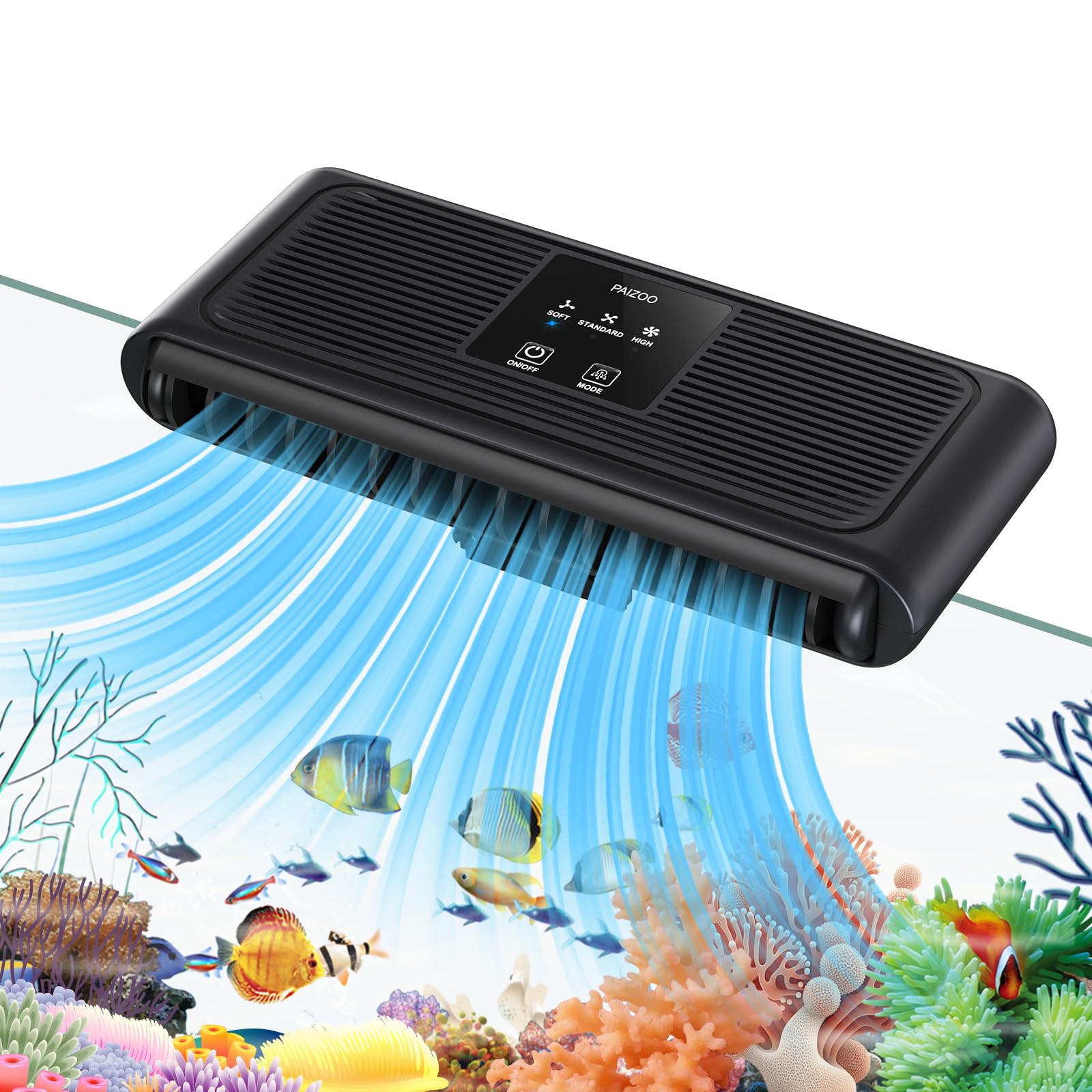
Rating: 4.2 ★ | Price: $ | Cooling Method: Evaporative fan | Special Feature: 3 speed
The PAIZOO fan provides genuine 4–7°F cooling for small tanks at a budget price, with straightforward clip-on installation. However, its clip may not fit rimmed tanks, and some units can develop noise or lose cooling performance over time. This places it behind the more durable hygger fan in long-term value — better as a low-cost backup or for temporary setups than as a primary cooler.
Pros
- Cools small tanks by 4–7°F effectively
- Budget-friendly with simple clip-on setup
Cons
- Clip may not fit thicker tank rims, limiting mounting options
- Long-term durability may be limited; some units can develop noise or diminished cooling over time
A sensible pick for nano-tank owners who need a cheap backup or temporary cooling solution and accept that it likely won’t outlast a season of daily use.
Best for Budget Rimless Tanks
DaToo 2-Fan

Rating: 4.1 ★ | Price: $ | Cooling Method: Evaporative fan | Special Feature: 2 fans
The DaToo 2-Fan is the most reviewed aquarium fan chiller, providing 4-10°F evaporative cooling at a price that’s tough to beat. Its two fans move air effectively for small tanks, and the value is clear from its popularity. Durability can be inconsistent, with some units stopping within months rather than years. This chiller is best approached as a budget tool for rimless tank owners who can accommodate its quirks and aren’t relying on it as a long-term primary cooling solution.
Pros
- Cools tanks by 4-10°F through evaporative cooling
- Budget-friendly price for a two-fan setup
Cons
- Mounting clip does not fit rimmed aquarium frames—requires rimless glass or a custom mount
- Noise level can vary; some units produce noticeable fan hum on higher settings
Ideal for ultra-budget buyers with small rimless tanks who can accept variable noise and are comfortable modifying the mount.
Best for Nano Tanks under 5
DaToo Mini Fan

Rating: 4.0 ★ | Price: $ | Cooling Method: Evaporative fan | Tank Size: 1-6 gal | Special Feature: USB powered
The DaToo Mini Aquarium Chiller is a compact USB-powered evaporative fan capable of lowering water temperature by 3-7°F in tanks up to 6 gallons. Its low cost and small footprint make it easy to set up for betta bowls or shrimp nano cubes during a heat wave. However, cooling relies on evaporation, so it works best in moderate humidity and cannot handle tanks larger than 6 gallons effectively. Durability may be short — the motor can stop working after a few months of use, making this better suited as a seasonal helper or emergency backup rather than a round-the-clock chiller. For anything above 6 gallons or long-term cooling, a compressor-based chiller or a more robust fan is worth considering.
Pros
- Very affordable and drops water temperature by 3-7°F in small tanks.
- Compact USB size fits nano tanks and betta bowls without taking up space.
Cons
- Motor may stop operating after a couple of months, so it’s not a long-term solution.
- Airflow may be too weak for tanks over 6 gallons, limiting its practical range.
Best suited as a budget backup for betta bowls or nano cubes under 6 gallons during heat waves, not a primary chiller.
Best for Lipless Rimless Tanks
Pawfly 1-Fan

Rating: 4.2 ★ | Price: $ | Cooling Method: Evaporative fan | Special Feature: Timer & speed
Pawfly’s fan delivers a consistent 4-6°F temperature reduction in tanks up to 20 gallons, with a timer and five fan speeds that give owners precise control over cooling. The evaporative cooling is effective for maintaining stable temperatures for axolotls or nano reef setups. While the adjustable speeds and timer are a plus, the cooling performance is slightly outclassed by the hygger fan for those with compatible rimless tanks.
Pros
- Cools small tanks by 4-6°F effectively through evaporation.
- Timer and five-speed control allow tailored airflow management.
Cons
- Clip opening is only 0.6 inch wide, limiting compatibility to lipless rimless tanks.
- Fan noise on higher speed settings may be noticeable in quiet rooms.
A solid option for rimless nano tank owners who value adjustable cooling on a budget, but it won’t work on standard rimmed aquariums.
Best for Small Tanks Auto Fan
PAIZOO PZBC-2
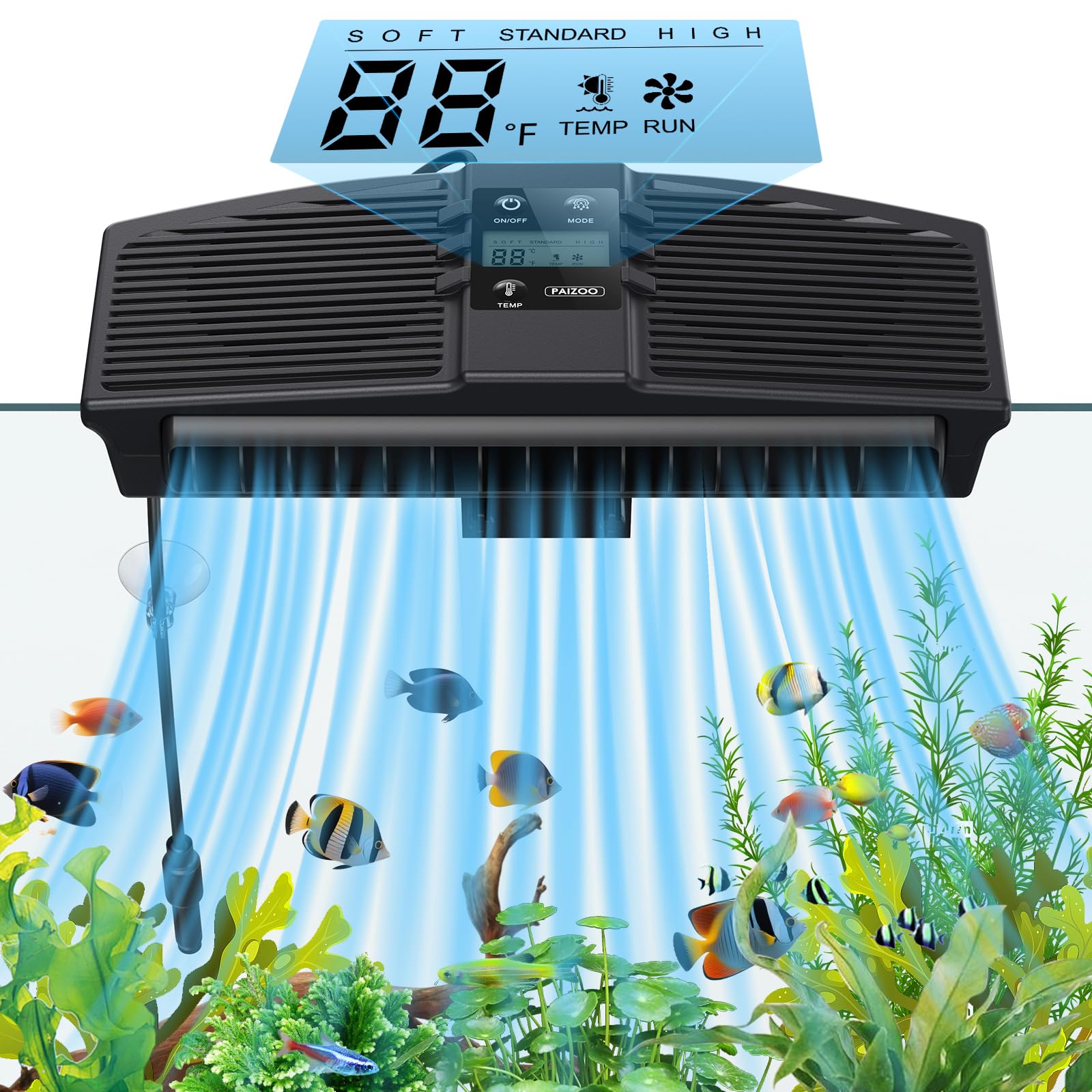
Rating: 4.1 ★ | Price: $ | Cooling Method: Evaporative fan | Special Feature: Auto temp control
The PAIZOO PZBC-2 brings automatic temperature control to small tanks at a budget-friendly price, using a submersible probe and LCD display to turn the fan on and off as needed. Noise can be unpredictable—rattling on startup and humming at levels that may be intrusive in quiet living spaces. Cooling effectiveness also tapers off above 20 gallons, confining it to nano setups. For most buyers seeking an automatic fan, the quieter model in this roundup is the better pick; the PAIZOO makes sense as a backup if that unit is out of stock or your installation can tolerate occasional fan noise.
Pros
- Auto on/off with temperature probe keeps small tanks at a steady temp
- Budget-friendly price for the automatic control feature
Cons
- Fan may rattle on startup or produce unpredictable noise, distracting in quiet rooms
- Cooling capacity diminishes significantly above 20 gallons, limiting it to nano tanks
A viable option if you need a budget fan with automatic temperature control for a nano tank and can tolerate occasional fan noise—especially when the preferred auto fan chiller is unavailable.
Best for Budget Compressor Risk
Poafamx 42gal

Rating: 4.0 ★ | Price: $$ | Cooling Method: Compressor | Tank Size: 42 gal | Horsepower: 1/10 | Special Feature: 264 GPH pump
The Poafamx 42gal chiller offers a low price for compressor cooling on mid-sized tanks, and owners of axolotl setups or quiet living rooms appreciate its stable cooling and low noise. However, the unit draws less power than advertised and the manual specifies a different refrigerant, which raises questions about real-world performance. A few units have shown early durability concerns — worth considering only if you’re comfortable with potential returns and don’t need guaranteed precision for sensitive reef systems.
Pros
- Effective cooling for axolotl and reef tanks
- Quieter than many compressor chillers in this price range
Cons
- Refrigerant discrepancy and lower power draw than claimed – worth verifying specs before purchase
- Temperature control may not hold below 60°F, limiting use for cold-water species
Best suited for hobbyists willing to accept spec quirks and a possible return process in exchange for a low upfront cost on a 42-gallon chiller.
Best for Nano Reef under 20
JBJ Arctica 1/15

Rating: 4.1 ★ | Price: $$$ | Cooling Method: Compressor | Horsepower: 1/15 | Special Feature: Titanium coils
The JBJ Arctica 1/15 HP cools nano tanks effectively, dropping temperatures by 2°F in 25 minutes and maintaining 63°F even in 90°F rooms. Its near-silent operation makes it a strong candidate for living room reefs. However, the cooling capacity is strictly for tanks under 20 gallons, and the premium pricing combined with occasional fuse issues and variable long-term performance means this is a niche choice for hobbyists who value silence over value.
Pros
- Cools 20-gallon tanks to 63°F in hot ambient conditions.
- Operates almost silently, ideal for quiet living spaces.
Cons
- Designed for nano tanks under 20 gallons – not suitable for larger setups.
- Premium pricing with occasional fuse issues and variable long-term performance.
Best suited for nano reef enthusiasts who prioritize silent operation and have a budget to match.
How to Choose
The single most important insight: Advertised cooling capacity assumes ideal lab conditions; real-world temperature drop is often 20–40% lower.
Cooling Method: Fan vs. Compressor
Evaporative fans rely on airflow to increase water evaporation, which cools the tank. This method works best in dry, air-conditioned rooms. In high humidity, the cooling effect drops sharply, often to just 2–3°F. A compressor chiller, like a mini refrigerator, uses refrigerant to actively remove heat and works regardless of ambient humidity. It’s the only option for consistent cooling in warm or humid environments.
Choose a fan when your room stays below 80°F and you only need a 5–8°F drop. Choose a compressor when you need precise temperature control below 75°F or live in a naturally warm climate.
Tank Size Compatibility
A chiller’s rated tank volume assumes ideal heat-load conditions—low ambient temperature, minimal lighting, and no powerful pumps. In reality, larger tanks hold more water mass, which takes longer to cool and generates more internal heat from equipment. A chiller rated for 40 gallons will struggle to maintain temperature in a 40-gallon reef tank with metal halide lights and a strong return pump.
As a rule of thumb, size up by one tier: for a 40-gallon display, choose a chiller rated for 50–60 gallons in summer conditions. This gives you headroom during heat waves.
Noise Level
Compressor chillers produce a consistent humming sound similar to a small window air conditioner or mini fridge. Fan chillers are quieter at low speeds but can develop rattles or vibrations over time. If the chiller sits in a living room or bedroom, prioritize models known for low noise—typically the JBJ Arctica or fan units with independent speed control.
Noise is subjective, but any chiller placed in the same room as a TV or bed should be auditioned during the return window. Many buyers regret buying a noisy compressor when they expected a near-silent unit.
Temperature Control Accuracy
Most compressor chillers use a built-in thermostat to maintain a set point within 1–2°F. However, cheap thermostats drift over time or have a wide hysteresis (the temperature range before the chiller kicks on again). This causes the tank temperature to swing, which stresses sensitive corals and axolotls. Units with digital calibration or an external temperature probe offer more precision.
For reef tanks, look for a chiller with a titanium probe or separate controller that allows you to adjust the on/off differential. For freshwater axolotl tanks, a 2°F swing is usually acceptable, but stability matters more than absolute accuracy.
Durability and Build Quality
The most common failure point is the included water pump—not the chiller itself. Many budget compressor units ship with weak pumps that die within a year, causing the chiller to overheat or stop circulating. Replacing the pump with a reliable brand like Eheim or Sicce is a cheap insurance policy. Also, check for leak-prone fittings and poorly sealed electrical compartments.
Compressor units with titanium evaporators (vs. copper) last longer in saltwater environments because titanium resists corrosion. In freshwater, copper evaporators are fine but can still develop pinholes after a few years. The best longevity comes from units that have at least 100+ reviews with consistent positive feedback on reliability after 12 months of use.
FAQ
Why does my aquarium chiller keep turning on and off every few minutes?
This is called short cycling and is usually caused by a thermostat that’s too sensitive or a unit oversized for your tank. Many chillers have a small temperature differential (hysteresis). If the chiller is too powerful, it cools the water quickly, shuts off, then the water warms up slowly, causing frequent cycles. To fix it, check if the unit has an adjustable hysteresis setting (some do), or use an external controller. If not, it’s often a sign the chiller is overkill for your setup.
Can I use a fan instead of a compressor chiller for my axolotl tank?
Yes, if your room stays air-conditioned (below 78°F) and you only need a 5–8°F drop. Many axolotl owners use a fan chiller successfully to maintain 63–68°F. But if your room regularly hits 85°F during summer, a fan will only lower the tank to about 80°F, which is too warm for axolotls. In that case, a compressor chiller is necessary.
How long should I wait before turning on a new aquarium chiller after unpacking?
Let the chiller sit upright for at least 2 hours (preferably 4) before plugging it in. This allows compressor oil to settle back into the compressor. If you turn it on immediately, the oil can be forced into the refrigerant lines, causing poor cooling or compressor damage. Same rule applies if the unit was shipped on its side.
What should I do if my evaporative fan doesn’t fit the rim of my tank?
Most fan clips are designed for glass up to 0.5 inches thick. If your tank has a thick plastic rim, the clip may be too narrow. Solutions: use a small piece of wood or plastic as a shim under the clip, mount the fan on the back frame using zip ties, or upgrade to a fan with a wider clamp (like the hygger which has an adjustable bracket). Alternatively, switch to a clip that attaches to the rim’s edge.
Does an aquarium chiller heat up the room as much as a window AC?
Compressor chillers work like a heat pump—they remove heat from the water and dump it into the room via the exhaust fan. In a small room, this can raise the ambient temperature by 5–10°F, similar to running a small window AC in reverse. Fan chillers do not add heat; they cool by evaporation, which adds humidity. If your room is already warm, a compressor chiller may make it hotter, requiring separate ventilation.