This post contains affiliate links. We may earn a small commission when you buy through our links — at no extra cost to you.
Buying an aquarium air stone should be simple: connect it to a pump and watch the bubbles. But anyone who has unpacked a new stone only to see bubbles dribbling from one corner knows the frustration. The real issue isn’t always a defective product—it’s often a mismatch between the stone’s internal resistance and the pump’s output pressure.
Pump and stone compatibility is the single factor that separates a quiet, oxygen-rich curtain from a disappointing trickle. A stone that’s too large for a weak pump will barely breathe; a tiny stone on a powerful pump can sound like a boiling kettle. The right combination produces fine, consistent bubbles that keep fish healthy without annoying noise.
This guide cuts through exaggerated marketing claims to focus on what actually matters: matching stone size and air flow rating to your pump’s wattage, and picking a shape that fits your tank’s dimensions. No hype, just the specs and use-cases that lead to a successful setup.
Top Picks
Best for Nano & Sponge
Pawfly 1" 10-Pack

Rating: 4.6 ★ | Price: $ | Size & Shape: 0.6×1 inch cylinder | Quantity: 10 stones
The Pawfly 1-inch air stones produce a steady stream of bubbles when driven by a 2–4 W nano pump — exactly what small tanks and sponge filters need. Each stone measures 0.6" by 1", so they fit easily into buckets, 5-gallon tanks, and breeder boxes without taking up floor space. The ten-stone count means you can rotate out stones as they clog or set up multiple nano tanks from one pack.
This pack suits hobbyists running tanks under 10 gallons — especially those using modified foam filters or sponge filters that benefit from a compact diffuser. An occasional stone may only bubble from half its surface, so it pays to test each one before installing. For the price, the consistent output from the majority of stones makes this a low-risk way to aerate multiple small setups.
Pros
- Ten stones at a budget price let you aerate multiple small tanks or replace stones as they age.
- Compact size pairs naturally with nano air pumps and sponge filters in tanks under 10 gallons.
- Consistent bubble output across the pack when used with a recommended 2–4 W pump.
Cons
- Some stones may arrive with uneven bubble distribution — only part of the stone aerates.
- The 1-inch size can be too small for medium tanks unless paired with a stronger pump.
If you need a handful of small diffusers for nano tanks or sponge filters, this ten-pack delivers the best per-stone cost in the category — just don’t expect every stone to bubble perfectly.
Best for Biorb Tanks
biOrb Airstone

Rating: 4.7 ★ | Price: $$ | Size & Shape: Small cylindrical | Quantity: 1 stone
The biOrb Airstone is the exact replacement part for biOrb freshwater and saltwater tanks, sealing directly onto the filter stem without adapters. The cylindrical stone delivers steady oxygenation that keeps water clear and supports fish health. The tradeoff: the barb is fragile and may split if forced in, so gentle, straight insertion is needed. This stone suits any biOrb owner who wants a guaranteed fit rather than modifying universal stones — but it won’t work in standard rectangular tanks.
Pros
- Delivers clear water and improved oxygen levels in biOrb tanks.
- Exact OEM fit slides onto filter stem securely — no adapters required.
Cons
- Fragile barb may crack if forced onto the filter stem during installation.
For biOrb owners, this is the only stone that fits properly — just handle the barb with care during installation.
Best for Hydroponics & Large
VIVOSUN 4×2" 2-Pack

Rating: 4.6 ★ | Price: $$ | Size & Shape: 4×2 inch cylinder | Quantity: 2 stones
These high-fired mineral stones weigh enough to sink naturally and stay put in deep water columns without relying on suction cups. Unlike disc stones that can float or shift with current, the 4×2-inch cylinders provide steady bubble distribution across the entire surface when working correctly.
Best suited for hydroponic DWC buckets and 40+ gallon aquariums where weight and placement matter. Some units only bubble from the ends rather than the full stone surface, so testing each stone before installation is wise.
Pros
- Self-sinking design stays on the bottom without suction cups or weights
- Produces ample bubble volume for hydroponic buckets and large tanks
Cons
- Bubble production may only occur from the ends on some stones – not across the whole surface
A practical choice for hydroponic and large tank aeration where weight and stability matter, though quality control means you may get a stone that only bubbles partially.
Best for Multiple Small Tanks
AQUANEAT 1" 12-Pack

Rating: 4.6 ★ | Price: $ | Size & Shape: 0.55×1 inch cylinder | Quantity: 12 stones
For under $4, this 12-pack of 1-inch plastic/mineral composite stones supplies enough units to outfit several nano tanks or swap out aging stones in bait buckets. The material is entry-level, so the bubble fineness won’t match a disc stone, but output is consistent on low-flow pumps. A small number of stones may arrive with glue blocking the barb — a quick pre-check by blowing into each one catches those before setup.
This pack suits shrimp and betta tanks where gentle oxygenation matters more than bubble density, or aerating a bait bucket without worrying about damage. Skip it for large aquariums that need high flow or hydroponic setups requiring dense fine bubbles — those applications demand a heavier stone or a disc design.
Pros
- 12 stones for under $4 — lowest per-unit cost in the category
- Produces fine bubbles that boost oxygen in small tanks, shrimp setups, and bait buckets
Cons
- Some stones may have glue blocking the barb, making them unusable out of the box
For hobbyists managing multiple nano tanks on a budget, this pack delivers more stones per dollar than any alternative — just accept a small chance of unusable units.
Best for Decorative Use
AnxunJim Groot Bubbler

Rating: 4.5 ★ | Price: $$ | Size & Shape: 2.6×2.4×4.3 inch | Quantity: 1 piece
AnxunJim’s Groot bubbler brings a Marvel character to life in your aquarium while providing basic aeration. The included tubing, check valve, control valve, and suction cups make setup straightforward even for beginners.
This works best for kids’ tanks or as a gift item where character matters more than aeration performance. For serious fish keepers or larger tanks needing reliable oxygenation, a functional air stone is a better fit.
Pros
- Decorative Groot design adds character to any aquarium
- Full accessory kit includes tubing, valves, and suction cups for easy setup
Cons
- Top-heavy design may tip over unless weighted with gravel
- Bubble output can be weak or intermittent
A fun addition to a themed tank, but not a reliable air stone for oxygenation-dependent setups.
Best for Ponds
AQUANEAT 2" Sphere 4-Pack

Rating: 4.5 ★ | Price: $$ | Size & Shape: 2 inch sphere | Quantity: 4 stones
These sphere stones are built for outdoor aeration rather than fine-bubble tank work. They hold up through freeze-thaw cycles and provide consistent oxygen diffusion in medium ponds. The four-pack delivers enough coverage for a 500-gallon setup without breaking the bank.
Indoor aquarium owners should look elsewhere — the bubbles are too coarse for nano tanks and the stone requires a pump rated above 4 watts to produce meaningful output. With a weaker pump, the stones may only emit a weak stream, not the fine mist many tank keepers expect. Best suited for pond keepers who need durable, cold-weather aeration and have a pump that can push enough air.
Pros
- Survives winter conditions outdoors without cracking
- Four spheres at a mid-range price cover ponds up to 500 gallons
Cons
- Bubble size is coarse; not suitable for small indoor tanks that need fine diffusion
- Need a pump rated 4W or higher — smaller pumps produce weak output
Pond keepers with a strong air pump get a durable, cold-tolerant set of stones at a fair price. Not the stone for aquarium hobbyists after fine bubbles.
Best for Small Tanks
Pawfly 1.5" Disc 4-Pack

Rating: 4.6 ★ | Price: $ | Size & Shape: 1.5 inch disc | Quantity: 4 stones
The disc shape is a draw for hydroponic growers who want a dense bubble column, and the fine output gives fish something to play in. For standard aquarium use, the top pick’s cylindrical stones offer broader utility, and the strong airflow can generate noticeable bubbling noise in small tanks – a flow control valve may help manage that.
Pros
- Creates a dense curtain of fine bubbles that fish enjoy interacting with.
- Holds up over time without disintegrating.
Cons
- Bubbling noise can be intrusive in quiet rooms; a flow control valve may be needed for small tanks.
A good fit for hydroponic growers who want disc-shaped stones, as long as the bubbling noise is not an issue in their setup.
Best for Mid-Size Tanks
Wenshall 1.6" 4-Pack

Rating: 4.5 ★ | Price: $ | Size & Shape: 1.6 inch disc | Quantity: 4 stones
These silicon carbide discs hold up longer than mineral stones and sink without suction cups. Fine bubbles aerate a small tank or hydroponic reservoir effectively. However, when multiple stones share one air line, downstream stones get reduced flow – this suits single-stone use only.
Pros
- Silicon carbide material resists disintegration longer than mineral or plastic alternatives.
- Heavy enough to stay in place without suction cups while producing fine bubbles.
Cons
- When multiple stones connect to one air line, downstream stones receive less airflow.
A good buy if you need a few separate stones for individual tanks or reservoirs – avoid splitting one pump’s output across them.
Best for Small Tanks
AQUANEAT 1.5" Disc 4-Pack
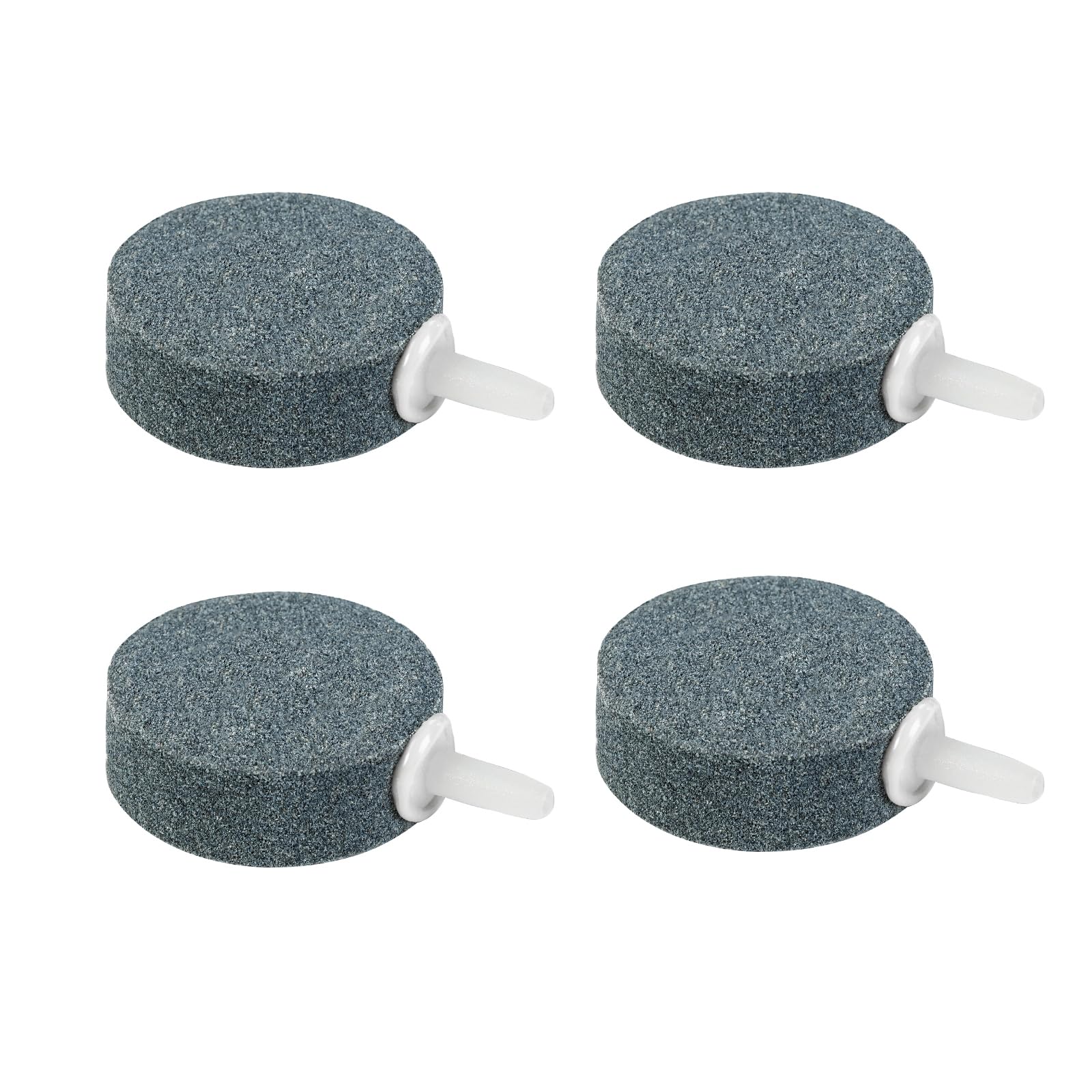
Rating: 4.5 ★ | Price: $ | Size & Shape: 1.5 inch disc | Quantity: 4 stones
These discs offer better material quality than most stones at this price, making them a practical pick for small tanks or backup use. The main caveat is that packaging can leave some units cracked or chipped during delivery, which introduces variability that more established options avoid.
Pros
- Build quality exceeds expectations for the price
- Four discs provide good value for multiple tanks
Cons
- Some discs may arrive cracked or chipped due to insufficient packaging
Best for hobbyists who want inexpensive backup stones for several small tanks and can tolerate the occasional damaged unit.
Best for Ponds
Pawfly 4" Cylinder 4-Pack

Rating: 4.5 ★ | Price: $$ | Size & Shape: 2×4 inch cylinder | Quantity: 4 stones
These heavy cylinders sink and stay put in ponds or large water features, producing a steady stream of medium-fine bubbles once fully soaked. However, some units may arrive with completely blocked pores, so a return-friendly vendor is advisable. The set suits outdoor setups rather than indoor aquariums, where smaller stones are more precise.
Pros
- Weighs enough to rest on the bottom without extra anchoring
- Delivers good oxygen transfer with medium-fine bubbles after initial soak
Cons
- Some stones may be completely clogged and produce no bubbling
Best for pond owners who need durable stones and can accept some unit variation; not recommended for aquarium use.
How to Choose
The most common mistake when buying air stones is mismatching the stone’s internal resistance with your pump’s output pressure – too high resistance gives weak bubbles, too low creates noisy splashing.
Size and Shape for Your Tank
Cylinders, discs, and bars distribute bubbles differently. Cylinders work well under sponge filters, discs create a wide curtain for plant roots, and bars line the back wall of a display tank. Larger stones require more air volume: a 4-inch disc needs at least a 4W pump, while a 1-inch cylinder is fine with a 2W nano pump.
Matching shape to your tank’s dimensions prevents dead spots. A tall cylinder placed near the bottom pushes oxygen upward through the whole water column, while a flat disc sits on the substrate and aerates from below. Measure the available space – some stones, like the biOrb airstone, only fit specific filter stems.
Air Flow and Pump Compatibility
Every stone has a rated air flow (L/min) and every pump has a maximum pressure (PSI). If the stone’s resistance is too high for the pump, air won’t push through the pores – you’ll see bubbles only from the hose fitting. If the resistance is too low, air rushes through noisily and water splashes.
A good rule: match a 0.8–2 L/min stone with a 2–4W pump, and a 5–12 L/min stone with a 7W+ pump. The Pawfly 1-inch cylinders (0.8 L/min) are designed for nano pumps, while the larger VIVOSUN cylinders (no rating given) pair with 4–8W units.
Material and Longevity
High-fired mineral stones resist crumbling better than plastic-composite alternatives, but they can clog faster in hard water. Silicon carbide (offered by Wenshall) is the most durable and won’t disintegrate over months of use. Resin decorations like the Groot bubbler are purely cosmetic – the aeration element inside can fail within weeks.
Plastic-mineral composite stones (AQUANEAT 1-inch) are the cheapest but may arrive with glue blocking pores. Regardless of material, all stones need periodic cleaning – a gentle scrub with a soft brush (no soap) restores flow. Replace every 3–6 months when bubbles become coarse or uneven.
How Many Stones You Need
Multi-packs lower the per-unit cost, ideal for setups with several small tanks or for replacing stones on a regular schedule. The Pawfly 10-pack and AQUANEAT 12-pack cost less per stone than any single stone. The trade-off is quality control – about 1 in 4 stones in a pack may have uneven bubble distribution or blocked pores.
For a single large tank or a critical application (hospital tank, growout), buying a single high-quality stone reduces the chance of a dud. The VIVOSUN 2-pack gives you a spare without the gamble of a 10-pack.
Installation and Daily Use
New stones must be soaked in tank water for 30–60 minutes before first use. Dry pores resist airflow and cause the “only one side bubbles” complaint. Gently push the airline onto the barb – twisting rather than forcing prevents cracking, especially with biOrb stones where the barb is delicate.
Position the stone at the lowest point in the tank for maximum oxygen exchange. If bubbles break the surface too aggressively, add an inline control valve to reduce flow. Avoid placing stones under heavy gravel or decor that can block the pores.
FAQ
Why is my new air stone only bubbling from one side?
This usually means the stone is dry or the pores are blocked. Soak it in warm water for at least 30 minutes to dissolve manufacturing dust. If only one side still bubbles after soaking, the stone is likely defective – return it. To prevent this, always pre-soak new stones and match them to the recommended pump wattage.
How often should I replace aquarium air stones?
Replace every 3 to 6 months. Over time, biofilm and mineral deposits clog the pores, reducing oxygen transfer. Coarse or uneven bubbles and a drop in water flow are signs it’s time for a swap. Softer materials like plastic composite may need replacement sooner than high-fired mineral.
Can I use a biOrb air stone in a regular fish tank?
No. The biOrb air stone is designed to fit the internal filter stem of biOrb aquariums. It will not attach to standard airline tubing or regular pump outlets. For any other tank, choose universal-sized stones with 3/16-inch barb fittings.
What size air pump do I need for a 4-inch disc stone?
A 4-inch disc stone typically requires a pump rated at 4 watts or higher. Check the stone’s recommended pump range – most 4-inch discs (like the Pawfly or VIVOSUN) need 4–16W. Using a smaller pump will produce weak bubbles; a larger pump may cause splashing unless you add a flow control valve.