This post contains affiliate links. We may earn a small commission when you buy through our links — at no extra cost to you.
Every freshwater aquarium filter will eventually need cleaning, but many stop working long before that first maintenance session. Motors that seize after two months or impellers that rattle are common complaints—especially among budget models. The real difference between a short-term fix and a reliable tank companion comes down to a few specific engineering choices.
One of the most overlooked is self-priming. Filters that require manual priming after a power outage are a hassle, and some never restart properly. On the other side, filters with fully customizable media baskets let you tailor filtration to your fish load but often lack that restart convenience. Matching your tank’s needs to the right filter type eliminates half the frustration before you even plug it in.
Longevity, not initial price, is what determines total cost of ownership. A filter that lasts three years at $60 is cheaper than one that dies in six months at $35. This guide focuses on the models that survive the long haul—without sacrificing water clarity or your sleep.
Top Picks
Best for 20-55 Gal Tanks
Seachem Tidal 55

Rating: 4.5 ★ | Price: Mid-Range | Flow Rate (GPH): Up to 350 GPH | Media Capacity: Large, customizable | Self-Priming: Yes
The Tidal 55 starts itself after power outages, lets you dial in flow from a trickle to 350 GPH, and holds enough media to customize biological and chemical filtration. Pump noise is low enough for a living room – a clear step up from the AquaClear line in this size class. The water noise from the surface skimmer and overflow is present but manageable if you keep the tank topped off.
This filter suits freshwater hobbyists with tanks between 20 and 55 gallons who want self-priming convenience and the ability to tweak media. It’s a poor fit for bedrooms or offices where even a low hum is intrusive – the skimmer can suck audibly when the water level drops. Motor failure has been noted in a small number of units, so checking warranty terms is wise, but the overwhelming majority operate without issue.
Pros
- Self-priming pump restarts automatically after power loss – no manual priming needed.
- Adjustable flow control lets you dial in current strength for sensitive fish.
- Large media basket accepts any combination of mechanical, biological, and chemical media.
Cons
- Pump hum is present – fine for living areas but audible in dead-silent rooms.
- Motor failure has been reported in a small number of units – verify warranty coverage.
Self-priming and quiet performance make this the best value HOB for most freshwater setups up to 55 gallons – just keep an eye on water level to quiet the skimmer.
Best for Planted Tank Hobbyists
Fluval 407 Canister

Rating: 4.5 ★ | Price: Premium | Flow Rate (GPH): 383 GPH | Media Capacity: EZ-Lift stackable | Self-Priming: Yes
Ultra-quiet operation and generous media capacity make the Fluval 407 a compelling filter for living‑room aquariums. It prioritizes near‑silent running over the sheer turnover of the monster‑tank Fluval FX4, delivering crystal‑clear water through a three‑stage design that stays unobtrusive in daily life.
Serious hobbyists with planted tanks up to 100 gallons will appreciate the calm environment. The tradeoff: seals may weep slightly after extended use, and the pump motor can wear out ahead of expectations. This makes it less ideal for setups on hardwood floors without a drip tray, but fits those who value peace over guaranteed longevity.
Pros
- Whisper-quiet operation suitable for bedrooms and living areas.
- Crystal-clear water from efficient three-stage filtration.
- EZ-Lift media baskets simplify routine cleaning.
Cons
- Seal seams may eventually seep, requiring periodic inspection.
- Pump motor can wear out earlier than expected, needing replacement.
The 407 rewards patient aquarists with near-silent filtration and clear water, provided they’re prepared for occasional seal checks and a possible motor swap over the years.
Best for 75-110 Gal Tanks
Seachem Tidal 110

Rating: 4.4 ★ | Price: Mid-Range | Flow Rate (GPH): Up to 550 GPH | Media Capacity: Very large basket | Self-Priming: Yes
The Tidal 110 offers the largest media basket and self-priming convenience among Seachem’s hang-on-back filters, ideal for tanks up to 110 gallons. Compared to the top-pick Tidal 55, it handles heavier bioloads but the pump noise becomes more noticeable at higher flow settings. This filter suits aquarists who prioritize filtration capacity over absolute quiet — a basement or dedicated fish room is a better match than a quiet living room. Motor consistency can vary between units, so a flexible return window is worth considering.
Pros
- Large media basket supports extensive customization of biological and chemical media.
- Adjustable flow up to 550 GPH provides strong circulation for heavy bioloads.
- Self-priming design and maintenance indicator simplify routine upkeep.
Cons
- Pump noise may be noticeable in quiet spaces — better suited to basement or garage installations.
- Motor reliability can vary between units; some may require early replacement.
The Tidal 110 is built for heavy bioloads in large tanks — hobbyists who need maximum media capacity will find it a capable choice.
Best for Beginners Medium Tanks
Marineland Penguin 350

Rating: 4.4 ★ | Price: Budget | Flow Rate (GPH): 350 GPH | Media Capacity: Rite-Size Cartridges
Setting up the Penguin 350 takes minutes, and its multi-stage filtration keeps water clear in tanks up to 55 gallons. Some units may need replacement within months, so this filter suits beginners on a budget who plan to upgrade later. The hum and water flow noise is present, making it better suited for living areas than quiet bedrooms. The low price and simple cartridge changes make it approachable for first-time fishkeepers. Owners who prioritize long-term durability should consider the Tidal 55 instead.
Pros
- Very easy to set up
- Keeps water clean effectively
- Good value for the price
Cons
- Bio-wheel and cartridge parts may wear faster than expected
An easy, low-cost entry point for new hobbyists who understand they may need to replace the unit within a year.
Best for Nano Betta Tanks
NICREW Slim

Rating: 4.2 ★ | Price: Budget | Flow Rate (GPH): 42 GPH | Media Capacity: Cartridge with sponge | Self-Priming: Yes
The NICREW Slim is built around silence and size. Its adjustable flow lets you dial down the current for betta fins or shrimp grazing, while the compact footprint leaves room for heaters and decor in tiny tanks. Compared to the fixed‑flow alternative in this category, you get control over water movement — a real benefit for sensitive inhabitants. The catch is longevity: some units can stop working after about a year, and replacement cartridges are not always easy to find locally. This suits buyers who prioritize quiet operation and low upfront cost over multi‑year service.
Pros
- Nearly silent operation even in a bedroom or office
- Adjustable flow protects betta fins and shrimp from strong currents
- Budget-friendly entry into HOB filtration for 1–5 gallon tanks
Cons
- Replacement cartridges may be hard to source locally; custom media cutting may be needed
- Occasional motor stoppage after extended use — worth considering as a seasonal or starter filter
Best for nano‑tank keepers who value near‑silent filtration and adjustable flow over long‑term certainty — plan for possible early replacement.
Best for Small Quiet Tanks
Aqueon QuietFlow 20

Rating: 4.4 ★ | Price: Budget | Flow Rate (GPH): Up to 30 gallons | Media Capacity: Floss carbon bio-holster | Self-Priming: Yes
The Aqueon QuietFlow 20 is one of the quietest HOB filters on the market, and it primes itself automatically. Water clarity improves quickly after setup. However, the flow is not adjustable — in very small tanks or shallow setups, the current may be too strong for delicate fish. Longevity also varies between units; some owners find the filter needs replacement sooner than expected. This filter is best for beginner nano tanks where silence matters and the fixed flow is acceptable, and where a possible shorter lifespan is a manageable tradeoff for the low entry price.
Pros
- Runs nearly silently, even in a bedroom setting.
- Cleans water effectively after initial setup.
- Setup is simple and tool-free.
Cons
- Flow rate is fixed and may be too strong for very small or shallow tanks.
- Longevity can be inconsistent between units, with some needing replacement sooner than expected.
If you want a whisper-quiet filter for a small community tank and don’t mind the lack of flow adjustment, this is a cost-effective entry point.
Best for Custom Media Lovers
AquaClear 70
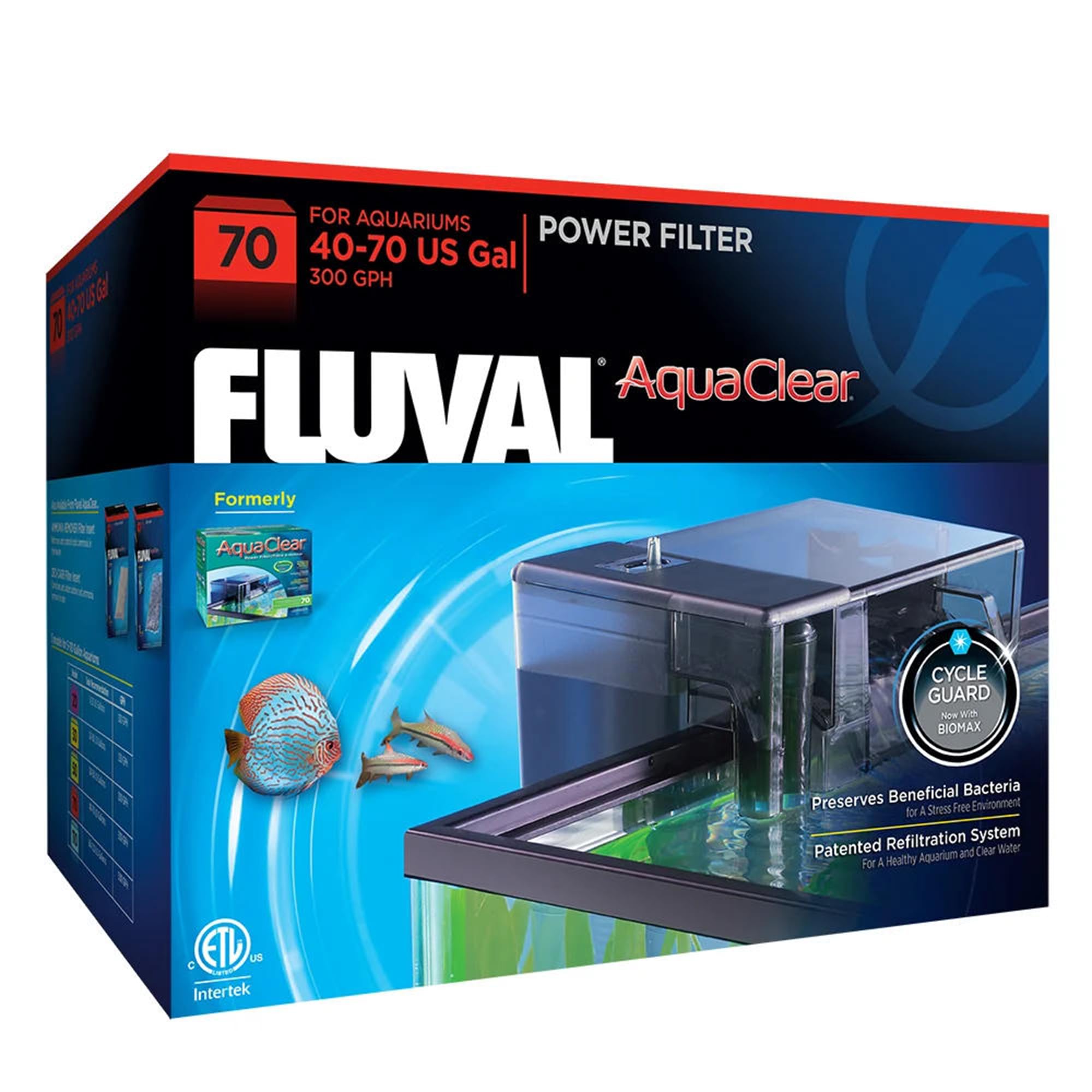
Rating: 4.4 ★ | Price: Mid-Range | Flow Rate (GPH): 300 GPH | Media Capacity: Large customizable basket
The AquaClear 70 delivers excellent water clarity and a large media basket for hobbyists who like to customize filter media. The motor hum is noticeable in quiet rooms, and some units may develop cracks in the plastic housing over time—a tradeoff that makes this a better fit for tinkerers than for those prioritizing near-silent operation or long-term hassle-free use.
Pros
- Customizable media basket for tailored filtration
- Effective at keeping tank clean
Cons
- Motor hum may be present in quiet spaces; occasional plastic cracking noted after extended use
Best for tinkerers who value media flexibility over quiet operation and don’t mind some noise in exchange for customization.
Best for Small Tank Users
Seachem Tidal 35

Rating: 4.5 ★ | Price: Mid-Range | Flow Rate (GPH): Up to 450 GPH | Media Capacity: Removable customizable | Self-Priming: Yes
The Seachem Tidal 35 brings self-priming, quiet operation, and easy maintenance to small freshwater setups up to 35 gallons. Its surface skimmer and adjustable flow are useful additions, but the motor has been known to develop issues in some cases, and the flow rate may not satisfy those with higher bioloads. This makes it a good fit for beginners and small-tank owners who value convenience, though the Tidal 55 offers more headroom for a small price difference.
Pros
- Very quiet operation
- Great filtration quality
Cons
- Water flow can be weak for some users
Ideal for small-tank owners who prioritize quiet operation and self-priming, but worth verifying motor durability with a flexible return policy.
Best for Medium Tank Hobbyists
Fluval 50 (AquaClear 50)
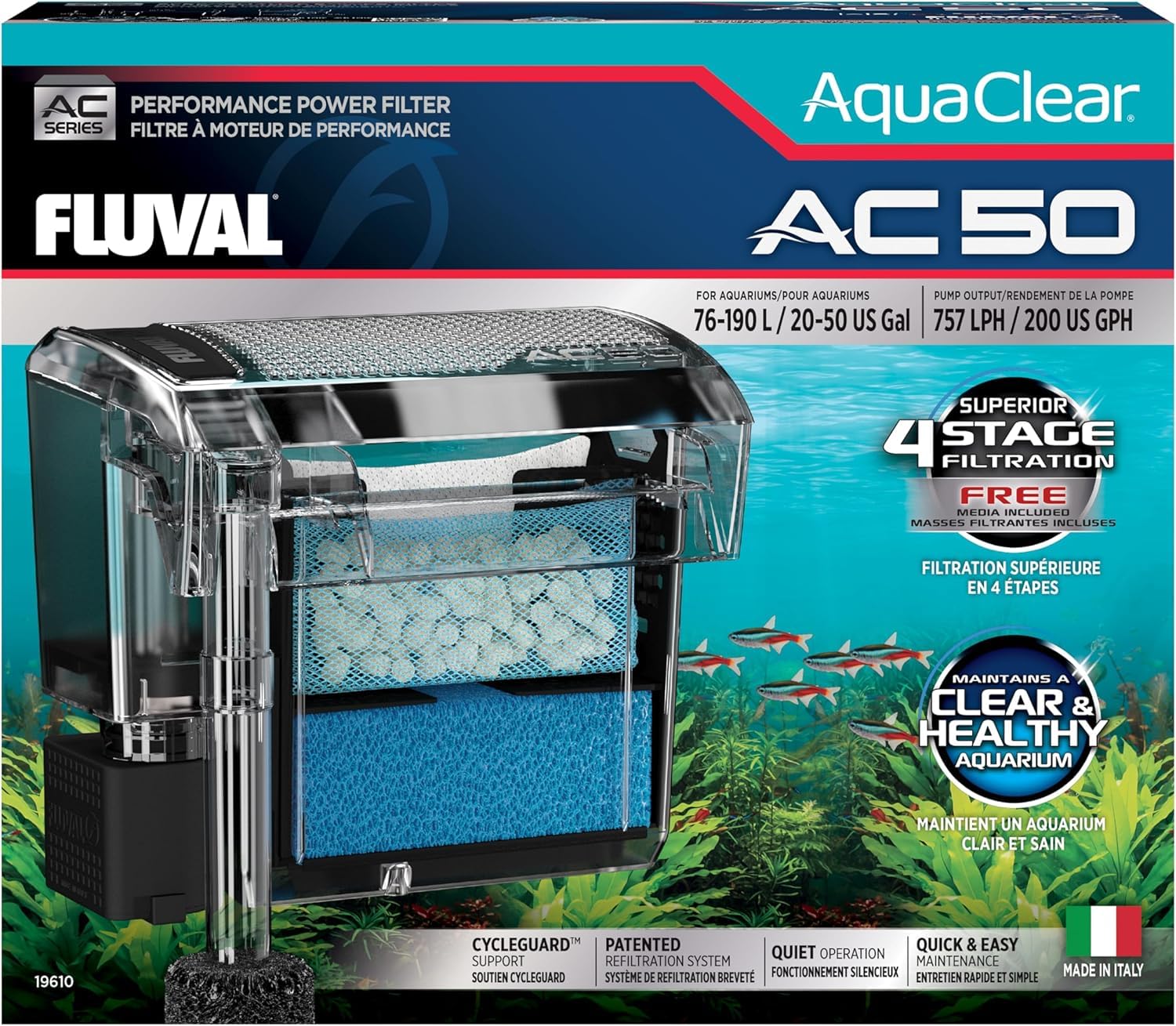
Rating: 4.2 ★ | Price: Mid-Range | Flow Rate (GPH): Up to 200 GPH | Media Capacity: Large customizable basket
The Fluval 50 delivers strong water clarity and a large customizable media basket for hobbyists who like to tailor filtration. Long-term durability has varied between units, and it lacks the self-priming convenience of newer filter designs. For those who prioritize media flexibility over advanced features, it remains a capable choice for 20-50 gallon tanks.
Pros
- Delivers strong water clarity and effective filtration for healthy aquarium conditions.
- Media basket and components are simple to rinse and reassemble during routine maintenance.
Cons
- Motor hum may be noticeable in quiet living spaces – less of an issue for tanks in basements or dedicated fish rooms.
Best for hobbyists who value media customization over silence and advanced features.
Best for Short-Term Backup
Aqua-Tech Ultra Quiet

Rating: 4.3 ★ | Price: Budget | Flow Rate (GPH): 20-40 gallon rating | Media Capacity: Cartridge with carbon
The Aqua-Tech filter provides effective filtration and easy cleaning at a low cost, making it a reasonable choice for temporary or emergency setups. However, noise can be noticeable in quiet rooms, and some units may stop operating earlier than expected — this is a backup filter, not a long-term primary solution.
Pros
- Good value for money
- Easy to clean
Cons
- Some units may stop operating within months
This filter fits as a low-cost backup or short-term fix, but not for daily primary use.
Best for Large Heavy Bioload
Fluval FX4 Canister
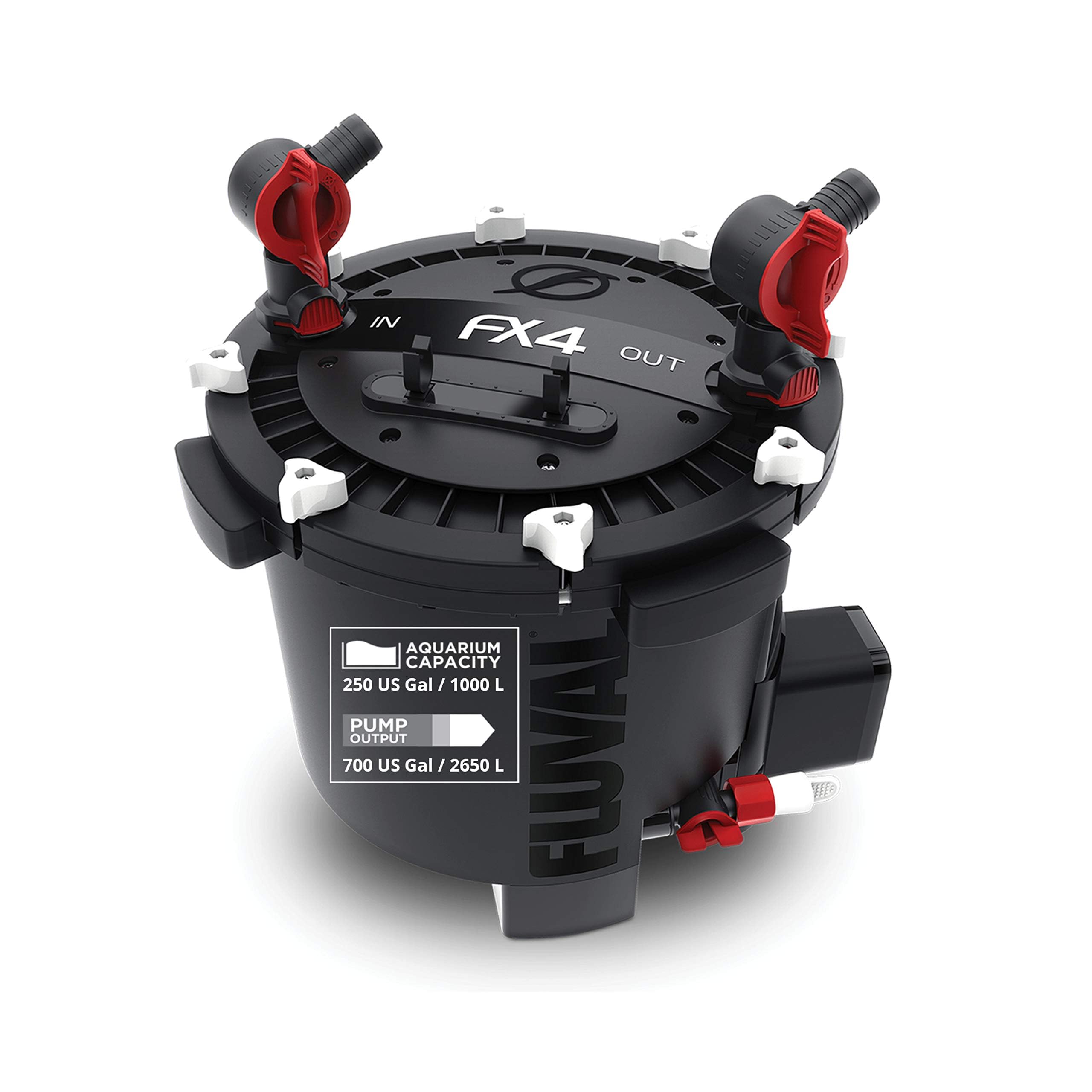
Rating: 4.5 ★ | Price: Luxury | Flow Rate (GPH): 700 GPH | Media Capacity: 1 gal baskets | Self-Priming: Yes
Exceptional filtration power and 700 GPH flow handle heavy bioloads in tanks up to 250 gallons. Motor performance can vary between units, making this a choice for dedicated hobbyists who prioritize capacity over cost efficiency.
Pros
- Handles high bioloads with strong mechanical, biological, and chemical filtration.
- Quiet operation even at high flow rates – suitable for living rooms.
Cons
- Premium pricing may not feel justified for tanks that don’t need this level of flow.
Best for serious aquarists with 75-250 gallon tanks who need robust filtration and are comfortable with a premium investment and possible motor variance.
Best for 40-75 Gal Tanks
Seachem Tidal 75

Rating: 4.4 ★ | Price: Mid-Range | Flow Rate (GPH): Up to 400 GPH | Media Capacity: Large basket | Self-Priming: Yes
The Seachem Tidal 75 delivers self-priming convenience, a spacious media basket for custom filtration, and adjustable flow up to 400 GPH. Pump noise can be noticeable in quiet rooms, and some units may produce weaker flow than expected — limitations that keep it from outshining the smaller Tidal 55 for most setups.
Pros
- Self-priming design eliminates manual siphoning for quick startup.
- Large media basket provides ample space for custom filter media.
Cons
- Pump hum may be disruptive in quiet living spaces or bedrooms.
A capable filter for utility rooms or tanks where noise is not a priority, but the Tidal 55 offers similar features in a quieter package.
How to Choose
The best filter for your tank is the one that still runs after a year, not the one with the most reviews.
Flow Rate (GPH)
Flow rate determines how many times per hour the tank water passes through the filter. A general rule is 4-6 times the tank volume per hour. Too little flow leaves debris and waste, while too much can create a strong current that stresses slow-moving fish like bettas or angelfish.
Rated flow (advertised GPH) is measured without media, so real flow is often 20-30% lower once the filter is packed with foam and ceramic rings. Match the filter to your tank’s bioload rather than chasing the highest number.
Media Capacity
More media volume means more surface area for beneficial bacteria and more room for chemical media like carbon or phosphate removers. Customizable baskets let you mix and match foam, bio-rings, and carbon to target specific water issues.
The trade-off is maintenance: larger baskets take longer to clean, and some filters require proprietary cartridges that cost more over time. Choose a filter with a removable, open basket if you want to control what goes inside.
Self-Priming Ability
Self-priming filters automatically restart after a power outage or water change, drawing water up into the pump without manual siphoning. This convenience is especially valuable in areas with frequent power cuts or for aquarists who forget to top off the water level.
The hidden cost is that self-priming mechanisms add complexity—seals can leak, and the priming chamber can trap air. Filters without self-priming are simpler and often cheaper, but require you to fill the intake tube manually after any disruption.
Noise Level
Noise in filters comes from two sources: motor vibration and water splash. Canister filters are generally quieter because the motor is enclosed and the water return is submerged. HOB filters often hum or rattle, especially if the impeller shaft wears or the water level drops.
Sound-dampening designs like decoupled motors and rimless tanks help, but even the quietest HOB will produce some water noise at higher flow settings. If silence is critical, a canister or internal filter with a fully submerged pump is the better bet.
Ease of Maintenance
Filters that are easy to maintain get cleaned more often, which keeps water quality high. Look for features like tool-free disassembly, lift-out media baskets, and rinseable foam instead of disposable cartridges. Canister filters with quick-release valves simplify hose removal.
The catch is that quick-release valves and removable baskets introduce potential leak points. A filter that is too easy to open may also be prone to accidental spills. Balance convenience with a sturdy sealing mechanism that won’t degrade over time.
FAQ
Why does my aquarium filter keep stopping after a few months?
Most early failures are due to a clogged impeller or dried-out bearings. Debris like sand or snail shells can jam the impeller, and running the filter dry burns out the motor. Clean the impeller and shaft every month, and always top off the water level. If the issue persists, the motor itself may be defective—a common problem with budget filters.
Can I use a hang‑on‑back filter instead of a canister for a planted tank?
Yes, especially for tanks under 40 gallons. HOB filters provide adequate flow and can hold enough bio-media for planted tanks. The main advantage of a canister is larger media volume and quieter operation, which matters if you run CO2 injection or need a very stable environment. For small planted tanks, a quality HOB like the Seachem Tidal 35 or AquaClear 70 works fine.
How often should I replace filter media in a HOB filter?
Disposable cartridges should be changed every 4 weeks, but only because the carbon becomes exhausted—the sponge portion is still usable. Better practice: replace the carbon portion and rinse the sponge in dechlorinated water. Ceramic bio-rings never need replacing unless they break down. Replacing media too often can crash your biological filtration, so only swap out items that are physically deteriorating.
Is the Fluval FX4 worth the price for a 75‑gallon freshwater tank?
Only if you have a heavy bioload like African cichlids or large goldfish. The FX4 moves 700 GPH and holds a huge volume of media, making it excellent for messy setups. For a standard community tank with 75 gallons, a Seachem Tidal 110 or AquaClear 70 provides ample filtration at a fraction of the price. The FX4’s premium cost is justified by its power and self-priming convenience, not by necessity.